Introduction
Artificial Intelligence (AI) is transforming how businesses work. It helps companies automate tasks, analyze large amounts of data, and make smarter decisions. From chatbots to predictive analytics, AI is becoming an essential technology for modern organizations.
However, one common question businesses ask before starting an AI project is: How much does AI development cost?
The cost of AI development depends on several factors, including project complexity, data requirements, development time, and the expertise of the development team. Simple AI solutions may cost only a few thousand dollars, while advanced custom AI systems can require a much larger investment.
In this guide, we will explain AI development costs, key pricing factors, development stages, and cost-saving strategies to help businesses plan their AI projects more effectively.
What Is AI Development?
AI development refers to the process of designing, building, and deploying systems that can perform tasks that normally require human intelligence. These tasks may include:
• Data Analysis – AI analyzes large amounts of business data to discover patterns, trends, and useful insights. This helps companies make faster and smarter decisions based on real data.
• Natural Language Processing (NLP) – AI understands human language and text. It is used in chatbots, voice assistants, translation tools, and customer support systems to improve communication.
• Image Recognition – AI can identify objects, faces, and patterns in images or videos. Businesses use this technology in security systems, healthcare diagnostics, and product recognition.
• Recommendation Systems – AI recommends products, services, or content based on user behavior and preferences. This technology is widely used in e-commerce, streaming platforms, and online marketplaces.
• Predictive Analytics – AI analyzes historical data to predict future trends and outcomes. Businesses use predictive analytics for demand forecasting, risk analysis, and better strategic planning.
• Chatbots and Virtual Assistants – AI-powered chatbots automatically interact with customers, answer questions, and provide support 24/7 on websites, apps, and messaging platforms.
AI systems rely on technologies such as machine learning, deep learning, computer vision, and natural language processing to process information and improve performance over time.
Average AI Development Cost
The cost of developing an AI solution varies widely depending on the type and complexity of the project.
Typical AI Development Cost Range
These estimates depend on project requirements, development time, and technical complexity.
Key Factors That Affect AI Development Cost
AI development costs are influenced by multiple technical and business factors.
1. Project Complexity
The more complex the AI system, the higher the cost. For example:
Simple tasks like chatbots or automation tools require less development time, while advanced predictive systems or autonomous AI models require more resources and expertise.
2. Data Collection and Preparation
AI models require large amounts of high-quality data to function properly.
Data-related costs may include:
• Data Collection – This process involves gathering data from different sources such as databases, websites, sensors, or business systems. High-quality data is essential for training accurate AI and machine learning models.
• Data Cleaning – Data cleaning removes errors, duplicates, and incomplete information from datasets. Clean and well-structured data improves the performance and reliability of AI systems.
• Data Labeling – Data labeling means adding tags or categories to raw data so AI models can understand it. For example, labeling images, text, or audio helps machine learning models learn patterns and make predictions.
• Data Storage – AI projects require secure and scalable storage systems to manage large datasets. Cloud storage and data warehouses are commonly used to store and access AI training data efficiently.
Preparing data for machine learning models can account for 30–40% of the total AI project cost.
3. Development Team Expertise
AI development requires skilled professionals such as:
• AI Engineers – AI engineers design and build artificial intelligence systems. They develop algorithms and models that allow machines to learn from data and perform intelligent tasks.
• Machine Learning Engineers – Machine learning engineers create and train machine learning models. They focus on improving model accuracy and ensuring the models work efficiently in real-world applications.
• Data Scientists – Data scientists analyze large datasets to discover patterns and insights. They use statistics, data analysis, and machine learning techniques to support data-driven business decisions.
• Software Developers – Software developers build the applications and systems that integrate AI models into websites, mobile apps, or enterprise software.
• DevOps Engineers – DevOps engineers manage the deployment, monitoring, and maintenance of AI systems. They ensure the infrastructure runs smoothly and the AI applications scale efficiently.
Highly experienced teams usually charge higher rates but deliver better quality and faster development.
4. Infrastructure and Cloud Services
AI development often requires powerful computing resources such as GPUs and cloud platforms.
Popular cloud platforms include:
• Amazon Web Services (AWS) – A popular cloud platform that provides powerful computing resources, storage, and AI tools. Businesses use AWS to train, deploy, and manage AI models without investing in expensive hardware.
• Google Cloud – A cloud platform that offers advanced AI and machine learning services. It provides tools for data analysis, model training, and scalable infrastructure for AI applications.
• Microsoft Azure – A cloud computing platform that provides AI development tools, machine learning services, and secure cloud infrastructure. Many businesses use Azure to build, deploy, and manage AI-powered applications.
These platforms charge based on storage, computing power, and usage time, which adds to the overall cost.
5. Integration With Existing Systems
Many businesses need AI systems to integrate with existing software such as:
• CRM Systems – Customer Relationship Management systems store and manage customer data. Integrating AI with CRM helps businesses improve customer support, predict customer behavior, and personalize marketing strategies.
• ERP Platforms – Enterprise Resource Planning platforms manage business operations such as finance, inventory, and supply chains. AI integration helps automate processes, improve forecasting, and increase operational efficiency.
• Analytics Tools – Analytics tools help businesses analyze data and generate insights. AI-powered analytics tools can identify trends, detect anomalies, and support better decision-making.
• Mobile Applications – AI can be integrated into mobile apps to provide smart features such as voice assistants, recommendations, chatbots, and personalized user experiences.
Integration increases development complexity and cost.
AI Development Cost by Development Stage
AI projects typically follow multiple development stages. Each stage contributes to the total project cost.
1. Problem Identification and Planning
In this stage, businesses define the goals and requirements of the AI system.
Estimated Cost: $5,000 – $15,000
2. Data Collection and Preparation
This stage involves collecting, cleaning, and organizing datasets.
Estimated Cost: $10,000 – $50,000
3. Model Development
AI engineers design and train machine learning models.
Estimated Cost: $20,000 – $100,000
4. Testing and Optimization
Models are tested to ensure accuracy and performance.
Estimated Cost: $10,000 – $40,000
5. Deployment and Integration
The AI system is integrated into production environments.
Estimated Cost: $10,000 – $50,000
6. Maintenance and Updates
AI systems require continuous monitoring, retraining, and updates.
Estimated Cost: $5,000 – $30,000 per year
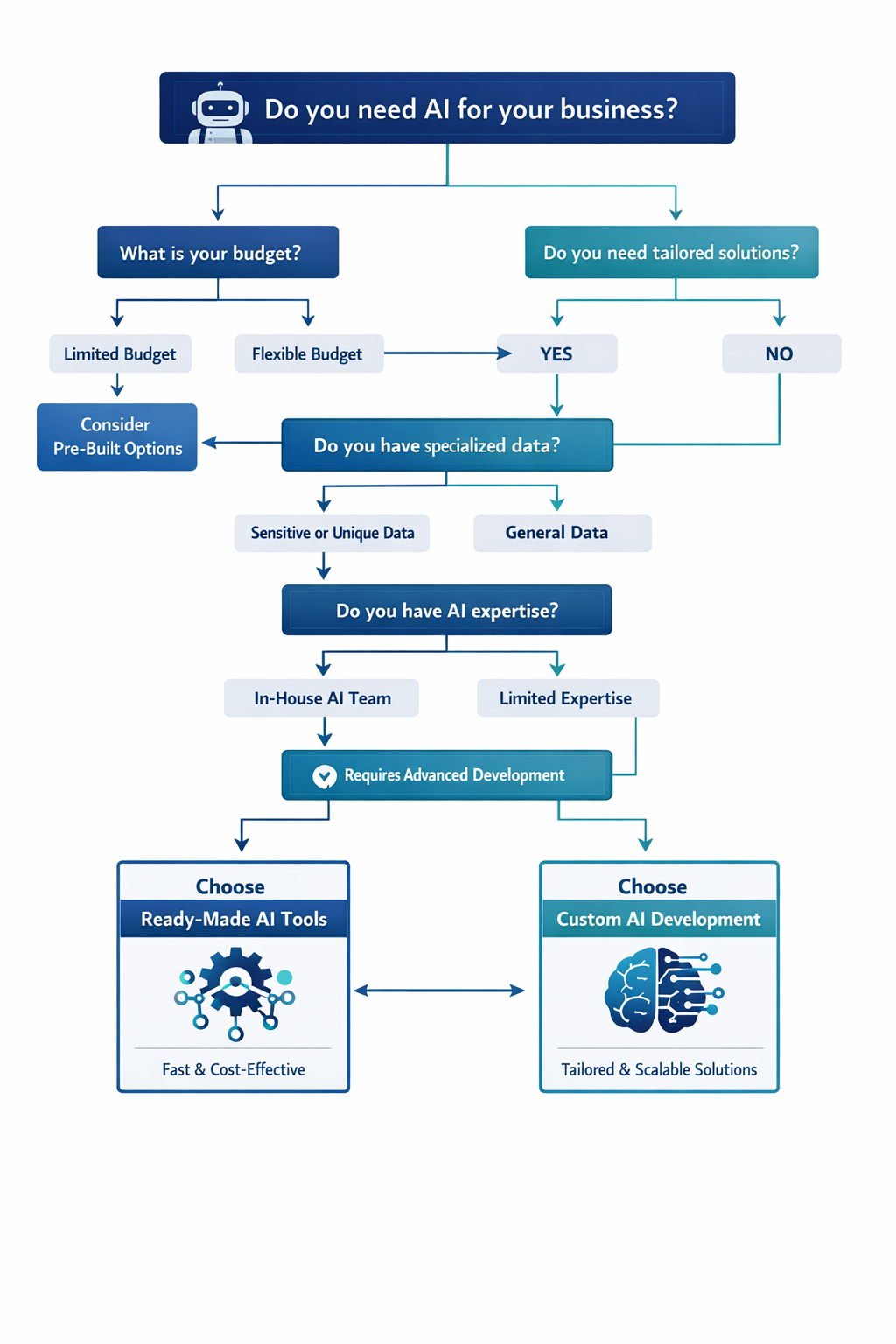
Cost Comparison: Custom AI vs Pre-Built AI Tools
Businesses can either build custom AI systems or use ready-made AI tools.
|
Feature |
Custom AI Development |
Pre-Built AI Tools |
|
Cost |
Higher upfront investment |
Lower initial cost |
|
Customization |
Fully customizable |
Limited customization |
|
Development Time |
Longer |
Faster |
|
Scalability |
Highly scalable |
Depends on platform |
Many businesses start with pre-built AI tools and later move to custom AI solutions as their needs grow.
Hidden Costs in AI Development
Many organizations underestimate the hidden costs of AI projects.
Common hidden expenses include:
• Data Labeling Costs – Training AI models requires properly labeled data. Labeling large datasets can be time-consuming and may require specialized tools or human experts, which increases the overall project cost.
• Infrastructure Scaling – As AI systems grow, businesses may need more computing power, storage, and cloud resources. Scaling infrastructure can increase operational expenses over time.
• Model Retraining – AI models must be updated regularly with new data to maintain accuracy and performance. Retraining models requires additional time, resources, and computing power.
• Security and Compliance – AI systems must follow data privacy laws and security standards. Implementing security measures and ensuring regulatory compliance can add extra costs to AI development.
• Ongoing Monitoring – AI systems need continuous monitoring to track performance, detect errors, and ensure they function correctly in real-world environments. This requires ongoing technical support and maintenance.
Planning for these costs helps avoid budget overruns.
How Businesses Can Reduce AI Development Costs
Businesses can reduce AI development costs by using smart strategies.
Start With a Minimum Viable Product (MVP)
Instead of building a full AI system immediately, companies can develop a smaller prototype to test the concept.
Use Pre-Trained Models
Many AI platforms provide pre-trained models that reduce development time.
Use Cloud-Based AI Services
Cloud platforms provide scalable AI infrastructure without requiring expensive hardware investments.
Outsource AI Development
Hiring an experienced AI development company can sometimes be more cost-effective than building an in-house team.
Industries Using AI Development
AI development is transforming many industries.
Healthcare
AI helps with disease prediction, medical imaging analysis, and patient data management.
Finance
Banks use AI for fraud detection, credit risk analysis, and automated trading.
E-commerce
Online stores use AI for product recommendations, customer analytics, and inventory forecasting.
Manufacturing
AI improves production efficiency through predictive maintenance and quality control.
Future Trends Affecting AI Development Cost
AI development costs are changing due to rapid technological advancements.
Key trends include:
• Growth of AI-as-a-Service Platforms – Many cloud providers now offer AI tools and services that businesses can use without building everything from scratch. This reduces development time and lowers the overall cost of implementing AI solutions.
• Improved Automation Tools – Modern AI development tools automate tasks such as data preparation, model training, and deployment. This helps developers build AI systems faster and more efficiently.
• Better Pre-Trained Models – Pre-trained AI models are already trained on large datasets and can be reused for different applications. Businesses can customize these models instead of building new ones, saving time and development costs.
• Faster AI Development Frameworks – New frameworks and libraries make it easier and quicker to develop AI and machine learning applications. These tools simplify coding, model training, and testing processes.
• Increased Adoption of Open-Source AI Tools – Many organizations are using open-source AI technologies and libraries. These tools are free to use and help businesses reduce development expenses while still building powerful AI systems.
These trends are gradually reducing the cost of AI implementation for businesses.
Frequently Asked Questions (FAQs)
1. How much does AI development cost?
AI development costs can range from $5,000 to over $500,000, depending on the complexity of the solution, the data required, and the development team.
2. Why is AI development expensive?
AI development requires skilled professionals, large datasets, powerful computing infrastructure, and continuous model training, which increases overall costs.
3. Can small businesses afford AI development?
Yes. Small businesses can start with pre-built AI tools or AI-as-a-Service platforms, which are more affordable than custom AI development.
4. How long does it take to develop an AI system?
AI development timelines vary depending on the project complexity. Simple AI solutions may take a few weeks, while complex systems can take several months or even a year.
5. Is AI development a good investment for businesses?
Yes. AI can improve efficiency, automate tasks, and provide valuable insights from data, which can significantly increase business productivity and profitability.
Conclusion
Artificial Intelligence has become a powerful tool for businesses looking to automate processes, analyze large datasets, and gain competitive advantages.
However, the cost of AI development varies depending on project complexity, data requirements, development team expertise, and infrastructure needs.
Simple AI solutions like chatbots may cost only a few thousand dollars, while advanced enterprise AI systems can require significant investments.
Businesses should carefully evaluate their goals, available data, budget, and long-term strategy before starting an AI project.
By planning development stages, using scalable infrastructure, and choosing the right development approach, organizations can control costs while maximizing the benefits of AI technology.
Ultimately, investing in AI development can deliver long-term value by improving efficiency, enabling data-driven decisions, and creating innovative business solutions.



Shreyans Padmani
Shreyans Padmani has 5+ years of experience leading innovative software solutions, specializing in AI, LLMs, RAG, and strategic application development. He transforms emerging technologies into scalable, high-performance systems, combining strong technical expertise with business-focused execution to deliver impactful digital solutions.