Introduction
Artificial Intelligence (AI) is transforming how businesses operate, analyze data, and interact with customers. From chatbots and recommendation systems to fraud detection and predictive analytics, AI is helping companies automate tasks and make smarter decisions.
However, when businesses decide to adopt AI, they usually face an important question: Should they choose custom AI development or use ready-made AI tools?
Both approaches offer powerful capabilities, but they serve different business needs. Ready-made AI tools allow companies to quickly implement AI features without heavy development, while custom AI solutions provide tailored systems designed specifically for a company’s workflows, data, and goals.
Choosing the right approach depends on factors such as budget, scalability, flexibility, and long-term strategy.
In this guide, we will explore the differences between custom AI development and ready-made AI tools, their advantages and disadvantages, and how businesses can decide which option is best for their needs.
Understanding Custom AI Development
Custom AI development involves building AI solutions specifically designed for a particular business or organization. These systems are developed from scratch using machine learning models, deep learning algorithms, and custom data pipelines.
Instead of using a generic solution, businesses create AI tools that match their unique workflows, datasets, and business goals.
For example, an e-commerce company may build a custom recommendation engine based on its customer purchase history, while a healthcare organization might develop AI models for disease prediction using medical data.
Key Features of Custom AI Development
• Built specifically for a company’s needs: Custom AI solutions are designed according to a company’s unique goals, workflows, and challenges, helping businesses solve specific problems more effectively.
• Uses proprietary or internal datasets: These AI systems can be trained using a company’s own data, which improves accuracy and provides deeper business insights.
• Highly scalable and flexible: Custom AI models can grow with the business, allowing companies to handle larger datasets, new features, and increasing workloads.
• Can integrate with existing business systems: Custom AI can easily connect with current tools like CRM, ERP, and analytics platforms to improve efficiency and automation.
• Offers full control over AI models and algorithms: Businesses maintain complete control over their AI systems, including data security, model updates, and performance improvements.
Benefits of Custom AI Development
1. Tailored to Business Needs
Custom AI solutions are designed to solve specific business problems. This ensures the system delivers accurate insights and supports company workflows.
2. Better Data Utilization
Businesses can train AI models using their own datasets, improving accuracy and performance.
3. Competitive Advantage
A custom AI solution can provide unique capabilities that competitors may not have.
4. Scalability
Custom systems can grow as the business grows, handling larger datasets and more complex tasks.
5. Full Control
Companies have full control over data, security, and system modifications.
Challenges of Custom AI Development
• High initial development cost: Building a custom AI system requires investment in development, infrastructure, and skilled professionals, making the initial cost higher than ready-made tools.
• Longer development time: Since the AI solution is built from scratch, it takes more time to design, develop, test, and deploy.
• Requires skilled AI developers and engineers: Custom AI development needs experienced professionals such as machine learning engineers, data scientists, and software developers.
• Continuous maintenance and updates are needed: AI systems must be regularly monitored, updated, and improved to maintain accuracy and adapt to new data or business changes.
Understanding Ready-Made AI Tools
Ready-made AI tools are pre-built solutions that businesses can quickly adopt without building AI models from scratch. These tools are typically provided as cloud platforms, APIs, or software products.
Examples include chatbot platforms, AI analytics tools, and automated marketing systems.
These tools allow businesses to implement AI features quickly without requiring deep technical expertise.
Key Features of Ready-Made AI Tools
• Pre-built AI models: Ready-made AI tools come with pre-trained models that businesses can use immediately without building AI systems from scratch.
• Easy integration with existing systems: Most AI tools provide simple APIs and integrations, allowing businesses to connect them with CRM, analytics platforms, or other software.
• Quick deployment: These tools can be implemented quickly, enabling companies to start using AI features within days or weeks.
• Lower initial cost: Since the infrastructure and models are already developed, businesses only need to pay subscription or usage-based fees.
• Minimal technical knowledge required: Ready-made AI tools are designed to be user-friendly, allowing businesses to use AI without needing advanced technical expertise.
Benefits of Ready-Made AI Tools
1. Faster Implementation
Businesses can start using AI within days or weeks instead of months.
2. Lower Cost
Since the AI infrastructure is already developed, companies only pay subscription or usage fees.
3. Easy Integration
Most AI platforms provide APIs and integrations with popular tools like CRM systems, analytics platforms, and marketing software.
4. Maintenance Handled by Provider
The vendor manages updates, improvements, and technical maintenance.
Limitations of Ready-Made AI Tools
• Limited customization options: Ready-made AI tools offer only basic customization, which may not allow businesses to fully adapt the system to their specific needs.
• May not fully fit business workflows: Since these tools are designed for general use, they may not perfectly match a company’s unique processes or operational requirements.
• Data privacy concerns in some industries: Businesses in sectors like healthcare or finance may face security and compliance concerns when sharing sensitive data with third-party AI platforms.
• Performance may be less accurate for specialized tasks: Pre-built AI models are trained on general datasets, so they may not perform as accurately for industry-specific or complex tasks.
Key Differences Between Custom AI Development and Ready-Made AI Tools
|
Feature |
Custom AI Development |
Ready-Made AI Tools |
|
Development Time |
Long |
Short |
|
Cost |
High initial investment |
Lower upfront cost |
|
Customization |
Fully customizable |
Limited customization |
|
Scalability |
Highly scalable |
Depends on provider |
|
Control |
Full control over system |
Limited control |
|
Implementation |
Complex |
Simple |
This comparison shows that both options serve different purposes depending on the business requirements.
When Businesses Should Choose Custom AI Development
Custom AI development is the right choice when businesses require highly specialized solutions.
1. Unique Business Problems
If your company needs AI for complex or industry-specific tasks, custom solutions are more effective.
2. Large Amounts of Proprietary Data
Companies with valuable internal datasets can build highly accurate AI models.
3. Long-Term AI Strategy
Organizations planning to integrate AI deeply into their operations benefit from custom systems.
4. Competitive Advantage
Custom AI solutions can differentiate a business from competitors.
Industries such as healthcare, finance, logistics, and manufacturing often rely on custom AI systems.
When Businesses Should Choose Ready-Made AI Tools
Ready-made AI tools are ideal for companies that want quick results with minimal investment.
1. Startups and Small Businesses
Smaller organizations may not have the resources for custom AI development.
2. Quick AI Implementation
Companies that want to add AI features quickly can use pre-built tools.
3. Standard Business Tasks
Tasks such as chatbots, email automation, sentiment analysis, and document processing can be handled effectively with ready-made tools.
4. Limited Technical Expertise
Businesses without AI development teams can still benefit from AI technologies.
Real-World Use Cases
Customer Support Automation
Businesses often use ready-made AI chatbot tools to handle customer inquiries.
Fraud Detection
Financial institutions may develop custom AI systems to detect fraudulent transactions.
Personalized Recommendations
Streaming platforms and e-commerce websites typically use custom AI algorithms for product recommendations.
Marketing Automation
Companies often use ready-made AI tools for automated email campaigns and customer segmentation.
How to Choose the Right Approach
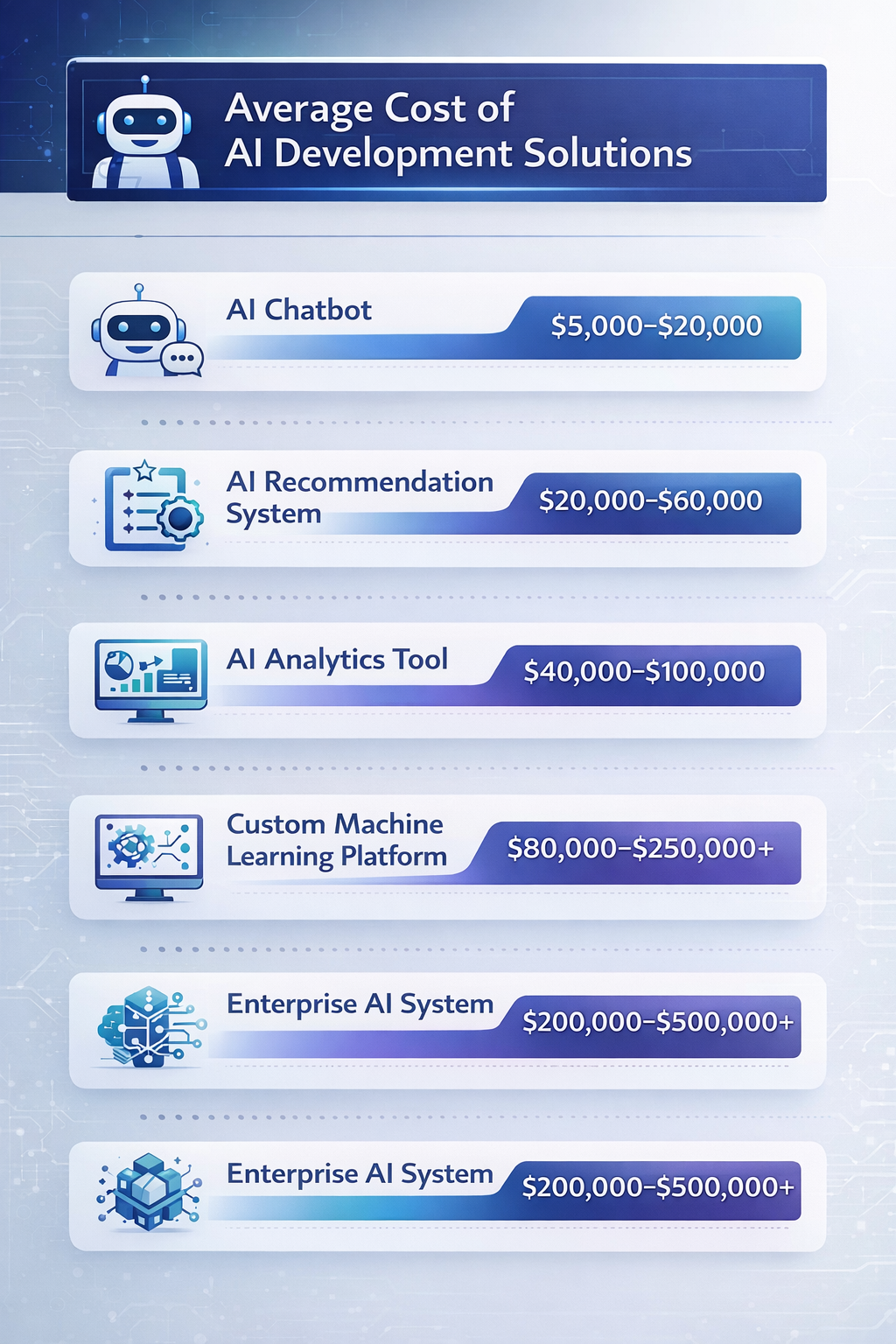
Selecting the right AI strategy requires careful evaluation of several factors.
Business Goals
Define what problems you want AI to solve.
Budget
Determine whether your organization can invest in custom development.
Data Availability
Custom AI works best when businesses have large and high-quality datasets.
Technical Expertise
Consider whether your team has AI development capabilities.
Scalability Needs
Think about how AI will support future business growth.
A balanced approach may also work for many organizations. Businesses can start with ready-made tools and later transition to custom AI solutions as their needs grow.
Future Trends in AI Development
• Increased adoption of hybrid AI models: Businesses are combining custom AI solutions with ready-made tools to create flexible and cost-effective AI systems.
• Growth of AI-as-a-Service platforms: More companies are using cloud-based AI services that provide ready-to-use AI capabilities without heavy infrastructure investment.
• Improved automation tools: Advanced AI automation tools are helping businesses streamline operations, reduce manual work, and improve productivity.
• Better integration with cloud infrastructure: Modern AI solutions are designed to work smoothly with cloud platforms, making deployment and scaling easier for businesses.
• Enhanced data security and privacy measures: AI platforms are improving security technologies to protect sensitive data and ensure compliance with privacy regulations.
Frequently Asked Questions (FAQs)
1. What is the difference between custom AI development and ready-made AI tools?
Custom AI development involves building AI systems specifically designed for a company’s needs, while ready-made AI tools are pre-built solutions that businesses can use immediately with minimal customization.
2. Are ready-made AI tools suitable for small businesses?
Yes. Ready-made AI tools are often ideal for startups and small businesses because they are affordable, easy to implement, and require minimal technical expertise.
3. Is custom AI development expensive?
Custom AI development usually requires a higher initial investment because it involves designing, training, and deploying AI models specifically for a business.
4. Can businesses switch from ready-made AI tools to custom AI later?
Yes. Many companies start with ready-made AI tools and later transition to custom AI solutions when their needs become more complex.
5. Which industries benefit most from custom AI solutions?
Industries such as healthcare, finance, logistics, e-commerce, and manufacturing often benefit from custom AI development because they handle large amounts of specialized data.
Conclusion
Both custom AI development and ready-made AI tools play important roles in modern business technology strategies.
Ready-made AI tools are ideal for companies that need quick implementation, lower costs, and simple AI capabilities. They allow businesses to adopt AI without complex development processes.
On the other hand, custom AI development offers greater flexibility, scalability, and control. It is best suited for organizations with unique business challenges, large datasets, and long-term AI strategies.
The best approach depends on a company’s goals, resources, and technical requirements. Many organizations start with ready-made AI tools and gradually invest in custom AI systems as their needs become more advanced.
By carefully evaluating business objectives and technology capabilities, companies can choose the AI solution that delivers the greatest value and long-term success.



Shreyans Padmani
Shreyans Padmani has 5+ years of experience leading innovative software solutions, specializing in AI, LLMs, RAG, and strategic application development. He transforms emerging technologies into scalable, high-performance systems, combining strong technical expertise with business-focused execution to deliver impactful digital solutions.