Introduction
Scientific research is evolving rapidly with the integration of artificial intelligence (AI). Traditional research methods, while effective, are often time-consuming, resource-intensive, and limited by human capacity. Today, Multi-AI Agent Systems are transforming how research is conducted by enabling collaboration between multiple intelligent agents that can think, analyze, and act independently.
These systems are designed to automate complex workflows, accelerate discoveries, and enhance decision-making across scientific domains such as healthcare, physics, climate science, and more. In this blog, we will explore what multi-AI agent systems are, how they work, their key benefits, real-world applications, and why they represent the future of scientific research.
What Are Multi-AI Agent Systems?
A Multi-AI Agent System consists of multiple intelligent agents that work together to solve complex problems. Each agent has a specific role, such as data collection, analysis, hypothesis generation, or decision-making.
Unlike single AI models, these systems:
-
Collaborate and communicate with each other
-
Operate independently while contributing to a shared goal
-
Adapt dynamically to changing data and environments
Simple Example:
Imagine a research project where:
-
One AI agent collects data
This agent gathers raw data from multiple sources such as databases, sensors, research papers, APIs, or online platforms. It ensures that the system has a continuous and updated flow of relevant information for analysis. -
Another cleans and processes it
This agent prepares the collected data by removing errors, duplicates, and inconsistencies. It also formats and organizes the data into a structured form, making it suitable for accurate analysis. -
A third analyzes patterns
This agent applies machine learning algorithms and statistical techniques to identify trends, patterns, and relationships within the data. It helps uncover hidden insights that may not be visible through manual analysis. -
A fourth generates insights and reports
This agent converts the analyzed data into meaningful insights, visualizations, and detailed reports. It presents the results in an easy-to-understand format, helping researchers make informed decisions quickly.
Together, they create a seamless and efficient research pipeline.
How Multi-AI Agent Systems Work
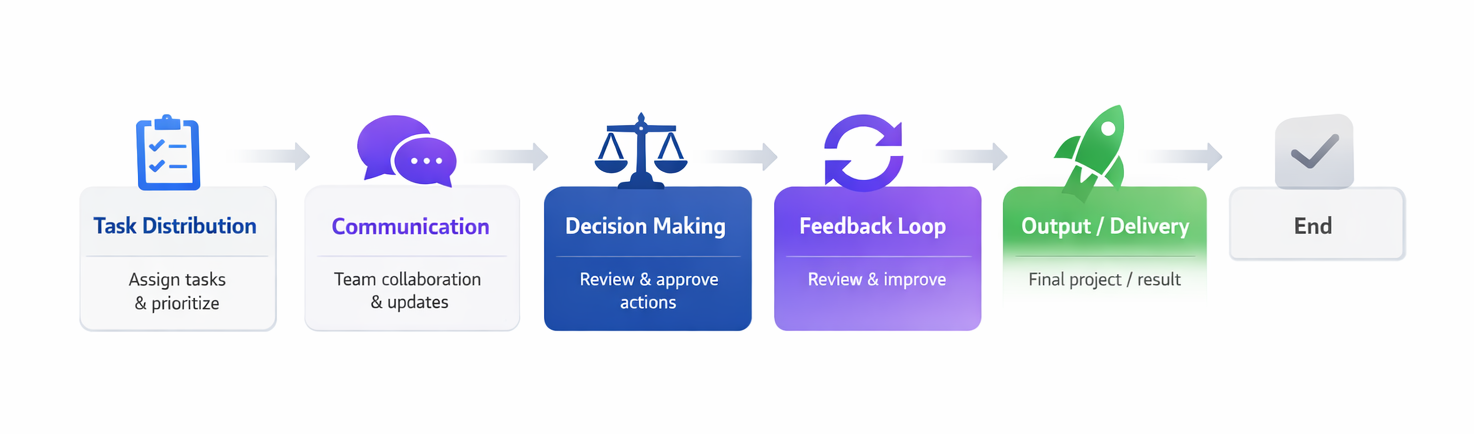
Multi-agent systems operate through a structured workflow:
1. Task Distribution
The main research problem is divided into smaller tasks, assigned to different agents based on their specialization.
2. Communication
Agents share information using predefined protocols, ensuring smooth collaboration.
3. Decision-Making
Each agent processes its assigned task and contributes results to the system.
4. Feedback Loop
Agents continuously refine their outputs based on feedback from other agents or new data.
5. Final Output
The system combines all contributions into a unified result, such as a research paper, prediction, or simulation.
Key Features of Multi-AI Agent Systems
1. Parallel Processing
Multiple AI agents work at the same time on different parts of a task, which significantly reduces the overall research time. Instead of completing tasks one by one, the system handles them simultaneously, leading to faster results and improved efficiency.
2. Scalability
Multi-AI agent systems are highly flexible and can easily scale as requirements grow. New agents can be added to handle additional tasks, larger datasets, or more complex problems without affecting the existing workflow.
3. Autonomy
Each agent can operate independently without constant human supervision. They can make decisions, execute tasks, and adapt their actions based on predefined rules or learned behavior, allowing researchers to focus on higher-level strategies.
4. Adaptability
These systems can quickly adjust to new data, changing environments, or updated research goals. Agents continuously learn and improve from new inputs, ensuring that the system remains effective even in dynamic conditions.
5. Collaboration
AI agents communicate and collaborate with each other similar to a human team. By sharing data and insights, they improve coordination and problem-solving efficiency, resulting in more accurate and comprehensive outcomes.
Benefits for Scientific Research
1. Faster Discovery
Multi-AI agent systems significantly reduce the time required for experiments, simulations, and data analysis. By working in parallel and automating multiple steps, they accelerate the entire research process, allowing scientists to achieve results much faster.
2. Improved Accuracy
These systems improve accuracy by cross-checking and validating results across multiple agents. This reduces human errors, minimizes bias, and ensures more reliable and precise outcomes in research findings.
3. Automation of Repetitive Tasks
Repetitive and time-consuming tasks such as data cleaning, literature reviews, and statistical analysis are handled automatically by AI agents. This allows researchers to focus more on critical thinking and innovation instead of routine work.
4. Enhanced Innovation
AI agents can test and explore multiple hypotheses at the same time. This parallel exploration increases the chances of discovering new patterns, ideas, and breakthroughs that might be missed in traditional research methods.
5. Cost Efficiency
By reducing the need for large teams and minimizing manual effort, multi-AI systems help lower operational and research costs. They optimize resource usage while delivering faster and more accurate results.
Real-World Applications
1. Healthcare and Drug Discovery
-
Identifying new drug compounds: AI agents analyze chemical structures and biological data to find potential new medicines faster than traditional lab testing.
-
Predicting disease outbreaks: By processing global health data in real time, agents can forecast epidemic or pandemic risks.
-
Personalizing treatments: Multi-AI systems help create individualized treatment plans based on a patient’s genetic and medical data.
2. Climate Science
-
Modeling climate change scenarios: AI agents simulate different climate scenarios to predict environmental changes.
-
Analyzing environmental data: Large datasets from satellites, sensors, and weather stations are processed to track trends and anomalies.
-
Predicting natural disasters: Early warnings for floods, hurricanes, and earthquakes can be generated using AI-driven analysis.
3. Physics and Astronomy
-
Simulating complex physical systems: Agents model phenomena such as particle interactions or quantum behaviors for research purposes.
-
Analyzing space data: Telescopic and satellite data is processed efficiently to detect unusual patterns or events.
-
Discovering new celestial patterns: Multi-AI systems help identify stars, exoplanets, and other cosmic structures faster than human analysis.
4. Genomics and Biology
-
DNA sequencing analysis: AI agents process genetic sequences to identify variations and mutations.
-
Protein structure prediction: They help predict how proteins fold and interact, critical for understanding diseases.
-
Genetic research automation: Multi-AI systems automate repetitive biological analysis, speeding up research timelines.
5. Engineering and Robotics
-
Designing smart systems: AI agents assist in creating intelligent devices and IoT solutions.
-
Optimizing manufacturing processes: Agents analyze production workflows to increase efficiency and reduce waste.
- Autonomous robotics research: Multi-agent systems enable robots to work independently and collaboratively in complex environments.
Multi-AI Agents vs Traditional Research Methods
|
Aspect |
Traditional Research |
Multi-AI Agent Systems |
|
Speed |
Slow |
Fast |
|
Accuracy |
Moderate |
High |
|
Scalability |
Limited |
Highly Scalable |
|
Cost |
High |
Reduced |
|
Automation |
Minimal |
Extensive |
Challenges and Limitations
While powerful, multi-AI agent systems also face challenges:
1. System Complexity
Designing and managing multiple AI agents is inherently complex. Developers must ensure each agent has a defined role, coordinates properly with others, and avoids task overlap. Poorly designed systems can lead to inefficiency or errors.
2. Data Dependency
Multi-AI agent systems rely heavily on high-quality, well-structured data. Inaccurate, incomplete, or inconsistent data can compromise results, making data preparation and validation a critical step in implementation.
3. Communication Overhead
Agents need to exchange information constantly to stay coordinated. Inefficient communication protocols or delays can create bottlenecks, misinterpretation of data, or duplicated efforts, affecting overall system performance.
4. Ethical Concerns
Using AI in research introduces ethical challenges such as:
-
Data privacy: Sensitive information must be protected.
-
AI bias: Agents may unintentionally reinforce existing biases in datasets.
-
Transparency: Decision-making processes need to be explainable for accountability.
5. Computational Resources
Multi-agent AI systems often require high processing power and advanced infrastructure. Running multiple agents simultaneously can be resource-intensive, requiring powerful servers, GPUs, and sufficient storage capacity.
Future of Multi-AI Agent Systems in Research
The future looks promising as advancements continue in AI technologies. We can expect:
1. Fully Autonomous Research Labs
Future labs could be entirely AI-driven, with multi-agent systems handling experiments, data collection, and analysis without constant human supervision. This will allow continuous, 24/7 research operations and faster scientific discovery.
2. Real-Time Global Scientific Collaboration
AI agents can collaborate across countries in real time, sharing data, insights, and findings instantly. This will enable global research networks, faster peer collaboration, and coordinated responses to urgent scientific challenges.
3. Integration with Quantum Computing
Combining multi-AI agent systems with quantum computing can process vast datasets and solve complex scientific problems much faster than classical computers, opening new frontiers in drug discovery, climate modeling, and material science.
4. Smarter and Self-Improving AI Agents
Future agents will continuously learn from new data and adapt their strategies autonomously. Self-improving AI will enhance efficiency, accuracy, and innovation, enabling the system to refine its own workflows over time.
5. Faster Breakthroughs in Medicine, Space, and Sustainability
Multi-AI systems will accelerate breakthroughs in critical fields:
-
Medicine: Rapid drug discovery and personalized treatments
-
Space: Advanced simulations and astronomical discoveries
-
Sustainability: Optimized solutions for climate change, energy efficiency, and environmental conservation
Multi-AI systems will not replace scientists but will empower them to achieve more in less time.
Best Practices for Implementing Multi-AI Agent Systems
To successfully adopt these systems:
1. Define Clear Objectives and Tasks
-
Before implementing a multi-AI agent system, clearly outline the research goals and break them into specific, manageable tasks. This ensures that each agent has a well-defined role and contributes effectively toward the overall objective.
2. Use High-Quality, Structured Data
-
The accuracy and reliability of the system depend on the quality of data. Collect clean, consistent, and well-organized datasets, and ensure proper preprocessing before feeding them into the agents.
3. Ensure Proper Agent Communication Protocols
-
Establish robust communication methods so that agents can share information efficiently and accurately. Clear protocols prevent errors, reduce duplication, and maintain coordination across the system.
4. Monitor and Evaluate System Performance
-
Continuously track the system’s outputs and performance metrics. Evaluate agent efficiency, accuracy, and collaboration to identify bottlenecks or areas for improvement. Regular monitoring ensures optimal operation.
5. Address Ethical and Security Concerns
-
Implement policies to safeguard data privacy and security. Ensure that agents operate fairly and transparently, and proactively address potential biases or misuse of AI systems.
FAQ (Frequently Asked Questions)
Q1. What is a Multi-AI Agent System?
Ans: It is a system where multiple AI agents work together to solve complex problems by sharing tasks and collaborating.
Q2. How is it different from a single AI model?
Ans: A single AI model works independently, while multi-agent systems involve multiple agents working together for better efficiency and accuracy.
Q3. Where are multi-AI agent systems used?
Ans: They are used in healthcare, climate science, engineering, biology, and many other research fields.
Q4. Are these systems fully autonomous?
Ans: They can operate autonomously but often require human supervision for critical decisions.
Q5. What are the main advantages?
Ans: Faster research, improved accuracy, scalability, automation, and cost efficiency.
Q6. What are the risks?
Ans: System complexity, data dependency, ethical concerns, and high computational requirements.
Conclusion
Multi-AI Agent Systems are revolutionizing scientific research by enabling intelligent collaboration between multiple AI entities. They bring speed, accuracy, and efficiency to complex research processes, helping scientists solve problems that were once considered impossible.
As technology continues to evolve, these systems will become an essential part of modern research, driving innovation across industries. Organizations and researchers who adopt multi-agent AI systems today will be better positioned to lead the scientific breakthroughs of tomorrow.



Shreyans Padmani
Shreyans Padmani has 5+ years of experience leading innovative software solutions, specializing in AI, LLMs, RAG, and strategic application development. He transforms emerging technologies into scalable, high-performance systems, combining strong technical expertise with business-focused execution to deliver impactful digital solutions.