Introduction
Generative AI is transforming how businesses and individuals interact with data. However, one major limitation of traditional AI models is that they rely only on pre-trained knowledge, which can become outdated or incomplete over time.
This is where RAG (Retrieval-Augmented Generation) comes in.
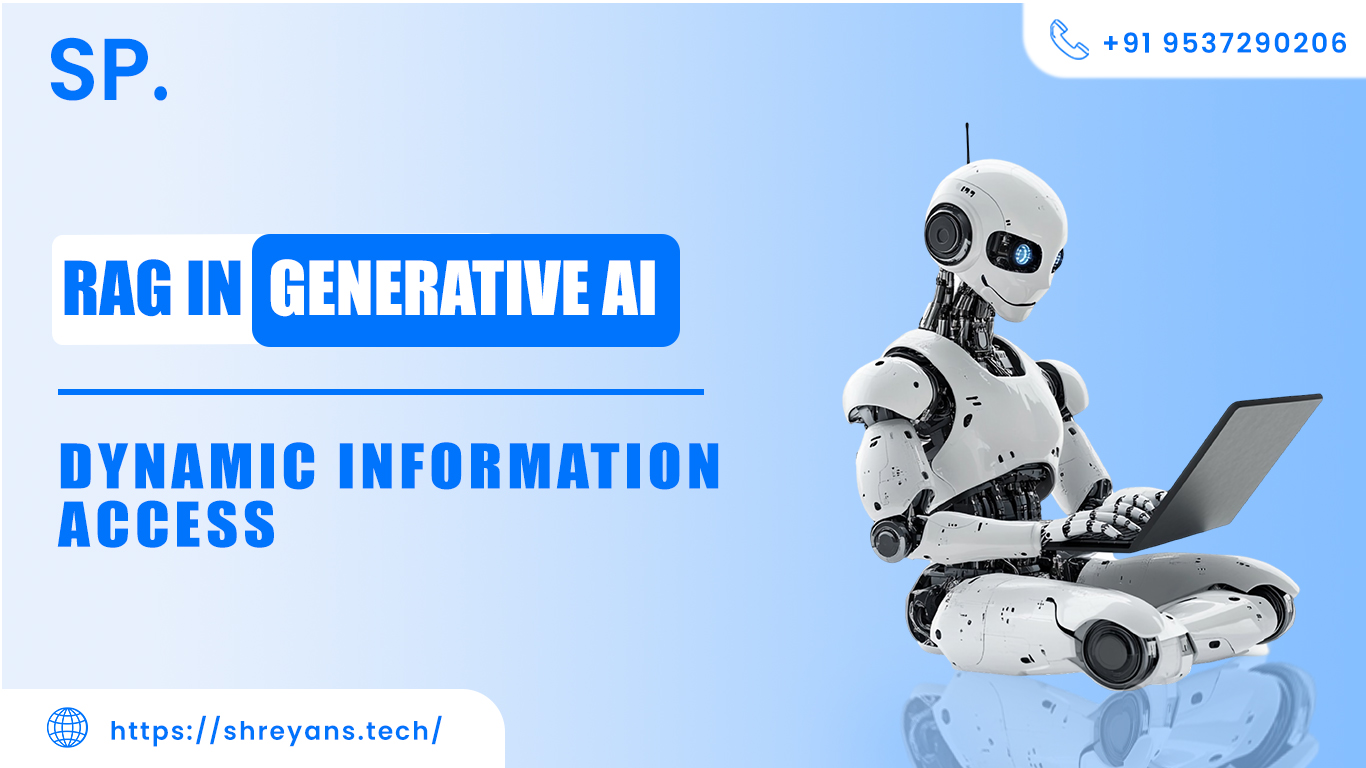
RAG enhances generative AI by enabling dynamic information access, allowing models to fetch real-time, relevant data from external sources before generating responses. This makes AI systems more accurate, up-to-date, and context-aware.
In this blog, we will explore what RAG is, how it works, its benefits, use cases, and why it is becoming essential in modern AI systems.
What is RAG in Generative AI?
RAG (Retrieval-Augmented Generation) is a technique that combines:
Information Retrieval (Searching Relevant Data):
-
Information retrieval is the process of finding and extracting the most relevant data from external sources such as databases, documents, websites, or APIs. In RAG systems, this step ensures that the AI model has access to accurate, up-to-date, and context-specific information before generating a response, which significantly improves the quality and reliability of the output.
Text Generation (Creating Human-Like Responses):
-
Text generation refers to the ability of AI models to produce natural, human-like language based on the input and retrieved data. Using advanced language models, RAG systems generate clear, meaningful, and context-aware responses that feel conversational while maintaining accuracy and relevance to the user’s query.
Instead of relying only on stored training data, RAG systems:
-
Retrieve relevant information from external sources (databases, APIs, documents)
-
Use that information to generate accurate and contextual responses
In simple terms:
RAG = Search + AI Generation
Why is RAG Important?
Traditional Generative AI Models:
-
Cannot Access Real-Time Data:
Traditional AI models rely only on pre-trained datasets, which means they cannot fetch or update information in real time. As a result, they may miss recent updates, trends, or changes happening after their training period. -
May Produce Outdated or Incorrect Answers:
Since the model’s knowledge is fixed, it can sometimes generate responses that are no longer accurate or relevant. This is especially problematic in fast-changing fields like technology, finance, or healthcare. -
Struggle with Domain-Specific Knowledge:
These models often lack deep understanding of specialized or company-specific data, making them less effective for industries that require precise and contextual information.
RAG Solves These Problems By:
-
Providing Real-Time Data Access:
RAG enables AI systems to retrieve the latest information from external sources such as databases, APIs, or documents, ensuring that responses are always current and relevant. -
Improving Accuracy and Reliability:
By combining retrieved data with AI-generated responses, RAG ensures that outputs are based on factual and verified information, leading to more trustworthy results. -
Reducing Hallucinations (False AI Outputs):
RAG minimizes the chances of AI generating incorrect or misleading information by grounding responses in real data instead of relying purely on assumptions or pre-trained knowledge.
How RAG Works (Step-by-Step)
1. User Query
The process begins when a user asks a question or provides an input to the AI system. This query can be anything from a simple question to a complex request. The quality of the query plays an important role in determining how accurate and relevant the final response will be.
2. Retrieval Process
In this step, the system searches a connected knowledge base such as databases, documents, APIs, or the web to find the most relevant information related to the user’s query. Advanced techniques like vector search and embeddings are used to ensure that the retrieved data closely matches the user’s intent.
3. Context Injection
Once the relevant data is retrieved, it is added as context for the AI model. This step is crucial because it provides the model with fresh, accurate, and domain-specific information, allowing it to better understand the query and generate more meaningful responses.
4. Response Generation
Finally, the AI model generates a response using both the retrieved data and its pre-trained knowledge. This combination ensures that the output is not only natural and human-like but also accurate, up-to-date, and contextually relevant.
-
Retrieved Data:
The external information ensures factual correctness and real-time relevance in the response. -
Pre-trained Knowledge:
The model’s existing knowledge helps in structuring the response clearly, maintaining fluency, and providing additional context where needed.
Key Components of RAG
1. Retriever
The retriever is responsible for finding the most relevant documents or data based on the user’s query. It acts like a smart search engine that understands the meaning of the query rather than just matching keywords.
-
Finds Relevant Documents or Data:
The retriever scans large datasets such as documents, databases, or knowledge repositories to identify information that closely matches the user’s question, ensuring high relevance and accuracy. -
Uses Techniques Like Vector Search or Embeddings:
Modern RAG systems use advanced techniques like vector search and embeddings to understand the semantic meaning of content. This allows the system to retrieve contextually similar information even if the exact keywords are not present.
2. Knowledge Base
The knowledge base is the external source of information that the RAG system uses to retrieve data. It plays a critical role in ensuring that the AI has access to accurate and up-to-date information.
-
External Data Source (PDFs, APIs, Databases, Websites):
The knowledge base can include multiple sources such as company documents, research papers, APIs, structured databases, or websites. This flexibility allows RAG systems to work across different industries and use cases.
3. Generator (LLM)
The generator is typically a large language model (LLM) that creates the final response using both the retrieved data and its pre-trained knowledge.
-
Generates the Final Response Using Retrieved Data:
The generator combines the retrieved information with its language understanding capabilities to produce a clear, natural, and context-aware response that directly answers the user’s query while maintaining accuracy and readability.
Benefits of RAG in Generative AI
1. Real-Time Information Access
RAG enables AI systems to access and retrieve the latest data from external sources such as databases, APIs, and documents in real time. This ensures that the information provided is always current, relevant, and aligned with the latest updates, making AI responses more useful for dynamic industries.
2. Improved Accuracy
With RAG, responses are generated using actual retrieved data instead of relying only on pre-trained knowledge. This significantly improves the accuracy of outputs, as the AI bases its answers on verified and context-specific information rather than assumptions.
3. Reduced Hallucinations
One of the major challenges in generative AI is hallucination, where the model produces incorrect or misleading information. RAG reduces this risk by grounding responses in real data, ensuring that the output is more reliable and fact-based.
4. Domain-Specific Expertise
RAG allows AI systems to access specialized or company-specific data such as internal documents, policies, or industry reports. This makes it highly effective for domains like healthcare, finance, legal, and enterprise applications where precise and contextual knowledge is essential.
5. Cost Efficiency
Since RAG retrieves updated information dynamically, there is less need to frequently retrain the AI model. This reduces development and maintenance costs while still keeping the system up-to-date and efficient.
Use Cases of RAG
1. AI Chatbots
Customer support bots can access:
-
FAQs (Frequently Asked Questions):
The bot can quickly retrieve answers from a predefined FAQ database, allowing it to respond instantly to common customer queries such as account issues, pricing details, or service information. This improves response time and enhances customer satisfaction. -
Product Databases:
By connecting to product databases, the bot can provide detailed information about products, including features, pricing, availability, and specifications. This helps users make informed decisions without needing human support. -
Company Policies:
The bot can access internal company policies such as return policies, refund rules, shipping guidelines, and terms of service. This ensures that customers receive accurate, consistent, and policy-compliant information every time.
2. Enterprise Search
RAG-powered enterprise search systems allow employees to quickly access internal knowledge stored across various company resources.
-
Employees Can Quickly Retrieve Internal Knowledge:
Instead of manually searching through multiple documents or systems, employees can simply ask questions and get instant, accurate answers from internal databases, reports, emails, or knowledge bases. This improves productivity, reduces time spent searching for information, and enhances decision-making within organizations.
3. Healthcare
RAG plays a crucial role in improving access to medical information and supporting healthcare professionals.
-
Doctors Can Get Updated Medical Research and Guidelines:
By retrieving the latest medical studies, clinical guidelines, and research papers, RAG systems help doctors make informed decisions. This ensures that treatments and diagnoses are based on the most recent and reliable medical knowledge, improving patient care and outcomes.
4. E-commerce
In the e-commerce industry, RAG enhances customer experience by providing intelligent and personalized assistance.
-
Product Recommendations:
AI can analyze user preferences, browsing history, and product data to suggest relevant products, helping customers find what they need faster and increasing sales conversions. -
Real-Time Inventory Details:
RAG systems can access live inventory data to inform customers about product availability, stock levels, and delivery timelines, ensuring accurate and up-to-date information during the shopping process.
5. Legal & Finance
RAG is highly valuable in industries where accuracy and up-to-date information are critical.
-
Access to Updated Laws, Regulations, and Financial Data:
Professionals can retrieve the latest legal documents, compliance regulations, financial reports, and market data. This helps lawyers, analysts, and financial experts make well-informed decisions while staying compliant with current laws and industry standards.
RAG vs Traditional Generative AI
|
Feature |
Traditional AI |
RAG-based AI |
|
Data Source |
Pre-trained only |
Dynamic + Pre-trained |
|
Accuracy |
Medium |
High |
|
Real-time Data |
❌ No |
✅ Yes |
|
Hallucination |
High |
Low |
|
Flexibility |
Limited |
High |
Challenges of RAG
While powerful, RAG also has some challenges:
Data Retrieval Quality Depends on the Knowledge Base:
-
The effectiveness of a RAG system heavily relies on the quality of the data stored in its knowledge base. If the data is outdated, incomplete, or poorly structured, the AI may retrieve irrelevant or incorrect information, leading to less accurate responses. Therefore, maintaining a clean, well-organized, and regularly updated knowledge base is essential for optimal performance.
Requires Proper Indexing and Embeddings:
-
For RAG to work efficiently, data must be properly indexed and converted into embeddings (vector representations). Without accurate indexing and high-quality embeddings, the system may fail to understand the context of queries and retrieve less relevant results, which can impact the overall quality of responses.
Slightly Higher System Complexity:
-
Compared to traditional AI models, RAG systems involve multiple components such as retrievers, databases, and generators. This increases the complexity of development, integration, and maintenance, requiring more technical expertise and careful system design.
Latency Due to Retrieval Step:
-
Since RAG involves an additional step of retrieving data before generating a response, it may introduce slight delays in response time. While usually minimal, this latency can become noticeable in large-scale systems or when handling complex queries with extensive data sources.
Best Practices for Implementing RAG
-
Use High-Quality and Clean Data Sources:
The performance of a RAG system depends heavily on the quality of its data. Always use reliable, well-structured, and accurate data sources such as verified documents, trusted databases, and updated APIs. Clean data ensures that the AI retrieves relevant information and generates precise, trustworthy responses.
-
Optimize Vector Search and Embeddings:
Efficient vector search and high-quality embeddings are essential for retrieving contextually relevant data. By optimizing embedding models and search algorithms, you can improve how well the system understands user queries and matches them with the most relevant information, resulting in better response accuracy.
-
Implement Ranking and Filtering Mechanisms:
Not all retrieved data is equally useful. Implementing ranking and filtering techniques helps prioritize the most relevant and high-quality information while removing noise or irrelevant results. This ensures that only the best data is passed to the AI model for response generation.
-
Regularly Update the Knowledge Base:
To maintain accuracy and relevance, the knowledge base should be updated frequently with the latest information. This is especially important for industries where data changes rapidly, such as technology, finance, or healthcare. -
Monitor and Evaluate Response Quality:
Continuously track the performance of the RAG system by analyzing outputs, user feedback, and accuracy metrics. Regular evaluation helps identify issues, improve retrieval quality, and ensure that the system consistently delivers high-quality and reliable responses.
Future of RAG in Generative AI
RAG is becoming a core architecture for modern AI systems. In the future, we can expect:
Better Real-Time Integration with APIs:
-
In the future, RAG systems will become more deeply integrated with APIs, enabling seamless access to live data from multiple platforms such as CRM systems, analytics tools, and third-party services. This will allow AI to deliver highly dynamic, real-time responses based on continuously updated information.
More Accurate and Context-Aware AI:
-
As retrieval techniques and language models improve, RAG systems will become even more accurate and better at understanding context. This means AI will not only provide correct answers but also deliver responses that are more relevant, detailed, and aligned with user intent.
Personalized AI Responses:
-
Future RAG systems will leverage user data, preferences, and behavior patterns to deliver personalized responses. This will enhance user experience by providing tailored recommendations, customized content, and more meaningful interactions.
Integration with Enterprise Workflows:
-
RAG will play a key role in automating and enhancing business processes by integrating directly into enterprise workflows. From customer support to internal operations, AI will assist in decision-making, streamline tasks, and improve overall efficiency within organizations.
RAG will play a key role in making AI more trustworthy and scalable.
FAQ (Frequently Asked Questions)
Q1: What does RAG stand for in AI?
Ans: RAG stands for Retrieval-Augmented Generation, a technique that combines data retrieval with AI-generated responses.
Q2: Why is RAG used in generative AI?
Ans: It is used to improve accuracy, provide real-time information, and reduce incorrect outputs.
Q3: Is RAG better than traditional AI models?
Ans: Yes, RAG is more accurate and reliable because it uses external data sources along with pre-trained knowledge.
Q4: Where is RAG commonly used?
Ans: It is used in chatbots, enterprise search systems, healthcare, finance, and e-commerce applications.
Q5: Does RAG require retraining models?
Ans: No, RAG reduces the need for frequent retraining because it retrieves updated information dynamically.
Conclusion
RAG (Retrieval-Augmented Generation) is revolutionizing generative AI by enabling dynamic information access. It bridges the gap between static AI knowledge and real-world, up-to-date data.
By combining retrieval systems with powerful language models, RAG ensures:
-
More Accurate Responses:
RAG improves the accuracy of AI-generated outputs by grounding responses in real, retrieved data instead of relying only on pre-trained knowledge. This ensures that the information provided is fact-based, relevant, and aligned with the user’s query, reducing the chances of errors.
-
Real-Time Knowledge Integration:
With RAG, AI systems can integrate real-time information from external sources such as APIs, databases, and documents. This allows the model to provide up-to-date answers, making it highly effective for industries where current information is critical.
-
Better User Experience:
By delivering accurate, relevant, and timely responses, RAG significantly enhances the overall user experience. Users receive faster, more helpful answers, leading to increased satisfaction, trust, and engagement with AI-powered systems.
As AI continues to evolve, RAG will become a standard approach for building intelligent, reliable, and scalable AI solutions.



Shreyans Padmani
Shreyans Padmani has 5+ years of experience leading innovative software solutions, specializing in AI, LLMs, RAG, and strategic application development. He transforms emerging technologies into scalable, high-performance systems, combining strong technical expertise with business-focused execution to deliver impactful digital solutions.