Introduction
Artificial Intelligence (AI) is no longer a futuristic concept—it’s shaping industries, driving innovation, and creating new career opportunities worldwide. Whether you are a student, professional, or tech enthusiast, understanding AI is essential in today’s data-driven world. This guide will take you through a complete AI roadmap, starting from the basics and progressing to advanced expert-level skills. By following this roadmap, you can build a strong foundation, master critical tools, and become an AI expert ready for the real-world challenges.
Stage 1: Beginner – Laying the Foundation
The beginner stage focuses on building your understanding of AI fundamentals and programming skills.
1. Learn Basic Mathematics for AI
-
Linear Algebra: Matrices, Vectors, and Operations
Linear Algebra is essential in AI for representing and processing data using vectors and matrices. It helps in performing operations like multiplication, addition, and transformations on large datasets. These concepts are widely used in machine learning models and neural networks. Techniques like PCA also rely on linear algebra to reduce data complexity. -
Probability and Statistics: Understanding Data and Uncertainty
Probability and Statistics help AI systems make decisions based on data and uncertainty. They are used to analyze patterns, calculate averages, and understand data distribution. Concepts like mean, variance, and probability distributions are key for predictions. Bayesian methods further improve decision-making by updating results with new data. -
Calculus: Derivatives and Integrals for Optimization
Calculus is used in AI to optimize models and reduce errors during training. Derivatives help algorithms like Gradient Descent adjust model parameters efficiently. Integrals are useful for understanding continuous data and probability. Calculus plays a major role in training neural networks through backpropagation.
2. Learn Programming
-
Python Programming for AI
-
Python is the most recommended programming language for AI because of its powerful and easy-to-use libraries. It allows developers to build machine learning and deep learning models efficiently. Learning basics like variables, loops, functions, and object-oriented programming is essential to get started. A strong foundation in Python helps you implement AI concepts smoothly and work on real-world projects.
3. Understand Core AI Concepts
-
What is AI? (AI vs Machine Learning vs Deep Learning)
Artificial Intelligence (AI) refers to machines that can perform tasks that normally require human intelligence. Machine Learning (ML) is a subset of AI that enables systems to learn from data without explicit programming. Deep Learning (DL) is a further subset of ML that uses neural networks to handle complex tasks like image and speech recognition. Together, they form the core technologies behind modern AI systems. -
Types of AI: Narrow AI vs General AI
Narrow AI is designed to perform specific tasks, such as voice assistants or recommendation systems, and is widely used today. General AI, on the other hand, aims to perform any intellectual task like a human, but it is still under development. Most current AI applications fall under Narrow AI. Understanding these types helps in knowing the current and future scope of AI. -
Applications of AI
AI is used in various real-world applications across industries. Chatbots help in customer support, recommendation systems personalize user experiences, and computer vision enables image and video analysis. It is also used in healthcare, finance, and automation. These applications show how AI is transforming everyday life and business operations.
Stage 2: Intermediate – Diving into Machine Learning
Once the basics are clear, move towards Machine Learning (ML), which is the backbone of AI.
1. Learn Machine Learning Algorithms
-
Supervised Learning: Regression and Classification
Supervised learning is a type of machine learning where models are trained using labeled data. Regression is used to predict continuous values like prices, while classification is used to categorize data into groups. It is widely used in applications like spam detection and sales prediction. This approach helps models learn patterns from known outputs. -
Unsupervised Learning: Clustering and Dimensionality Reduction
Unsupervised learning works with unlabeled data and helps discover hidden patterns. Clustering groups similar data points together, while dimensionality reduction simplifies data by reducing features. These techniques are useful for data analysis and visualization. They help in understanding complex datasets more efficiently. -
Reinforcement Learning Basics
Reinforcement learning is based on learning through actions and rewards. An agent interacts with an environment and improves its performance by receiving feedback. It is commonly used in robotics, gaming, and decision-making systems. Over time, the model learns the best strategy to achieve its goals.
2. Tools and Libraries
-
Python libraries like scikit-learn, pandas, and NumPy.
-
Data preprocessing and visualization skills using matplotlib and seaborn.
3. Practical Projects
-
Hands-on Practice and Projects
-
Building simple predictive models, such as housing price prediction, helps you apply machine learning concepts in real scenarios. Working on real-world datasets improves your problem-solving and analytical skills. Platforms like Kaggle provide a variety of datasets to practice and learn. These projects help you understand data challenges and gain practical experience in AI.
Stage 3: Advanced – Mastering Deep Learning
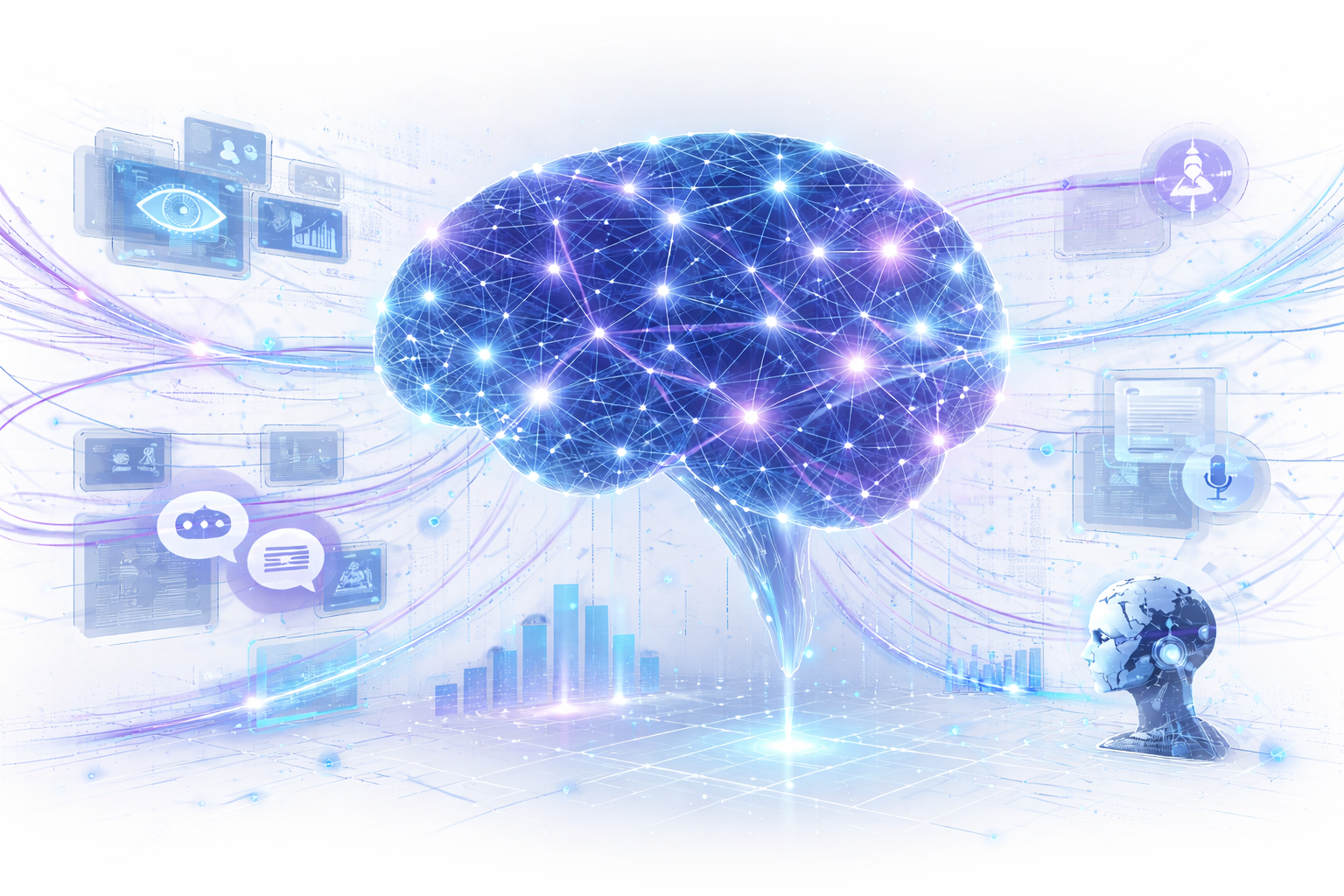
Deep Learning takes AI to a new level by mimicking the human brain through neural networks.
1. Learn Neural Networks
-
Understand artificial neurons, activation functions, and network architecture.
-
Study deep learning frameworks: TensorFlow, PyTorch, and Keras.
2. Specialized Domains
-
Computer Vision: Image classification, object detection.
-
Natural Language Processing (NLP): Chatbots, sentiment analysis.
-
Generative AI: AI art, text generation, and synthetic media.
3. Real Projects
-
Build a CNN for image recognition.
-
Develop an NLP model for text summarization.
Stage 4: Expert – Becoming an AI Specialist
At the expert level, focus on research, optimization, and real-world deployment.
1. AI Research
-
Stay updated with the latest AI trends and publications.
-
Learn about reinforcement learning, GANs, and large language models.
2. Deployment Skills
-
Use cloud platforms like AWS, Google Cloud, or Azure for AI deployment.
-
Learn about containerization (Docker) and APIs for model integration.
3. Soft Skills
-
Critical thinking and problem-solving for AI solutions.
-
Collaboration and communication for interdisciplinary projects.
Frequently Asked Questions (FAQ)
Q1. How long does it take to become an AI expert?
Ans: It depends on your dedication and learning path. Typically, 1–2 years of focused study and practice can make you proficient in AI.
Q2. Do I need a degree in computer science to learn AI?
Ans: No. While a background in CS helps, anyone with dedication and a strong math foundation can learn AI.
Q3. What are the best tools to start with?
Ans: Python, NumPy, pandas, scikit-learn for ML, and TensorFlow or PyTorch for deep learning.
Q4. Can I work on AI projects without coding experience?
Ans: Yes, but learning programming will significantly enhance your understanding and capabilities.
Q5. Are there free resources to learn AI?
Ans: Yes. Platforms like Coursera, edX, Kaggle, and YouTube offer quality free courses and tutorials.
Conclusion
AI is a powerful field with immense opportunities, but mastering it requires a structured approach. By following this roadmap—from understanding basics to building advanced deep learning projects—you can transition from a beginner to an expert efficiently. Remember, consistency, practice, and curiosity are key. Start your AI journey today and be part of the next technological revolution.



Shreyans Padmani
Shreyans Padmani has 5+ years of experience leading innovative software solutions, specializing in AI, LLMs, RAG, and strategic application development. He transforms emerging technologies into scalable, high-performance systems, combining strong technical expertise with business-focused execution to deliver impactful digital solutions.