Introduction
AI is no longer some futuristic concept. It’s Tuesday morning, and it’s already inside your CRM, your inbox, and your customer support queue. Businesses of every size, from two-person startups to 50,000-employee enterprises, are trying to figure out exactly how to use it without blowing their budget or confusing their customers.
The thing is, most conversations about AI in business blur two very different tools into one. Chatbots. AI agents. People use the terms interchangeably, and honestly, I get why they’re both “AI,” they both talk to users, and they both promise to save you time. But they don’t work the same way. Not even close.
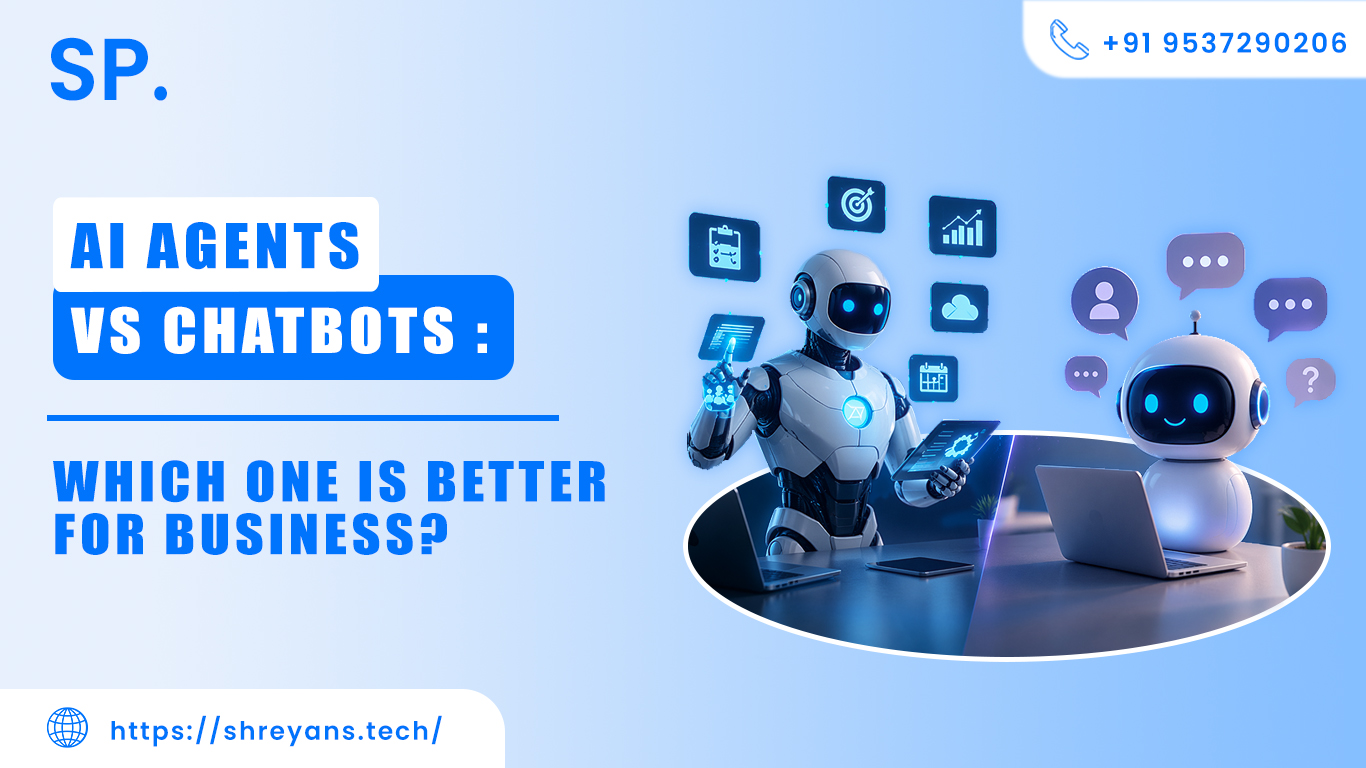
A chatbot waits for a question and answers it. An AI agent actually goes and does something, makes a decision, runs a process, finishes a task without you hovering over it. That gap matters enormously when you’re deciding where to put your money. Get it wrong and you either overpay for power you’ll never use, or you buy a budget tool and wonder why it keeps dropping the ball on anything complicated.
What is an AI Chatbot?
An AI chatbot is software that holds a conversation text or voice based on rules, scripts, or a relatively lightweight AI model. Think of it as a very well-trained receptionist who’s read the FAQ document a thousand times. Reliable. Fast. But pretty lost the moment someone asks something it wasn’t briefed on.
Key Features:
Responds to user queries using predefined logic:
The chatbot follows a decision tree or something close to one to give fast, consistent answers. Someone asks “What’s your return policy?” and the bot fires back in under a second. No wait time, no staffing cost, no variation in tone. That consistency is genuinely useful. (It’s also the ceiling. Once you color outside the lines, the cracks show fast.)
Handles repetitive and common questions:
Order status. Pricing tiers. Store hours. Password resets. If your team is answering the same ten questions forty times a day, a chatbot can take that whole workload off their plate permanently. I’ve seen small support teams cut their ticket volume by 40% just by deploying a decent chatbot on the FAQ stuff alone.
Uses Natural Language Processing (NLP):
Modern chatbots don’t just match keywords anymore. NLP lets them read intent so “I want to cancel” and “how do I stop my subscription” both lead to the same answer. It’s not magic, but it’s a real upgrade from the clunky menu-driven bots we all hated in 2015.
Requires human intervention for complex issues:
Here’s where chatbots hit a wall. Anything nuanced, emotional, or multi-step? The bot needs to hand it off to a real person. That handoff, if done well, is seamless. Done badly which is more common it frustrates the customer and burns the goodwill the bot just built up.
Common Use Cases:
Customer support (FAQs):
This is the chatbot’s home turf. Instant answers to common questions, product details, policies, troubleshooting basics without making anyone wait for a human to become available. It works. It’s cost-effective. And customers genuinely don’t mind it as long as the answers are actually correct.
Order tracking:
Customers want to know where their package is. Right now. Not in an email thread tomorrow. A chatbot connected to your order management system can spit out real-time status updates in seconds, reducing “where’s my order?” tickets by a significant margin.
Booking assistance:
Restaurants, clinics, salons, consultancies any business that runs on appointments can use a chatbot to handle bookings around the clock. No phone tag. No missed calls after hours. The customer books, gets a confirmation, and moves on with their day.
A chatbot sitting on your landing page can engage a visitor, ask a few qualifying questions, collect contact info, and tag the lead as hot, warm, or cold before a salesperson even knows they exist. Not glamorous work, but it fills the pipeline.
Simple definition: Chatbots are built to answer questions efficiently.
What is an AI Agent?
An AI agent is a whole different beast. It’s not waiting for a question to answer, it's capable of analyzing a situation, forming a plan, and executing a series of actions to get something done. No hand-holding required. You give it a goal, and it figures out how to reach it.
Key Features:
Autonomous decision-making:
This is the part that actually blows people’s minds when they first see it in action. An AI agent doesn’t just retrieve information it evaluates options, picks the best path, and acts on it. Independently. That’s not a chatbot with extra steps. That’s a fundamentally different kind of tool.
Handles multi-step and complex tasks:
Imagine a process that involves pulling data from three systems, running a check, generating a report, flagging an anomaly, and sending a summary to the right person all without a human touching it. A chatbot can’t do that. An AI agent can, and does, every day in businesses that have figured out how to deploy it.
Learns and improves over time:
AI agents don’t stay static. They pick up patterns from interactions and outcomes, and they use that data to get better. Slowly at first, then noticeably. The agent you deploy in month one and the agent running in month six are meaningfully different in how well they perform that compounding value is something a rule-based chatbot simply cannot offer.
Integrates with APIs, databases, and business systems:
CRM. ERP. Inventory management. Ticketing systems. Billing platforms. An AI agent can plug into all of them, read live data, and take action based on what it finds. That’s not theoretical companies are doing this right now to run entire back-office workflows with minimal human involvement.
Common Use Cases:
End-to-end customer support resolution:
Not just answering the question, solving the problem. An AI agent can look up the account, see the issue, check the policy, issue a refund, send a confirmation email, and update the CRM record. The whole thing. Start to finish. The customer gets resolved faster, and your team doesn’t spend their day doing admin.
Workflow automation (HR, finance, operations):
Onboarding a new employee involves a dozen steps across multiple departments. Payroll, IT access, policy sign-off, equipment orders. An AI agent can coordinate that entire flow, flag blockers, and keep everything moving without someone manually chasing each piece. Same story in finance with invoice processing, approval chains, and reconciliation.
Smart recommendations:
When an AI agent knows your customer’s behavior, purchase history, and browsing patterns, it can surface recommendations that actually make sense not the generic “people also bought” stuff, but genuinely personalized suggestions that feel like they came from someone who was paying attention.
Business process optimization:
AI agents can watch your operations in real time, spot where things are slowing down or breaking, and surface actionable insights. Some can even adjust parameters automatically to fix inefficiencies without you ever writing a ticket. That’s the long-term value proposition not just doing tasks, but making the whole system run better.
Simple definition: AI agents are built to solve problems and complete tasks.
AI Agents vs Chatbots: Key Differences
Here’s the side-by-side view. Read this table once and the fog lifts:
|
Feature |
AI Chatbot |
AI Agent |
|
Function |
Conversational |
Action-oriented |
|
Intelligence |
Limited |
Advanced |
|
Decision Making |
Rule-based |
Autonomous |
|
Task Complexity |
Simple |
Complex |
|
Learning Ability |
Low |
High |
|
Integration |
Basic |
Deep |
|
User Experience |
Scripted |
Personalized |
Core difference: Chatbots respond to queries. AI agents take action and get things done.
Advantages of AI Chatbots
Cost-effective and easy to implement:
You don’t need a six-figure IT project to get a chatbot running. Most platforms have you set up in days, not months. For a small business looking to automate the easy stuff without breaking the bank, this is genuinely the right starting point. Low risk. Quick win. Real value from day one.
Provides 24/7 customer support:
Your human team goes home. Your chatbot doesn’t. Customers hitting your site at 2am on a Sunday still get an answer and that matters more than most businesses realize. Missed queries at odd hours are missed revenue. A chatbot captures that.
Handles large volumes of queries:
One human agent can handle maybe five simultaneous conversations if they’re really good. A chatbot handles five thousand without breaking a sweat. When volume spikes product launches, seasonal rushes, viral moments the bot absorbs the shock so your team doesn’t have to.
Improves response time:
Instant. Every time. No queue, no music, no “your wait time is approximately 14 minutes.” The customer asks, the bot answers. That speed alone improves satisfaction scores in a way that’s hard to argue with.
Limitations:
Limited understanding of complex issues:
Anything outside the script and the chatbot starts to struggle. Weird edge cases, emotional situations, requests that require actual judgment these break the flow. The bot either gives a wrong answer with confidence or just loops the customer back to the menu. Both are bad.
Often requires human escalation:
The handoff problem is real. A customer who’s spent five minutes going in circles with a bot and then has to re-explain their issue to a human is not a happy customer. If your escalation process isn’t smooth, the chatbot actually makes the experience worse, not better.
Less personalized interaction:
Chatbots don’t really know who you are. They answer the question in front of them. That’s fine for transactional stuff, but if you’re trying to build any kind of relationship with your customers, the scripted responses feel cold. Noticeable. Impersonal in a way that lingers.
Advantages of AI Agents
Automates complete workflows:
This is the headline feature. Not just one step in the whole process. From trigger to completion, an AI agent can own an entire workflow end-to-end, freeing your team to focus on the work that actually requires a human brain. That’s not a small efficiency gain. That’s a structural shift in how you operate.
Reduces operational costs:
Automating complex, multi-step tasks cuts labor costs in a way that simple chatbots can’t. You’re not just deflecting a support ticket, you're eliminating entire categories of manual work. The ROI compounds over time, and it tends to look very good by the end of year two.
Delivers personalized experiences:
AI agents work with real data about real users. That means recommendations, responses, and actions that are tailored to the individual, not a persona, not a segment, but the specific person. That level of personalization drives engagement in a way generic scripts simply cannot match.
Scales with business growth:
As you grow, your AI agent grows with you. More customers, more transactions, more complexity the agent handles increased load without a proportional increase in cost or headcount. That scalability is what makes the upfront investment worth it for businesses with serious growth ambitions.
Handles complex decision-making:
Multiple data points. Real-time analysis. Actual judgment calls. An AI agent can do this fast, accurately, and without the cognitive load that wears humans down. For businesses running fast-moving operations, that capability is genuinely valuable.
Limitations:
Higher setup complexity:
Look, I won’t sugarcoat it. Setting up an AI agent properly takes time, technical know-how, and careful planning. You’re configuring integrations, defining logic, testing edge cases, and training the system. It’s not a weekend project. If you’re not ready to invest in the setup, you’ll get messy results.
Requires quality data and system integration:
Garbage in, garbage out that rule applies here more than anywhere. An AI agent is only as smart as the data it has access to. If your CRM is a mess or your systems don’t talk to each other cleanly, the agent will struggle. Data quality and integration work are prerequisites, not optional extras.
Needs monitoring and proper governance:
You can’t just set it and forget it at first, anyway. AI agents need oversight, especially early on. Are the decisions they’re making actually correct? Are they compliant with your policies and regulations? Building a governance framework around your AI agent isn’t glamorous work, but skipping it is how you end up with expensive problems.
Which One is Better for Business?
Honest answer: it depends on what you’re trying to do. There’s no universal winner here. The right tool is the one that matches where your business is right now and where you realistically want to go.
Choose Chatbots if:
-
You need to handle simple and repetitive queries: If your business mainly fields common questions, FAQs, order status, basic support a chatbot handles that workload efficiently and cheaply. No need to overcomplicate it.
-
You want a low-cost and quick solution: Tight budget, fast timeline, clear use case. Chatbots deliver real value here without requiring months of implementation work or a dedicated technical team.
-
Your business is in the early stage: Startups and small businesses don’t need the full AI agent treatment yet. Start with a chatbot, prove the concept, learn what your customers actually need, and grow from there.
Choose AI Agents if:
-
You require advanced automation: If basic chat deflection doesn’t cut it and you need a system that can actually make decisions and complete tasks, you’re in AI agent territory. The capability gap is real.
-
Your processes involve multiple steps: Any workflow with more than two or three stages data processing, validation, action, confirmation is a candidate for AI agent automation. That’s where the technology earns its keep.
-
You want long-term scalability and efficiency: Growing businesses that are thinking beyond the next quarter should be looking at AI agents. The compounding efficiency gains over 12 to 24 months make the setup investment look very reasonable in hindsight.
Best Approach: Combining Both
Here’s the thing: you don’t always have to pick one. The smartest businesses I’ve seen aren’t choosing between chatbots and AI agents. They’re using both, at different points in the same workflow.
Chatbots handle initial interactions and basic queries:
The bot sits at the front. It greets customers, handles the easy stuff, qualifies the issue, and collects basic context. Fast, cheap, and reliable for that layer.
AI agents take over for complex tasks and automation:
When the issue needs real work account changes, multi-system updates, personalized recommendations, escalation logic the agent steps in and executes. No friction. No re-explanation. The handoff is seamless because both systems are working from the same data.
This hybrid setup gives you the coverage of a chatbot and the horsepower of an AI agent, without having to sacrifice one for the other. In practice, it’s the setup that delivers the best customer experience and the most operational value simultaneously.
Future of AI in Business
AI agents are moving fast. The systems available today are already a different category of product compared to what existed two years ago and the trajectory is steep. Expect agents to handle increasingly complex operations, integrate more deeply across business systems, and require progressively less human supervision as the technology matures.
Chatbots aren’t going anywhere. They’ll keep doing what they’re good at, front-line interactions, volume management, and instant response while agents take on more of the heavy lifting behind the scenes.
The businesses that get ahead of this won’t be the ones who adopted AI earliest. They’ll be the ones who deployed it most thoughtfully, right tool, right place, right time. That’s the actual competitive edge here.
Frequently Asked Questions (FAQ)
1. Are AI agents more powerful than chatbots?
Yes, by a meaningful margin. Chatbots are built to handle conversation. AI agents are built to take action. Those are different jobs, and agents are equipped for the harder one.
2. Which is more cost-effective?
Chatbots cost less to deploy upfront. AI agents cost more to set up but tend to generate better long-term returns because they automate more valuable work. The right answer depends on what you’re automating and over what time horizon.
3. Can AI agents replace chatbots?
Not completely. A chatbot is actually better suited for front-line, high-volume, simple interactions and that category of work isn’t going away. The two tools serve different parts of the same problem.
4. Do small businesses need AI agents?
Not yet, for most. Start with a chatbot, understand your automation needs, and graduate to AI agents when the complexity justifies it. There’s no prize for overbuilding early.
5. Can both be used together?
Yes, and honestly, that’s the setup most growing businesses should aim for. Chatbot at the front, AI agent in the back. They complement each other well when deployed with a clear division of responsibilities.
Conclusion
Chatbots and AI agents are both genuinely useful. That’s the honest take. But they’re useful in different ways, at different stages, for different kinds of problems.
Chatbots are where most businesses should start. Fast to deploy, affordable, reliable for high-volume simple interactions. They’ll take a real workload off your team and improve your response times from day one.
AI agents are where serious automation leads. If you’re running complex workflows, growing fast, and thinking about what your operations look like in two or three years, agents are the technology worth investing in today.
The smartest move isn’t picking a side, it's building a system where both do what they’re best at. Start with the chatbot. Layer in the agent when you’re ready. That’s how you build something that actually scales.



Shreyans Padmani
Shreyans Padmani has 5+ years of experience leading innovative software solutions, specializing in AI, LLMs, RAG, and strategic application development. He transforms emerging technologies into scalable, high-performance systems, combining strong technical expertise with business-focused execution to deliver impactful digital solutions.