Introduction
Every single day, insurance companies drown in paper. Policy documents. Claims forms. Invoices. ID proofs. Mountains of it and for decades, someone had to manually touch every single page, which is where the whole operation quietly starts falling apart. Slow turnarounds. Avoidable mistakes. Customers waiting three weeks for answers that genuinely should've taken three hours.
That's changing. Fast. AI-powered automation has quietly gutted the old way of doing things: it grabs data from documents, cross-checks it, and processes it at a speed no human team can realistically match. I've watched this shift happen up close, and honestly? The gap between companies using this and companies not using it is already uncomfortable. In this post, I'll walk you through exactly how it works plain language, no fluff, no buzzword soup.
What is AI-Based Document Processing?
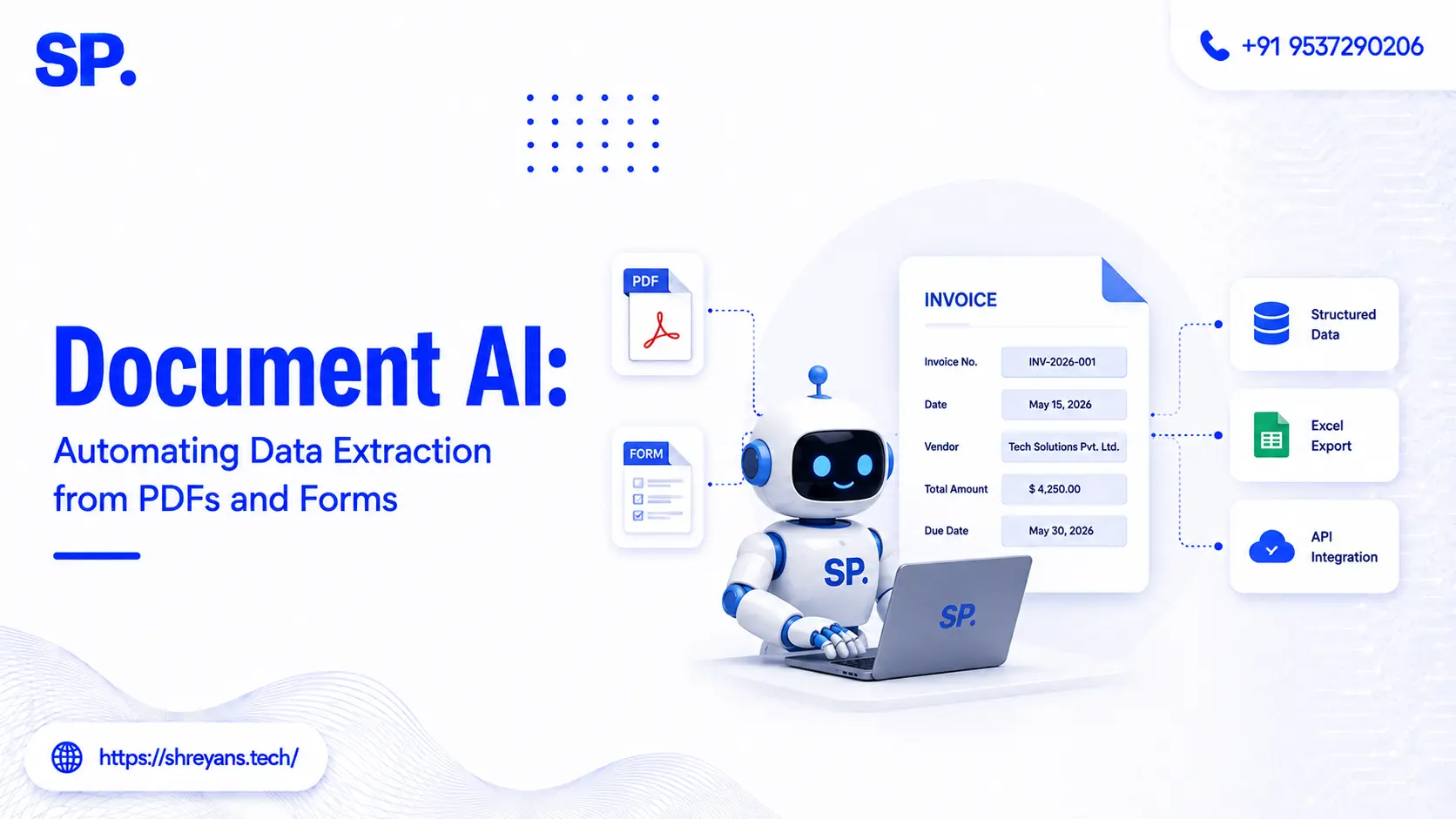
Think of it this way. You hand a pile of 500 forms to a machine. It reads every one. It pulls out what matters: the names, figures, dates, policy references. It organizes everything into clean, structured data. No coffee break. No mid-afternoon lag. No "I'll finish the rest tomorrow."
That's AI-based document processing, stripped down to what it actually does. Under the hood, it runs on three things working together: Machine Learning (ML), which trains systems to recognize patterns across massive volumes of documents; Optical Character Recognition (OCR), which reads text off physical images and scans even blurry ones; and Natural Language Processing (NLP), which goes a step further and actually understands what the words mean in context.
The old pipeline was manual data entry slow, soul-crushing, and genuinely error-prone. This replaces it entirely. AI scans the document, pulls the key information, validates it on the spot, and drops it into a structured format. Clean. Fast. Done. No one's retyping anything off a blurry fax at 4pm on a Friday.
Key Challenges in Traditional Insurance Document Processing
Look, I've talked to people who've spent years inside insurance operations, and the stories are rough. Not "inconvenient" rough operationally broken rough. The old process wasn't just slow. It was a genuine mess held together by people working harder than they should've had to.
Here's what those teams were dealing with before any of this existed: manual work eating entire workdays on tasks that produced zero strategic value; human errors slipping through on high-stakes data wrong policy numbers, transposed figures, missed fields; document volumes that flatly couldn't scale without hiring more bodies; claim delays that left customers furious and ready to switch carriers; and documents arriving in every format imaginable PDFs, blurry phone photos, handwritten forms that looked like someone wrote them during an earthquake.
Each one of those is its own headache. Together, they're a system-wide bottleneck that no amount of overtime fixes. AI doesn't patch this problem. It tears it out by the roots and replaces the whole structure.
How AI Automates Insurance Document Processing
1. Intelligent Data Extraction
Here's the kicker AI doesn't need a perfectly formatted document to do its job. It can pull policy numbers, customer details, claim amounts, dates, and signatures from messy, inconsistent layouts without skipping a beat. Change the form template? Doesn't matter. The system reads the intent of the document and grabs what it needs anyway.
I've heard this called "flexible extraction," and that description earns it. Rigid rule-based systems break the moment a format shifts one new field, one redesigned layout, and the whole thing falls over. AI adapts. It's the difference between a process that requires constant babysitting and one that just works.
2. Optical Character Recognition (OCR)
OCR is the piece that makes physical documents actually usable. Got a scanned driving licence? A blurry photo of a registration certificate? A stack of handwritten invoices from a decade ago? OCR reads the text off those images and converts it into workable digital data accurately, quickly, without anyone manually retyping a single character.
The days of a data entry operator squinting at a scan and typing it out character by character are genuinely over. OCR handles it in seconds. (I've watched this demo live and the speed still catches people off guard.)
3. Document Classification
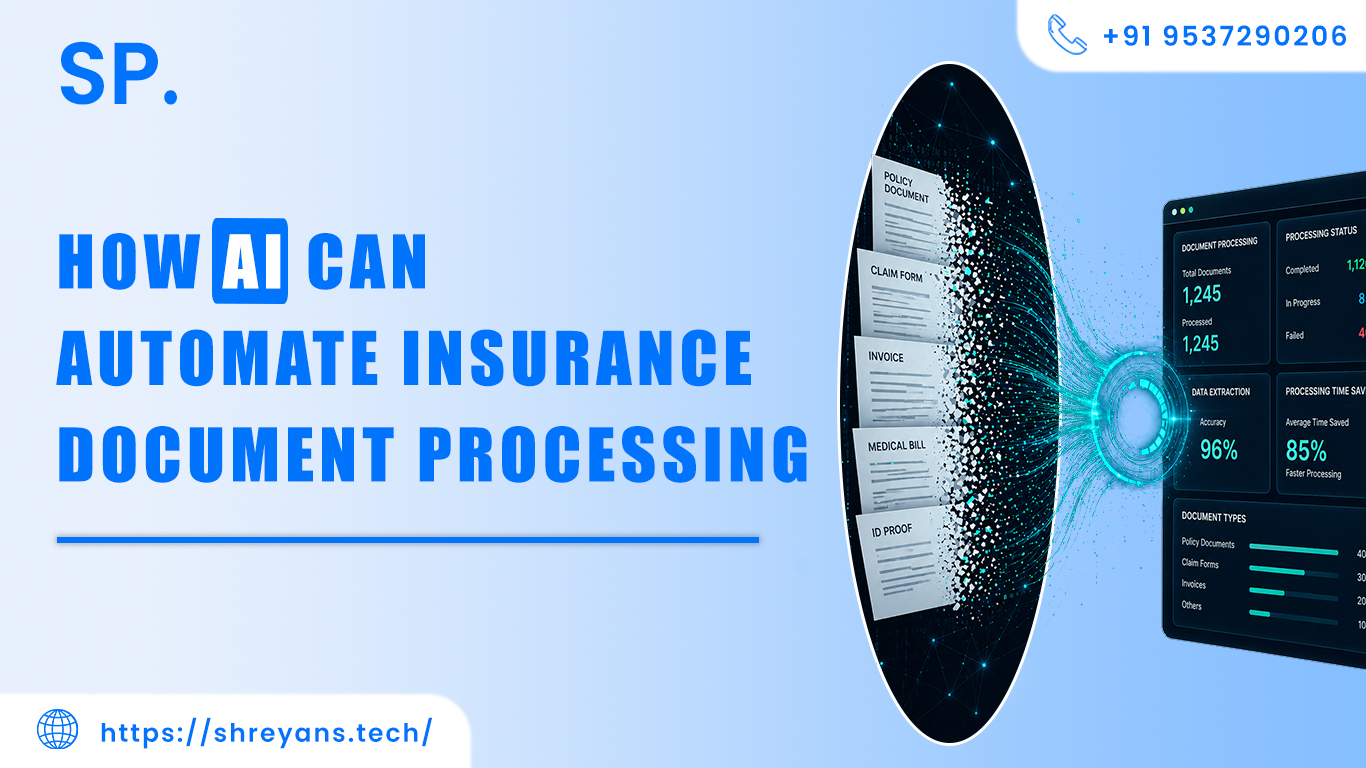
Before you can process anything, you need to know what it is. AI handles that automatically. Claim form? Sorted. Medical bill? Sorted. Identity proof? Sorted. Policy document? You get the idea.
Automatic categorization keeps workflows moving without someone manually routing every file to the right department. It sounds like a small fix. In practice, it's a massive time win especially when you're dealing with thousands of documents hitting the system at once.
4. Data Validation & Verification
Extracting data is only half the job. The other half is making sure it's actually right. AI cross-checks extracted information against existing records in real time matching policy numbers to customer files, verifying claim figures against the invoices submitted, flagging anything that doesn't line up before it goes any further.
This layer is where a lot of fraud gets caught early. Mismatched numbers don't quietly slip through. They get flagged instantly, before they become approved payouts nobody can claw back.
5. Automated Claim Processing
This is the part that genuinely changes the customer experience and honestly, it's the one that gets the most pushback from people who haven't seen it in action. Once AI pulls the required data and validates the documents, straightforward claims can be approved automatically. No humans in the loop. No waiting for a handler to finish their other twelve tasks first.
Complex cases still go to a human reviewer that's right and appropriate. But the simple ones? Processed in minutes. Settlement timelines that used to stretch across days or weeks compress dramatically. That's a win for the customer, a win for the operations team, and a win for the carrier's reputation.
6. Fraud Detection
AI doesn't just process documents, it watches for patterns. Duplicate claims submitted weeks apart. Inflated invoices that don't match market rates. Documents where the metadata doesn't line up with the submission date. The system learns what legitimate claims look like across thousands of real examples, so the suspicious ones stand out fast.
Insurance fraud is a multi-billion dollar problem globally, and it doesn't take exotic schemes to pull off. Sometimes it's just someone submitting the same claim twice hoping nobody checks. AI checks. Every time. Without getting tired.
Benefits of AI in Insurance Document Processing
1. Faster Processing
We're talking hours of work compressed into minutes. Not a marginal improvement, a genuine order-of-magnitude shift in throughput.
2. Improved Accuracy
Humans get tired. Attention drifts. AI doesn't have that problem. Consistent, high-accuracy extraction cuts out the downstream errors that come from bad data making it through the first checkpoint.
3. Cost Reduction
Less manual labor means lower operating costs full stop. Teams that used to burn their days on data entry can shift to work that actually requires human judgment. That's a better use of everyone's time, and it shows up on the balance sheet.
4. Better Customer Experience
Nobody wants to wait three weeks to find out if their claim was approved. Faster processing means faster answers. Customers notice and they remember.
5. Scalability
A busy claims period used to mean overtime, backlogs, and stressed-out staff. AI-powered systems scale without breaking a sweat thousands of documents processed at the same speed whether it's a slow Tuesday morning or the aftermath of a major weather event hitting half a region at once.
Real-World Use Case
Let me make this concrete. Picture a vehicle insurance claim not a hypothetical one, this is a workflow that's running right now at carriers across multiple markets.
A customer photographs their RC, driving licence, and repair invoice, then uploads them through the insurer's app. AI scans every document, extracts the relevant data, cross-checks it against the policy already on file, and validates the invoice figures all without a human touching it. If everything lines up, the claim moves to approval in minutes.
What used to require a claims handler to manually review every document, make follow-up calls, wait for callbacks, and manually enter data into three different systems now runs almost entirely without human intervention. The handler's time goes to the complicated cases, the ones that actually need human judgment.
That's not a future scenario. It's happening right now.
Frequently Asked Questions (FAQ)
Q1. What is AI in insurance document processing?
It's the use of OCR, ML, and NLP to read, extract, and handle data from insurance documents automatically cutting out the manual work that slows everything down and introduces errors at every step.
Q2. How does AI improve claim processing?
It pulls data from submitted documents without human input, verifies it against existing records on the spot, and routes claims for approval faster than any manual process realistically could. The result is quicker settlements, fewer delays, and customers who don't have to call in to ask where their claim is.
Q3. Is AI accurate in document processing?
Genuinely, yes. Modern AI systems run at high accuracy rates, and they keep improving over time through continuous learning on new data. Error rates are significantly lower than manual processing and critically, the errors that do occur tend to get caught by the validation layer before they cause downstream problems.
Q4. Can AI detect insurance fraud?
It can. AI spots unusual patterns, duplicate claims, inflated invoices, documents with inconsistencies that don't match the narrative and flags them before they become approved payouts. It's not perfect, but it makes pulling off a convincing fraudulent claim a whole lot harder than it used to be.
Q5. What types of documents can AI process?
PDFs, scanned images, handwritten forms, invoices, policy documents, identity proofs, repair estimates, medical bills. If it has readable text on it or even semi-readable text AI can work with it. OCR handles the messy physical stuff; NLP handles understanding what the content actually means.
Conclusion
The old way of handling insurance documents was slow, expensive, and held together by manual effort that flatly couldn't scale. AI has changed that equation completely faster processing, fewer errors, lower costs, and customers who actually feel like their time is worth something.
The thing is, this isn't optional anymore. Companies still running manual document workflows aren't just inefficient, they're already falling behind carriers who made this move two or three years ago. The operational gap is real, and it widens every quarter.
The ones investing in AI automation now are building the muscle they'll need when volumes grow, when weather events spike claims, when customer expectations keep rising and "we're processing your claim" stops being an acceptable answer. The window to get ahead of this is open. It won't stay that way and by the time it's obvious, the catch-up cost will be much higher than the investment is today.



Shreyans Padmani
Shreyans Padmani has 5+ years of experience leading innovative software solutions, specializing in AI, LLMs, RAG, and strategic application development. He transforms emerging technologies into scalable, high-performance systems, combining strong technical expertise with business-focused execution to deliver impactful digital solutions.