Introduction
In the modern corporate landscape, "time" is the most expensive commodity. Despite decades of digitization, many businesses remain bogged down by manual processes—repetitive data entry, tedious resume screening, and constant email sorting. These "micro-tasks" may seem small, but collectively, they act as an anchor, slowing down innovation and draining employee morale.
As an AI Engineer, I’ve seen firsthand how shifting from manual to machine-driven workflows isn’t just about "replacing" tasks; it’s about unlocking human potential. Here is how Artificial Intelligence is systematically reducing manual work across the business spectrum in 2026.
1. The High Cost of the "Manual Mindset"
Before looking at the solution, we must acknowledge the problem. Relying on manual labor for repetitive tasks is no longer just slow—it’s a business risk.
• The Error Tax: Fatigue and monotony lead to data entry mistakes. In finance or healthcare, a single misplaced decimal can cost thousands of dollars or lead to compliance violations.
• The Scalability Ceiling: If your business requires hiring one new administrative person for every ten new clients, your margins will eventually shrink. AI allows for nonlinear growth.
• The Innovation Gap: When your best talent spends 60% of their day on "maintenance" tasks, they aren't brainstorming the next big product.
2. Deep Dive: Revolutionary AI Applications
A. Generative AI & The Evolution of Content
Manual content creation—whether it’s writing product descriptions, internal reports, or social media updates—used to take hours.
•The AI Shift: Generative models now act as first-draft engines. By feeding an AI the key parameters of a project, businesses can generate high-quality drafts in seconds.
•Impact: This reduces the "time-to-publish" by nearly 80%, allowing marketing teams to focus on high-level strategy and brand voice rather than syntax.
B. Intelligent Document Processing (IDP)
Gone are the days of manual filing. Using Computer Vision and Transformer-based models, AI can now "read" and understand unstructured data.
• The AI Shift: An AI system can analyze a 50-page legal contract, flag non-standard clauses, and summarize the key obligations in under a minute.
• Impact: This eliminates the need for junior associates or clerks to spend days on manual document review.
C. AI Agents in Customer Experience
We have moved past the "press 1 for support" era. 2026 is the year of Autonomous AI Agents.
• The AI Shift: These agents use Natural Language Understanding (NLU) to access internal databases, check real-time inventory, and process refunds end-to-end without human intervention.
• Impact: Support teams are no longer "ticket-closers"; they become "success managers" who only handle the most nuanced human-centric issues.
D. Predictive Logistics and Supply Chain
Manual inventory tracking is notoriously inaccurate.
• The AI Shift: Machine Learning models analyze historical sales data, weather patterns, and even social media trends to predict demand.
• Impact: Automated ordering systems ensure that stock is replenished exactly when needed, reducing manual warehouse audits and preventing overstocking.
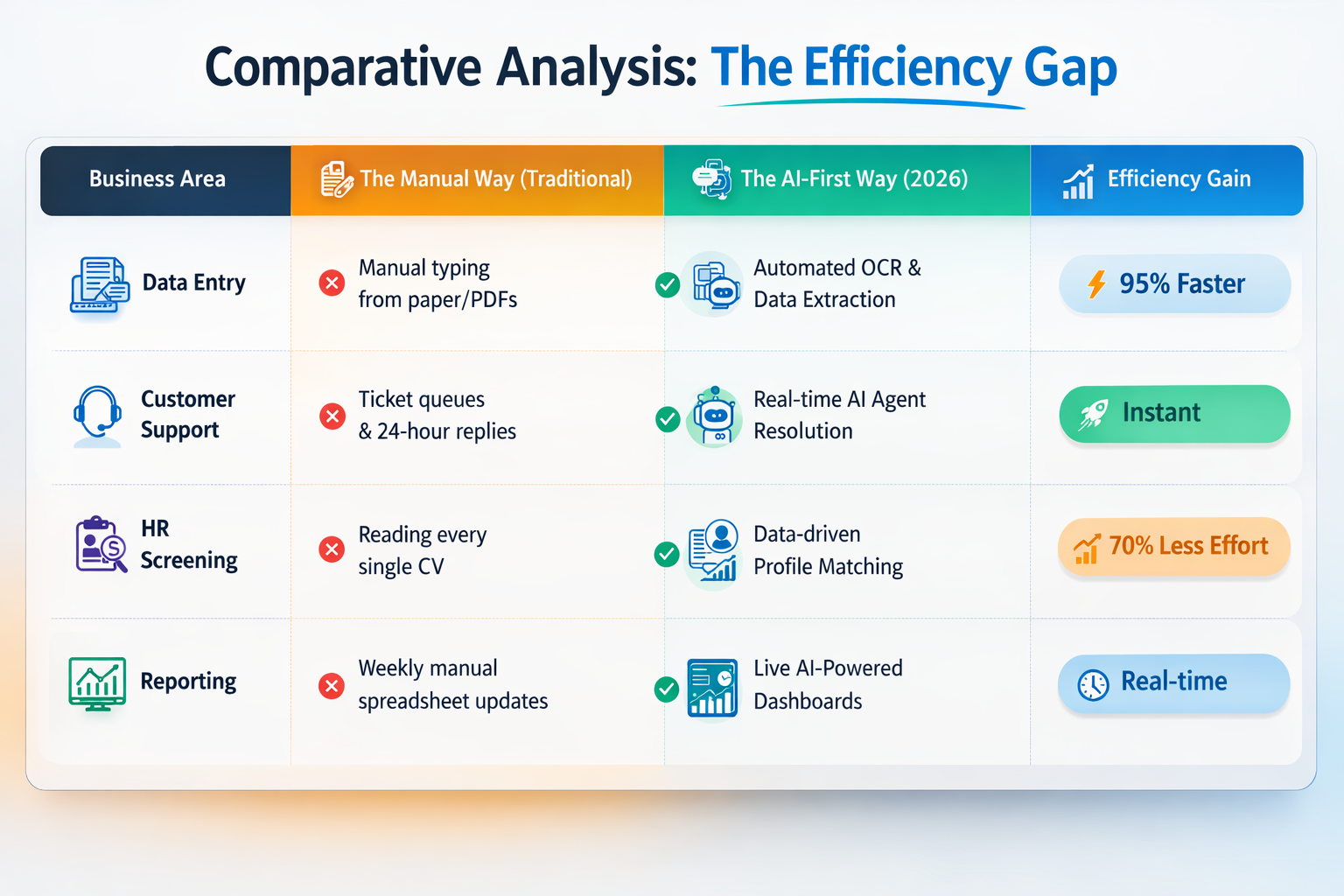
3. Comparative Analysis: The Efficiency Gap
4. Overcoming the Implementation Hurdle
Moving toward an automated business isn't an overnight switch. It requires a strategic roadmap:
1. Identify "Low-Hanging Fruit": Start with tasks that are high-volume but low-complexity (e.g., email sorting or invoice processing).
2. Data Centralization: AI cannot work in silos. Centralizing your business data into a secure, accessible environment is the first technical step.
3. The "Human-in-the-Loop" Model: We don't remove humans; we reposition them. AI does the 90% "grunt work," while a human performs the final 10% "quality check."
4. Security & Ethics: In 2026, data privacy is paramount. Implementing AI means ensuring that your models are compliant with global data protection standards (like GDPR or CCPA).
5. Conclusion: Embracing the "AI-First" Philosophy
The goal of AI is not to replace the workforce, but to augment it. By removing the "manual" from business, we allow teams to focus on strategy, relationship building, and creative innovation. The competitive landscape of 2026 will be divided into two groups: those who spend their time doing the work, and those who use AI to manage the work.



Shreyans Padmani
Shreyans Padmani has 5+ years of experience leading innovative software solutions, specializing in AI, LLMs, RAG, and strategic application development. He transforms emerging technologies into scalable, high-performance systems, combining strong technical expertise with business-focused execution to deliver impactful digital solutions.