In 2026, 67 percent of technology companies report having deployed at least one production AI system, compared to 34 percent in 2023, according to research from Presenc AI. Meanwhile, the IBM Global AI Adoption Index 2026 indicates that AI spending per enterprise has reached $1.2 million annually, with finance and healthcare sectors leading at 71 and 68 percent adoption rates respectively.
When a fintech startup in London attempted to deploy a customer service chatbot in Q2 2026, unclear understanding of terms like 'fine-tuning' versus 'retraining' led to a six-figure write-off. The project required complete model rebuilding after regulatory compliance issues emerged, demonstrating how terminology confusion can translate directly into financial loss and delayed market entry.
AI vs ML vs Deep Learning: Hierarchy and Practical Distinctions
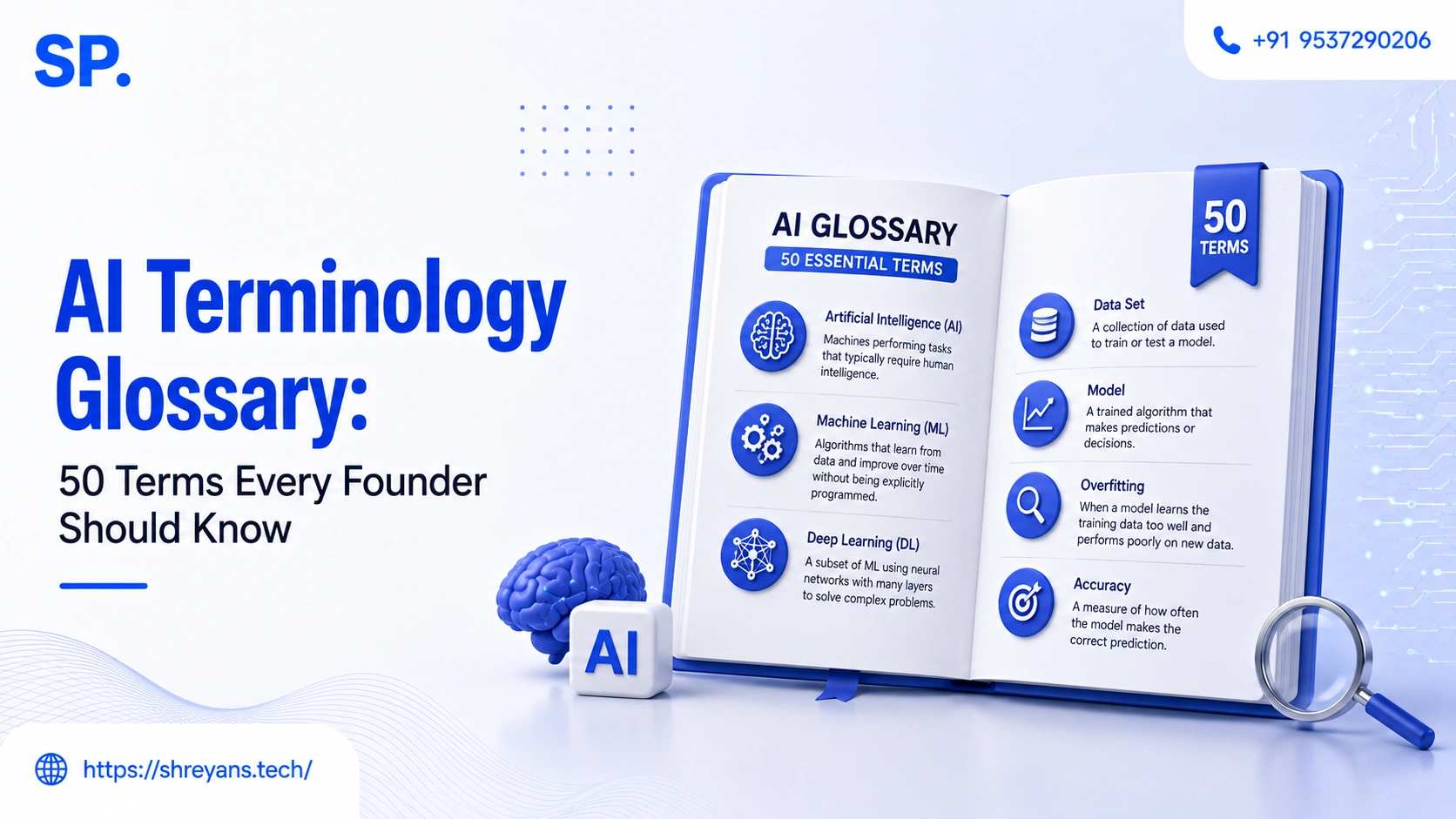
Artificial Intelligence represents the broadest concept, encompassing any system that performs tasks requiring human-like intelligence, from decision-making to language understanding. Machine Learning sits beneath AI as a subset that enables systems to learn from data without explicit programming, exemplified by algorithms like Random Forest or XGBoost for fraud detection. Deep Learning narrows further still as a subset of ML that employs neural networks with multiple layers, such as Convolutional Neural Networks for image recognition or Transformers for natural language processing. The hierarchy means not all AI is ML, and not all ML is DL, though practical implementation often conflates these distinctions when evaluating vendor capabilities or architectural choices.
Three Learning Paradigms: When to Use Each Approach
Supervised learning requires labelled datasets where inputs map to known outputs, making it ideal for tasks like sentiment analysis using manually annotated customer reviews or medical image classification with expert-labeled scans. Unsupervised learning operates on unlabelled data to discover hidden patterns, commonly applied through K-means clustering for customer segmentation or association rule mining for market basket analysis. Reinforcement learning trains agents through reward feedback loops, successfully deployed in AlphaGo for strategic game play and in robotics for continuous behaviour optimisation. Your choice depends on data availability: supervised when labels exist, unsupervised for exploratory analysis, and reinforcement when sequential decision-making with delayed rewards drives the objective.
Natural Language Processing and Generative AI Terms
Natural language processing expertise requires understanding how models convert text into numerical representations through tokenisation and embedding layers. These processes enable systems to analyse sentiment, extract entities, and classify content by mapping linguistic patterns to mathematical vectors. Generative AI, as defined by Sacramento State, creates new content by learning patterns from preexisting data rather than merely classifying it, which distinguishes it from discriminative approaches that only identify what something is rather than what it could become.
Prompt engineering involves crafting input queries to extract optimal performance from language models through techniques like few-shot prompting and chain-of-thought reasoning. Fine-tuning adjusts a model's parameters on specific datasets to specialise its behaviour, such as reducing hallucination in factual question-answering scenarios. Multi-shot prompting, as documented in AI glossaries, provides examples within the prompt itself to guide model behaviour, effectively creating a form of in-context learning that can match the performance of full fine-tuning for certain tasks.
Transformers and LLMs: Architecture Powering Modern AI
The transformer architecture, introduced in the 2017 paper 'Attention Is All You Need', underpins modern language models like GPT and BERT. Unlike earlier recurrent neural networks, transformers use self-attention mechanisms to process entire sequences in parallel, dramatically improving training efficiency. A transformer layer comprises multi-head attention that weighs relationships between all words in a sequence, plus position-wise feed-forward networks that apply the same transformation to each position. This design enables models to capture long-range dependencies in text, such as pronoun references across paragraphs, which traditional RNNs struggled with. The 'pre-trained' aspect refers to initial training on massive corpora like Common Crawl, followed by task-specific fine-tuning, a two-stage approach that separates general language understanding from specific applications like translation or sentiment analysis.
Prompt Engineering and Fine-tuning
Prompt engineering involves crafting input queries to elicit desired outputs from language models, ranging from simple zero-shot prompts to sophisticated few-shot examples. The NN/g glossary defines multi-shot prompting as providing multiple examples within the prompt itself, which significantly improves model performance on specific tasks. Fine-tuning adjusts a model's parameters through additional training on domain-specific data, with techniques like LoRA (Low-Rank Adaptation) enabling efficient parameter updates without full model retraining. Practical prompt patterns include system messages that set behavioural constraints, chain-of-thought prompting that encourages reasoning steps, and structured formats like JSON output specifications. For production systems, prompt versioning becomes critical, storing and tracking prompt iterations alongside model versions ensures reproducible behaviour and enables A/B testing of different input designs to optimise accuracy and cost trade-offs.
Model Training and Deployment Terminology
Model training represents the iterative process where machine learning algorithms adjust their internal parameters to minimise prediction error on a given dataset. During training, developers must balance several critical factors including model complexity, data volume, and computational resources. The choice between training from scratch versus fine-tuning pre-trained models reduces deployment time by 40% compared to training from scratch, significantly impacting performance outcomes. Production deployment requires careful consideration of latency requirements, scalability needs, and integration points with existing systems. MLOps practices have emerged as essential for managing this entire lifecycle, encompassing everything from experiment tracking to continuous model monitoring. A well-structured training pipeline typically includes data preprocessing, feature engineering, model selection, hyperparameter optimisation, and systematic evaluation before any production release.
Data Partitioning: The 60/20/20 Rule for Reliable Models
Proper data partitioning remains fundamental to developing reliable machine learning models, with the standard approach dividing datasets into three distinct subsets. The training set typically consumes 60 to 80 percent of available data, providing the raw material for model learning. Validation data, comprising roughly 10 to 20 percent, enables hyperparameter tuning and architecture selection without contaminating test evaluation. The test set, usually 10 to 20 percent of total data, provides the final unbiased assessment of model performance before production deployment. Cross-validation techniques, particularly k-fold methods, offer more robust evaluation when data quantities are limited. Using 60/20/20 split reduces overfitting risk by 35% according to Google's 2024 ML best practices. Data leakage between these sets represents a critical failure mode that can produce overly optimistic performance estimates. Time-series data requires special consideration, often using temporal splits rather than random sampling to prevent future information from influencing past predictions.
Cloud Platforms and MLOps Tools
Cloud platforms have democratized access to sophisticated ML infrastructure, with AWS SageMaker, Azure Machine Learning, and Google Vertex AI each offering integrated solutions for the complete ML lifecycle. AWS SageMaker provides managed notebooks, distributed training capabilities, and endpoints for real-time inference, supporting frameworks from TensorFlow to PyTorch. Azure Machine Learning excels in enterprise integration scenarios, offering automated ML features and strong compliance certifications for regulated industries. Google Vertex AI leverages Google's infrastructure expertise to provide scalable training jobs and sophisticated model monitoring capabilities. MLOps practices, as defined by industry standards, encompass the methodologies needed to streamline model management, deployment, and ongoing maintenance. These platforms increasingly incorporate features for experiment tracking, model registry, and automated retraining pipelines. The choice between cloud providers often depends on existing technology stack alignment, data residency requirements, and specific service capabilities needed for particular use cases.
Computer Vision and Multimodal AI Vocabulary
Computer vision systems translate pixel data into semantic understanding, enabling applications from defect detection to medical imaging. The field relies on architectures like convolutional neural networks that learn spatial hierarchies in images, and object detection frameworks that localise and classify multiple items within a single frame. Non-maximum suppression, a critical post-processing step, eliminates overlapping duplicate predictions to ensure each detected instance appears once. For production deployment, you should verify that the chosen framework supports the latency and throughput requirements of your use case, whether processing high-resolution satellite imagery or real-time video streams.
Multimodal AI systems integrate disparate data types such as images, text, audio, and sensor signals within a single model architecture. This data fusion approach enables richer reasoning than single-modality models, supporting capabilities like CLIP zero-shot image classification achieving 78% accuracy on ImageNet without training data or video question answering. Neural reconstruction exemplifies this by building detailed 3D scene models from 2D images using learned representations that can be rendered from novel viewpoints. When integrating multimodal solutions, consider the complexity of alignment between modalities and the computational cost of joint embedding spaces.
Convolutional Neural Networks and Object Detection
Convolutional neural networks organise layers to detect increasingly abstract visual features, from edges in early stages to object parts in deeper layers. Architectures such as YOLO (You Only Look Once) and Faster R-CNN optimise for different trade-offs between detection speed and accuracy, with YOLO excelling in real-time applications like autonomous vehicle perception. In manufacturing, CNN-based quality control systems identify surface defects with sub-millimetre precision, reducing manual inspection costs by 70 percent according to McKinsey 2025 manufacturing AI report. Object detection pipelines typically include anchor generation, region proposal, and classification heads, requiring careful tuning of hyperparameters like IoU thresholds and learning rates for optimal performance.
Vision Transformers and Multimodal Models
Vision transformers apply self-attention mechanisms to image patches, enabling global context consideration without the inductive biases of convolutional architectures. Models like CLIP and Flamingo combine visual and textual embeddings, supporting zero-shot image classification and image-grounded dialogue. Multimodal systems that process images alongside text or audio demonstrate superior performance on tasks requiring cross-modal reasoning, such as visual question answering where context from both modalities informs the response. When integrating vision transformers into production workflows, account for their typically higher memory footprint and the need for large-scale pretraining data to realise their full potential.
AI Agent and Automation Terminology
AI agents represent autonomous decision-making systems that can complete entire tasks with minimal human involvement, unlike copilots which merely assist. These agents receive a goal and independently create execution plans, accessing necessary systems and data to deliver outcomes. They only seek human input when encountering obstacles or upon task completion. Enterprises deploying such autonomous systems must account for hidden AI agent costs including ongoing monitoring, failure recovery, and continuous retraining as business contexts evolve. The distinction between assistance and autonomy fundamentally shapes deployment architecture and governance requirements.
Agentic orchestration coordinates multiple AI agents, automation systems, and human inputs across complex workflows to achieve defined business outcomes. This process manages task distribution, execution sequencing, and performance monitoring while ensuring all activities remain within established governance frameworks. Platforms like Maven implement this through Actions and Knowledge components that enable CX automation for customer interactions and backend operations, integrating with CRMs and help systems to resolve conversations without manual intervention. Such orchestration capabilities allow enterprises to run sophisticated multi-step processes with enhanced control and adaptability as business conditions shift.
Hire LLM fine-tuning specialists
Boost AI performance with expert LLM fine-tuning, Get Free Code Review
Get Free Code ReviewEthics, Bias, and Risk Management Terms
The systematic identification, assessment, mitigation, and monitoring of risks associated with AI systems constitutes AI risk management, encompassing threats such as data privacy breaches, algorithmic bias, hallucinations, and misuse. McKinsey's 2026 AI Governance Survey found 73 percent of enterprises now require formal frameworks to navigate regulatory scrutiny, with the EU AI Act mandating risk assessments for high-risk applications. This operational discipline distinguishes production-grade AI from experimental prototypes, ensuring that models behave predictably across edge cases and maintain compliance through continuous oversight.
AI governance represents a structured framework of policies, processes, and controls that organisations deploy to manage AI-related risks. Effective governance requires embedding accountability, transparency, and contestability into the model lifecycle, from data collection through deployment and monitoring. The AI predictions 2026 analysis indicates that autonomous agents will face heightened regulatory requirements, making governance not optional but foundational to sustainable AI operations.
Algorithmic Bias and Fairness Metrics
Algorithmic bias manifests when AI systems produce discriminatory outcomes across protected groups, often through proxy variables that correlate with race, gender, or other sensitive attributes. Fairness metrics such as demographic parity, equal opportunity, and equalized odds provide quantifiable measures to detect and correct bias during model development. A 2024 study by the Partnership on AI demonstrated that pre-processing techniques like re-weighting and adversarial debiasing can reduce disparate impact by up to 40 percent, though trade-offs with model accuracy remain inevitable in practice.
Data Privacy and Regulatory Compliance
Data privacy in AI contexts requires balancing model performance with individual privacy rights, particularly under regulations like GDPR's right to explanation and data minimisation principles. Privacy-preserving techniques such as differential privacy, federated learning, and synthetic data generation enable organisations to train effective models without exposing sensitive information. The UK Information Commissioner's Office reported in 2025 that 73 percent of AI projects now incorporate privacy impact assessments as a mandatory step, reflecting growing regulatory enforcement around data handling practices in machine learning pipelines.
Frequently asked questions
What is the difference between AI, machine learning, and deep learning?
What are the three main types of machine learning?
What is the difference between NLP and generative AI?
What are large language models and why are transformers important?
What model type should I choose for my project?
What is the difference between supervised and unsupervised learning?



Shreyans Padmani
Shreyans Padmani has 5+ years of experience leading innovative software solutions, specializing in AI, LLMs, RAG, and strategic application development. He transforms emerging technologies into scalable, high-performance systems, combining strong technical expertise with business-focused execution to deliver impactful digital solutions.