Retrieval-augmented generation is the correct starting point for roughly 80 percent of enterprise LLM applications in 2026, according to AI consultancy Winder.AI's decision framework, because it lets a team change source data without retraining and switch base models freely. Menlo Ventures' State of Generative AI in the Enterprise report found that 51 percent of enterprise AI deployments already use RAG in production. Despite that, teams still routinely hire the wrong specialist for the job, briefing a candidate on fine-tuning when the actual problem is retrieval, or the reverse.
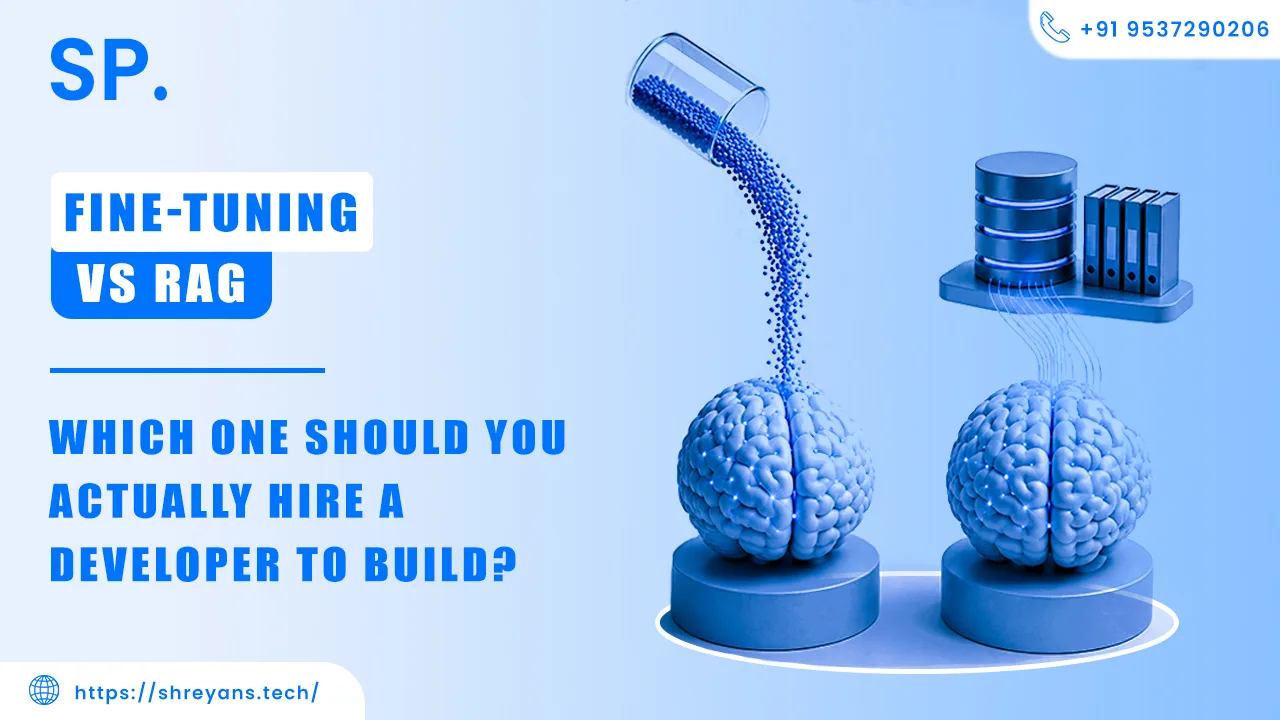
The confusion is understandable because both techniques answer the question "how do I make a general-purpose model behave like it knows my business," but they solve it in opposite ways. RAG changes what the model sees; fine-tuning changes the model itself. Hiring the wrong specialist for the wrong technique is one of the most common and most expensive mistakes in generative AI projects, so this guide sets out what each approach actually does, when each is the right call, and what to ask a candidate before you commit budget.
What RAG Actually Does
RAG leaves the underlying model untouched and instead retrieves relevant chunks of your own data at query time, then stuffs them into the prompt so the model answers using current, sourced information. A production RAG pipeline is an engineering system as much as a modelling one: it needs a chunking strategy, an embedding model, a vector index, and a reranking step, wired through an orchestration layer such as LangChain or LlamaIndex on top of a vector database such as Pinecone, Qdrant, Weaviate or pgvector. Because the knowledge lives outside the model, updating it is as simple as re-indexing a document, not retraining anything, which is exactly why teams needing citations, provenance or a fast-moving knowledge base default to it. This is the core of what generative AI development services cover for most enterprise LLM engagements: building the retrieval pipeline, not the model.
The tooling landscape has consolidated around a fairly clear split. LlamaIndex is generally favoured for document-heavy ingestion, indexing and query engines, while LangChain and its LangGraph extension are favoured when the project is really an agent orchestration problem with tool calling and branching logic. On the storage side, teams under roughly one million vectors can start with Chroma or Qdrant's free tier at effectively no cost, while teams already on PostgreSQL often test pgvector before introducing a dedicated vector database at all. A candidate who cannot explain this split, and why they would pick one combination over another for a specific data shape, has not actually built a production RAG system.
What Fine-Tuning Actually Does
Fine-tuning changes the model's weights using labelled examples, so the new behaviour is baked into the model itself rather than supplied at query time. In 2026, LoRA and QLoRA are the only fine-tuning approaches most teams should realistically consider, since they adapt a small set of additional parameters instead of retraining the full model, which keeps compute and storage costs manageable. The technique you pick depends on the data you have: supervised fine-tuning for labelled input-output pairs, preference-based methods such as DPO or ORPO when you have comparative judgements rather than single correct answers, and reinforcement-style fine-tuning for tasks with a verifiable reward signal. Building and evaluating any of these is custom AI model training work in the most literal sense, and it needs an evaluation harness in place before training starts, or there is no way to tell whether a new checkpoint is actually better than the last one.
The most common misconception about fine-tuning is that it teaches a model new facts. It does not, reliably. A model fine-tuned on medical literature adjusts its style and pattern recognition, but factual recall from that training data stays unreliable, especially for specific figures, which is precisely the gap RAG is built to close. Fine-tuning is for form, not facts: tone, output schema, refusal behaviour, and consistent structure are what it is actually good at, and hiring a developer to fine-tune a model for factual knowledge that changes weekly is a near-certain way to end up with an expensive, stale system.
Hire RAG Experts
Optimize your LLM projects with expert RAG developers, schedule a consultation
Hire AI SpecialistsThe 2026 Default: Why Most Teams Should Start With RAG
The practical decision tree most experienced teams use is short. Does the answer depend on data that changes, policies, prices, product specifications, support tickets? Use RAG, because fine-tuning bakes that data into weights and goes stale the moment the underlying data updates. Do you need to cite a source, show provenance, or pass an audit? Use RAG again, since a fine-tuned model cannot point to the document it drew an answer from. Only once those questions are answered does fine-tuning enter the conversation, typically to fix a behaviour that prompting and retrieval have already been tried against and have not resolved.
This is why the default guidance across current enterprise LLM literature converges on the same order of operations: fix the prompt, build a real retrieval pipeline, write evaluations, and only then consider fine-tuning if a specific, measured gap remains. Teams that skip straight to fine-tuning because it "sounds like the more serious option" typically discover months later that their actual problem, stale or unsourced answers, was a retrieval problem the whole time, and no amount of additional training data would have fixed it.
When Fine-Tuning Is the Right Call
Fine-tuning earns its place in two situations that come up repeatedly in production systems. The first is distillation: taking a frontier model's behaviour on a narrow task and compressing it into a smaller, cheaper, faster model that a business can run at scale without frontier-model latency or cost. The second is locking in a fixed style, tone or output schema that prompting alone cannot hold consistently across thousands of calls, such as a consistently empathetic and cautious conversational style, a pattern some healthcare organisations have piloted by fine-tuning on approved interaction transcripts. Neither of these is a knowledge problem; both are behaviour problems, which is the correct test for whether fine-tuning is warranted at all.
Deciding between the specific fine-tuning techniques, and between fine-tuning and simply prompting harder, is its own scoping exercise, and the model training approaches post covers how that choice shifts with budget and data volume in more depth than a single section here can. The short version: full fine-tuning is rarely the right call in 2026, LoRA and QLoRA cover the overwhelming majority of legitimate use cases, and the real cost is not the training compute, it is the data curation and evaluation work that has to exist before training starts.
The Hybrid Pattern and Where Agents Fit
Most serious production systems in 2026 use both techniques rather than choosing one. The typical split is that RAG handles what the model knows, current documents, pricing, product data, while a light fine-tuning pass handles how the model responds, tone, format and domain conventions. A fintech support assistant is the canonical example: RAG for product and pricing information that changes constantly, fine-tuning for the compliance-appropriate tone legal has signed off on. Agentic systems add a further layer on top of this hybrid, where a model does not just retrieve and answer but plans, calls tools, and executes multi-step tasks, which is why hiring for a RAG-powered agent means vetting for AI agent development services, tool orchestration and guardrails, not retrieval skill alone.
The failure mode to watch for in hybrid systems is synchronisation drift. If a fine-tuned model's baked-in assumptions about a workflow fall out of step with what the RAG layer is currently retrieving, the two halves of the system start contradicting each other in ways that are hard to debug because neither half is technically wrong on its own. A developer scoping a hybrid build needs to own that synchronisation problem explicitly, not discover it after launch.
|
Approach |
What It Changes |
Best For |
Typical Tools |
|---|---|---|---|
|
RAG |
What the model sees at query time, not the model itself |
Fast-changing facts, source citations, audit trails |
LangChain, LlamaIndex, Pinecone, Qdrant, Weaviate, pgvector |
|
Fine-Tuning |
The model's weights and default behaviour |
Fixed tone, format, schema, or distilling to a smaller model |
LoRA, QLoRA, SFT, DPO, ORPO |
|
Hybrid |
Both, in the same production system |
High-stakes systems needing current knowledge plus consistent behaviour |
RAG pipeline layered on a lightly fine-tuned base model |
Hiring and Vetting: What Actually Separates a Real Candidate
The strongest signal in a technical interview for this kind of work is not whether a candidate can name LangChain and LoRA; almost everyone can. It is whether they can explain, for your specific use case, why they would choose RAG, fine-tuning, or both, and what evaluation they would run to prove the choice was correct rather than just asserting it. Ask a candidate to walk through how they would detect that a RAG pipeline's retrieval quality has degraded, and separately how they would prove a fine-tuned checkpoint is actually better than the base model on your task, not just different from it.
Portfolio review matters more here than in most AI hiring, because generative AI work is easy to demo impressively and hard to verify without probing. The Gen AI portfolio red flags post is a useful checklist for spotting demos that look production-ready but were never load-tested or evaluated rigorously, and the Gen AI vetting questions post covers the broader freelancer-vetting questions worth asking alongside the technical round.

Where the Vetting Actually Pays Off
The projects that go wrong are rarely the ones where a team picked the wrong technique after careful evaluation; they are the ones where nobody ran the evaluation at all, and the choice between RAG and fine-tuning was made on vibes or on whichever term appeared in a job posting. A developer who defaults to RAG first, measures where it falls short, and only then scopes a targeted fine-tuning pass will consistently outperform one who picked a technique on day one and built the entire system around defending that choice.
If you are scoping a generative AI project and are not yet sure whether the right build is retrieval, fine-tuning, or a hybrid of both, hire an AI developer who will run that evaluation before writing the proposal, not after it. The technique that wins on a whiteboard is rarely the one that wins in production, and the only way to know which one you need is to test it against your actual data.
Frequently asked questions
What is the core difference between fine-tuning and RAG?
Fine-tuning vs RAG: which one is more expensive to build and maintain?
How should a candidate be tested for RAG versus fine-tuning skills?
Can fine-tuning add new factual knowledge to a model?
Should a startup building its first LLM feature start with RAG or fine-tuning?
Is a hybrid RAG and fine-tuning system harder to hire for than either alone?



Shreyans Padmani
Shreyans Padmani has 5+ years of experience leading innovative software solutions, specializing in AI, LLMs, RAG, and strategic application development. He transforms emerging technologies into scalable, high-performance systems, combining strong technical expertise with business-focused execution to deliver impactful digital solutions.