Introduction
Machine Learning (ML) is no longer just a futuristic concept — it’s a key driver for innovation, automation, personalization, and data‑driven decision‑making in today’s world. From fraud detection in finance to recommendation engines in e‑commerce, ML systems are deeply embedded across industries. However, building an effective ML solution requires much more than just selecting a model — it demands a systematic end‑to‑end process that transforms an idea into a fully deployed, production‑ready asset.
In this blog, you’ll learn the complete journey of ML solution development — from ideation, through data engineering, to deployment and monitoring — explained clearly and in practical terms.
1. Understanding the ML Development Lifecycle
At its core, Machine Learning solution development is the process of designing, creating, deploying, and maintaining systems that learn and improve from data. Unlike traditional software applications, ML solutions are data‑driven and probabilistic, which means their performance depends on real‑world data and continuous evaluation.
To succeed with ML at scale, companies adopt a lifecycle approach — starting with problem definition and concluding with deployment and ongoing improvement.
2. Phase‑by‑Phase Breakdown
Phase 1: Define the Business Problem
Every ML project must begin with a clear business objective. Ask:
What real problem are we trying to solve?
-
Identify the specific challenge or opportunity in your business or industry.
-
Determine whether ML can improve efficiency, accuracy, or decision-making.
-
Examples: reducing customer churn, predicting equipment failure, or automating repetitive tasks.
How will success be measured?
-
Define clear Key Performance Indicators (KPIs) for the ML solution.
-
Use measurable metrics like accuracy, precision, recall, or ROI.
-
Ensure alignment with business goals, such as cost savings, faster processing, or increased revenue.
Setting well‑defined goals and KPIs ensures that the ML solution drives actual business value not just technical novelty.
Phase 2: Data Engineering & Data Collection
Data is the foundation of any ML system. This phase focuses on gathering relevant data from sources like databases, APIs, and logs. Activities include:
Cleaning, Normalization, and Deduplication
-
Remove errors, inconsistencies, and duplicate records from your data.
-
Standardize formats so all data points are uniform and ready for analysis.
Handling Missing Values
-
Fill in or remove missing data to prevent model errors.
-
Techniques include mean/median imputation, interpolation, or using default values.
Transformation and Feature Extraction
-
Convert raw data into meaningful features for the ML model.
-
Examples: converting dates into day/month/year features, encoding categories, or creating new predictors from existing data.
Good data quality leads to accurate and stable models — even more than complex algorithms.
Phase 3: Exploratory Data Analysis (EDA)
Before modeling, data scientists explore patterns, distributions, and anomalies in the data to better understand what it can and cannot reveal. EDA helps uncover assumptions, outliers, and relationships that guide feature engineering.
Phase 4: Feature Engineering & Selection
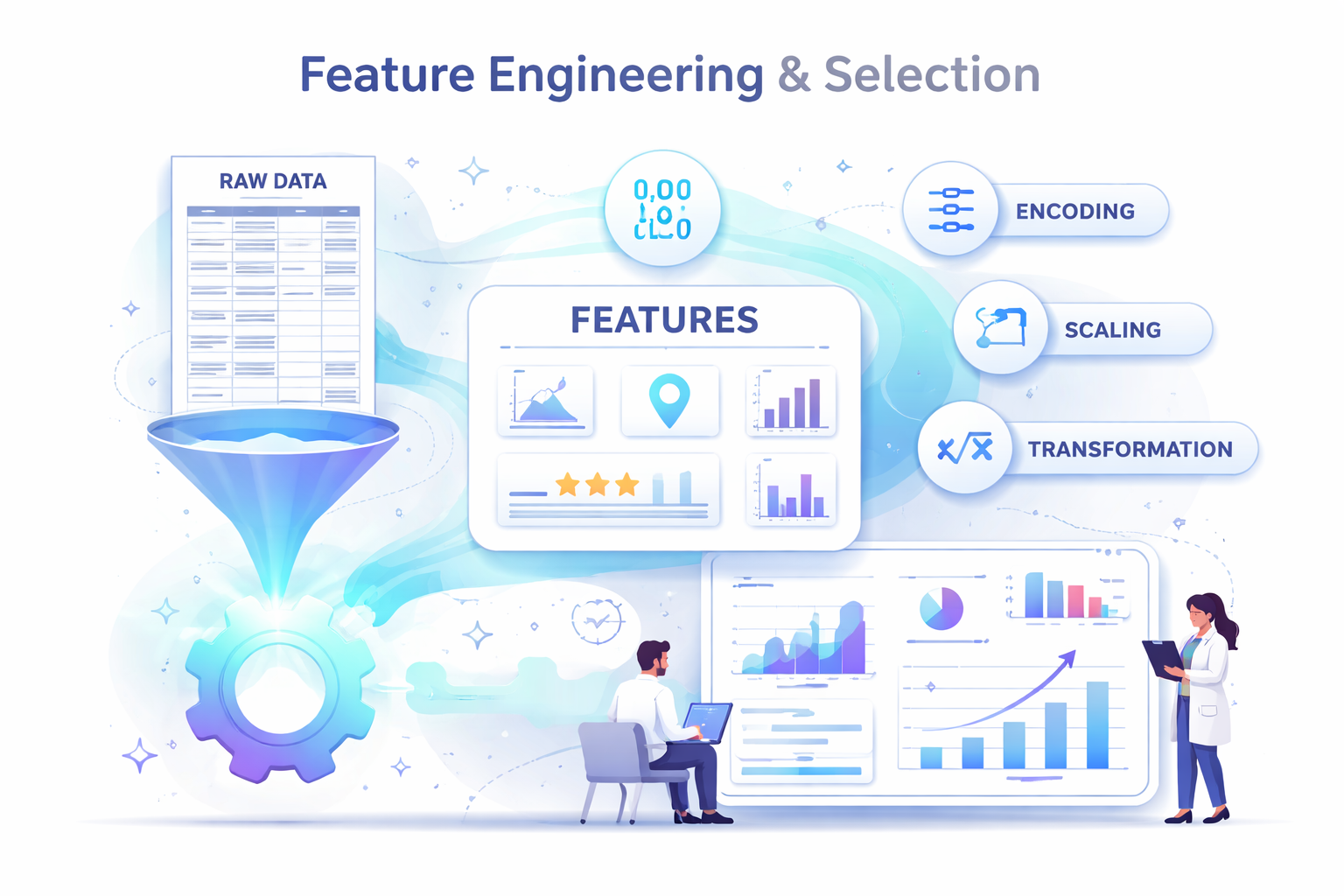
Feature engineering transforms raw data into meaningful inputs for models. This includes:
Encoding Categorical Variables
-
Convert non-numeric data (like “Red,” “Blue,” “Green”) into numerical values that ML models can process.
-
Methods include one-hot encoding, label encoding, or embedding techniques.
Normalizing Numerical Features
-
Scale numeric data to a standard range so that all features contribute equally.
-
Helps improve model accuracy and training speed.
Constructing Domain‑Specific Predictors
-
Create new features based on business knowledge or domain expertise.
-
Example: combining “purchase frequency” and “average order value” to predict customer lifetime value.
Smart feature design often beats fancy algorithms in improving performance.
Phase 5: Model Training & Selection
Here, models are trained using algorithms suited to the problem type such as regression, classification, or deep learning and tuned for best performance. A typical process includes:
Splitting Data into Training, Validation, and Testing Sets
-
Divide your dataset so the model can learn (training), fine-tune (validation), and be evaluated on unseen data (testing).
-
Ensures that the model generalizes well and avoids overfitting.
Trying Multiple Algorithms
-
Test different ML algorithms to find the one that performs best for your problem.
-
Examples: decision trees, random forests, support vector machines, or neural networks.
Tuning Hyperparameters for Optimal Results
-
Adjust model settings like learning rate, depth, or regularization to maximize accuracy.
-
Techniques include grid search, random search, or automated hyperparameter tuning.
Phase 6: Model Evaluation & Validation
Before deployment, models are rigorously evaluated with metrics like accuracy, precision, F1‑score, RMSE, and others depending on the task. Validation ensures that the model generalizes well to new data.
Phase 7: Deployment & Integration
Deploying a model means integrating it with real‑world systems. Deployment options include:
REST APIs for Real-Time Predictions
-
Serve your ML model through an API so applications can get instant predictions.
-
Ideal for recommendation engines, fraud detection, or chatbots.
Batch Processing Pipelines
-
Process large volumes of data at scheduled intervals instead of in real-time.
-
Useful for generating reports, analytics, or periodic predictions.
Edge Deployments on Devices
-
Deploy ML models directly on devices like smartphones, IoT sensors, or industrial machines.
-
Reduces latency and dependency on cloud connectivity.
Infrastructure considerations involve scalability, latency, and security.
Phase 8: MLOps & Continuous Monitoring
Unlike traditional software, ML models drift over time — meaning their predictions degrade as data patterns change. To maintain performance, teams implement:
MLOps Pipelines (CI/CD for Models)
-
Implement Continuous Integration and Continuous Deployment specifically for ML models.
-
Ensures smooth, repeatable updates and consistent model performance in production.
Automated Retraining Triggers
-
Set up automatic retraining when new data arrives or model performance drops.
-
Keeps the model accurate and up-to-date without manual intervention.
Performance Monitoring with Alerts
-
Continuously track model accuracy, latency, and other KPIs in real-time.
-
Send alerts when performance degrades, enabling fast corrective action.
Phase 9: Security, Compliance & Governance
ML systems often process sensitive data and must meet regulations like GDPR or HIPAA. Best practices include audit trails, data privacy safeguards, and transparent model explainability to stakeholders.
Common Challenges You Should Know
ML development isn’t without hurdles. Typical challenges include:
Poor or Biased Data Quality
-
Inaccurate, incomplete, or biased data can lead to unreliable ML predictions.
-
Ensuring clean and representative data is critical for model success.
Scalability Issues with Large Datasets
-
Handling massive amounts of data can slow training and increase costs.
-
Use distributed computing or cloud-based solutions to scale efficiently.
Integration Complexity with Existing Systems
-
Incorporating ML models into legacy software or workflows can be challenging.
-
Requires careful planning, APIs, and compatible infrastructure.
Misalignment Between Business Goals and Technical Teams
-
Lack of clear communication can lead to ML solutions that don’t deliver real value.
-
Align objectives and KPIs between stakeholders and data teams from the start.
Addressing these early improves outcomes significantly.
FAQs (Frequently Asked Questions)
Q1. What is the difference between ML and traditional software?
Ans: ML systems learn from data and adapt, whereas traditional software follows predefined rules. ML models also require continuous evaluation and retraining.
Q2. How long does ML development take?
Ans: ML projects vary widely, but data preparation and model training often take the most time sometimes up to 80% of total effort.
Q3. What tools are used for deployment?
Ans: Popular tools include Docker, Kubernetes, Flask/FastAPI for APIs, and MLOps platforms like MLflow or Kubeflow.
Q4. Why is continuous monitoring important?
Ans: Because data trends change over time, causing performance drops; monitoring helps detect and correct model drift.
Conclusion
Developing a successful Machine Learning solution requires a holistic process from business alignment and data engineering to model deployment and ongoing monitoring. Each phase plays a vital role in building scalable, ethical, and high‑performing ML systems. When planned and executed carefully, ML transforms data into real strategic advantage for businesses.
Are you ready to take your ML projects from concept to real‑world deployment? Share this guide or start building your roadmap today!



Shreyans Padmani
Shreyans Padmani has 5+ years of experience leading innovative software solutions, specializing in AI, LLMs, RAG, and strategic application development. He transforms emerging technologies into scalable, high-performance systems, combining strong technical expertise with business-focused execution to deliver impactful digital solutions.