Introduction
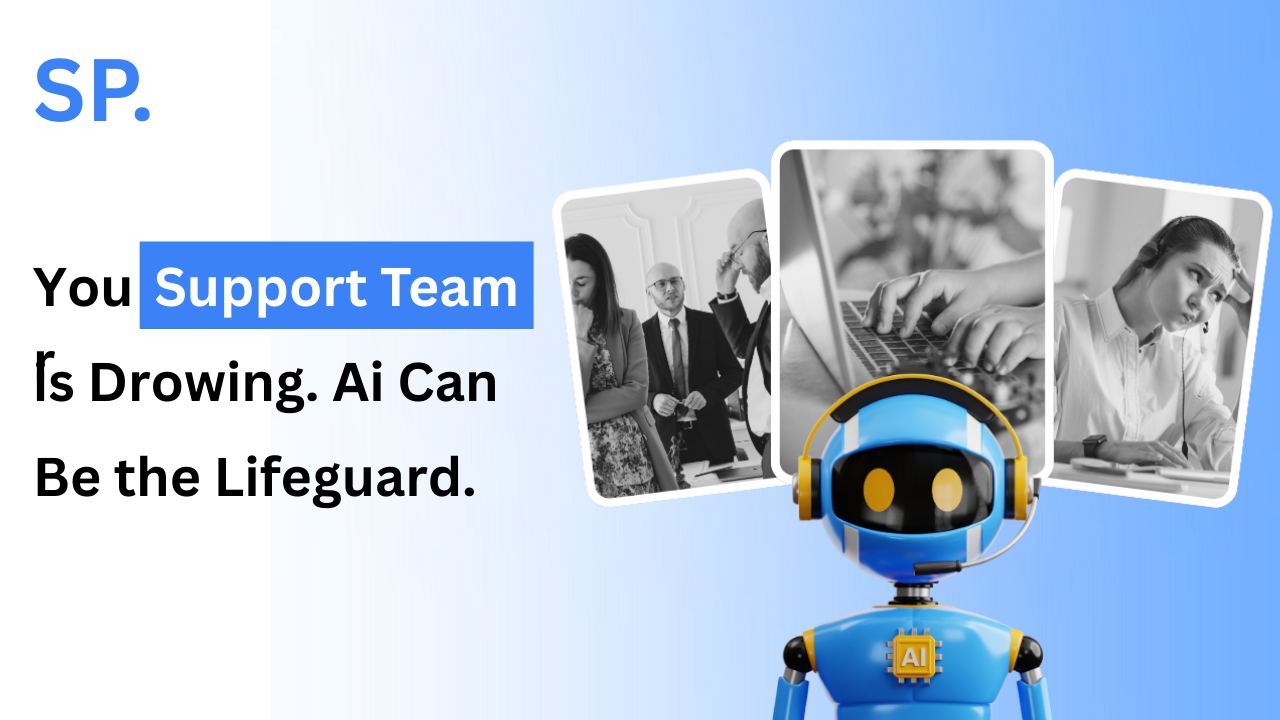
Is your customer support team feeling like they’re treading water? Or worse, drowning under an endless deluge of inquiries? The modern customer demands instant, accurate, and always-on support. According to a Gartner report, service leaders face immense pressure to meet these escalating expectations. This reality puts a heavy burden on human teams.
You’re likely facing the core challenges: high call volume, a flood of repetitive customer questions, the escalating expense of providing 24/7 support, and the customer frustration caused by slow response times. This isn’t just a crisis; it’s an opportunity. Artificial Intelligence is not just another tool; it’s the lifeline, the ultimate lifeguard your support operations desperately need.
This blog will explore how integrating AI into your customer service strategy can rescue your team from burnout. We’ll show you how it can fundamentally improve your operations, allowing you to significantly reduce customer support costs while dramatically enhancing customer satisfaction and efficiency.
The Tsunami of Support Challenges: Why Your Team is Overwhelmed
Understanding the problem is the first step toward a solution. Your team isn’t struggling because of a lack of effort; they’re facing systemic challenges that are difficult to overcome with human power alone.
The Relentless Tide of High Call Volume
Every business experiences a constant flow of customer inquiries. This flow can become a tidal wave during seasonal spikes, new product launches, or marketing campaigns. When high call volume overwhelms your team, agents become stressed, availability plummets, and potential sales opportunities are missed. Customers left waiting often become customers lost.
Drowning in Repetitive Customer Questions
“How do I reset my password?” “What are your business hours?” “Where is my order?” These common, easily solvable issues consume a disproportionate amount of your agents’ time. Every minute an agent spends on a simple, repetitive question is a minute they can’t dedicate to a complex, high-value case that truly requires a human touch. This inefficiency drains resources and lowers team morale.
The Sinking Ship of Slow Response Times
In today’s fast-paced world, waiting is frustrating. Long hold times, delayed email replies, and unresolved tickets directly harm the customer experience. These slow response times lead to negative reviews, public complaints on social media, and a damaged brand reputation. Ultimately, poor service drives customers to your competitors.
The Hidden Costs of 24/7 Support: Is It Sustainable?
Offering round-the-clock service is a great way to meet global customer needs, but it comes at a steep price. The financial burden of staffing human agents 24/7, including salaries, benefits, night-shift differentials, and infrastructure, makes 24/7 support expensive and often unsustainable. The operational complexity of managing a global, multi-time-zone team adds another layer of difficulty.
People Also Ask:Question: Will AI replace my customer support agents?
Answer: No, the goal of AI in customer support is not replacement but augmentation. AI acts as a “copilot,” handling repetitive, low-level tasks. This frees up human agents to focus on complex problem-solving, emotional connection, and high-value customer interactions that require empathy and critical thinking. It makes your best people even better.
AI: The Lifeguard Your Support Team Deserves
AI offers a set of powerful tools designed to pull your team from the churning waters of modern support challenges. It works tirelessly, intelligently, and cost-effectively to manage the deluge so your human agents can focus on what they do best.
Automating the Mundane: AI Chatbots & Virtual Assistants
Intelligent chatbots and virtual assistants are your first line of defense. They can instantly handle FAQs, answer basic queries like “What’s my account balance?”, guide users through simple processes, and even complete transactions.
| Direct Impact: This immediately helps reduce customer support costs by deflecting up to 80% of simple inquiries from human agents. They also eliminate slow response times for these queries by providing instant, 24/7 answers. |
Intelligent Routing & Prioritization: Navigating High Call Volume
Not all customer issues are created equal. AI analyzes incoming tickets and chats based on keywords, user history, and even sentiment. It then accurately routes the inquiry to the best-equipped agent or department. An urgent, frustrated message from a high-value client gets prioritized over a simple question from a new user.
| Direct Impact: This immediately helps reduce customer support costs by deflecting up to 80% of simple inquiries from human agents. They also eliminate slow response times for these queries by providing instant, 24/7 answers. |
Aiding Agents: AI-Powered Tools for Better Efficiency
AI can also be an agent’s best friend. These tools work in the background to make their jobs easier.
|
The Promise of 24/7 Support, Sustainably
AI finally makes round-the-clock support affordable. While a human team is offline, AI chatbots can handle a vast number of issues. This directly addresses the 24/7 support expensive problem by providing consistent, quality service globally without the prohibitive human overhead.
Data-Driven Insights: Beyond Just Support
AI analyzes thousands of customer interactions to spot trends. It can identify common product bugs, highlight gaps in your knowledge base, and reveal customer preferences. This turns your support center from a cost center into a valuable source of business intelligence.
Tangible Benefits: How AI Helps You Reduce Customer Support Costs
Let’s focus on the bottom line. Implementing AI is not just about better service; it’s a direct strategy to improve your company’s financial health. Here’s a breakdown of the cost savings.
| Cost Reduction Area | How AI Contributes |
| Labor Costs & Staffing | Automates routine tasks, reducing the need for extensive entry-level or after-hours staff. |
| Training & Onboarding | AI agent-assist tools and integrated knowledge bases help new hires become productive much faster. |
| Infrastructure Overhead | Reduces the need for physical office space and phone lines as more inquiries are handled digitally by chatbots. |
| Customer Churn | Faster, more accurate 24/7 service leads to higher satisfaction, increasing loyalty and reducing acquisition costs. |
| Operational Efficiency | Faster resolutions, fewer escalations, and higher agent productivity lead to significant, ongoing savings. |
By automating the predictable, you allow your talented human team to focus on building relationships and solving the unpredictable. This optimization is the core of how AI helps reduce customer support costs so effectively.
Implementing Your AI Lifeguard: A Strategic Approach
Adopting AI doesn’t have to be a monumental task. A smart, phased approach ensures a smooth transition and maximum return on investment.
1. Assess Your Current State & Identify Pain Points
Start by looking at your data. What are the most common questions your team answers? Where are the longest wait times? Analyze your support tickets, call logs, and customer feedback to find the areas where AI can make the most immediate impact.
2. Start Small, Scale Smart
You don’t need to automate everything at once. Begin with a pilot program. Implement a simple FAQ chatbot on your website to handle the top 10 most repetitive customer questions. Once you see success, you can scale to more complex tasks and other channels.
3. Choose the Right Partner: WebMob Technologies – Your AI Development Experts
A crucial step is partnering with an experienced software development company. A generic, off-the-shelf solution might not fit your unique business needs. At WebMob Technologies, we specialize in developing custom AI solutions tailored to your specific challenges, ensuring seamless integration with your existing systems and optimal performance.
4. Integration is Key
For AI to be truly effective, it must connect with your other business tools. Ensure your AI solution integrates seamlessly with your CRM, ticketing systems, and e-commerce platforms. This provides a unified view of the customer and enables more personalized, context-aware support.
5. Train, Monitor, and Iterate
AI is not a ‘set it and forget it’ technology. It requires ongoing monitoring and training. Analyze its performance, gather feedback, and continuously refine its responses and processes. This iterative improvement is vital for long-term success.
Beyond Support: The Future of Customer Experience with AI
The true potential of AI extends far beyond just managing tickets. It paves the way for a more proactive and personalized customer experience. Imagine AI identifying a potential shipping delay and notifying a customer before they even think to ask. Picture it analyzing a user’s behavior on your website and offering help at the exact moment of confusion. This is the future: turning customer support into a profit-generating customer retention hub.
Conclusion: Don’t Let Your Team Drown – Embrace the AI Lifeguard
The challenges facing modern customer support teams are real and growing. Your agents are your most valuable asset, and letting them drown in a sea of repetitive tasks is a recipe for burnout and turnover. AI offers a powerful, sustainable solution.
It’s not about replacing your team but giving them the tools they need to succeed. By handling the volume and the monotony, AI frees your human experts to deliver exceptional service that builds loyalty. This strategic shift will not only elevate your customer experience but will also fundamentally reduce customer support costs.
Ready to throw your support team a lifeline? Don’t let your valuable agents burn out. Partner with WebMob Technologies to design and implement custom AI solutions that will rescue your team, redefine your customer experience, and unlock significant cost savings. Contact us today for a personalized consultation!
Frequently Asked Questions (FAQ)
Q1. What is the typical ROI of implementing AI in customer support?
A: The ROI can be significant. Businesses often see a 20-40% reduction in support costs within the first year, driven by ticket deflection, reduced handling times, and lower staffing needs for routine inquiries.
Q2. How much does it cost to implement an AI chatbot?
A: Costs vary widely based on complexity. Simple FAQ bots can be relatively inexpensive, while custom AI assistants integrated with multiple business systems require a larger investment. The key is to start with a solution that matches your immediate needs and budget.
Q3. Can AI handle complex and emotional customer issues?
A: Currently, AI excels at handling transactional and informational queries. It can detect emotion (sentiment analysis) and escalate to a human agent, but it cannot replicate genuine human empathy. The best strategy is a hybrid model where AI handles the simple tasks and seamlessly transfers complex or emotional issues to humans.
Q4. How long does it take to implement an AI support solution?
A: A basic chatbot can be deployed in a few weeks. A more comprehensive, integrated AI system can take 3-6 months to fully develop, test, and deploy. A phased approach allows you to see benefits quickly while building out more advanced capabilities.
Q5. Will my customers get frustrated talking to a bot?
A: Customers get frustrated by slow and inaccurate service, regardless of whether it’s from a human or a bot. A well-designed AI chatbot that provides quick, accurate answers to simple questions is often preferred over waiting on hold for a human agent. The key is transparency and an easy-to-find option to connect with a person.



Shreyans Padmani
Shreyans Padmani has 5+ years of experience leading innovative software solutions, specializing in AI, LLMs, RAG, and strategic application development. He transforms emerging technologies into scalable, high-performance systems, combining strong technical expertise with business-focused execution to deliver impactful digital solutions.