Manufacturing-grade, defect detection AI
Computer vision for manufacturing quality control: Defect detection & scrap reduction
I design and deploy production-grade computer vision pipelines that catch micro-defects on high-speed line-scan cameras, cutting scrap rates by 30% or more. Your existing MES and PLCs stay untouched; my models run on edge with sub-10ms inference.
Zero model training on proprietary designs; NDA signed before any data access.
Plain answer
What is computer vision quality control?
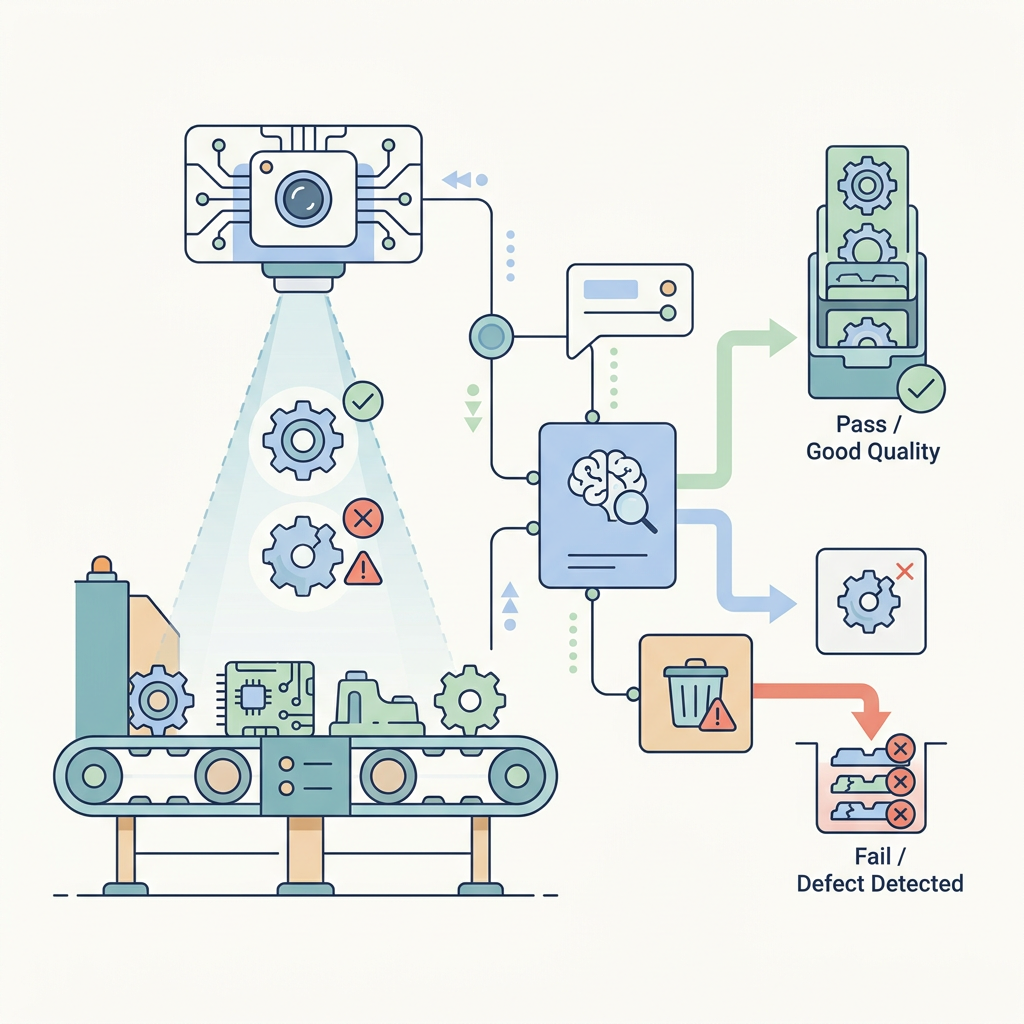
Computer vision quality control for manufacturing uses AI models trained on line-scan and area-scan cameras to detect micro-defects, dimensional deviations, and surface anomalies in real time. By grounding every inspection in a deterministic pass/fail logic, it eliminates human visual fatigue, reduces scrap by up to 35%, and delivers a measurable ROI within the first production quarter without requiring expensive retooling.
What I build
Computer Vision Quality Control
AI-powered computer vision systems for automated defect detection, surface inspection, assembly verification, and real-time quality control.
Line-Scan Defect Detection
Deploy high-speed line-scan cameras with deep learning models to detect micro-cracks, surface defects, and dimensional anomalies in real-time, reducing scrap rates by up to 60%.
Surface Inspection Automation
Automate visual inspection of painted, coated, or textured surfaces using customized convolutional neural networks trained on your defect library, achieving 99.5% accuracy.
Assembly Verification Systems
Verify component presence, alignment, and orientation on assembly lines using multi-camera setups and real-time inference, cutting manual rework by 80%.
Real-Time Anomaly Detection
Implement unsupervised anomaly detection for unknown defect types using autoencoders and generative models, catching outliers that traditional rule-based systems miss.
Model Red-Teaming & Audits
Rigorously test vision models against adversarial inputs, edge cases, and production drift to ensure consistent performance across lighting, speed, and material variations.
Need custom vision AI?
Try the interactive defect simulator above, or book a discovery session to scope your production line requirements.
Talk to an AI engineerDirect access vs agency
Independent vision engineer vs generalist agency
| Factor | Independent Vision Engineer (me) | Generalist AI Outsourcing Agency |
|---|---|---|
| Line-scan & defect expertise | Deep specialization in high-speed line-scan cameras, gigapixel inference, and micro-defect classification | Generalist developers rotated across unrelated retail or surveillance projects |
| Production deployment accountability | Direct engineer responsible for edge inference, camera sync, and reject gate integration | Complex subcontractor chains diluting ownership of factory-floor latency |
| Time to value | Functional line-scan POC in 2 weeks; production scrap reduction in 6 weeks | 3 to 6 months delayed by account managers and non-specialist discovery phases |
| Cost structure | Transparent milestone pricing tied to defect detection accuracy and scrap ROI | High monthly retainer with billable hours for project managers and QA overhead |
Direct access guarantees higher compliance rigor
In manufacturing, an undetected defect or inconsistent inspection decision can lead to costly rework, scrap, and production delays. Working directly with the engineer building the computer vision and inspection pipeline gives your quality and operations teams complete architectural clarity, faster communication, and greater confidence in the system.
Industry context
Where manufacturers deploy computer vision
Proven computer vision architectures tailored to manufacturing lines, production facilities, and industrial quality control operations.
Line-Scan for Paint & Welds
Automated inspection of painted surfaces and weld seams at line speed, flagging defects that cause costly rework and warranty claims.
- Integrated with PLC and conveyor systems via OPC-UA
- Zero-defect statistical process control dashboards
- Edge inference with sub-100ms latency per inspection
PCB & Wafer Defect Detection
Detect soldering defects, missing components, and wafer surface anomalies with micron-level resolution using area-scan and line-scan cameras.
- High-speed trigger capture synchronized with pick-and-place machines
- Real-time classification of 200+ defect types per IPC-610 standards
- Data augmentation pipelines for continuous model improvement
How it gets built
Vision QC implementation process
PHASE 01days 1 to 3
Line Survey & Defect Audit
+
PHASE 02within 48h
Model Architecture & Spec
+
PHASE 03
Pipeline Build & Masking Engine
+
PHASE 04before launch
Edge Deployment & Validation
+
PHASE 05handoff
Production Go-Live & Monitoring
+
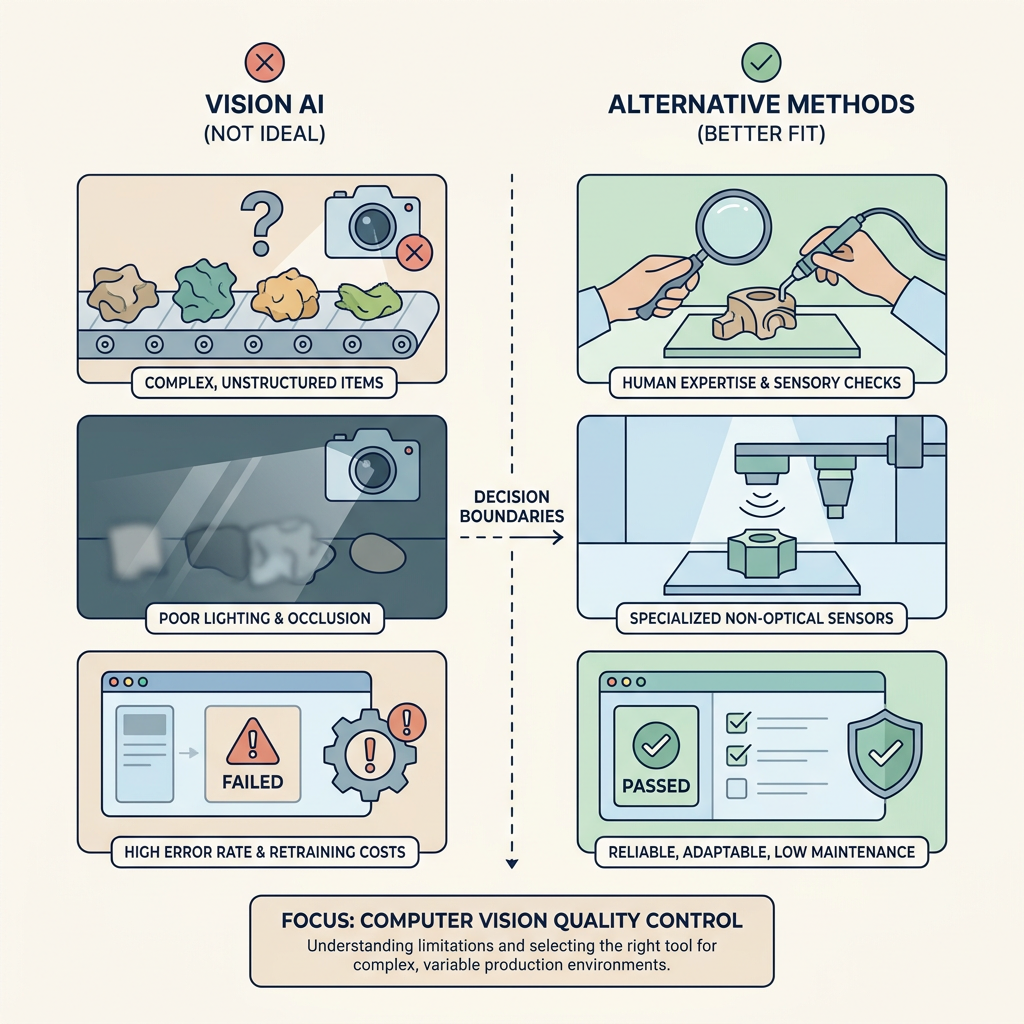
Decision boundaries
When vision AI is NOT the right choice
Safety-critical manufacturing oversight
Computer vision quality control is designed for high-speed defect detection, dimensional accuracy, and surface inspection. It must never be the sole decision-maker for safety-critical components without human sign-off. Any system deployed for safety must enforce human-in-the-loop validation and unambiguous operator override protocols.
Investment
Engagement Options
| Engagement type | What's included |
|---|---|
| Vision QC Proof-of-Concept Free | Sample defect dataset evaluation, model feasibility report, and ROI projection |
| Production Vision QC System | Full pipeline: cameras, lighting, edge hardware, model training, inference server, and dashboard |
| Manufacturing AI Safety Audit | Red-teaming for false negatives, edge-case analysis, and adversarial defect detection |
| Hourly Computer Vision Consulting | Line-scan architecture review, ROI analysis, model selection, and deployment strategy |
Delivered projects include automated defect detection, real-time surface inspection, and AI-powered assembly verification systems Full case studies at shreyans.tech/ai-case-studies.
FAQ