Production-grade agents
LangChain development services: custom agents and RAG pipelines
I build LangChain agents that actually work in production: multi-step reasoning, tool use, and persistent memory for real business workflows. You get direct access to a senior developer who delivers a written architecture spec in 48 hours, not a generic proposal.
I'll tell you honestly whether LangChain is the right framework for your use case, no upselling.
Plain answer
What is LangChain?
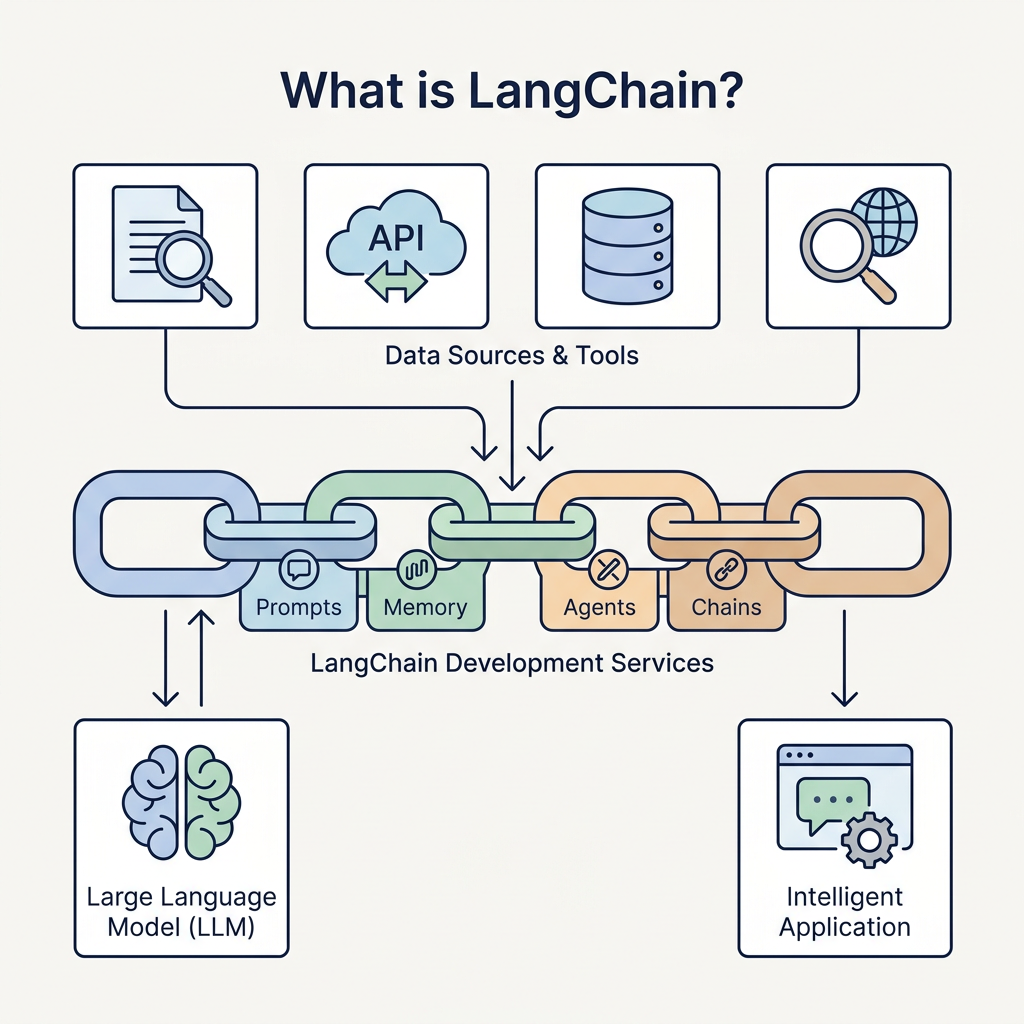
LangChain is an open-source framework for building applications powered by large language models. It provides composable building blocks, chains, agents, tools, memory, and retrievers, connected via the LangChain Expression Language (LCEL). Its agent framework, LangGraph, adds explicit state management and conditional logic for multi-step, tool-using AI systems. LangChain is the most widely adopted framework of its kind, with roughly 119K GitHub stars and 500+ integrations.
What I build
LangChain development services
RAG pipeline development
Retrieval-augmented generation pipelines using LangChain's retriever and chain primitives, paired with LlamaIndex for the retrieval layer when document-heavy retrieval quality is the priority.
Multi-step agent development (LangGraph)
Agents that take multiple actions in sequence, call external tools and APIs, and adapt based on intermediate results, built with explicit state graphs, conditional edges, and checkpointing.
Tool-using & function-calling systems
Systems that connect an LLM to your actual business tools: databases, internal APIs, third-party services, so the AI can take real actions, not just generate text.
Conversational memory systems
Chatbots and assistants that maintain context across a conversation or across sessions, tuned to your specific need: short-term context, long-term preference memory, or both.
LangChain system audits & migration
Review and improvement of an existing LangChain implementation, or migration support for teams adding agentic capability to a retrieval-only system.
Not sure LangChain is right?
Part of the engagement is an honest read on whether it's even the right tool.
Get an honest assessmentThe honest comparison
LangChain consultant vs LangChain agency
| Factor | Independent LangChain consultant (me) | LangChain development agency |
|---|---|---|
| Cost | Lower, direct rate, no team overhead | Higher, includes team and account management |
| Who builds it | Me, directly, every time | Allocated team member, may change |
| Best for | Scoped agent or RAG builds, $2K to $30K range | Large, multi-disciplinary product builds |
| Start time | 48 to 72 hours | 2 to 4 weeks typically |
Most LangChain projects, a specific agent, a specific RAG pipeline, a specific tool integration, are well within scope for a single experienced developer working directly with you. An agency's advantage shows up when a project genuinely needs several specialists working in parallel on a larger product, not for the LangChain engineering itself.
How we work together
Engagement models
Fixed-price, milestone-based
A scoped LangChain build delivered as a fixed-price, milestone-based engagement.
Consulting
Architecture review or debugging support for an existing implementation.
Dedicated monthly
Ongoing LangChain development for businesses with a continuing agentic AI roadmap.
How it gets built
Process
PHASE 01days 1 to 2
Discovery
+
PHASE 02within 48h
Architecture spec
+
PHASE 03the decisive one
Build in milestones
+
PHASE 04before launch
Testing & evaluation
+
PHASE 05handoff
Deployment & monitoring
+
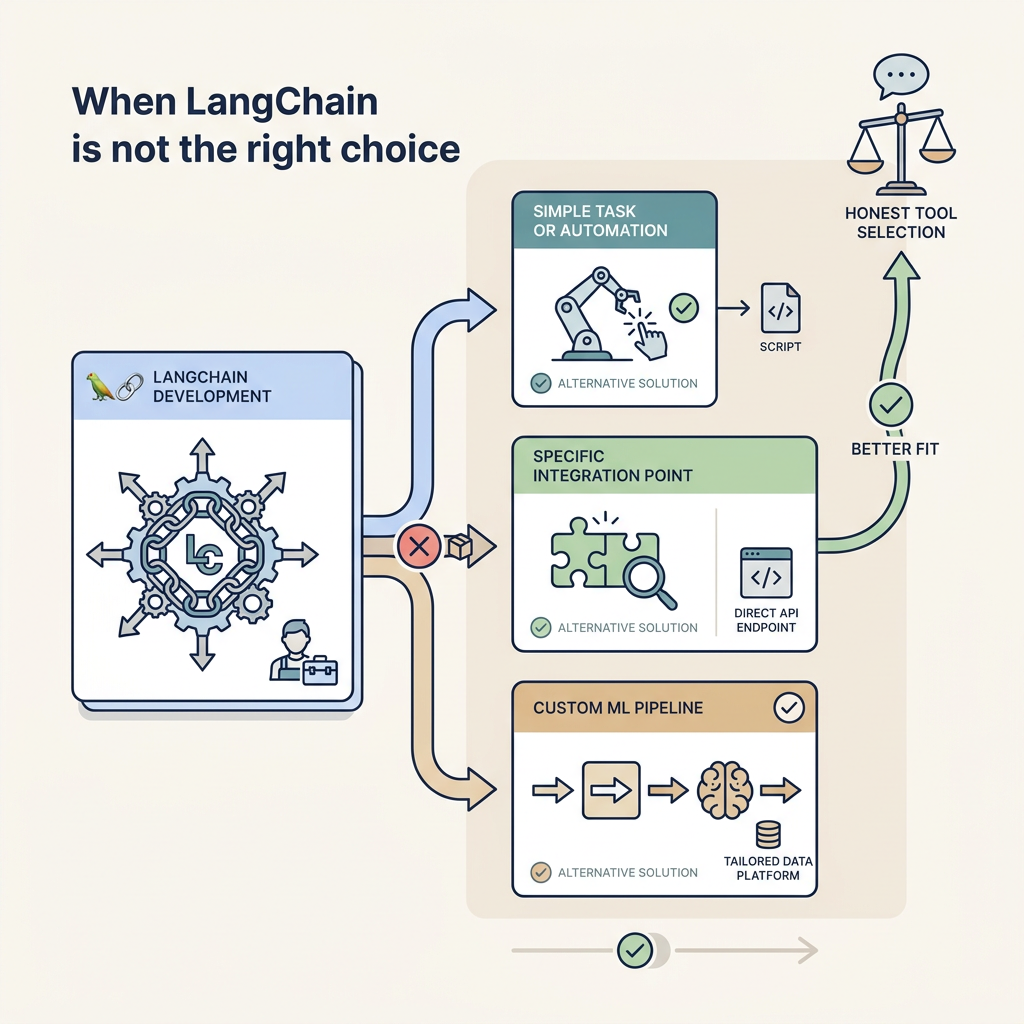
Honest tool selection
When LangChain is not the right choice
Direct architectural honesty upfront
Part of a proper LangChain engagement is an honest assessment of whether LangChain is even the right tool for your specific problem. If your actual need is narrower, purely high-quality document retrieval with no agentic behavior, LlamaIndex alone may be a simpler, lower-overhead choice. See the RAG framework development services page for the fuller comparison.
Investment
Engagement Options
| Engagement type | What's included |
|---|---|
| Single tool/agent integration Free | One scoped agent or tool-calling workflow |
| Full agentic system | Multi-step agent with state, tools, memory, guardrails |
| LangChain system audit | Review and improvement plan for an existing implementation |
| Hourly consulting | Architecture review, debugging support |
Retrieval and generation-grounded systems built using this class of architecture include the AI Customer Feedback Classification pipeline and AI Video Summarizer. Full case studies at shreyans.tech/ai-case-studies.
FAQ