The right framework, built correctly
LangChain vs LlamaIndex development services: the right RAG framework
Choosing between LangChain and LlamaIndex determines how much you spend, how fast it ships, and how well it performs in production. I build with both frameworks and pick the right one, or the right combination, based on your actual retrieval and orchestration needs, not a default toolkit.
Written recommendation with reasoning, before any build work begins
Plain answer
What is Pinecone? What is Weaviate?
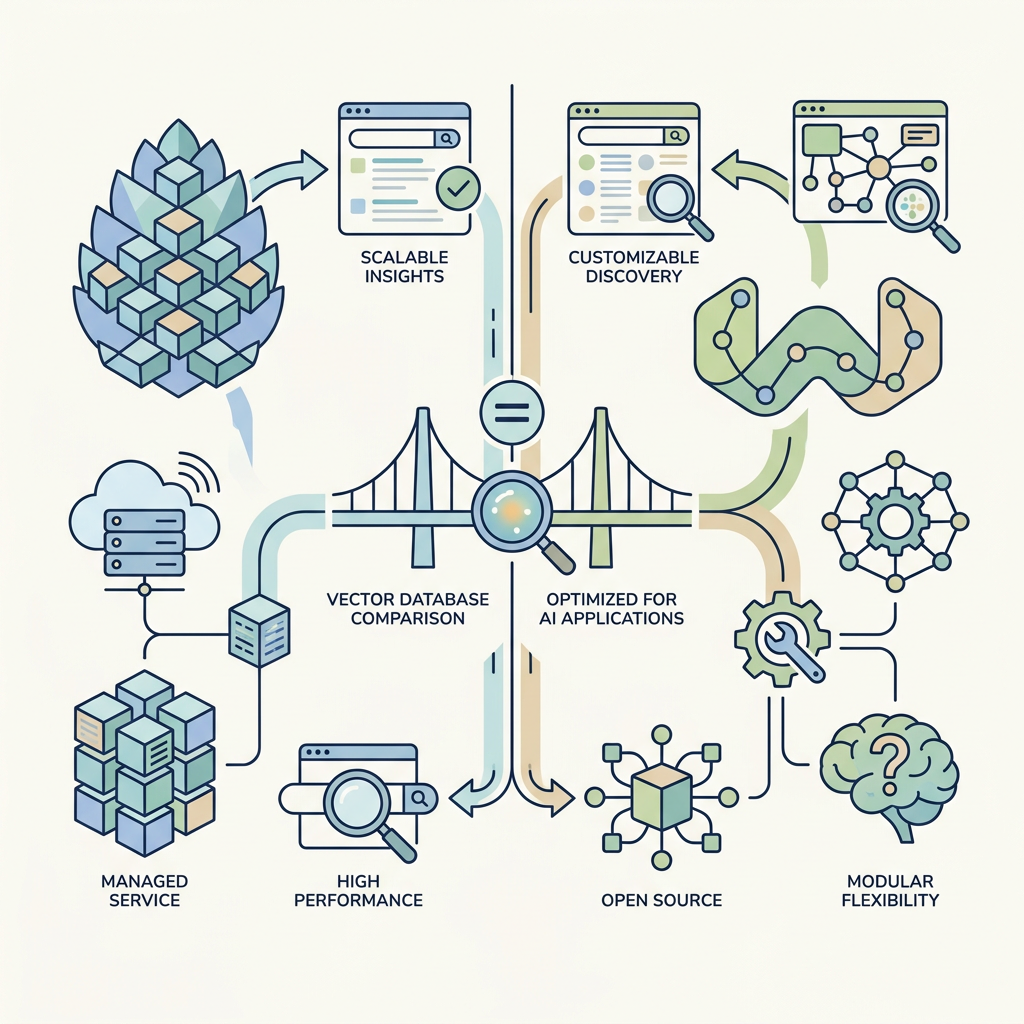
Pinecone is a fully managed vector database optimized for high-scale similarity search, with a focus on low latency and zero operational overhead. Weaviate is an open-source vector database that offers both self-hosted and managed options, giving you flexibility in deployment and cost control. The core architectural choice comes down to managed vs self-hosted: Pinecone abstracts infrastructure, Weaviate gives you control at the cost of operations.
The comparison
Vector database comparison: Pinecone vs Weaviate
| Factor | Pinecone | Weaviate |
|---|---|---|
| Primary strength | Fully managed, zero-ops vector search | Open-source flexibility, self-hosted control |
| Best for | Teams that want to ship fast without managing infrastructure | Teams that need on-premise deployment or cost predictability |
| Cost model | Pay-per-query and storage; predictable at scale but higher per-unit cost | Open-source core; self-hosted infrastructure costs; managed cloud also available |
| Operational overhead | None; fully managed by Pinecone | Requires Kubernetes, scaling, and maintenance if self-hosted |
| Integration ecosystem | Native integrations with LangChain, LlamaIndex, OpenAI; limited to cloud | Wide ecosystem; RESTful and GraphQL APIs; modular design |
| Observability | Built-in monitoring and metrics via Pinecone console | Requires external monitoring tools or Prometheus/Grafana setup |
The verdict
For most teams, the choice is clear: if you want to focus on building your product without managing database infrastructure, Pinecone is the better fit. If you need on-premise deployment, data sovereignty, or want to avoid per-query costs at high volume, Weaviate self-hosted is the way to go. Some teams run both: Pinecone for production scaling, Weaviate for development or edge cases.
Hosting & cost
Pinecone vs Weaviate: managed vs self-hosted breakdown
What I build with each framework, matched to what your project actually needs.
Pinecone: managed, high cost at scale
Fully managed vector database with no infrastructure overhead, but pricing scales linearly with pod size and index volume, becoming expensive at millions of vectors.
Weaviate: self-hosted or cloud, flexible cost
Open-source core with hybrid cloud options; self-hosting offers lower cost at scale, while cloud manages operational burden with predictable pricing.
Scalability & performance comparison
Pinecone excels at high-throughput, low-latency search with automatic scaling; Weaviate supports multi-tenancy and hybrid search (vector + keyword) with manual tuning.
Managed vs self-hosted trade-offs
Pinecone removes ops friction for teams wanting zero maintenance; Weaviate gives full control for compliance, data residency, and cost optimization.
When to choose Pinecone vs Weaviate
Choose Pinecone for simplicity and high-performance managed service; choose Weaviate for open-source flexibility, hybrid search, and lower self-hosted cost at scale.
Not sure which database fits?
Use the table above to compare cost, scale, and hosting needs.
Get a recommendationThe honest breakdown
Where each framework wins
Operational simplicity is critical
- You need a fully managed, zero-ops vector database with automatic scaling and no infrastructure management
- Low-latency, high-throughput search is paramount for real-time applications with consistent performance
- Budget allows for managed pricing: Pinecone's cost is linear with pod size and index volume, making it cost-efficient at moderate scale but expensive at millions of vectors
- Integration with cloud-native ecosystems (AWS, GCP) is a priority for seamless deployment
Flexibility and control are required
- You need open-source flexibility with option to self-host for compliance, data residency, or cost optimization
- Hybrid search (vector + keyword) is essential for more accurate retrieval across diverse data types
- Multi-tenancy support is needed for isolating data across customers or projects in a single deployment
- Self-hosting reduces costs at scale: Weaviate's open-source core avoids per-vector fees, and cloud pricing is more predictable than Pinecone's pod-based model
How it gets built
Engagement process
PHASE 01days 1 to 2
Discovery
+
PHASE 02within 48h
Framework recommendation
+
PHASE 03the decisive one
Build
+
PHASE 04before launch
Evaluation
+
PHASE 05handoff
Deployment
+
Investment
Engagement Options
| Engagement type | What's included |
|---|---|
| Framework selection consulting Free | Written architecture recommendation and spec |
| LlamaIndex RAG build | Retrieval pipeline, ingestion, evaluation, deployment |
| LangChain/LangGraph agent build | Multi-step agent, tools, memory, guardrails, deployment |
| Hybrid architecture build | Both frameworks combined, full production system |
FAQ