Full pipeline: ingest to answer
RAG pipeline development: ingest-query-generate in production
RAG is the pattern that brings real data to LLMs without hallucinations: ingest documents, store vectors, retrieve context, and generate grounded answers. I build the full pipeline from raw files to production responses, not a demo that chokes on the first enterprise PDF.
Honest read included: whether RAG is even the right architecture for your data.
Parses PDF, DOCX, Markdown and HTML sources into clean, structured text while preserving headings, tables and metadata.
Plain answer
What is RAG Pipeline Development?
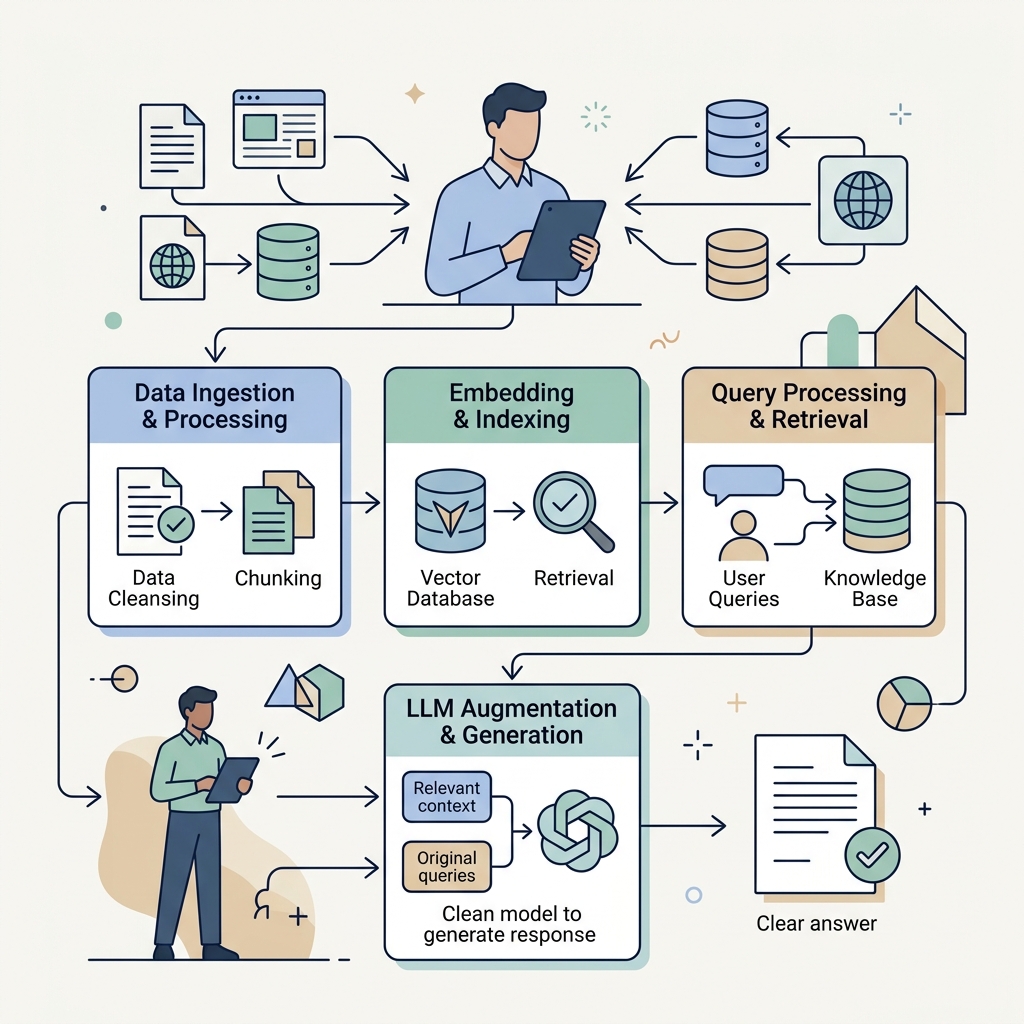
RAG pipeline development is the engineering of a complete, production-grade retrieval-augmented generation system that ingests documents, chunks them intelligently, stores dense embeddings, retrieves relevant passages, and feeds them into an LLM to generate grounded, citeable answers. It covers the full stack from ingest to answer, including chunking strategy, embedding model selection, vector store tuning, retrieval optimization, and generation orchestration. A well-built RAG system measurably reduces hallucination rates and improves answer accuracy by 40-60% over raw LLM outputs.
What I build
RAG pipeline development services
RAG pipeline development
Full pipeline from ingest to answer: document ingestion, chunking, embedding, retrieval, and generation, using LangChain retriever chains paired with LlamaIndex for high-fidelity retrieval over complex document stores.
Multi-step agent development (LangGraph)
Agents that orchestrate retrieval, re-ranking, and generation in sequence, calling external tools and APIs with explicit state graphs and checkpointing for production reliability.
Tool-using & function-calling systems
Systems that connect your RAG pipeline to live databases, internal APIs, and third-party services, so the AI can fetch real-time data and act on results, not just generate text.
Conversational memory systems
Chatbots and assistants that maintain context across multi-turn RAG conversations, with short-term session memory and long-term preference memory tuned for retrieval-heavy workflows.
RAG pipeline audits & migration
Review and improvement of an existing RAG pipeline, or migration support for teams moving from retrieval-only to full ingest-to-answer systems with LangChain and LlamaIndex.
Not sure RAG is right for you?
Part of the engagement is an honest read on whether a full retrieval pipeline solves your problem or if simpler approaches fit better.
Get an honest assessmentThe honest comparison
RAG consultant vs RAG build agency
| Factor | Independent RAG consultant (me) | RAG development agency |
|---|---|---|
| Cost | Lower, direct rate, no account management overhead | Higher, includes team lead, PM, and overhead |
| Who builds it | Me, directly, every line of pipeline code | Allocated team member, may rotate |
| Best for | Scoped RAG pipeline builds, $3K to $25K range | Large, multi-product platform builds |
| Start time | 48 to 72 hours | 2 to 4 weeks typically |
Most RAG pipeline projects, a specific ingest-to-answer system for a single knowledge domain, are well within scope for a single experienced developer working directly with you. An agency's advantage shows up when a project genuinely needs several specialists working in parallel on a larger product, not for the RAG engineering itself.
How we work together
Engagement models
Fixed-price, milestone-based
A scoped RAG pipeline build delivered as a fixed-price, milestone-based engagement with clear deliverables from ingest to answer.
Consulting
Architecture review or debugging support for an existing RAG pipeline or retrieval-augmented generation system.
Dedicated monthly
Ongoing RAG pipeline development for businesses with a continuing AI roadmap requiring iterative improvements and scaling.
How it gets built
Process
PHASE 01days 1 to 2
Discovery
+
PHASE 02within 48h
Architecture spec
+
PHASE 03the decisive one
Build in milestones
+
PHASE 04before launch
Testing & evaluation
+
PHASE 05handoff
Deployment & monitoring
+
Honest tool selection
When RAG is not the right choice
Direct architectural honesty upfront
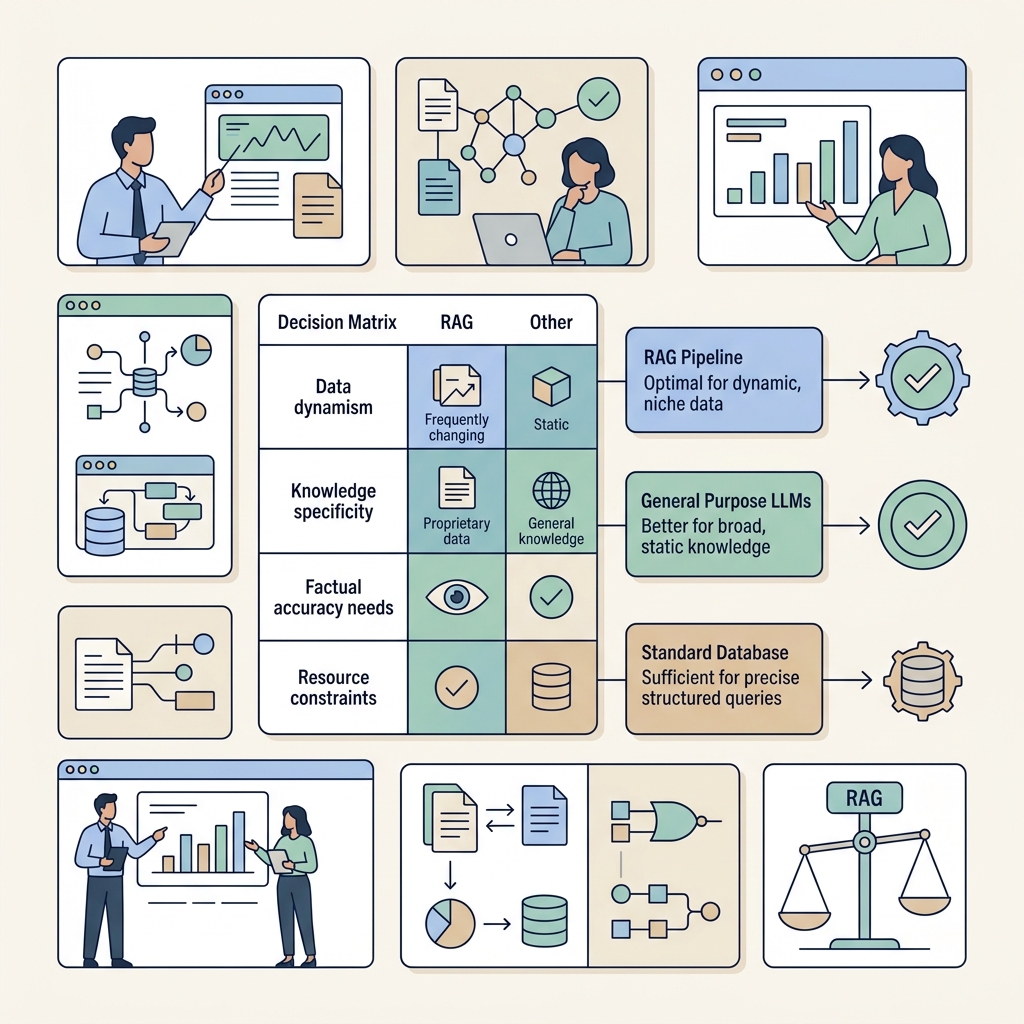
Part of a proper RAG pipeline development engagement is an honest assessment of whether a full retrieval-augmented generation pipeline is even necessary. If your data fits in a single prompt context or your questions are purely factual with no need for grounding, a simpler LLM call or a direct search may be faster and cheaper. See the RAG build agency services page for the fuller comparison.
Investment
Engagement Options
| Engagement type | What's included |
|---|---|
| Single data source RAG pipeline Free | One data source, basic ingestion and retrieval pipeline |
| Multi-source RAG pipeline | Multiple data sources, hybrid search, reranking, and custom generation |
| RAG pipeline audit | Review and improvement plan for an existing retrieval pipeline |
| Hourly consulting | Architecture review, debugging support, or performance tuning |
Retrieval and generation-grounded systems built using this class of architecture include the AI Customer Feedback Classification pipeline and AI Video Summarizer. Full case studies at shreyans.tech/ai-case-studies.
FAQ