The right framework, built correctly
LangChain vs LlamaIndex development services: the right RAG framework
Choosing between LangChain and LlamaIndex determines how much you spend, how fast it ships, and how well it performs in production. I build with both frameworks and pick the right one, or the right combination, based on your actual retrieval and orchestration needs, not a default toolkit.
Written recommendation with reasoning, before any build work begins
- RAG strengths
- Retrieves live knowledge from your documents — always up-to-date, no retraining. Ideal when facts change frequently or domain breadth matters.
- Fine-tuning strengths
- Teaches the model a specific style or narrow logic. Best for fixed-output tasks like classification or structured code generation where rules are stable.
- Decision rule
- If you need retrieval of facts → RAG. If you need mastery of a narrow task → Fine-tuning. Hybrid approaches also exist.
Plain answer
What is RAG? What is Fine-Tuning?
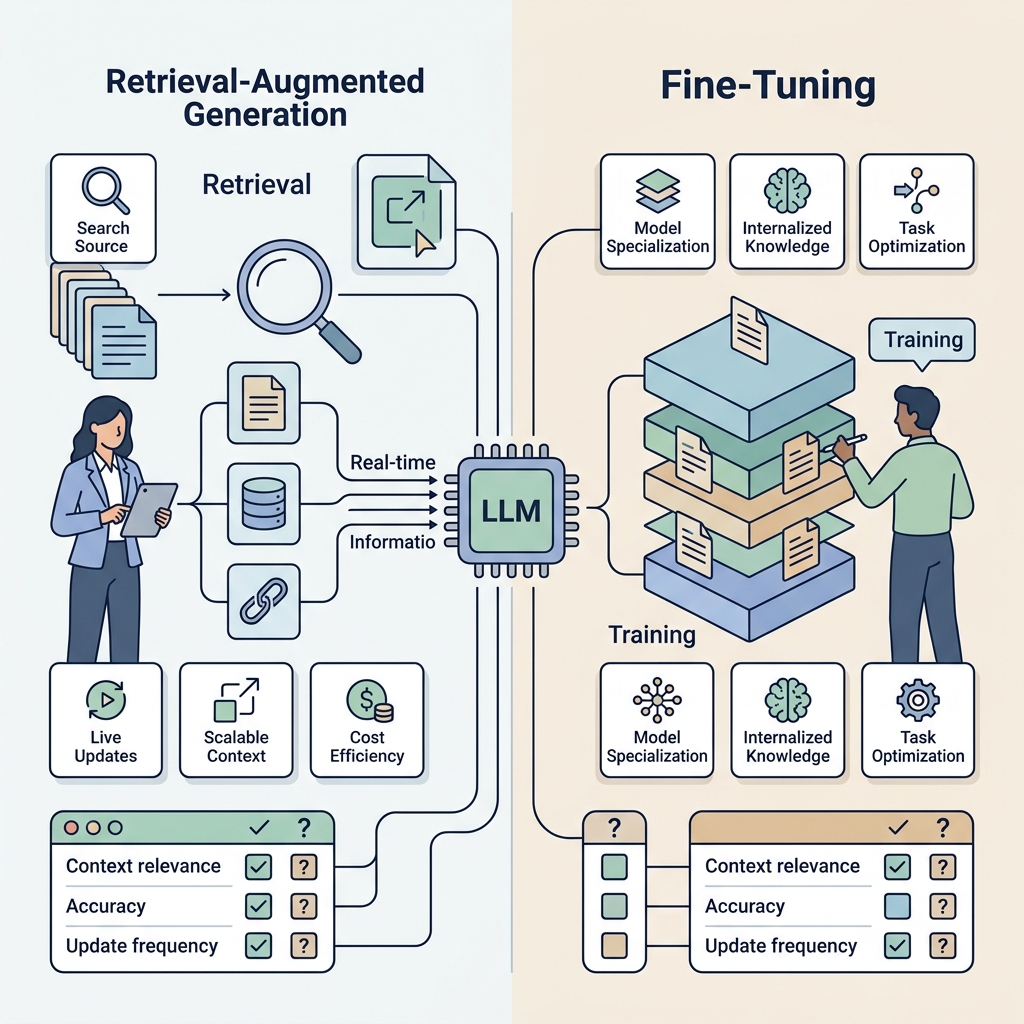
RAG (Retrieval-Augmented Generation) retrieves relevant external documents at inference time to ground model answers, while fine-tuning updates model weights on a domain dataset to shape behavior and output style. Both are open-source approaches, and by 2026 the decision is a high-intent, use-case-driven choice: RAG for factual accuracy and evolving data, fine-tuning for consistent tone and specialized tasks.
The comparison
Framework comparison: RAG vs Fine-Tuning
| Factor | RAG | Fine-Tuning |
|---|---|---|
| Primary strength | Real-time factual grounding via external retrieval | Permanent behavior modification and style adaptation |
| Best for | Dynamic knowledge bases, Q&A on proprietary docs, low-latency fact updates | Consistent tone, domain-specific jargon, specialized output formats |
| Code volume for equivalent result | Baseline (retrieval pipeline, index, prompt) | Higher (dataset curation, training pipeline, evaluation) |
| Framework overhead | ~10ms retrieval latency (vector DB + rerank) | Hours to days of training, then same inference cost |
| Ecosystem | LangChain, LlamaIndex, Chroma, Pinecone, Weaviate | Hugging Face, PyTorch, TensorFlow, Axolotl, Unsloth |
| Observability | LangSmith, Arize, Phoenix for retrieval quality | MLflow, W&B, Comet for training metrics and eval |
The hybrid reality
Most production systems use both strategies: RAG for grounding answers in live data, fine-tuning for aligning the model's tone and domain behavior. The decision framework prioritizes retrieval complexity first, then checks if fine-tuning adds measurable ROI for consistency.
What I build
RAG vs fine-tuning services
What I build with each framework, matched to what your project actually needs.
Approach selection consulting
An independent assessment of your use case, data, latency, and accuracy requirements, resulting in a written recommendation: RAG, fine-tuning, or a hybrid, with benchmarks and reasoning.
RAG system development
Build retrieval-augmented generation pipelines using vector databases, hierarchical chunking, and query synthesis for accurate, grounded answers from your corpus.
Fine-tuning pipeline development
Develop custom fine-tuning workflows with LoRA, QLoRA, or full fine-tuning for domain adaptation, using your labeled data to improve model performance on specific tasks.
Hybrid RAG + fine-tuning approach
Combine retrieval-augmented generation with fine-tuned models for optimal accuracy: use fine-tuning for domain-specific knowledge and RAG for dynamic external data, balancing cost and latency.
RAG vs fine-tuning audit
Assess your current system to determine whether RAG, fine-tuning, or a hybrid would yield better results, with recommendations based on data, latency, and accuracy requirements.
Not sure which you need?
Try the decision framework above, or get a personalized recommendation.
Get a recommendationThe honest breakdown
Where each approach wins
You need dynamic, up-to-date knowledge
- Your data changes frequently and you cannot retrain models every week; RAG allows real-time updates without retraining.
- You need to ground answers in specific documents or sources to reduce hallucination—studies show RAG can cut hallucination by 30–40% compared to base models.
- Your corpus is large and diverse; fine-tuning would require massive labeled datasets and risks catastrophic forgetting.
- Latency and cost of fine-tuning outweigh the retrieval overhead for your use case; RAG typically adds 50–200ms per query versus hours of fine-tuning.
You need specialized behavior or domain expertise
- Your task requires consistent formatting, tone, or domain-specific jargon that RAG alone cannot guarantee; fine-tuning adapts the model’s output style.
- You have a fixed, high-quality dataset that defines the task—fine-tuning can improve accuracy by 20–50% on narrow tasks compared to RAG with base models.
- Latency is critical and you cannot afford an extra retrieval step; fine-tuned models respond in 100–300ms without external calls.
- You need to operate offline or in low-connectivity environments where RAG’s external dependencies are impractical.
Decision framework
How we choose
PHASE 01days 1 to 2
Use case audit
+
PHASE 02within 48h
Architecture recommendation
+
PHASE 03the decisive one
Prototype build
+
PHASE 04before launch
Comparative evaluation
+
PHASE 05handoff
Production deployment
+
Investment
Engagement Options
| Engagement type | What's included |
|---|---|
| RAG vs fine-tuning consultation Free | Written architecture recommendation and decision framework |
| RAG pipeline build | Retrieval pipeline, embedding model selection, chunking strategy, evaluation with RAGAS |
| Fine-tuning build | Dataset curation, LoRA adapter training, evaluation, deployment with inference server |
| Hybrid architecture build | RAG pipeline with fine-tuned generation adapter, orchestration, monitoring, full production system |
FAQ