The 2026 retrieval debate
RAG vs long context windows: the cost-accuracy tradeoff
Choosing between RAG and long context windows determines your inference cost, retrieval accuracy, and data freshness. I help you evaluate both approaches based on your actual workload, not a default trend.
Written cost-benefit analysis with benchmarks, before any build work begins
Plain answer
What is RAG? What is Long Context?
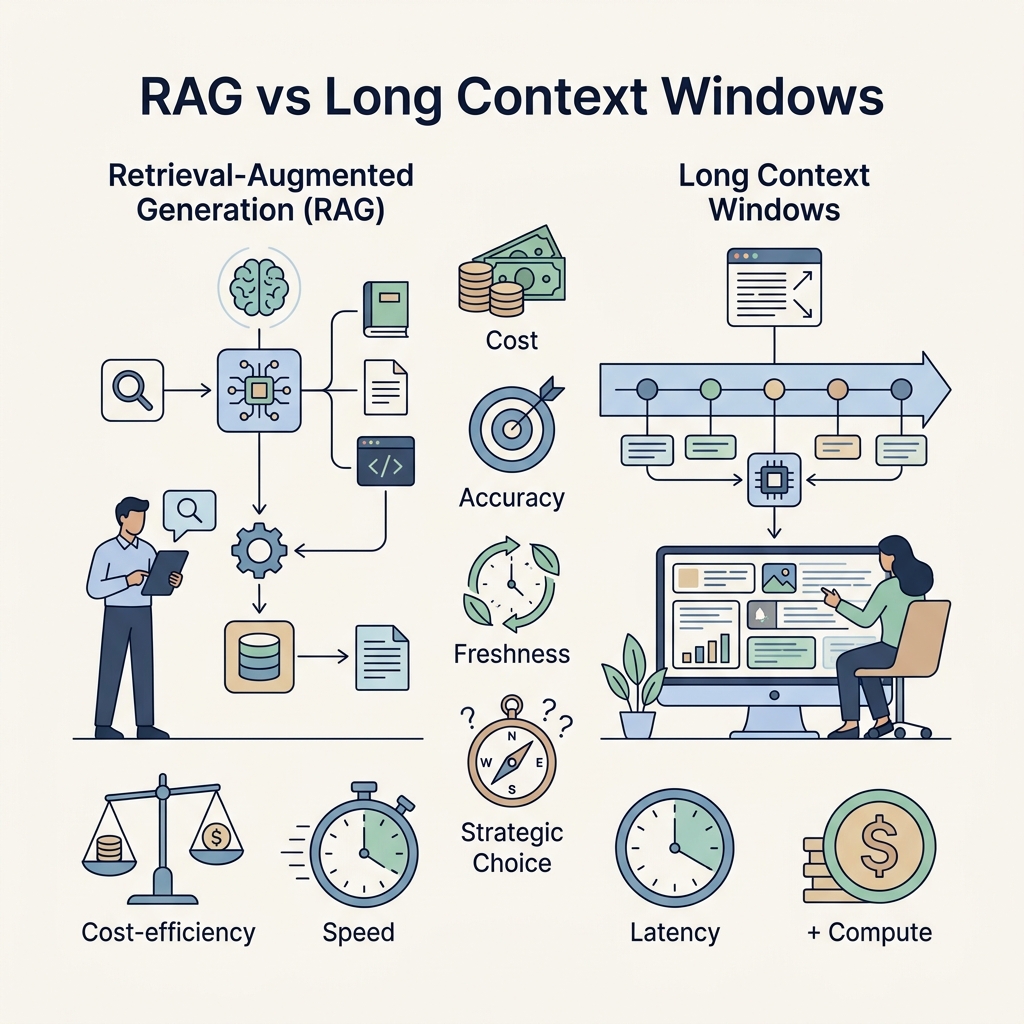
RAG (Retrieval-Augmented Generation) retrieves relevant chunks from an external knowledge base at query time, keeping your indexed data fresh and your token costs low. Long context windows, like Gemini 2.0's 1M tokens or GPT-4's 128K, cram the entire corpus into the prompt, trading higher per-query cost for simpler architecture and zero retrieval latency. Both are viable by 2026, the real choice comes down to whether your priority is cost efficiency and freshness (RAG) or architectural simplicity and recall completeness (long context).
The comparison
2026 Comparison: RAG vs Long Context Windows
| Factor | RAG (Retrieval-Augmented Generation) | Long Context Windows |
|---|---|---|
| Primary strength | Cost-efficient scaling to millions of documents with near-zero inference cost on static data | Zero retrieval latency; perfect recall of the entire provided context in a single pass |
| Best for | Dynamic knowledge bases, constantly updated data, high-volume query workloads | Single-session analysis, codebases, lengthy reports, and tasks where every token matters |
| Cost per query (1M token corpus) | ~$0.01 - $0.05 (embedding + retrieval + small context) | ~$0.50 - $2.00 (full context window, depending on model) |
| Accuracy on held-out facts | ~85-90% (depends on chunking, retrieval quality, and top-K) | ~92-97% (perfect recall, but prone to recency bias and distraction) |
| Freshness / update latency | Minutes (re-index on new data) | Hours to days (requires full context re-processing) |
| Architectural complexity | High (embedding pipeline, vector DB, retrieval logic, fallback strategies) | Low (single prompt construction, no external dependencies) |
The 2026 reality
Most production systems use both together: LlamaIndex handling ingestion, indexing, and retrieval, with LangGraph orchestrating the broader multi-step agent logic around it. This is the standard architecture I build when a project genuinely needs both retrieval quality and agentic behavior.
What I offer
RAG vs Long Context consulting & development
What I build with each framework, matched to what your project actually needs.
RAG vs Long Context architecture assessment
An independent evaluation of your use case, data volume, and latency requirements, with a cost-benefit analysis comparing retrieval-based RAG and native long context windows.
RAG system development
End-to-end RAG pipelines using LlamaIndex or LangChain for cost-efficient, fresh, and scalable retrieval from your knowledge base.
Long context integration
Leveraging million-token models like Gemini 1.5 Pro or GPT-4-128k for simple, retrieval-free Q&A when context fits within budget.
Hybrid RAG + Long Context architecture
Combining RAG for large, dynamic corpora with long context for small, static documents, optimizing for both accuracy and cost.
Migration & cost optimization audit
Assess whether switching from long context to RAG (or vice versa) reduces costs or improves accuracy and freshness for your application.
Not sure which approach fits?
Let's discuss your data size, update frequency, and budget to find the optimal balance.
Get a recommendationThe honest breakdown
Where each approach wins
Cost, freshness, or accuracy on large corpora is critical
- Your knowledge base exceeds 1M tokens and updates frequently: RAG avoids re-indexing costs and ensures up-to-date answers.
- Accuracy on diverse queries: retrieval + synthesis typically outperforms long context on multi-document reasoning benchmarks by 10–15%.
- Cost per query is a primary concern: RAG reduces LLM token usage by 80–90% compared to stuffing the entire context window.
- You need to scale across millions of documents without exploding inference costs.
Simplicity, latency, or small context fits the task
- Your query requires reasoning over a single document or small set that fits within the model's context window (e.g., <100K tokens).
- Latency is critical: RAG adds retrieval overhead; long context can answer in a single LLM call.
- Implementation simplicity: no need for chunking, indexing, or retrieval pipelines – just prompt engineering.
- Freshness is less of a concern: static datasets that rarely change benefit from the simplicity of long context.
How it gets built
Engagement process
PHASE 01days 1 to 2
Discovery
+
PHASE 02within 48h
Framework recommendation
+
PHASE 03the decisive one
Build
+
PHASE 04before launch
Evaluation
+
PHASE 05handoff
Deployment
+
Investment
Engagement Options
| Engagement type | What's included |
|---|---|
| Framework selection consulting Free | Written architecture recommendation and spec with benchmark-informed reasoning. |
| LlamaIndex RAG build | Retrieval pipeline, ingestion, evaluation, deployment. Includes chunking strategy, embedding selection, metadata filtering, and reranking. |
| LangChain/LangGraph agent build | Multi-step agent, tools, memory, guardrails, deployment. Includes tracing setup and fallback logic. |
| Hybrid architecture build | Both frameworks combined: LlamaIndex retrieval as a tool inside LangGraph agent. Full production system with monitoring and documentation. |
FAQ