The math behind AI's understanding
What is a vector embedding? A plain definition, and why it matters
A vector embedding is a mathematical representation of text, images, or other data as a list of numbers — a vector — that captures meaning and relationships. Think of it as a coordinate in a high-dimensional space where similar concepts cluster together. I build production-grade embedding pipelines that turn your raw data into searchable, comparable vectors for AI applications.
Every vector is generated with a consistent, auditable embedding model — no drift, no black boxes.
A vector embedding is a numerical representation of text — a list of numbers — that captures semantic meaning. Sentences with similar meanings produce vectors that are close together in high-dimensional space.
Plain answer
What is a vector embedding?
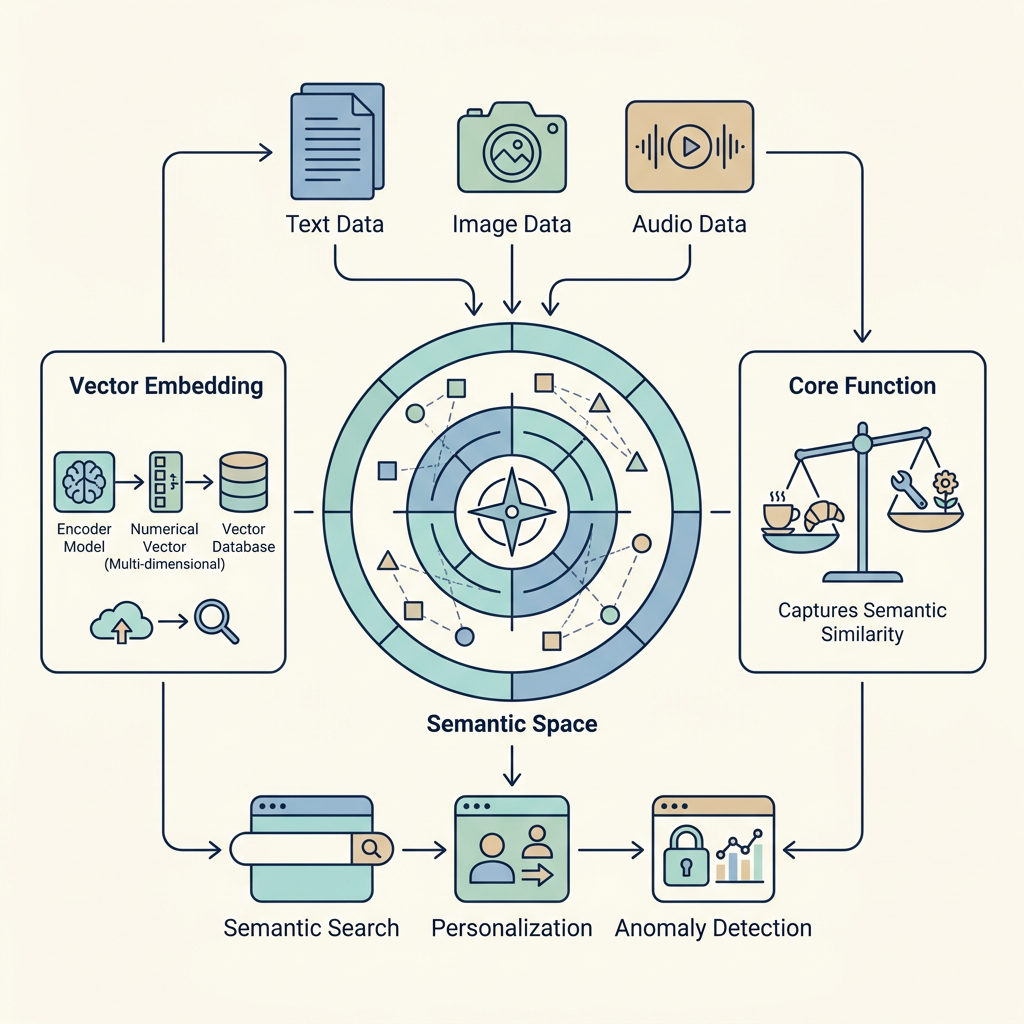
A vector embedding is a numerical representation of data—such as text, images, or audio—converted into a dense array of floating-point numbers that captures the semantic meaning and relationships of the original content. Unlike one-hot encoding or bag-of-words, embeddings map similar concepts to nearby points in a high-dimensional space (e.g., 768 dimensions), enabling machines to measure similarity, cluster related items, and retrieve relevant information by calculating distances like cosine similarity. This technique forms the backbone of modern search, recommendations, and retrieval-augmented generation (RAG) by translating human language into machine-readable vectors.
Step by step
How embeddings work
The same five-step pipeline animating in the signature panel above, applied to your own documents.
Input text
A sentence or phrase is tokenized into smaller units like words or subwords.
Model encodes
A pretrained neural network (e.g., BERT) maps tokens to a fixed-length vector.
Vector stored
The resulting embedding is saved in a vector database with an index for fast search.
Similarity scored
Cosine distance or dot product compares query vectors to stored embeddings.
Results ranked
Top-k nearest neighbors are returned as the most semantically relevant matches.
The basics
Dense vs sparse vs hybrid embeddings
These are frequently combined: a fine-tuned model for task-specific behavior, grounded by RAG for current or proprietary data access.
| Factor | Dense Embedding | Sparse Embedding | Hybrid Embedding |
|---|---|---|---|
| Representation | Continuous vector in ℝⁿ, e.g., 768 dimensions | High-dimensional sparse vector with term frequencies | Combined dense vector plus sparse features |
| Semantic capture | Captures synonyms and context (e.g., 'car' ≈ 'automobile') | Exact keyword matching only | Both semantic similarity and exact keyword match |
| Example similarity | 'king' – 'man' + 'woman' ≈ 'queen' | 'king' only matches documents containing 'king' | 'king' matches both semantic and exact occurrences |
| Best for | General semantic search and RAG | Keyword-centric search (e.g., legal, medical terms) | Domain-specific precision and recall balance |
What I build
Embedding pipeline services
Each layer of a production RAG pipeline, built and tested as its own verifiable stage.
Embedding generation
Building the pipeline that converts text into high-quality dense vectors using models like text-embedding-3-small or BERT, with chunking strategies for optimal retrieval.
Vector database setup
Selecting and configuring the right vector store (Pinecone, Weaviate, Qdrant, FAISS, pgvector) for your scale, latency, and hosting requirements.
Hybrid search implementation
Combining semantic and keyword retrieval with reranking to maximize relevance and accuracy for your specific use case.
Embedding evaluation
Testing embedding quality against your real queries using metrics like recall, precision, and mean reciprocal rank.
Performance tuning
Optimizing embedding dimensionality, indexing algorithms, and batch processing for speed and cost efficiency.
Production deployment
Deploying the full embedding pipeline as a versioned, monitored API integrated with your product or internal tools.
Why it matters
Why vector embeddings matter
Raw text is meaningless to machine learning models—they require numerical input. Vector embeddings convert words, sentences, or documents into fixed-length arrays of numbers that capture semantic meaning, enabling tasks like similarity search and clustering without retraining. This process is the foundation of modern semantic search and AI systems that understand context, not just keywords.
Where embeddings are applied
- Semantic search over documents and knowledge bases
- Recommendation engines using item similarity
- Clustering and topic modeling for large text corpora
- Anomaly detection in high-dimensional data
- Question answering systems that match queries to answers
- Image and audio retrieval via multimodal embeddings
How embeddings work
Process
PHASE 011-2 days
Data preparation
+
PHASE 02within 1 day
Model selection
+
PHASE 03the core step
Vector generation
+
PHASE 04before launch
Indexing & storage
+
PHASE 05ongoing
Query & retrieval
+
Resources
Available Options
| Engagement type | What's included |
|---|---|
| Embedding basics guide Free | Plain-language explanation, use cases, and a simple Python notebook |
| Custom embedding pipeline | End-to-end pipeline design, model selection, and vector database integration |
| Embedding performance audit | Evaluate existing embeddings for accuracy, latency, and cost |
| Hourly advisory | Architecture review, model comparison, and best practices |
Retrieval-grounded systems delivered include the AI Customer Feedback Classification pipeline and AI Video Summarizer. Full case studies at shreyans.tech/ai-case-studies.
FAQ