AI basics for buyers
What is an LLM? A plain-English guide for business decision-makers explained without the jargon
A large language model (LLM) is an AI system trained on vast text data to generate human-like responses. For non-technical buyers, think of it as a tool that can draft content, answer questions, or summarize reports, but it often needs careful setup to avoid mistakes.
Every LLM capability is presented in plain terms, with no technical barriers, from the start.
Plain answer
What is an LLM (large language model)?
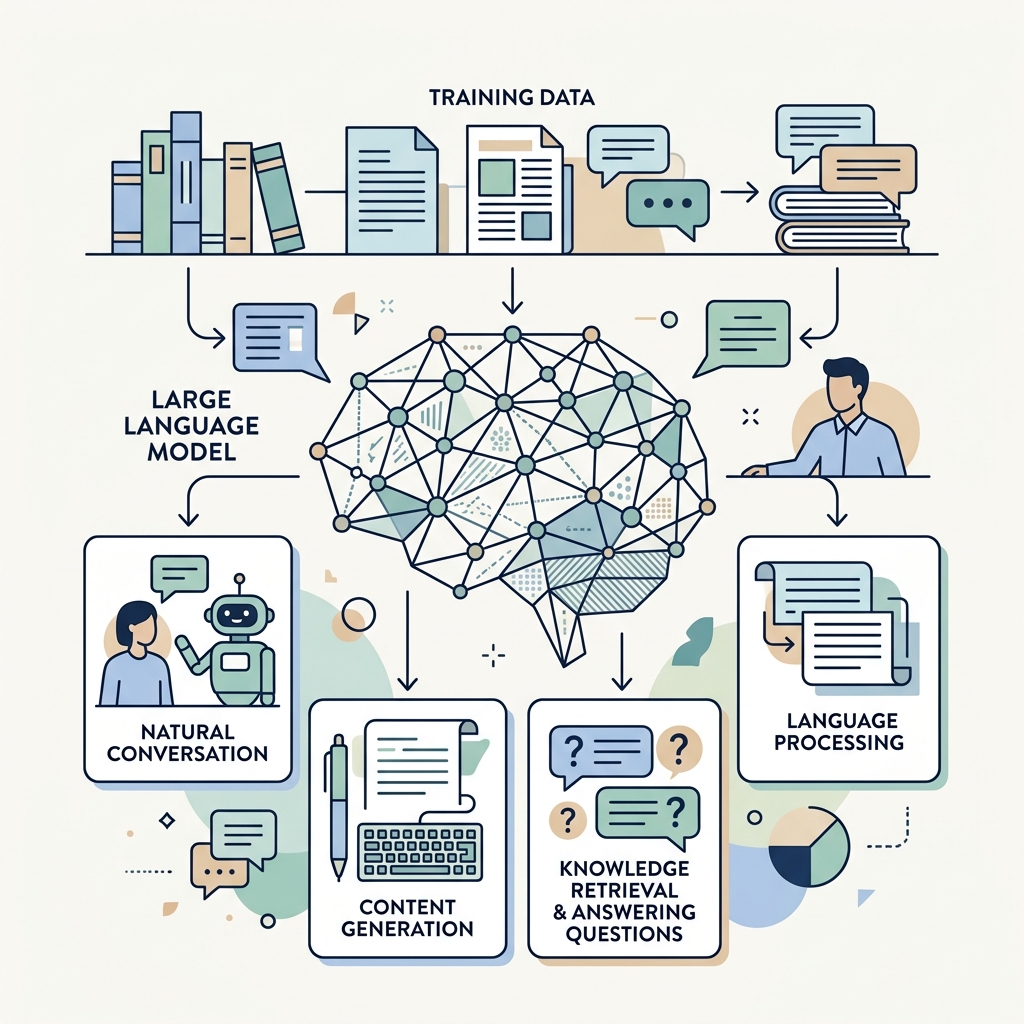
A large language model (LLM) is an AI system trained on massive amounts of text data that can understand and generate human-like language by predicting the most likely next word in a sequence. Unlike traditional software, it doesn't follow fixed rules—it learns patterns from examples, allowing it to answer questions, write paragraphs, and hold conversations without needing external retrieval at query time.
Step by step
How an LLM works
The same five-step pipeline animating in the signature panel above, applied to your own documents.
You type a question
Your input is sent to the model as a starting prompt.
Input is tokenized
The text is broken into small pieces called tokens.
Model processes tokens
Neural network layers analyze the sequence of tokens.
Next word predicted
It calculates the most probable next token billions of times.
Response assembled
The predicted tokens are combined into a complete answer.
The choice
LLM vs RAG vs fine-tuning
These are frequently combined: a fine-tuned model for task-specific behavior, grounded by RAG for current or proprietary data access.
| Factor | Plain LLM | RAG | Fine-tuning |
|---|---|---|---|
| Knowledge source | Fixed training data only | Training data plus live retrievable documents | Training data plus new learned behavior from examples |
| Update process | Requires full retraining of the model | Add, remove, or update documents with no model retraining | Requires retraining on new labeled examples |
| Best for | General or open-ended conversation | Accessing domain-specific, current, or private data | Changing the model's style, tone, or response behavior |
| Traceability | No source citations provided | Can cite the exact source document used | No source citations provided |
What I build
RAG development services
Each layer of a production RAG pipeline, built and tested as its own verifiable stage.
Document ingestion & chunking
Building the pipeline that prepares your source content—PDFs, wikis, databases, support tickets—into properly chunked, retrievable pieces. This step determines the ceiling on everything downstream.
Vector database architecture
Selecting and configuring the right vector store (Pinecone, Weaviate, Qdrant, FAISS, pgvector) for your scale, latency, and hosting requirements.
Retrieval engineering
Building the retrieval layer: hybrid search (semantic plus keyword), metadata filtering, and reranking to maximize the relevance of what gets passed to the LLM.
Generation & guardrails
Configuring the generation layer with grounding constraints, defensive fallback behavior, and confidence thresholds so the system says "I do not know" instead of guessing.
RAG evaluation
Testing retrieval and generation quality against your real queries using RAGAS, DeepEval, or a custom evaluation set, with results shared transparently before launch.
Production deployment
Deploying the full RAG pipeline as a versioned, monitored API integrated with your product or internal tools.
Why it matters
What is an LLM?
An LLM, or large language model, is an AI system trained on vast amounts of text to understand and generate human-like language. For businesses, it means being able to automate conversations, generate content, and extract insights from data—without needing a team of programmers. Think of it as a powerful language assistant that learns from the world's written knowledge.
Common LLM applications
- Customer support chatbots that handle common questions
- Content generation for marketing and blogs
- Code generation and debugging assistance
- Data analysis and summarization
- Language translation and localization
- Personalized learning and tutoring
How it works
Process
PHASE 01Massive scale
Data Collection
+
PHASE 02Weeks to months
Training
+
PHASE 03Often done
Fine-tuning
+
PHASE 04Regularly
Evaluation
+
PHASE 05Ongoing
Deployment
+
Investment
Engagement Options
| Engagement type | What's included |
|---|---|
| LLM explainer guide Free | A plain-English guide to how LLMs work and their business applications |
| LLM consulting session | One-on-one session to discuss LLM use cases and strategy |
| LLM system audit | Review of an existing LLM implementation for improvements |
| Hourly consulting | Ad hoc advice on LLM integration and usage |
Retrieval-grounded systems delivered include the AI Customer Feedback Classification pipeline and AI Video Summarizer. Full case studies at shreyans.tech/ai-case-studies.
FAQ