The hidden lever in RAG
What is chunking in RAG? and how to get it right
Chunking splits documents into retrievable pieces for RAG systems. Poor chunking causes missed context or noise; strategic chunking—fixed-size, semantic, recursive—maximizes retrieval accuracy. I engineer chunking strategies and avoid common pitfalls like over-splitting or losing document structure.
Every chunk traces to its source document, guardrails against fragmentation included from day one
Plain answer
What Is Chunking in RAG?
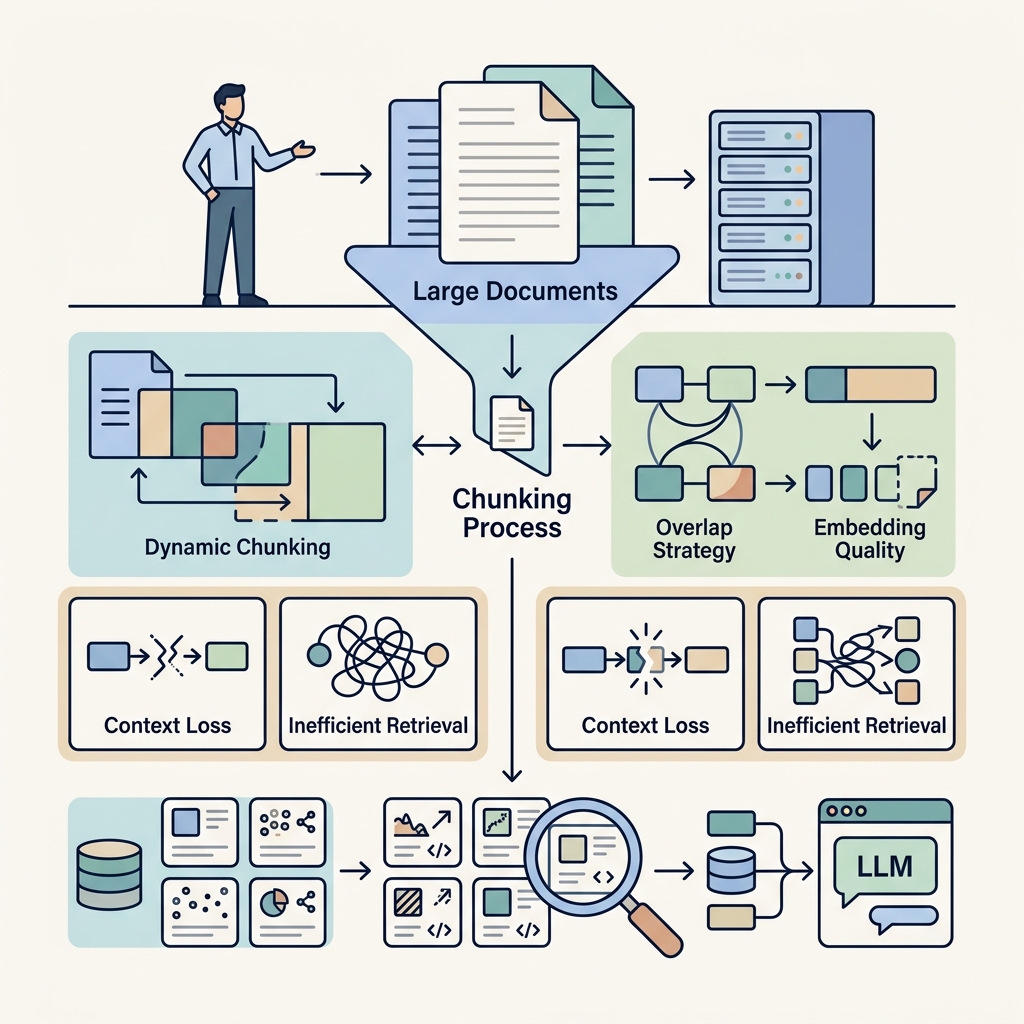
Chunking in retrieval-augmented generation (RAG) is the process of dividing source documents into smaller, self-contained text segments before they are embedded and stored in a vector database. At query time, these chunks are the atomic units retrieved and fed into the language model’s context window. A well-designed chunking strategy — including decisions about size, overlap, segmentation method, and boundary logic — directly determines how accurately relevant information is located and how much surrounding context the model receives, making chunking a critical lever for both recall and answer quality.
Step by step
How Chunking Works
The same five-step pipeline animating in the signature panel above, applied to your own documents.
Document loaded
A source document (PDF, HTML, or plain text) is ingested into the pipeline.
Chunk strategy applied
The system splits the text using a fixed token count, semantic boundaries, or recursive logic.
Chunks optimized
Optional preprocessing trims whitespace, normalizes formatting, and ensures content completeness.
Chunks embedded
Each chunk is converted into a numerical vector that captures its meaning.
Index stored
Vectors and their original text are persisted in a vector database for retrieval.
Chunking strategies
Chunking: RAG vs LLM vs Fine-tuning
These are frequently combined: a fine-tuned model for task-specific behavior, grounded by RAG for current or proprietary data access.
| Factor | Plain LLM | RAG | Fine-tuning |
|---|---|---|---|
| Knowledge source | Static training data, no chunking involved | Dynamic document chunks enable targeted retrieval | Task-specific examples, chunking optional for preprocessing |
| Update process | Requires full retraining to update knowledge | Add or replace chunks without retraining | Requires retraining on new chunked examples |
| Best for | General knowledge, no document granularity needed | Domain-specific queries needing precise chunk retrieval | Changing model behavior, chunking not primary |
| Traceability | No source citation possible | Can cite specific chunk and document | No source citation for learned behavior |
Chunking services
Document chunking services
Each layer of a production RAG pipeline, built and tested as its own verifiable stage.
Document chunking strategies
Designing chunk size, overlap, and splitting methods (semantic, recursive, fixed-size) tailored to your document types and query patterns.
Chunk-aware vector indexing
Configuring vector stores to index chunks with metadata, enabling hybrid search and efficient retrieval based on chunk structure.
Chunk retrieval optimization
Implementing hybrid search, metadata filtering, and reranking to maximize relevance of retrieved chunks for the LLM.
Chunk-grounded response generation
Configuring LLM to use retrieved chunks as grounding, with fallbacks to avoid hallucination when no relevant chunk exists.
Chunk quality evaluation
Testing chunk retrieval and generation quality using metrics like chunk recall, precision, and end-to-end answer accuracy.
Chunking pipeline deployment
Deploying chunking pipeline as a versioned, monitored API integrated with your product or internal tools.
Why it matters
Why chunking matters
Chunking determines how documents are split before indexing, directly impacting retrieval accuracy and context preservation. A poorly chosen chunk size or strategy leads to missed information, irrelevant context, or broken reasoning chains — the most common source of RAG pipeline failure after embedding quality.
Chunking strategies & pitfalls
- Fixed-size chunking: simple but risks splitting sentences or semantic units, losing meaning
- Semantic chunking: splits on topic boundaries using embeddings or NLP cues, preserving coherence
- Recursive chunking: applies multiple separators hierarchically, balancing structure and granularity
- Common mistake: choosing a chunk size too small (misses context) or too large (dilutes relevance)
- Common mistake: ignoring overlap — no overlap loses boundary context, excessive overlap inflates index size
- Common mistake: using the same chunking strategy for all document types without testing
How chunking works
Chunking process
PHASE 01days 1 to 2
Discovery
+
PHASE 02within 48h
Architecture spec
+
PHASE 03the decisive one
Build chunker
+
PHASE 04before launch
Evaluation
+
PHASE 0530 days plus
Deployment & support
+
Investment
Engagement Options
| Engagement type | What's included |
|---|---|
| Chunking strategy consultation Free | 30-minute review of your documents and recommendation of best chunking approach |
| Custom chunking pipeline | Full implementation of fixed, semantic, or recursive chunker with overlap tuning and testing |
| Chunking audit | Diagnose retrieval issues caused by poor chunking; provide optimized parameters and report |
| Hourly consulting | Deep dive into chunk size experiments, strategy selection, and integration with your RAG pipeline |
Retrieval-grounded systems delivered include the AI Customer Feedback Classification pipeline and AI Video Summarizer. Full case studies at shreyans.tech/ai-case-studies.
FAQ