The cost of smarter models
What is fine-tuning? A practical definition, when to use it, and its actual cost
Fine-tuning is the process of taking a pre-trained large language model and training it further on a smaller, specific dataset to adapt its behavior, knowledge, or tone for a particular task or domain. I design and implement fine-tuning pipelines: dataset curation, hyperparameter optimization, evaluation, and deployment, balancing performance gains against training and inference costs.
Every fine-tuned model is evaluated for accuracy, cost, and drift before deployment
Plain answer
What is fine-tuning?
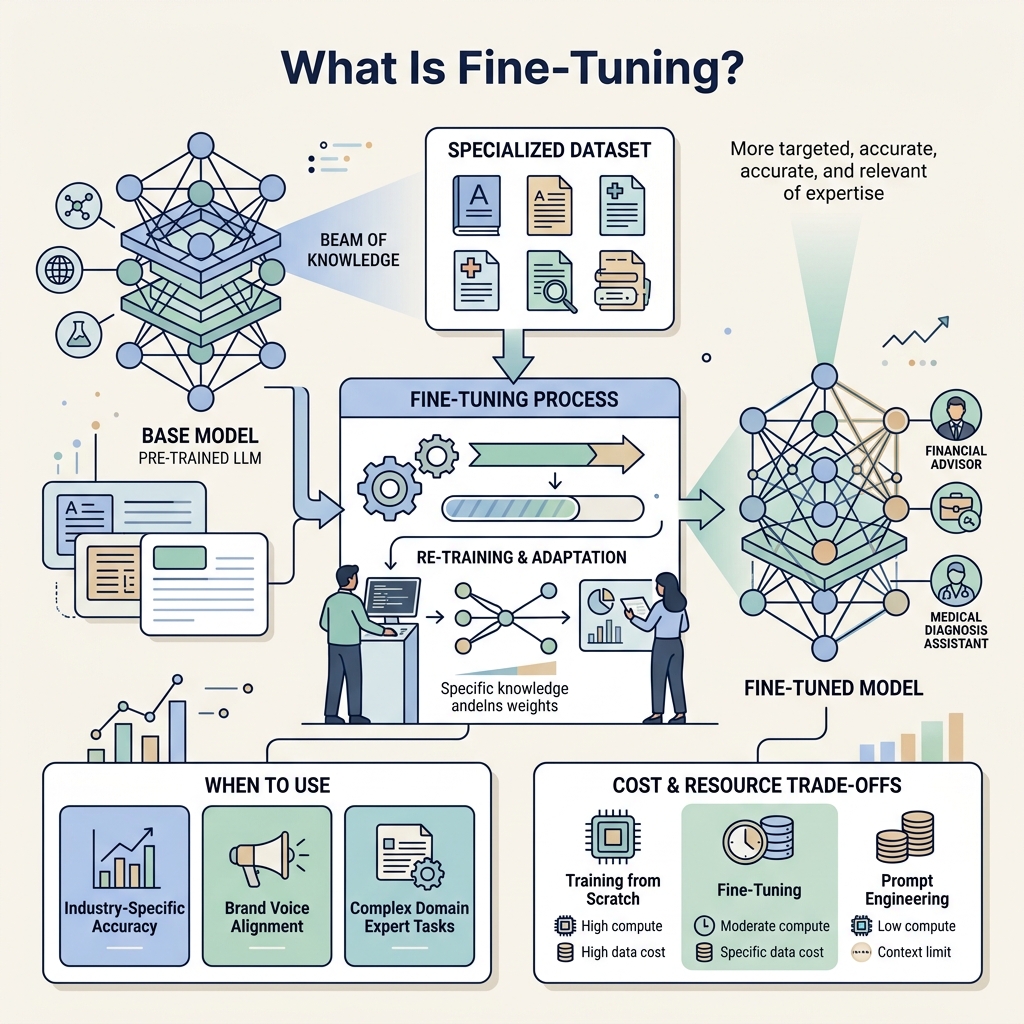
Fine-tuning is the process of taking a pre-trained large language model (LLM) and further training it on a smaller, task-specific dataset to adjust its weights, making the model specialize for a particular domain, style, or function. It is used when a general model’s baseline performance is insufficient for a targeted use case, but it comes with computational costs for training runs and ongoing infrastructure, plus the need for high-quality labeled data to avoid overfitting or catastrophic forgetting.
Step by step
How fine-tuning works
The same five-step pipeline animating in the signature panel above, applied to your own documents.
Base model selected
Choose a pre-trained LLM that aligns with your general language needs and licensing.
Dataset prepared
Curate and clean a labeled dataset of input-output examples representing your target task.
Training run
Update the model's weights via supervised learning on your dataset, often using low-rank adaptation (LoRA) to reduce cost.
Evaluation
Benchmark the fine-tuned model against a held-out test set to measure accuracy and detect overfitting.
Deployment
Serve the specialized model in production, accepting that it remains static until you retrain with new data.
The decision
RAG vs plain LLM vs fine-tuning
These are frequently combined: a fine-tuned model for task-specific behavior, grounded by RAG for current or proprietary data access.
| Factor | Plain LLM | RAG | Fine-tuning |
|---|---|---|---|
| Knowledge source | Fixed training data | Training data plus live retrievable content | Training data plus new task-specific behavior |
| Update process | Requires retraining | Add or update documents, no retraining | Requires retraining on new examples |
| Best for | General knowledge tasks | Domain-specific, current, or private data access | Changing model style, tone, or task behavior |
| Traceability | No source citation | Can cite exact source document | No source citation |
What I build
RAG development services
Each layer of a production RAG pipeline, built and tested as its own verifiable stage.
Document ingestion & chunking
Building the pipeline that prepares your source content, PDFs, wikis, databases, support tickets, into properly chunked, retrievable pieces. This step determines the ceiling on everything downstream.
Vector database architecture
Selecting and configuring the right vector store (Pinecone, Weaviate, Qdrant, FAISS, pgvector) for your scale, latency, and hosting requirements.
Retrieval engineering
Building the retrieval layer: hybrid search (semantic plus keyword), metadata filtering, and reranking to maximize the relevance of what gets passed to the LLM.
Generation & guardrails
Configuring the generation layer with grounding constraints, defensive fallback behavior, and confidence thresholds so the system says "I do not know" instead of guessing.
RAG evaluation
Testing retrieval and generation quality against your real queries using RAGAS, DeepEval, or a custom evaluation set, with results shared transparently before launch.
Production deployment
Deploying the full RAG pipeline as a versioned, monitored API integrated with your product or internal tools.
Why it matters
What is fine-tuning
A general-purpose LLM lacks knowledge of your proprietary data, domain-specific terminology, or desired output format. Fine-tuning updates the model's weights through additional training on your custom dataset, embedding that knowledge directly into the model without requiring external retrieval at query time.
Where fine-tuning excels
- Customizing tone and style for brand-consistent customer communications
- Teaching a model specialized medical or legal terminology from a corpus of documents
- Structuring outputs into a specific JSON schema or format for downstream automation
- Adapting a base model to a high-volume, low-latency production environment
- Improving accuracy on a narrow, well-defined classification or extraction task
- Reducing per-query costs by eliminating the need for retrieval infrastructure
How it gets built
Process
PHASE 01days 1 to 2
Discovery
+
PHASE 02within 48h
Data preparation
+
PHASE 03the decisive one
Training & eval
+
PHASE 04before launch
Deployment
+
PHASE 0530 days plus
Monitoring & support
+
Investment
Engagement Options
| Engagement type | What's included |
|---|---|
| Fine-tuning feasibility study Free | Dataset analysis and cost estimate with a written recommendation |
| Full fine-tuning pipeline | Data preparation, training, evaluation, and endpoint deployment |
| Fine-tuning audit | Diagnose and improve an underperforming existing fine-tuned model |
| Hourly consulting | Hyperparameter tuning, dataset strategy, and deployment architecture |
Retrieval-grounded systems delivered include the AI Customer Feedback Classification pipeline and AI Video Summarizer. Full case studies at shreyans.tech/ai-case-studies.
FAQ