The meaning behind relevance
Semantic search explained: what it is, and why keyword isn't enough
Semantic search is the technology that understands the intent behind a query, not just the words. Unlike keyword search, it maps queries to concepts, so 'best running shoes for flat feet' returns results about arch support, not just pages with those exact words. I design and build production semantic search systems for e-commerce, knowledge bases, and enterprise search.
Meaning, not keywords, drives every result from day one
Semantic search is a method of information retrieval that understands the contextual meaning and intent behind a query, rather than relying only on exact keyword matches. It uses natural language understanding to map queries and documents into a shared vector space where meaning is represented by distance between embeddings.
Plain answer
What is semantic search?
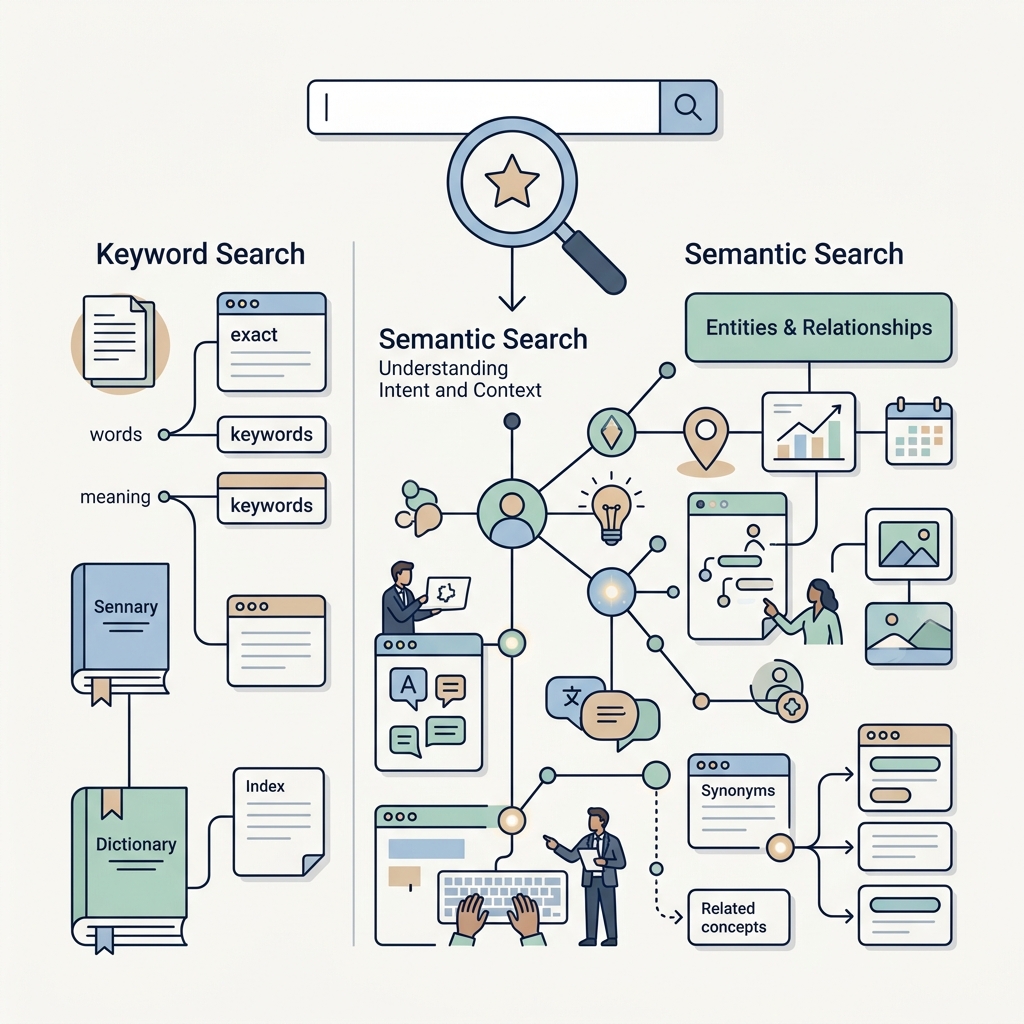
Semantic search is a search technique that understands the meaning and intent behind a user's query, rather than relying solely on literal keyword matching. It uses natural language processing and machine learning to interpret the context, synonyms, and conceptual relationships between words, allowing it to retrieve results that are conceptually relevant even if they don't contain the exact search terms.
Step by step
How semantic search works
The same five-step pipeline animating in the signature panel above, applied to your own documents.
Query submitted
A user asks a question in natural language.
Query embedded
Converted into a numerical embedding capturing its meaning.
Vector search
The system finds the most relevant chunks in a vector database.
Context inserted
Retrieved content joins the query in the LLM's context window.
Grounded answer
The LLM generates a response with sources available to cite.
The decision
Semantic search vs keyword search
These are frequently combined: a fine-tuned model for task-specific behavior, grounded by RAG for current or proprietary data access.
| Factor | Keyword search | Semantic search | Hybrid search |
|---|---|---|---|
| Matching logic | Exact term or character matching | Meaning-based via vector embeddings | Both exact and meaning-based |
| Handles synonyms | No, unless manually added | Yes, via semantic similarity | Yes, with fallback to exact terms |
| Best for | Product codes, names, exact phrases | Natural language questions, conceptual queries | Mixed queries and enterprise search |
| Traceability | Clear why a result matched | Less obvious, requires explanation | Both exact and semantic explanations |
What I build
Semantic search services
Each layer of a production RAG pipeline, built and tested as its own verifiable stage.
Embedding generation
Selecting and optimizing a sentence-transformer or LLM embedding model for your domain, then building the pipeline that converts your documents into high-quality vectors. This step determines the ceiling on retrieval accuracy.
Vector database architecture
Choosing and configuring the right vector store (Pinecone, Weaviate, Qdrant, FAISS, pgvector) for your scale, latency, and hosting requirements, including index tuning for approximate nearest neighbor performance.
Hybrid retrieval engineering
Building the retrieval layer that combines semantic and keyword search with metadata filtering and reranking to maximize precision and recall across diverse query types.
Query understanding
Implementing query expansion, intent detection, and embedding-based query rewriting so that natural language questions and conversational inputs return the most relevant results.
Search evaluation
Testing retrieval quality against your real queries using custom evaluation sets, human relevance judgments, and metrics like recall@k and nDCG, with results shared transparently before launch.
Production deployment
Deploying the full semantic search pipeline as a versioned, monitored API integrated with your product, internal tools, or existing search infrastructure.
Why it matters
Why semantic search matters
Keyword search fails when users phrase queries differently from the exact words in your content. Semantic search understands the meaning behind a query, retrieving the right information even when the wording doesn't match, which directly improves answer quality and reduces user frustration.
Where semantic search wins
- Customer support portals where users describe problems in their own words, not the exact product terms
- Internal knowledge bases for employees searching policies and procedures by intent, not exact wording
- Healthcare information systems matching symptoms and plain-language questions to clinical terminology
- Legal research tools finding relevant precedents and clauses even when the query uses different phrasing
- Ecommerce product discovery where shoppers search by need or scenario, not just product names
- Enterprise search surfacing relevant documents across large repositories regardless of synonym usage
How it works
Process
PHASE 01days 1 to 2
Discovery
+
PHASE 02within 48h
Architecture spec
+
PHASE 03the decisive one
Build in milestones
+
PHASE 04before launch
Evaluation
+
PHASE 0530 days plus
Deployment & support
+
Investment
Engagement Options
| Engagement type | What's included |
|---|---|
| Semantic search proof-of-concept Free | Baseline retrieval pipeline on a data sample, relevance evaluation report |
| Production semantic search system | Full pipeline, hybrid retrieval, deployment, documentation |
| Semantic search audit | Diagnose and improve an underperforming existing search system |
| Hourly consulting | Architecture review, embedding strategy design |
Retrieval-grounded systems delivered include the AI Customer Feedback Classification pipeline and AI Video Summarizer. Full case studies at shreyans.tech/ai-case-studies.
FAQ