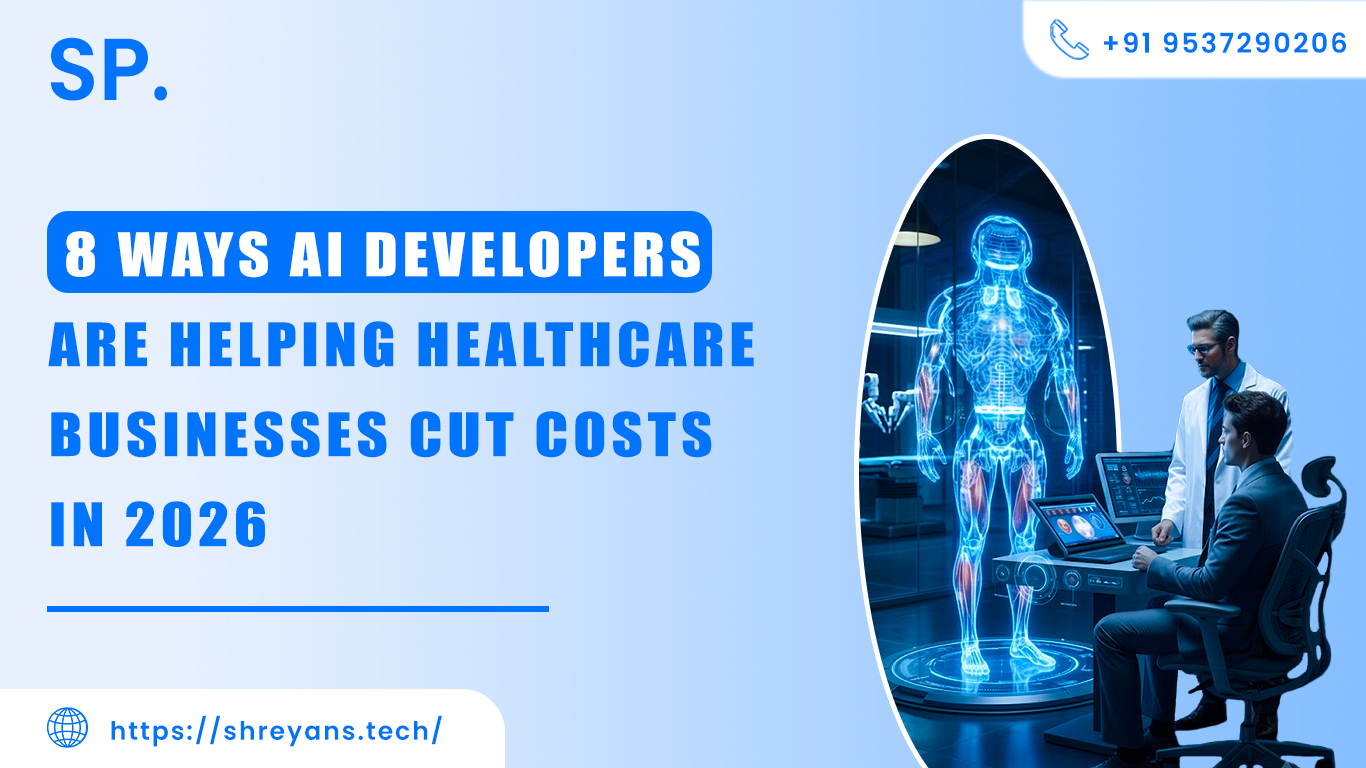
McKinsey estimates that wider deployment of AI across US healthcare could reduce total spending by 5% to 10%, equivalent to $200 billion to $360 billion annually, without cutting access or clinical quality. The opportunity concentrates in one place more than any other: administrative work alone accounts for roughly 25% of total US healthcare spending, which MedPAC data puts at over $1.4 trillion a year in billing, coding, and insurance processing.
That gap between total spend and where the waste actually sits is exactly where a well-scoped AI build pays for itself fastest. Below are eight specific ways healthcare businesses are using custom-built AI systems to cut real costs in 2026, with the mechanisms, the numbers, and where an AI healthcare cost reduction project typically starts paying back.
1. Automating Clinical Documentation
Clinicians spend a disproportionate share of every visit writing notes instead of treating patients, and that documentation burden translates directly into overtime costs, burnout-driven turnover, and fewer billable patient hours per day. Ambient AI scribes that listen to a visit and generate structured clinical notes automatically are now one of the fastest-adopted AI agents in healthcare applications, specifically because the ROI is so easy to measure.
Documented results across large health systems show ambient scribe tools cutting after-visit charting time by 30 percent or more, with some deployments reporting documentation time dropping from several hours a day to under 90 minutes. A comparable pattern shows up in a Patient Record Processing build handling intake and record digitization: 65 percent faster record processing, a 45 percent reduction in manual data entry, and 99 percent data accuracy, freeing administrative staff for higher-value work instead of retyping the same information across systems.
2. Speeding Up Prior Authorization and Claims Processing
Prior authorization, the back-and-forth of faxes, phone calls, and manual forms required before an insurer approves treatment, is one of the most universally hated cost centres in healthcare, both for the delay it adds to patient care and for the staff hours it consumes. AI systems that auto-generate approval requests, pre-fill forms from existing patient data, and verify insurer eligibility in real time can cut this cycle dramatically.
Health tech deployments using this pattern report processing times cut by roughly 60 percent alongside a 70 percent drop in data entry errors. The scale of the opportunity is significant on its own: CAQH's index estimates that 33 percent of healthcare administrative spending, roughly $13.3 billion annually, could be recovered through automation of exactly this kind of workflow.
3. Reducing No-Shows Through Predictive Scheduling
A missed appointment is not just a lost hour, it's lost revenue on a slot that could have gone to a paying patient, plus the administrative cost of manually rebooking. AI-based scheduling systems that flag which patients are statistically likely to miss an appointment, based on history, distance, and prior behaviour, and trigger targeted outreach before the visit, have been shown to cut no-show rates by roughly half in some deployments.
A Smart Appointment and Scheduling system built around this exact problem delivered 50 percent faster appointment handling, a 35 percent reduction in scheduling errors, and a 30 percent improvement in patient flow across a multi-location clinic network. Separately, published estimates put the cost of a single avoidable no-show at $13,000 to $13,700 per patient annually once lost capacity and rebooking overhead are counted across a full patient panel.
4. Cutting Turnaround Time on Lab and Diagnostic Reports
The gap between a lab test being run and a doctor actually seeing the result is pure waiting cost: delayed treatment decisions, repeat visits, and administrative staff chasing down results that are sitting in a queue. Automated systems that process incoming lab data, organise results, and push notifications directly to the ordering physician close that gap without adding headcount.
A Laboratory Report Processing system built for exactly this workflow delivered 55 percent faster report delivery, a 40 percent reduction in administrative workload, and around-the-clock report access for both doctors and patients, replacing a process that previously depended on staff being at their desk during business hours to move a result forward.
5. Shortening Hospital Length of Stay with Predictive Discharge Tools
Every extra day a patient stays in a hospital bed adds staff time, medication, room costs, and meals, none of which is fully reimbursable once a patient's condition no longer requires that level of care. Predictive models that flag which patients are ready for discharge earlier, based on vitals, lab trends, and recovery patterns, let care teams act on that readiness instead of defaulting to a longer, cautious stay.
A large US hospital network using predictive discharge tooling documented a 0.67-day average reduction in length of stay across its patient population, a small-sounding number that compounds into meaningful bed capacity and cost savings at scale. Separate simulation research on internal medicine wards has modelled up to 2 days of potential reduction using similar predictive approaches, though that figure reflects modelling rather than a live deployment.
6. Catching Billing Fraud and Errors Before They Cost Money
Healthcare fraud, duplicate claims, mismatched billing codes, and services billed against the wrong diagnosis cost the US system an estimated $100 billion to $300 billion annually according to the National Health Care Anti-Fraud Association. Machine learning models trained to spot anomalous claim patterns catch far more of this than manual auditing ever could, simply because they can compare a claim against millions of historical patterns in real time instead of a sampled review.
One documented deployment of an ML-based fraud classification system reduced medical costs by 50 basis points purely through improved fraud detection accuracy, a small percentage that translates into meaningful absolute savings once applied across a large payer's full claim volume. Beyond outright fraud, the same detection layer routinely catches routine billing errors that would otherwise go unnoticed for months.
7. Lowering Readmission Penalties with Predictive Risk Scoring
Hospitals face direct financial penalties under Medicare for avoidable 30-day readmissions, and CMS data puts the total cost of hospital readmissions at over $26 billion annually, of which roughly $17 billion is considered preventable with better discharge planning and follow-up. A predictive model that scores each patient's readmission risk at discharge, based on their diagnosis, social determinants of health, and real-time vitals, lets care teams intervene with the highest-risk patients specifically, rather than spreading limited follow-up resources evenly across everyone.
That targeting is what makes the economics work: a follow-up call or home visit costs a fraction of an avoidable readmission, so even a modest improvement in identifying genuinely high-risk patients recovers a meaningful share of that $17 billion in preventable spend across the industry.
8. Reducing Diagnostic Errors and the Downstream Cost of Late-Stage Treatment
Diagnostic errors affect an estimated 5 percent of US adults annually and contribute to up to 10 percent of patient deaths, according to National Academy of Medicine research, and every missed or delayed diagnosis carries a downstream cost in more advanced, more expensive treatment. AI-assisted diagnostic tools that cross-reference imaging, lab results, and patient history in real time are closing part of that gap: AI-assisted mammography has been shown to improve breast cancer detection rates by roughly 5 to 7 percent over standard practice, and FDA-cleared diabetic retinopathy screening systems now perform at 87 percent sensitivity and around 89 percent specificity.
Catching a condition even one stage earlier consistently costs less to treat than catching it late, which is why diagnostic-support tooling shows up in nearly every serious healthcare cost-reduction roadmap, not just as a quality initiative but as a direct line item on the budget.
Where Each Approach Typically Pays Back
|
Approach |
Typical documented savings |
Primary cost driver addressed |
|---|---|---|
|
Documentation automation |
30%+ less charting time, up to 99% data accuracy |
Clinician overtime, administrative rework |
|
Prior authorization automation |
~60% faster processing, ~70% fewer errors |
Staff hours, delayed reimbursement |
|
Predictive scheduling |
~50% fewer no-shows |
Lost appointment revenue |
|
Lab/report automation |
40–55% faster turnaround |
Admin workload, delayed treatment decisions |
|
Predictive discharge |
0.67–2 days shorter stay |
Bed cost, non-reimbursable care days |
|
Fraud/billing detection |
50+ basis points cost reduction |
Fraudulent and erroneous claims |
|
Readmission risk scoring |
Share of $17B preventable spend |
Medicare readmission penalties |
|
Diagnostic support tools |
5–7% better detection rates |
Late-stage, high-cost treatment |
None of these are off-the-shelf purchases; each one is a scoped build matched to a specific workflow, and the budget varies accordingly depending on data readiness and integration depth. AI development cost in India breaks down how project complexity and region both move that number, which is worth reading before assuming any of the eight approaches above requires an enterprise-scale budget to start.
What Comes Next
As ambient documentation tools and predictive risk models keep maturing, the cost-reduction opportunities on this list will keep getting cheaper to implement and faster to prove out, which means the healthcare businesses that move first on a well-scoped pilot will keep compounding that advantage over the ones still evaluating whether AI is worth the investment. The eight approaches above aren't equally relevant to every healthcare business, the right starting point depends on where your specific administrative and clinical bottlenecks actually sit, which is exactly the kind of scoping conversation worth having before choosing an AI development partner for the build. If one of these eight maps to a real cost problem in your organisation right now, hire ai and ml developers with documented healthcare deployments can help you scope where to start.
Frequently asked questions
How much can AI actually reduce healthcare costs?
What is the fastest way for a healthcare business to start cutting costs with AI?
How much does it cost to build a custom AI healthcare cost-reduction system?
Is AI-driven fraud detection reliable enough to trust for healthcare billing?
Do these AI cost-reduction tools require replacing existing EHR or hospital systems?
How do I hire AI developer for healthcare work if I don't have in-house technical expertise?



Shreyans Padmani
Shreyans Padmani has 5+ years of experience leading innovative software solutions, specializing in AI, LLMs, RAG, and strategic application development. He transforms emerging technologies into scalable, high-performance systems, combining strong technical expertise with business-focused execution to deliver impactful digital solutions.