Introduction
Look "Artificial Intelligence" stopped being a flashy sci-fi term somewhere around 2021. Now? It's the actual engine keeping serious businesses alive. I've watched two-person startups and sprawling corporate machines alike dump serious resources into AI software development services. The reason isn't complicated: they're exhausted from hemorrhaging time on manual chaos, and they want a real, measurable edge.
Here's what people get wrong, though. They think machine learning and NLP are just for Silicon Valley show-offs. They're not. These tools help real teams chew through insane volumes of data, offload the repetitive garbage, and figure out what customers want sometimes before the customer even figures it out themselves. (Which, honestly, is the whole game.)
In 2026, pretending AI doesn't apply to you isn't caution. It's a slow fade into irrelevance. The businesses still waiting for the "right moment"? They're already behind. Building smarter isn't a future goal. It's a current survival requirement.
What is AI Software Development?
When we talk about AI software development, we're not talking about software that just sits there, waiting to be told what to do. We're talking about systems that actually learn. They analyze. They act without someone standing over them micromanaging every click and keystroke. Here's how these systems actually pull their weight in the real world:
Ditch the busy work:
AI grabs those mind-numbing, repetitive jobs think data entry, ticket sorting, or basic support queues — and chews through them instantly. Your people stop wasting hours on tasks that pay nothing back. Productivity actually moves.
Real-time data crunching:
Nobody has time to wait on last Thursday's report. AI-powered setups dig into live data right now, so the decisions you make are based on what's happening in this moment not some snapshot from three weeks ago that's already useless.
Seeing around corners:
Predictive tech is where it gets genuinely exciting. AI catches patterns that human brains as impressive as they are consistently miss. It's like having a market radar that never goes offline, helping you stay two or three steps ahead of whoever's competing with you.
Fixing the "vibe" with customers:
Chatbots that don't make people want to throw their phones. Recommendation engines that feel personal instead of robotic. Happy users. More revenue. That's the loop. Whether you're running a healthcare clinic, a fintech platform, or even a neighborhood shop, AI is the thread pulling everything tighter and faster.
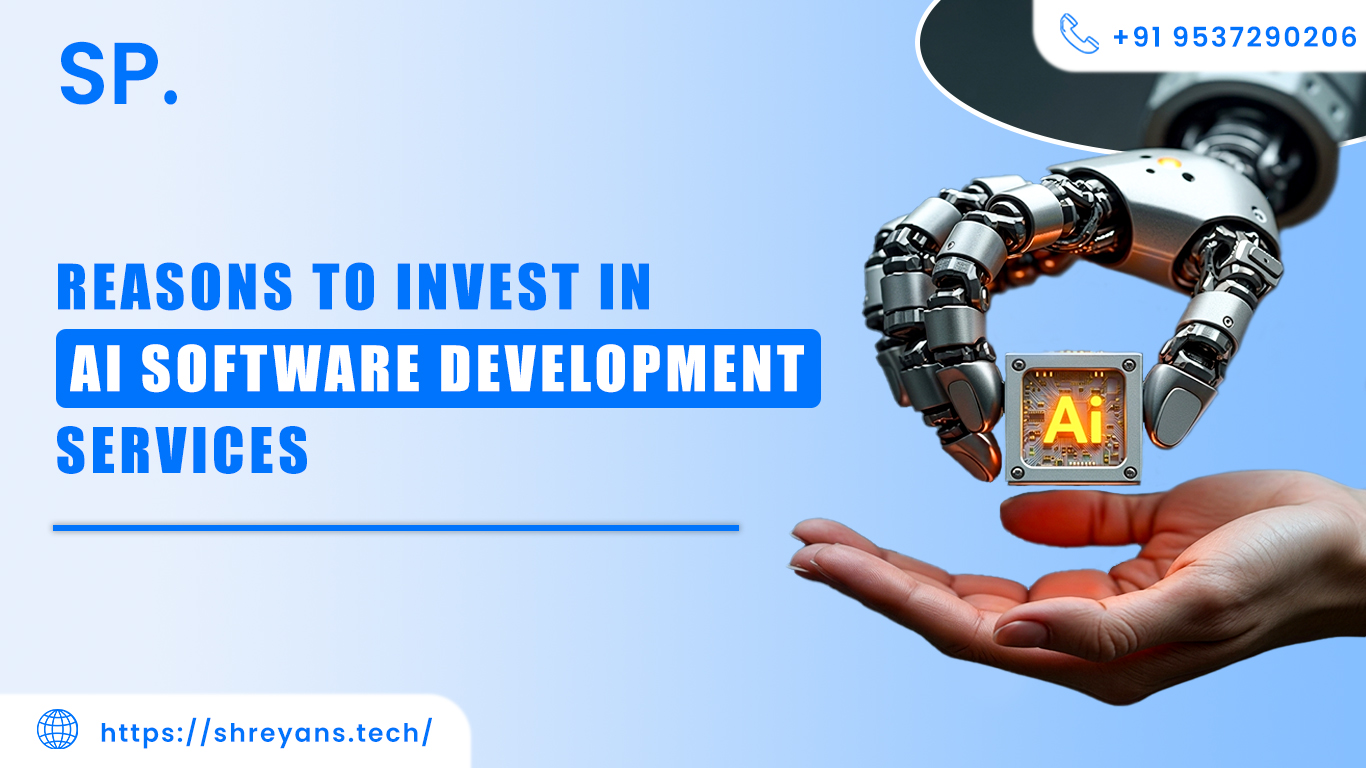
Top Reasons to Invest in AI Software Development Services
1. Enhances Efficiency and Automation
The biggest, clearest win with AI is dead simple: it stops the clock-watching. AI systems reach in and grab those soul-crushing tasks reporting, data cleanup, pipeline management and run them at speeds that would embarrass any human team. That's not an insult; it's just physics. And when AI handles that layer, your actual people can focus on the stuff that really matters. The strategy calls. The creative decisions. The "what do we do next" conversations that no algorithm can replicate and that actually move the needle.
I've seen mid-sized teams nearly double their throughput simply by automating what used to eat three or four hours of someone's morning. Every single day. That's time compounding in your favor instead of evaporating.
2. Better Data-Driven Decision Making
Stop guessing. Seriously. AI can gut through volumes of raw data that would take a human analyst literal weeks, and it spits out insights that are actually actionable not just interesting-looking charts nobody acts on. I've noticed that companies running AI-driven analytics don't just feel more confident; they perform measurably better. They're not throwing darts in the dark. They see a real picture of what's working, what's bleeding money, and where the market is quietly shifting before anyone else notices.
3. Improved Customer Experience
People expect you to already know what they want. That's just the standard now. AI helps you decode customer behavior in ways that make every interaction feel personal not scripted, not generic, not frustrating.
Bots that don't suck:
Real AI chatbots deliver 24/7 support with zero hold music, zero "your call is important to us" nonsense, and answers that actually land.
The "Amazon" Effect:
AI studies behavior, spots preferences, and suggests things people will genuinely want. Not random. Not intrusive. Just relevant.
Marketing that hits:
No more spam-blasting your entire list. AI helps you target people based on what they actually care about — which means higher conversions and fewer unsubscribes. (That alone is worth the investment for a lot of teams.)
4. Increased Productivity
AI tools aren't just "nice-to-have" productivity bumps. They're serious levers. By cutting out manual drag at every layer of the development cycle, you compress timelines in ways that used to feel impossible. Some teams have reported 20–40% jumps in output after integrating solid AI tools and that's not just internal satisfaction, that's the difference between launching this quarter and launching next year when the moment has already passed.
5. Reduces Human Errors
Humans get tired. That's not a character flaw; it's just biology. When tasks are repetitive and data-heavy, mistakes creep in. Small ones, mostly. But enough of them at the wrong time, and you've got a real problem. AI doesn't have an "end of shift." It follows its logic to the letter, every single time.
Catching the bad guys: In finance, AI spots weird transaction patterns that a bleary-eyed analyst scrolling through a spreadsheet at 4pm would almost certainly miss. It flags fraud before the damage spreads.
Spotting the duds: In manufacturing, AI catches a defect on the production line in milliseconds. Less waste. Less rework. Better final product.
A second pair of eyes in health: AI helps clinicians scan medical reports and imaging for early warning signs that are easy to overlook. When accuracy matters most, you want a second layer that doesn't get distracted.
6. Enabling Predictive Analytics
Predictive analytics is the quiet secret weapon behind a lot of the growth stories you read about. If you can see which direction things are heading, you stop reacting and start positioning.
Stocking the right stuff: AI pulls from historical sales, current demand signals, and market noise to tell you exactly what inventory you need and when. No more capital sitting dead on shelves in the form of goods nobody's buying.
Reading minds: It studies behavioral patterns to anticipate what customers are likely to do next so you're already there when they arrive.
Safe bets in finance: Real-time risk analysis means you're flagging potential losses before they get ugly, not writing post-mortems after the fact.
7. Strengthens Cybersecurity
The internet is genuinely a mess of threats right now, and they're getting more sophisticated every month. AI has become, essentially, the new digital bodyguard and a pretty aggressive one.
Spot the "weird": AI watches behavioral patterns constantly. The moment something deviates from the baseline, it flags it. No waiting for a human to notice something's off.
Fight back in real-time: It doesn't sit around waiting for a patch to deploy. It identifies threats as they're landing and responds immediately.
Stop the leak: By finding structural weaknesses before attackers do, AI prevents the kind of data breaches that end up on the front page and tank customer trust overnight. (Which, trust me, is a situation nobody recovers from quickly.)
8. Reduces Costs and Optimizes Resources
Here's the kicker: despite the upfront investment, AI actually saves serious money over time. It's not a cost center. It's a cost cutter. By automating the grunt work across departments, you're squeezing more value out of every dollar you spend.
Leaner support: Bots handle the repetitive, high-volume stuff. You don't need a 40-person call center to cover what three well-deployed AI tools can manage.
Smarter inventory: No more money frozen in place as unsold stock sitting in a warehouse gathering dust.
Fixing it before it breaks: Predictive maintenance tells you when equipment is showing early signs of failure before it actually dies. Avoiding an unplanned shutdown? That's not just a money save. That's a headache you'll never know you dodged.
9. Faster Time-to-Market
Speed is currency. AI helps developers write cleaner code faster, run automated tests without losing weekends to it, and squash bugs while they're still small enough to handle easily. The result? Your product ships while the market is still hungry for it not six months later when three competitors have already claimed the space you were sitting on.
10. Competitive Advantage and Innovation
AI is the "get ahead" card that most businesses underestimate until someone else plays it first. It lets you build smarter products that genuinely do more for the user without requiring more from your team. When the market shifts and it always does AI helps you see it first, pivot faster, and come out of the turn ahead of whoever hesitated. Better quality. Faster responses. Clients who actually stick around. It's not complicated. It just requires moving.
Industries Benefiting from AI Development
AI isn't just flipping the script in one or two sectors. It's reshaping almost everything.
Healthcare: Early detection over guesswork. Patient care that's driven by data, not assumption.
Finance: Moving money safely, making calls that actually pay off, and stopping fraud before it compounds.
eCommerce: A shopping experience that feels like it was built specifically for each person because, increasingly, it is.
Education: Content that adjusts to how an individual student actually learns, instead of forcing every learner through the same rigid path. (Finally.)
Logistics: Smarter routing, tighter supply chains, and a lot fewer "we don't know where your shipment is" conversations.
FAQ
Q1. Why should businesses invest in AI software development?
Because you're probably tired of watching money bleed out through slow, inefficient processes. AI fixes that not theoretically, but measurably by boosting efficiency, sharpening decision-making, and making your customers actually want to deal with you again.
Q2. Is AI software development expensive?
It depends entirely on the scope of what you're building. But the ROI conversation usually resolves itself fast. The productivity gains and the recovered "lost time" typically make the investment pay for itself sooner than most people expect. It's not a spend it's a bet on compounding returns.
Q3. How does AI improve customer experience?
It makes things feel personal. By actually digging into what users do not just what they say AI provides suggestions and support that feel relevant. The user feels seen, not processed. That's a very different emotional experience, and it shows up in retention numbers.
Q4. Can small businesses invest in AI?
Absolutely. You don't need a Google-sized infrastructure budget to play in this space anymore. There are plenty of accessible, entry-level AI tools built exactly for smaller operations that want to compete without drowning in overhead.
Q5. Is AI secure for handling data?
In many respects, yes more secure than older systems. AI is genuinely good at spotting security gaps and shutting down breach attempts before they snowball. It's not perfect, but it's a significant upgrade over hoping nobody notices the holes.
Conclusion
Jumping into AI software development isn't really a bold move anymore. It's the baseline. In 2026, it's about survival, efficiency, and not watching your competitors quietly eat your market share while you're still debating whether the timing is right. Whether you're a scrappy three-person startup or a company with hundreds of employees and legacy systems holding you back, AI is how you scale without losing your mind in the process. The ones who move now are the ones telling the success stories later. Don't be the one who waited until "later" arrived.



Shreyans Padmani
Shreyans Padmani has 5+ years of experience leading innovative software solutions, specializing in AI, LLMs, RAG, and strategic application development. He transforms emerging technologies into scalable, high-performance systems, combining strong technical expertise with business-focused execution to deliver impactful digital solutions.