Consero's 2026 CFO Survey of 102 private-equity and venture-backed finance leaders found fully embedded AI use in finance functions up 91 percent year over year, with 56 percent of finance leaders now using AI tools daily according to CFO Connect's State of AI in Finance 2026 report. Management reporting and variance analysis carry the fastest payback of any finance AI use case, closing the business case in three to six months.
Finance has historically been the last function to adopt new technology, and 2026 budgets reflect a narrower, more disciplined list than the broad experimentation of 2024 and 2025. CFOs are no longer funding pilots for their own sake. They are funding six categories of work with measurable payback, and the teams building them are increasingly turning to specialised AI development for finance teams rather than generic automation vendors. Here is what is actually on the 2026 line item, ranked by how finance teams are prioritising spend.
1. Continuous Close and Reconciliation
Spendesk runs AI-powered reconciliation continuously throughout the month rather than compressing the work into a five-day close window, according to CFO Connect's 2026 reporting on finance AI adoption. The mechanism is simple: a model matches transactions against bank feeds and ledger entries in near real time, flags exceptions as they occur, and routes only genuine anomalies to a human reviewer instead of surfacing every discrepancy at month end.
The effect compounds. Close teams that used to spend the first week of every month chasing unmatched line items now spend that week on the two or three exceptions the model could not resolve on its own. Continuous reconciliation is one of the few finance AI projects with a close-to-immediate, self-evident ROI case, which is why it tends to be the first line item CFOs approve when building a 2026 AI budget.

2. FP&A Forecasting and Scenario Planning
Houseblend's 2026 FP&A guide for mid-market CFOs reports that AI-assisted planning shortens budgeting cycles by 30 to 40 percent, with one vendor case study cutting an eight-week forecasting process to five weeks while reducing forecast bias by roughly 25 percent. Analysts using these tools reported modelling twice as many scenarios in the same amount of time, which changes the nature of the forecasting conversation with the board.
Where a traditional FP&A cycle produced three scenarios per quarter, teams using AI-assisted planning now run 50 or more, according to industry analysis cited by Houseblend. That shift matters because it moves finance from producing a single point estimate to presenting a distribution of outcomes, which is a materially different and more defensible input for capital allocation decisions. This is also where machine learning development services earn their budget line: a forecasting model tuned to a company's actual revenue drivers outperforms a generic scenario tool bolted onto a spreadsheet.
3. Contract and Document Intelligence
OpenAI's own finance team built an internal Contract Reader Bot that extracts contract terms, applies ASC 606 and IFRS 15 revenue recognition logic, and auto-generates journal entries, letting the team operate with approximately 22 percent of the headcount of comparable technology companies, according to CFO Connect's 2026 finance AI reporting. The use case generalises well beyond one company: any finance function processing vendor contracts, lease agreements, or revenue recognition documentation at volume has the same structural opportunity.
Document intelligence work is fundamentally a natural language processing problem, not a generic automation problem. The model has to parse inconsistent contract language, identify the clauses that trigger a specific accounting treatment, and flag ambiguous terms for human review rather than guessing. Finance teams evaluating this use case for 2026 are increasingly specifying NLP development services in their RFPs rather than treating it as an off-the-shelf document scanning problem, because accuracy on edge-case clauses is what determines whether audit trusts the output.
4. Agentic Treasury and Liquidity Management
Kyriba's 2026 CFO research frames treasury as the most practical proving ground for agentic AI in finance: identifying idle cash sooner, explaining a cash forecast variance faster, detecting a payment anomaly earlier, and proactively surfacing liquidity risk scenarios. TechRadar-cited industry forecasts put projected savings from agentic AI in financial services above 2.9 million pounds per year for firms that deploy it at scale, though baselines vary widely by company size.
What separates a genuine treasury agent from a dashboard with an AI label is the ability to take multi-step action inside a workflow, not just surface an alert. A treasury agent that flags an anomalous payment, cross-references it against three related transactions, and drafts the exception report for a human to approve is doing meaningfully different work than a rules-based alert engine. Building that kind of custom AI agent solutions requires orchestration across a company's ERP, banking APIs, and internal approval workflows, which is why treasury agent projects tend to sit later in a 2026 budget than continuous reconciliation, even though the long-run payoff is larger.
5. AI-Generated Management Reporting and Variance Analysis
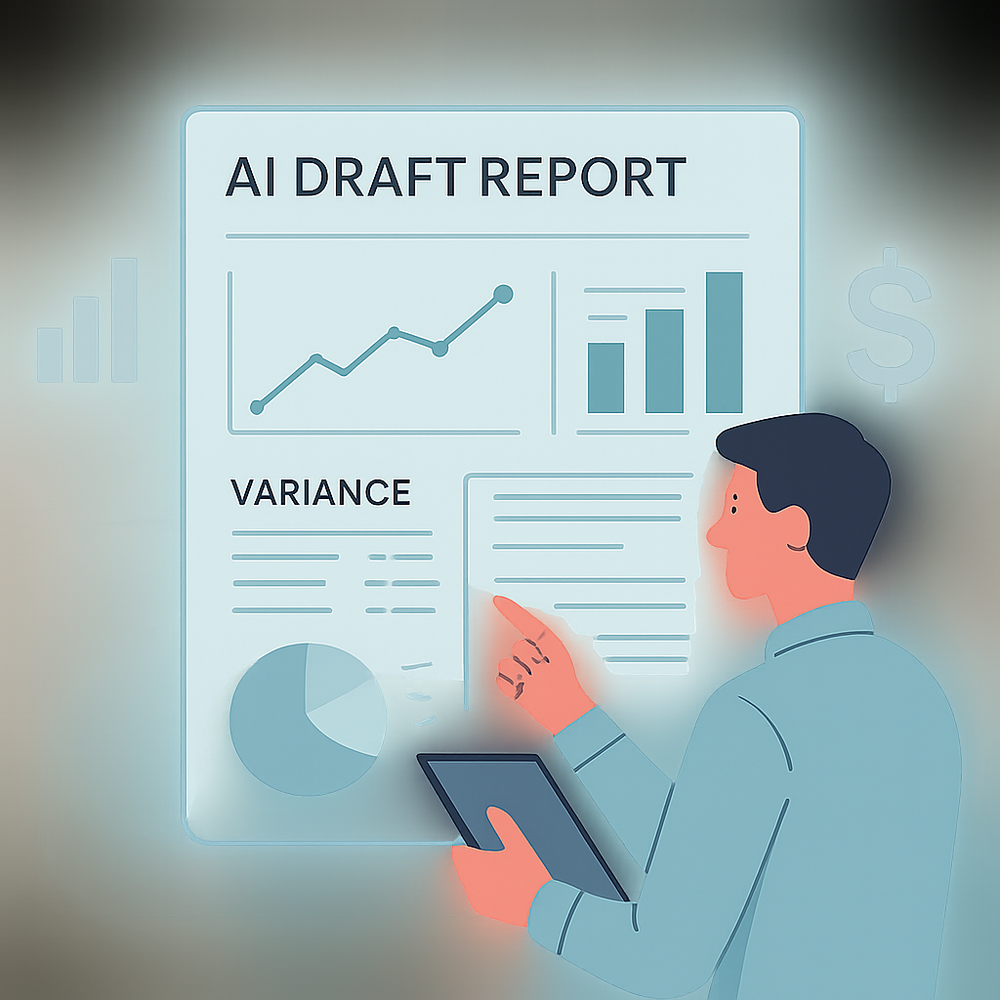
Consero's 2026 CFO Survey ranks management reporting and variance analysis as the fastest-paying AI use case in finance, with a three to six month payback across the surveyed peer group of 102 finance leaders. The mechanism is narrative generation layered on top of variance data finance already has: instead of an analyst manually writing up why gross margin moved 80 basis points, a model drafts the first pass of the explanation from the underlying transaction and forecast data, and the analyst edits rather than writes from scratch.
This is a lower-risk starting point than treasury automation or contract intelligence because the output is a draft for a human to review, not an autonomous action. Finance leaders exploring how ML consulting for business decisions reshapes board reporting often start here precisely because the failure mode is a bad first draft, not a bad payment.
6. Payment Anomaly and Fraud Detection
Payment fraud detection sits alongside customer service as one of the few finance-adjacent AI use cases with a majority of programs reaching payback within the first year, per Bain's Agentic AI Benchmark 2026, because the underlying data is high-volume, standardised, and already labelled with historical fraud outcomes to train against. A model that scores every outbound payment against a company's own transaction history catches the pattern a rules-based threshold misses, such as a vendor's bank details changing shortly before an unusually large invoice.
The budgeting reality is that fraud detection projects rarely ship as standalone line items. They are usually scoped alongside treasury or reconciliation work and priced together, which is why finance leaders comparing vendor quotes should read the AI agent development cost for the underlying agent infrastructure before assuming fraud detection is a separate line.
Payback Timelines at a Glance
|
Use Case |
Typical Payback |
Primary Blocker |
|
Continuous close and reconciliation |
1 to 3 months |
Ledger and bank feed integration |
|
FP&A forecasting and scenario planning |
3 to 6 months |
Historical data quality |
|
Contract and document intelligence |
4 to 8 months |
Contract language variability |
|
Agentic treasury and liquidity |
6 to 12 months |
ERP and banking API access |
|
Management reporting and variance analysis |
3 to 6 months |
Report template standardisation |
|
Payment anomaly and fraud detection |
4 to 9 months |
Labelled historical fraud data |
Where the 2026 Finance AI Budget Actually Lands
The pattern across all six use cases is the same: finance teams are funding work with a measurable before-and-after, not work with a compelling demo. Continuous reconciliation, variance narrative drafting, and contract term extraction all have a clear baseline to measure against, which is exactly why they clear budget committees faster than open-ended treasury automation.
Finance leaders building a 2026 roadmap around these six categories are better served scoping the highest-payback item first and proving the model before committing to the harder integration work in treasury or fraud detection. For teams ready to move past the pilot stage, working with someone who can hire an AI and ML developer with production finance experience shortens that path considerably.
Frequently asked questions
What is the fastest paying AI use case in finance for 2026?
Why does finance rank last among business functions in AI deployment?
How much do AI assisted forecasting tools shorten the budgeting cycle?
Is agentic AI in treasury actually generating savings in 2026?
What is the biggest risk in finance AI contract intelligence projects?
Should finance teams build AI agents in house or hire a specialist?



Shreyans Padmani
Shreyans Padmani has 5+ years of experience leading innovative software solutions, specializing in AI, LLMs, RAG, and strategic application development. He transforms emerging technologies into scalable, high-performance systems, combining strong technical expertise with business-focused execution to deliver impactful digital solutions.