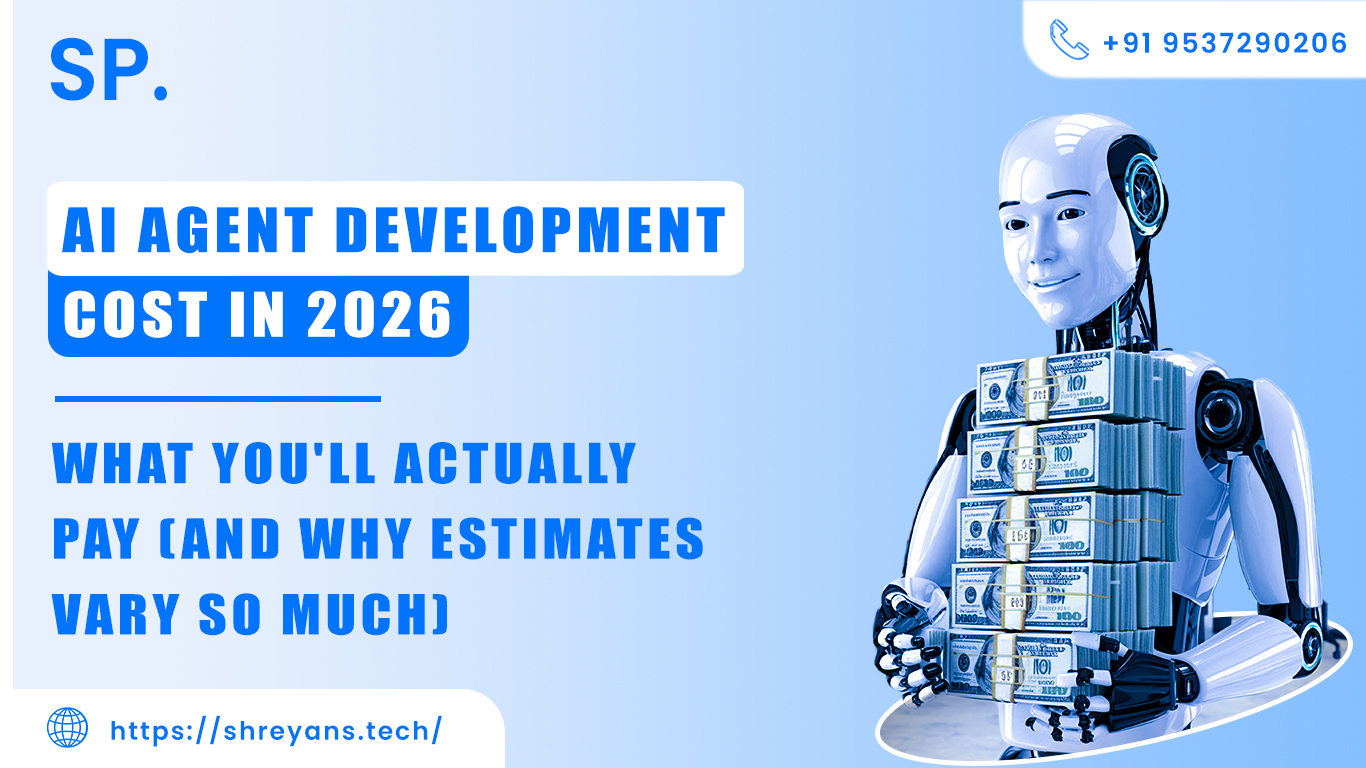
Even the analysts can't agree. Fortune Business Insights puts the 2026 global agentic AI market at $9.14 billion, Mordor Intelligence puts it at $9.89 billion, MarketsandMarkets says $7.06 billion, and Deloitte estimates $8.5 billion, four credible firms, four different numbers, all tracking the same underlying market. If professional analysts can't converge on a market size, it's no surprise that AI agent development cost quotes for what sounds like the same project routinely vary by 3 to 5 times, based on a 2026 survey of more than 40 real agent builds.
Whether you're comparing vendors for AI agent development services or evaluating in-house estimates, understanding what is and isn't included in each proposal is essential for making meaningful cost comparisons.
That variance isn't vendors being dishonest, it's usually a sign that "build me an AI agent" is being scoped completely differently by each person quoting it. Here's what actually drives the number, tier by tier, and how to get quotes that are comparable instead of wildly apart.
The Price Range You'll Actually See
The single biggest reason quotes vary is that "AI agent" describes wildly different systems. Here's roughly where each tier lands in 2026.
|
Tier |
Typical cost |
What it actually is |
|---|---|---|
|
Rule-based / simple |
$1,500–$20,000 |
Fixed logic, predictable triggers, minimal reasoning (e.g. "classify this ticket and forward to Slack") |
|
Model-based / context-aware |
$20,000–$75,000 |
Understands intent, uses one or two tools, handles a single well-defined workflow |
|
Learning / multi-step reasoning |
$50,000–$150,000 |
Plans across multiple steps, calls several tools, adapts based on intermediate results |
|
Multi-agent / enterprise |
$150,000–$400,000+ |
Multiple coordinated agents, shared memory, full compliance and orchestration layer |
The jump between tiers is rarely gradual. full stack vs specialist covers how to figure out which tier your actual problem needs before requesting quotes, since scoping a single-workflow problem as a multi-agent system (or the reverse) is the single most common reason a budget ends up wrong from the start.
What Actually Drives the Price Within Each Tier
Two projects in the same tier can still price 2x apart based on four factors that rarely show up clearly in a summary quote.

Model choice
Routing every call through a top-tier reasoning model versus a tiered approach, cheap models for simple classification, expensive models only for genuinely complex steps, can swing ongoing API cost by 60% to 80%. This affects the quote directly if the vendor is pricing in a model-cost buffer, and affects your operating cost either way.
Integration count and documentation quality
Connecting to a well-documented modern API costs a fraction of what it costs to connect to an internal legacy system with no documentation. Vendors who've seen your actual systems before quoting price integration work very differently from vendors quoting off a generic description of "connects to our CRM."
Team location and engagement model
A US-based agency, a nearshore team, and an offshore freelance developer can all deliver the same technical outcome at meaningfully different price points. AI development cost in India breaks down how much this single factor alone can move the final number, often by 40% to 60%, independent of the technical scope.
Industry and compliance overlay
Healthcare, finance, and other regulated industries add real cost for audit trails, access controls, and compliance documentation, commonly 20% to 40% on top of the base build. This is a legitimate cost, not padding, but it should be itemised separately in a quote rather than buried in a single number.
Why Two Quotes for the "Same" Agent Can Differ by 3x
When a vendor quotes low, it's often because the quote assumes your data is already clean, your APIs are already documented, and your requirements won't change once development starts. None of those assumptions usually survive contact with a real project. When a vendor quotes high, it's often because they're pricing in exactly the risk the low quote ignored, plus their own margin for the discovery work a vague brief forces them to do.
The practical result is that a $15,000 quote and a $60,000 quote for what looks like the same agent on paper are frequently not actually comparable at all, one includes a real discovery phase and buffer for the unknowns, the other assumes everything goes exactly as described in a one-paragraph brief. Comparing quotes by dollar figure alone, without checking what assumptions each one is built on, is how businesses end up either overpaying for padding or underpaying for a project that stalls the moment reality diverges from the brief.
A Realistic Budget by Business Size and Stage
|
Stage |
Realistic first-project budget |
What to prioritise |
|---|---|---|
|
Pre-seed / early startup |
$5,000–$20,000 |
A single focused workflow, validated fast, before committing more |
|
Growth-stage startup |
$25,000–$80,000 |
One well-integrated agent solving a proven, high-volume bottleneck |
|
Mid-market business |
$50,000–$150,000 |
Multiple integrations, a real discovery phase, documented compliance if needed |
|
Enterprise |
$150,000–$400,000+ |
Multi-agent orchestration, full governance, dedicated ongoing support |
These are first-project budgets, not full three-year totals. Ongoing operation, API costs, maintenance, prompt tuning, adds meaningfully more over time, and is worth planning for separately from the initial build number.
How to Get an Accurate Quote Instead of a Wide Range
The single biggest lever you control is the brief. A request for proposal that names the exact workflow, the exact data sources involved, the exact integrations required, with a note on documentation quality, and your compliance requirements up front, will get back quotes that are actually comparable to each other, instead of quotes reflecting how much risk each vendor decided to price in for the ambiguity you left them to fill.
A short, paid discovery phase, typically $500 to $2,000, before a full quote is issued, is a strong signal you're working with a vendor who scopes based on your actual systems rather than a generic template. choosing an AI development partner covers the broader vendor evaluation questions worth pairing with this pricing framework before you commit to any one quote.

What Comes Next
As agent frameworks standardise and more of the underlying orchestration work becomes reusable rather than custom-built for every project, the price spread between vendors should compress somewhat over the next few years, but the gap between a scoped brief and a vague one will probably matter just as much as it does today. The businesses getting accurate, comparable quotes right now aren't the ones asking the most vendors for pricing, they're the ones giving every vendor the same detailed brief to price against. If you're ready to scope a real number for your specific project, hire ai and ml developers who ask about your actual data and systems before quoting, not after, can give you a figure worth planning a budget around.
Frequently asked questions
What is the average AI agent development cost in 2026?
Why do AI agent development cost quotes vary so much between vendors?
What's the difference between a single-agent and multi-agent system cost-wise?
Does hiring an offshore or freelance AI agent developer reduce cost significantly?
What should be included in an RFP to get comparable AI agent development cost quotes?
How much should I budget beyond the initial ai agent development services quote for ongoing costs?



Shreyans Padmani
Shreyans Padmani has 5+ years of experience leading innovative software solutions, specializing in AI, LLMs, RAG, and strategic application development. He transforms emerging technologies into scalable, high-performance systems, combining strong technical expertise with business-focused execution to deliver impactful digital solutions.