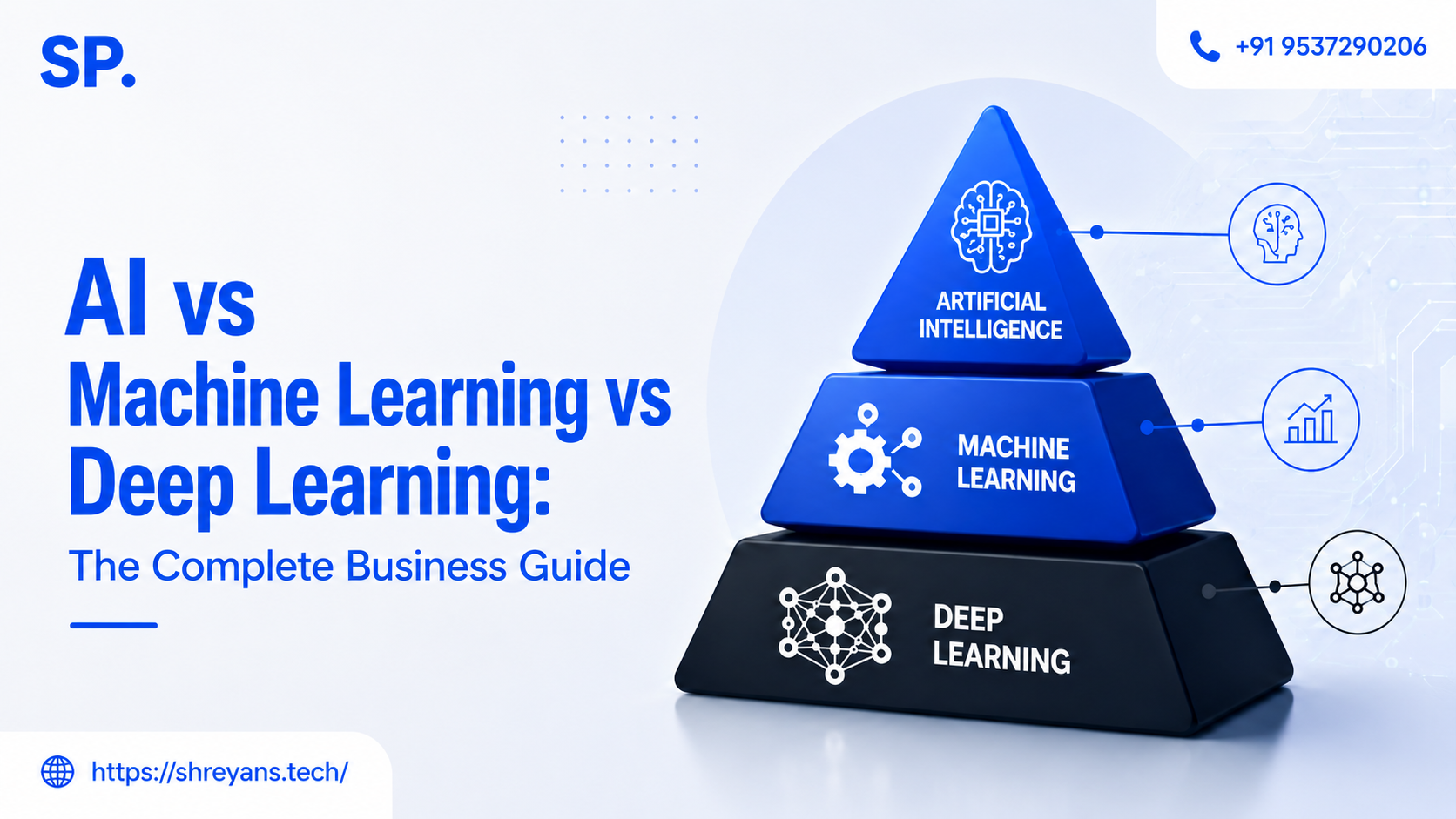
Approximately one in four companies implemented AI to address workforce constraints in 2026, accelerating adoption across the global ML and AI markets according to iTransition's 2026 statistics compilation. AI is the broad field of making machines intelligent, while machine learning is one method within AI that uses data and statistical algorithms to learn, and deep learning is a subset of ML that uses multi-layer neural networks according to AI Growth Gear's 2026 business guide.
The Hierarchy: AI, Machine Learning, and Deep Learning Defined
Artificial intelligence forms the outermost circle, encompassing any system that simulates human intelligence through rules, search, or learning. Machine learning sits inside that circle, defined by the shift from hand-coded logic to models that improve automatically from data. Deep learning occupies the innermost ring, a specialised branch of machine learning that stacks multiple neural-network layers to learn hierarchical representations directly from raw inputs such as images, audio, or text.
A competent developer will map the problem to the correct layer before writing any model code, because moving one ring outward or inward changes the entire MLOps stack from data labelling strategy to monitoring for concept drift.
Structured Data: Classic ML Territory
Tabular workloads remain the natural domain of gradient-boosted decision trees and linear models wrapped in scikit-learn pipelines. XGBoost and LightGBM handle missing values natively, scale to millions of rows on a single machine, and expose feature importance metrics that stakeholders can audit. A typical production pipeline couples these estimators with column transformers for encoding, imputation, and scaling, then serialises the entire object with joblib for reproducible inference. The result is a model that trains in minutes, serves in milliseconds, and requires no GPU infrastructure.
Unstructured Data: Deep Learning Territory
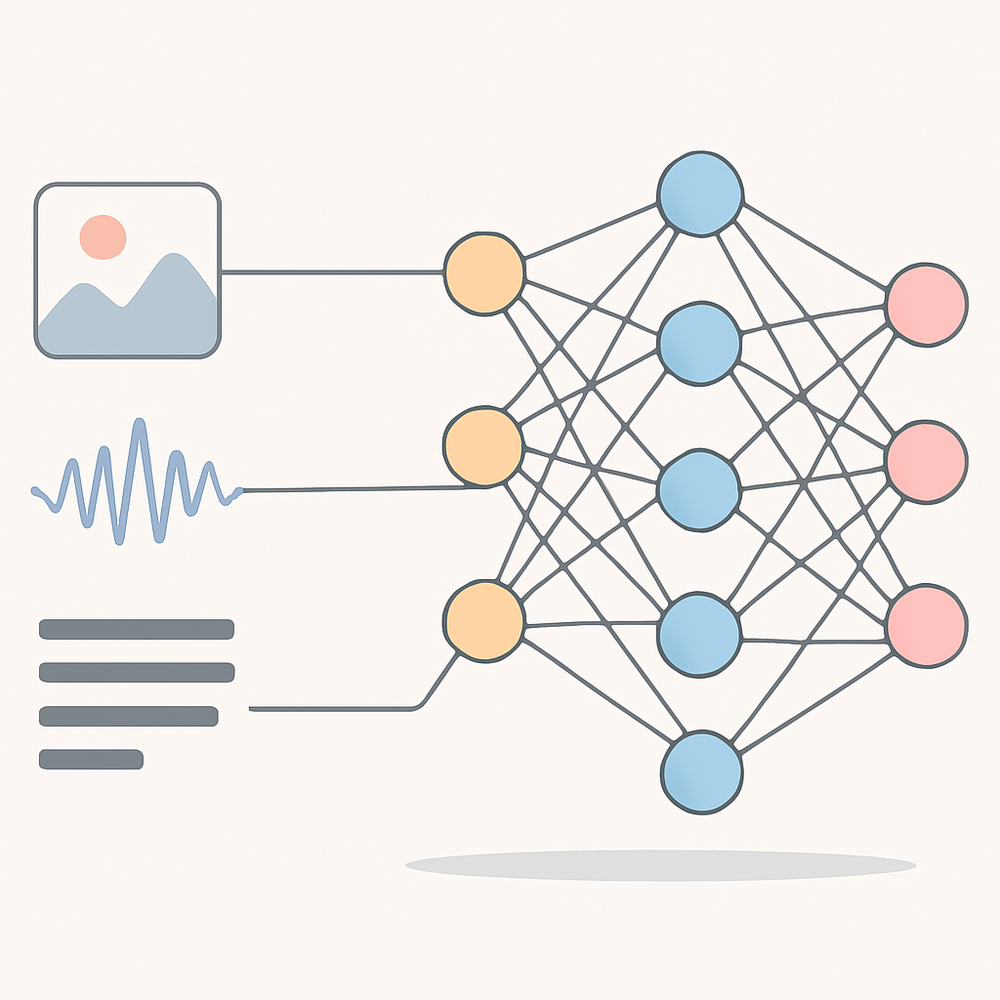
Images, audio, and free-form text demand architectures that learn representations from raw pixels, waveforms, or token sequences. Convolutional neural networks such as YOLO or EfficientNet remain the workhorses for detection and classification, while transformer-based models including BERT, Whisper, and the GPT family dominate language and speech tasks. Pre-trained checkpoints from Hugging Face or PyTorch Hub let you fine-tune on domain data with a fraction of the labelled examples required for training from scratch.
Infrastructure and Compute Requirements Compared
Choosing the right compute tier starts with the model class. Classic machine learning workloads built on scikit-learn, XGBoost, or LightGBM run efficiently on CPUs and can be prototyped in weeks. Deep learning stacks such as PyTorch or TensorFlow demand GPUs or TPUs for high-speed parallel computation and typically extend training cycles to months. A 2026 industry analysis found that training naturally gravitates toward the most powerful GPUs available, while inference workloads are more concise and less demanding, making affordable GPU-CPU combinations like the AMD Instinct MI300A sensible choices.
| Tier | Typical Hardware | Memory Footprint | Training Time | Inference Latency |
|---|---|---|---|---|
| Classic ML | CPU (e.g. AMD EPYC, Intel Xeon) | GBs | Minutes to hours | Sub-millisecond |
| Deep Learning (single GPU) | NVIDIA H100 / A100 | 80 GB HBM | Hours to days | Low single-digit ms |
| Deep Learning (multi-GPU) | 4-8x H100 / H200 / B200 | 320 GB-640 GB | Days to weeks | Low single-digit ms |
| Inference Optimised | AMD Instinct MI300A / T4 / L4 | 16-128 GB | N/A | Sub-millisecond to ms |
Cloud pricing follows the same gradient. An on-demand H100 instance can exceed thirty dollars per hour, while a T4 or L4 for inference often sits below one dollar per hour. Multi-GPU clusters add interconnect costs (NVLink, InfiniBand) that can double the effective hourly rate. Factoring these figures into a ML consultant cost model helps you separate infrastructure spend from engineering fees.
Hire AI Experts
Accelerate AI adoption with expert consultants, schedule a consultation
Hire AI DevelopersTraining Compute: CPU vs GPU vs TPU
Training compute decisions hinge on model size and iteration speed. Classic ML algorithms converge on CPU clusters in minutes to hours, keeping cloud bills low. Deep learning runs on single H100 or A100 GPUs accelerate matrix operations but require 80 GB HBM to fit large batches. Top-tier labs choose B200 chips for massive next-generation models, and multi-GPU setups distribute the workload across dozens of processors to handle large mathematical equations faster. The trade-off is a steep rise in per-hour cost and engineering complexity for distributed training frameworks such as DeepSpeed or FSDP.
Inference at Scale: Latency and Throughput
Inference at scale shifts the priority from raw FLOPS to latency and throughput per dollar. Serving architectures like Triton Inference Server or vLLM enable dynamic batching and model parallelism on cheaper GPUs such as the T4, L4, or MI300A. Model compression techniques (quantisation to INT4/INT8, distillation, pruning) reduce memory footprint and cut latency by 30 to 50 percent with minimal accuracy loss. Real-time endpoints favour sub-millisecond response and benefit from GPU caching, while batch pipelines can saturate throughput on CPU-only instances, lowering the total cost of ownership for high-volume workloads.
Why Production ML Projects Fail
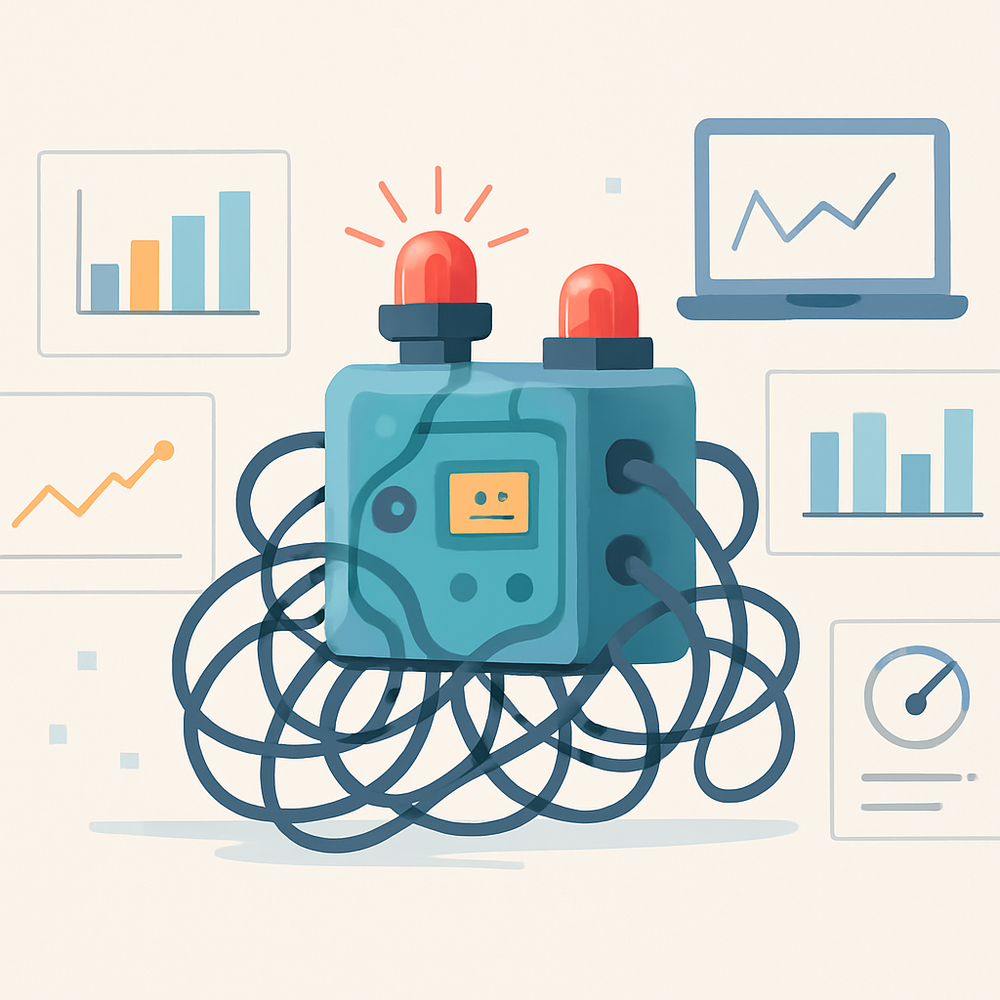
Technical debt compounds quickly when monitoring is an afterthought. Without observable latency, error-rate, and data-quality metrics wired into alerting, a degradation that starts at 2 percent can reach 20 percent before anyone notices. Teams that treat MLOps as a first-class concern, versioning data alongside code and enforcing contract tests on feature pipelines, spend far less time firefighting and more time improving the product. For a breakdown of where budgets typically overrun, see the hidden costs guide.
Decision Framework: Choosing the Right Tier for Your Use Case
A competent developer will ask for a labelled sample, a baseline metric, and a cost ceiling before proposing an architecture. If the baseline from a simple logistic regression already meets the business threshold, adding a transformer only increases training cost and operational complexity. Expect to add 20 to 35 percent to project costs for high-risk AI systems to cover bias testing, documentation, audit trails, and legal review, according to a 2026 industry analysis.
| Problem profile | Recommended approach | Typical data need | Inference budget |
|---|---|---|---|
| Tabular, structured features, < 50k rows | Classical ML (XGBoost, LightGBM) | Labelled CSV, feature engineering | Milliseconds on CPU |
| Images, video, audio, long text | Deep learning (CNN, Transformer) | 10k+ labelled samples per class | GPU or accelerator preferred |
| Hybrid: tabular + text or image | Multi-modal or ensemble | Both structured and unstructured labels | Depends on heaviest modality |
Map your use case to the row that fits, then validate with a two-week spike before committing to a full build. A production-grade pipeline needs monitoring, drift detection, and a rollback plan regardless of which tier you choose.
Hiring for the Right Skill Set
Matching the engineering profile to the problem tier prevents the common mismatch of hiring a research scientist for a production integration or a prompt engineer for a custom model build. Tier one work such as retrieval augmented generation pipelines, structured extraction, or fine tuning open weight models on proprietary data demands a developer fluent in LangChain, LlamaIndex, and vector databases such as Pinecone or Weaviate. Tier two projects that require custom architectures, distributed training, or latency optimised inference call for deep PyTorch or JAX experience, CUDA profiling skills, and a track record of deploying models behind generative AI model integration endpoints. Tier three engagements involving novel research, publication grade experimentation, or fundamental algorithm design need a PhD level researcher with conference papers and reproducible codebases.
| Tier | Typical Scope | Core Skills | Interview Focus |
|---|---|---|---|
| Tier 1: Integration & Fine Tuning | RAG pipelines, prompt engineering, LoRA fine tuning, structured extraction | LangChain, LlamaIndex, vector DBs, OpenAI or Anthropic APIs, evaluation frameworks | RAG eval design, hallucination debugging, chunking strategy, cost latency trade offs |
| Tier 2: Custom Models & Production ML | Custom architectures, distributed training, optimised inference, MLOps pipelines | PyTorch, JAX, CUDA, Triton, vLLM, Kubernetes, MLflow, feature stores | Distributed training checkpoints, mixed precision, serving architecture, drift monitoring |
| Tier 3: Research & Novel Algorithms | Novel architectures, publication grade experiments, fundamental algorithm design | Advanced mathematics, conference publications, reproducible research, JAX or PyTorch internals | Published method walkthrough, ablation design, reproducibility checklist, theoretical grounding |
Specialised problem domains demand matching specialisations. Computer vision work such as detection, segmentation, or pose estimation requires fluency in YOLO, Detectron2, or SAM plus experience with ONNX export and edge deployment on TensorRT or CoreML. Natural language tasks beyond generic chat such as multilingual NER, domain specific summarisation, or constrained generation need spaCy, Hugging Face transformers, and token level evaluation expertise. Engaging a developer with proven computer vision capabilities or natural language processing expertise reduces ramp time and avoids the costly trial and error of generalists learning on your budget.
For organisations that need sustained delivery across multiple tiers, a machine learning development services partner who can staff the right profile per workstream eliminates the hiring overhead of building an internal bench for every specialisation. The key is defining the tier before the search begins so the interview loop, compensation band, and onboarding plan all align with the actual engineering demand.
Where the Real Work Starts
Definitions are useful, but they do not ship models. The gap between a labelled diagram and a production system is measured in data pipelines that hold up under drift, evaluation harnesses that catch regression before users do, and inference costs that stay predictable at scale. Choosing the right tier of the stack, classical ML, deep learning, or a hybrid, only matters once those foundations exist.
When you are ready to move from taxonomy to delivery, hire AI developer who ships systems, not slide decks.
Frequently asked questions
What is the difference between AI, machine learning, and deep learning?
When should I choose classical machine learning over deep learning?
How much does it cost to build a production machine learning system?
What data volume do I need for deep learning versus classical ML?
Which tools and frameworks are standard for each approach?
What are the operational risks of deploying deep learning in production?



Shreyans Padmani
Shreyans Padmani has 5+ years of experience leading innovative software solutions, specializing in AI, LLMs, RAG, and strategic application development. He transforms emerging technologies into scalable, high-performance systems, combining strong technical expertise with business-focused execution to deliver impactful digital solutions.