Introduction
Artificial Intelligence (AI) is no longer just a futuristic concept—it’s a reality shaping the way businesses operate. In 2026, AI technologies are smarter, faster, and more integrated into daily business processes than ever before. Companies adopting AI early can gain a competitive edge by improving efficiency, enhancing customer experiences, and making data-driven decisions.
This blog explores the key AI trends every business should know in 2026, along with practical insights and FAQs to help you understand how AI can impact your organization.
Key AI Trends for Businesses in 2026
1. Generative AI Goes Mainstream
Generative AI is now capable of creating content, designs, videos, and even software code. Businesses are leveraging this technology to:
-
Produce marketing content instantly: Generative AI tools can create high-quality blog posts, social media updates, ads, and newsletters in seconds, saving businesses hours of manual work. This allows marketing teams to focus on strategy while maintaining consistent and engaging content.
-
Automate creative processes: AI can generate designs, graphics, product mockups, videos, and other creative assets automatically. This reduces the need for repetitive design tasks and helps businesses bring ideas to life faster and more efficiently.
-
Improve customer engagement through AI-generated communication: AI-powered chatbots and virtual assistants can respond to customer queries in real-time with natural, human-like language. Personalized messages and content recommendations enhance customer satisfaction and keep users engaged longer.
Companies using generative AI can save time, reduce costs, and maintain high-quality content output.
2. AI-Powered Automation Expands
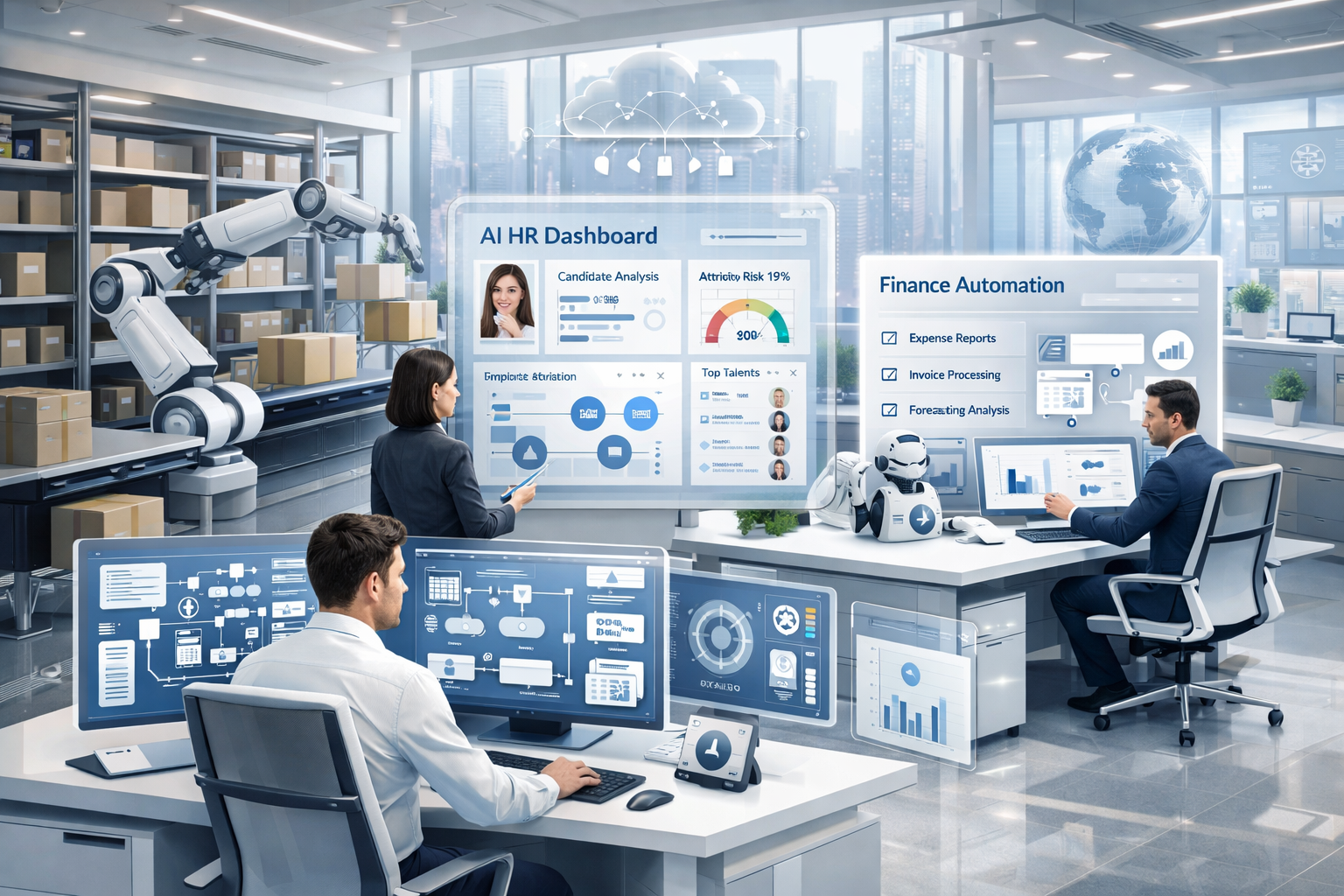
Automation is no longer limited to repetitive tasks. Modern AI systems can handle complex processes across industries:
-
Optimize supply chain operations: AI can predict demand, manage inventory levels, and plan delivery routes efficiently. This reduces delays, minimizes costs, and ensures that products reach customers on time, improving overall supply chain performance.
-
Automate HR workflows like recruitment and onboarding: AI tools can screen resumes, shortlist candidates, schedule interviews, and even guide new employees through onboarding. This saves HR teams time and ensures a faster, more accurate hiring process.
-
Streamline finance and accounting tasks: AI can automate payroll, reconcile accounts, detect anomalies, and generate financial reports. This reduces human error, speeds up processes, and allows finance teams to focus on strategic decision-making.
This allows teams to focus on strategy and innovation rather than routine work.
3. Advanced Predictive Analytics
Predictive analytics uses AI to forecast trends and customer behavior. In 2026, businesses are seeing:
-
Accurate sales and inventory predictions: AI analyzes historical sales data and market trends to forecast demand accurately. This helps businesses maintain optimal inventory levels, reduce stockouts or overstock situations, and improve overall supply chain efficiency.
-
Financial forecasting with reduced errors: AI-powered predictive models can project revenue, cash flow, and expenses with higher accuracy than traditional methods. This reduces financial risks and helps companies make smarter investment and budgeting decisions.
-
Personalized marketing campaigns targeting the right audience: AI analyzes customer behavior, preferences, and past interactions to create highly targeted marketing campaigns. Personalized messages, product recommendations, and promotions increase engagement, conversion rates, and customer loyalty.
Predictive analytics helps companies make smarter, data-driven decisions and reduce business risks.
4. AI in Cybersecurity
With cyber threats rising, AI has become essential for protecting business data:
-
Real-time threat detection and response: AI continuously monitors systems and networks to identify potential security threats instantly. This allows businesses to respond immediately, minimizing the risk of data breaches and cyber attacks.
-
Identifying anomalies in network traffic: AI analyzes patterns in network activity and detects unusual behavior that may indicate hacking attempts or malware. Early detection prevents significant damage and protects sensitive business information.
-
Automating cybersecurity workflows: AI automates routine security tasks like vulnerability scanning, patch management, and incident reporting. This reduces manual effort, improves efficiency, and ensures that security protocols are consistently followed.
Investing in AI-driven security safeguards sensitive data and maintains customer trust.
5. Voice and Visual Search Integration
Voice and visual search are transforming how customers find products:
-
Shoppers can search using images or voice commands: AI-powered visual and voice search allows customers to find products by simply uploading a photo or speaking a query. This makes product discovery faster, easier, and more interactive.
-
Businesses can enhance the user experience and accessibility: Voice and visual search improve accessibility for users with disabilities or those who prefer hands-free navigation. This creates a smoother, more inclusive shopping experience.
-
Marketing strategies can be optimized for visual and voice-based search: Businesses can adjust SEO, product listings, and advertising campaigns to target voice and image search queries. This increases online visibility and drives more qualified traffic to websites.
Integrating these technologies can increase engagement and sales.
6. Ethical and Responsible AI
AI adoption comes with ethical responsibilities:
-
Ensuring transparency in AI decision-making: Businesses should make AI processes clear and explainable. Customers and stakeholders must understand how AI reaches decisions, which builds trust and confidence in automated systems.
-
Avoiding algorithmic bias: AI models must be regularly tested to ensure they do not favor or discriminate against any group. Reducing bias ensures fair, accurate, and ethical outcomes in hiring, lending, marketing, and other critical business areas.
-
Complying with emerging AI regulations: Companies need to stay updated with new AI laws and industry standards. Compliance prevents legal risks, protects customer data, and promotes responsible AI adoption.
Ethical AI practices build trust with customers and stakeholders.
7. AI for Enhanced Customer Experience
AI improves how businesses interact with customers:
-
Chatbots provide 24/7 instant support: AI-powered chatbots handle customer queries at any time of day, reducing response times and ensuring customers always get help when needed. This improves satisfaction and builds trust in your brand.
-
AI analyzes feedback to improve products and services: AI tools can collect and analyze customer reviews, surveys, and interactions to identify trends and pain points. Businesses can use these insights to enhance products, services, and overall customer experience.
-
Personalized recommendations increase sales and retention: AI studies user behavior, preferences, and purchase history to provide personalized product or service suggestions. This not only drives more sales but also encourages repeat purchases and long-term customer loyalty.
Companies prioritizing AI-driven customer experiences see higher satisfaction and loyalty.
FAQs About AI Trends in 2026
Q1. What is the difference between AI and Machine Learning?
Ans: AI is the broader concept of machines performing intelligent tasks, while Machine Learning (ML) is a subset of AI where systems learn from data to make predictions or decisions without explicit programming.
Q2. How can small businesses benefit from AI in 2026?
Ans: Small businesses can use AI for automation, marketing personalization, customer support, and predictive analytics—helping them save time, reduce costs, and compete with larger companies.
Q3. Is AI expensive to implement?
Ans: The cost of AI depends on the scale and type of technology. Cloud-based AI solutions and pre-built AI tools make it more affordable, even for small and medium-sized businesses.
Q4. Will AI replace human employees?
Ans: AI is designed to assist, not replace humans. It automates repetitive tasks, allowing employees to focus on strategic, creative, and high-value work.
Q5. How can businesses ensure ethical AI usage?
Ans: By ensuring transparency, monitoring algorithms for bias, complying with regulations, and educating teams about responsible AI practices.
Conclusion
AI in 2026 is transforming business operations across industries. From generative AI and predictive analytics to automation and ethical AI, the possibilities are immense. Businesses that understand and adopt these trends early will be able to improve efficiency, make smarter decisions, enhance customer experiences, and gain a competitive advantage.
Staying informed about AI trends and implementing the right strategies is no longer optional—it’s essential for sustainable growth in the modern digital landscape.



Shreyans Padmani
Shreyans Padmani has 5+ years of experience leading innovative software solutions, specializing in AI, LLMs, RAG, and strategic application development. He transforms emerging technologies into scalable, high-performance systems, combining strong technical expertise with business-focused execution to deliver impactful digital solutions.