Introduction
In today’s fast-paced digital world, startups face intense competition, limited budgets, and constant pressure to grow quickly. This is where Artificial Intelligence (AI) becomes a powerful game-changer.
AI helps startups automate tasks, understand customers better, and make smarter decisions—all while saving time and money. Instead of building large teams, startups can now use AI tools to scale faster and compete with bigger companies.
In simple words, AI is not just an option anymore—it’s a necessity for startup success.
What is AI for Startups?
AI for startups means using technologies like:
• Machine Learning
-
Machine Learning is a branch of artificial intelligence that allows computers to learn from data without being explicitly programmed. It helps startups analyze patterns, predict future trends, and improve decision-making. Businesses use machine learning for recommendations, fraud detection, and customer insights. By using this technology, startups can automate complex tasks and grow faster with smarter strategies.
• Data Analytics
-
Data Analytics is the process of collecting, analyzing, and interpreting data to make better business decisions. It helps startups understand customer behavior, market trends, and performance metrics. With data analytics, companies can identify opportunities, reduce risks, and improve efficiency. This makes it an essential tool for startups aiming for data-driven growth and success.
• Automation
Automation uses technology to perform repetitive tasks without human effort. Startups can automate processes like emails, customer support, billing, and marketing campaigns. This saves time, reduces errors, and increases productivity. By using automation, startups can focus more on innovation and business growth instead of routine work.
• AI Chatbots
-
AI Chatbots are virtual assistants that can interact with customers in real-time. They help startups provide 24/7 customer support, answer queries instantly, and improve user experience. Chatbots reduce workload on support teams and increase customer satisfaction. This makes them a powerful tool for improving engagement and boosting business growth.
These tools help startups:
• Automate Repetitive Work
-
Automation helps startups handle repetitive tasks like data entry, emails, and scheduling without manual effort. This saves time and reduces human errors in daily operations. By automating routine work, businesses can improve efficiency and productivity. It also allows teams to focus on more important tasks like innovation and strategy.
• Analyze Large Data Quickly
AI tools can process and analyze huge amounts of data in a very short time. This helps startups find patterns, trends, and useful insights easily. Instead of spending hours on manual analysis, businesses can make quick and accurate decisions. Fast data analysis gives startups a strong advantage in competitive markets.
• Improve Customer Experience
AI helps startups understand customer needs and preferences better. It can personalize recommendations, provide instant support, and improve communication. This leads to higher customer satisfaction and loyalty. A better customer experience also increases engagement and boosts business growth.
• Make Data-Driven Decisions
-
Data-driven decisions mean making choices based on real data instead of guesswork. AI analyzes past data and predicts future outcomes to guide business strategies. This reduces risks and improves accuracy in decision-making. Startups using data-driven approaches can grow faster and achieve better results.
This allows small businesses to grow faster with fewer resources.
Why AI is Important for Startup Growth
Startups need speed, efficiency, and smart decisions to survive—and AI provides all three.
Key Reasons:
• Faster Decision-Making with Real-Time Data:-
-
AI helps startups make quick decisions by analyzing real-time data instantly. Instead of waiting for reports, businesses get immediate insights and updates. This allows founders to respond faster to market changes and opportunities. Faster decision-making gives startups a strong competitive advantage.
• Reduced Operational Costs Through Automation:-
-
Automation reduces the need for manual work and large teams, which helps lower operational costs. Tasks like data entry, customer support, and marketing can be handled by AI tools. This saves money and improves efficiency. Startups can invest those savings into growth and innovation.
• Better Understanding of Customer Behavior:-
-
AI analyzes customer data to understand preferences, habits, and buying patterns. This helps startups create personalized experiences and targeted marketing strategies. Knowing what customers want improves engagement and satisfaction. It also increases chances of conversions and long-term loyalty.
• Increased Productivity:-
-
AI tools handle repetitive and time-consuming tasks, allowing employees to focus on important work. This improves overall productivity and efficiency within the team. Startups can achieve more work in less time without increasing workload. Higher productivity leads to faster business growth.
• Easy Scalability Without Large Hiring:-
-
AI allows startups to scale their operations without hiring many employees. Automated systems can handle increased workload as the business grows. This makes scaling faster, cost-effective, and manageable. Startups can expand their business smoothly without major resource challenges.
AI helps startups do more work in less time, which is critical in early stages.
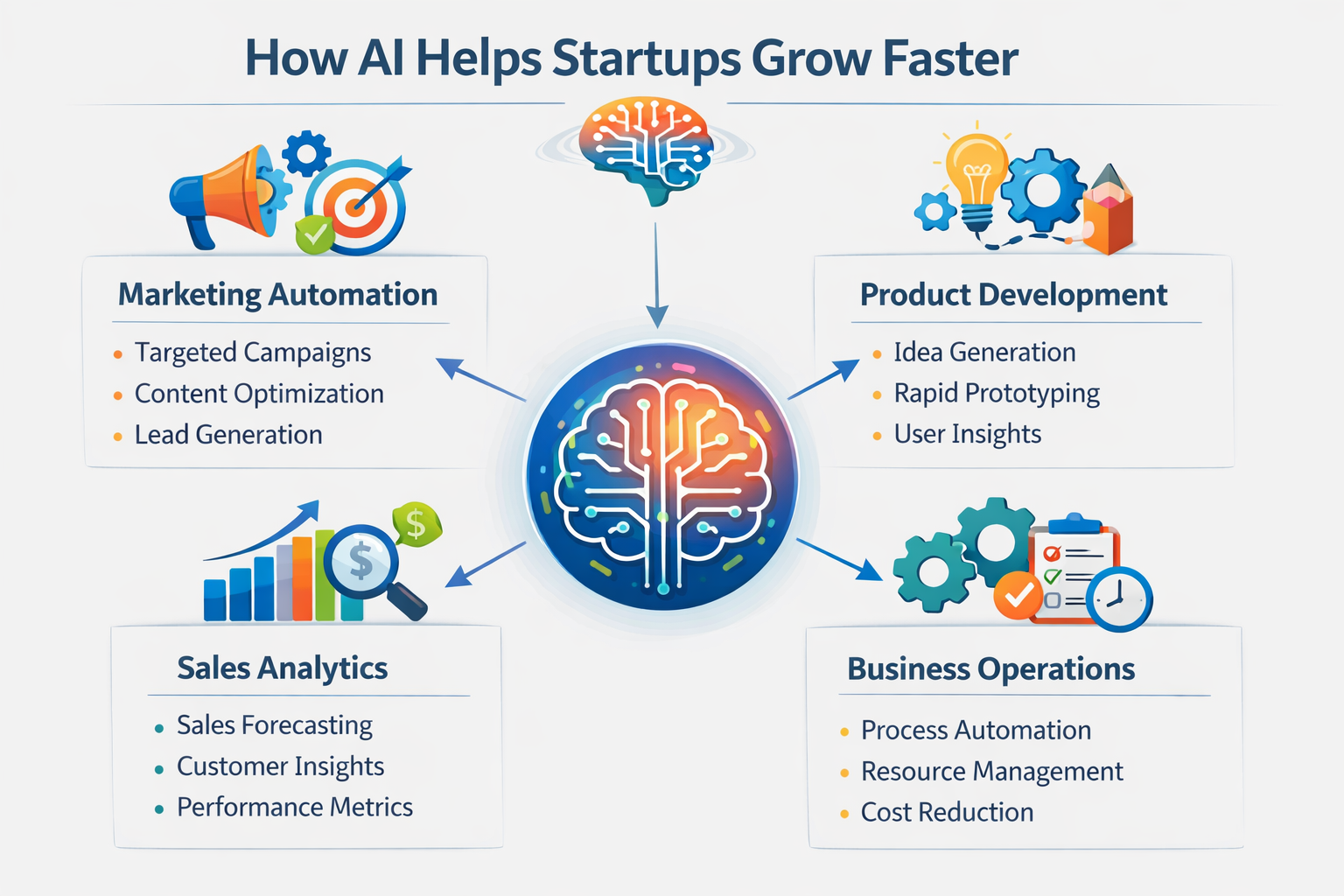
How AI Helps Startups Grow Faster
1. AI in Marketing & Customer Acquisition
AI improves marketing by:
-
• Personalizing Content:- AI helps startups create content tailored to individual customer preferences and interests. It analyzes user behavior, search history, and interactions to deliver relevant messages. Personalized content increases engagement and makes customers feel valued. This leads to higher conversion rates and stronger brand loyalty.
-
• Targeting the Right Audience:- AI allows businesses to identify and target the most relevant audience for their products or services. It uses data to segment users based on demographics, behavior, and interests. This ensures that marketing efforts reach the right people at the right time. As a result, startups can improve ROI and reduce wasted marketing costs.
-
• Automating Campaigns:- AI can automate marketing campaigns such as email marketing, social media posts, and advertisements. This reduces manual effort and ensures consistent communication with customers. Automated campaigns can also be optimized in real-time for better performance. This helps startups save time while increasing efficiency and results.
-
• Running Chatbots for 24/7 Support:- AI chatbots provide instant customer support at any time of the day. They can answer common questions, solve basic issues, and guide users through processes. This improves customer satisfaction and reduces workload on support teams. 24/7 availability ensures that no customer query goes unanswered.
This increases engagement and conversions while reducing marketing costs.
2. AI in Product Development
Startups can build better products using AI:
-
• Analyze User Feedback Automatically:- AI helps startups analyze customer feedback from reviews, surveys, and social media automatically. It quickly identifies common issues, suggestions, and customer sentiments. This saves time compared to manual analysis and provides accurate insights. By understanding feedback better, startups can improve their products and services effectively.
-
• Predict Market Trends:- AI uses historical data and patterns to predict future market trends and customer demands. This helps startups stay ahead of competitors and make proactive decisions. Businesses can plan strategies, launch products at the right time, and reduce risks. Predicting trends gives startups a strong advantage in a fast-changing market.
-
• Improve Features Quickly:- AI provides insights into how users interact with a product and what improvements are needed. Startups can identify weak points and update features faster based on real data. This leads to continuous product improvement and better user experience. Quick updates help startups stay relevant and competitive.
AI helps startups launch products faster and improve them continuously.
3. AI in Sales & CRM
AI tools help sales teams:
-
• Track Leads:- AI helps startups track and manage potential customers (leads) efficiently. It collects data from different sources like websites, emails, and social media. This allows businesses to monitor where leads come from and how they interact with the brand. Better lead tracking improves conversion rates and sales performance.
-
• Predict Customer Behavior:- AI analyzes past customer data to understand buying patterns and preferences. It can predict what customers are likely to purchase or how they will act in the future. This helps startups create personalized offers and improve marketing strategies. Predicting behavior increases customer satisfaction and boosts sales.
-
• Automate Follow-Ups:- AI tools can automatically send follow-up emails, messages, or notifications to customers. This ensures no lead or customer is missed during the sales process. Automated follow-ups save time and maintain consistent communication. It also increases chances of conversion and builds strong customer relationships.
This increases conversion rates and builds stronger customer relationships.
4. AI in Operations & Automation
AI simplifies daily business operations:
-
• Automates Repetitive Tasks (Emails, Reports, Scheduling):- AI helps startups automate routine tasks like sending emails, generating reports, and scheduling meetings. This reduces manual effort and saves valuable time for employees. Automation ensures tasks are completed quickly and consistently without delays. It allows teams to focus on important business activities and strategic growth.
-
• Manages Inventory and Workflows:- AI systems can track inventory levels and manage business workflows efficiently. They help ensure that stock is available when needed and prevent overstocking or shortages. AI also organizes tasks and processes, making operations smoother and more structured. This improves overall efficiency and supports better business management.
-
• Reduces Human Errors:- AI minimizes mistakes that often occur in manual work such as data entry or calculations. It follows programmed rules and processes data accurately every time. Reducing errors improves the quality of work and builds trust with customers. It also saves time and cost required to fix mistakes.
This saves time and allows teams to focus on important tasks.
Top Benefits of AI for Startups
1. Faster Decision-Making
AI analyzes large data instantly, helping founders make quick and accurate decisions.
2. Cost Efficiency
Automation reduces the need for large teams and lowers operational costs.
3. Better Customer Experience
AI personalizes services and improves customer satisfaction.
4. Increased Productivity
Teams can focus on strategy while AI handles routine work.
5. Scalable Growth
AI systems grow with your startup without increasing costs significantly.
6. Competitive Advantage
Startups using AI innovate faster and stay ahead of competitors.
AI can even reduce operational costs by up to 30% and save significant time for businesses.
Real Examples of AI in Startups
-
Stripe uses AI for fraud detection
-
PathAI uses AI for medical diagnosis
-
Dynamic Yield uses AI for personalization
These examples show how AI is driving real growth and innovation.
Best AI Tools for Startups
🔹 Marketing Tools
- • AI Content Generators
-
AI content generators help startups create blogs, social media posts, emails, and marketing content quickly. They use advanced algorithms to generate high-quality and relevant content based on user input. This saves time and reduces the need for large content teams. Using AI content tools also helps maintain consistency and improve content marketing strategies.
-
• SEO Tools
-
SEO tools powered by AI help startups improve their website ranking on search engines like Google. They analyze keywords, optimize content, and suggest improvements for better visibility. These tools help businesses attract more organic traffic and reach the right audience. Strong SEO strategies are essential for long-term online growth and success.
-
• Social Media Automation
-
Social media automation tools help startups schedule and manage posts across multiple platforms. They can automatically publish content, track performance, and engage with audiences. This saves time and ensures consistent online presence. Automation also helps startups grow their brand and connect with customers more effectively.
🔹 Sales Tools
-
• AI CRM Systems
-
AI CRM (Customer Relationship Management) systems help startups manage customer data and interactions in one place. They track customer activities, preferences, and communication history automatically. This allows businesses to build stronger relationships and provide personalized experiences. AI CRM systems also improve sales efficiency and customer retention.
-
• Email Automation
-
Email automation uses AI to send emails to customers automatically based on their behavior or actions. It helps startups send welcome emails, follow-ups, promotions, and updates without manual effort. This ensures timely communication and keeps customers engaged. Automated emails also increase conversion rates and save valuable time.
-
• Lead Scoring Tools
Lead scoring tools use AI to rank potential customers based on their likelihood to convert. They analyze user behavior, interactions, and engagement levels. This helps startups focus on high-quality leads instead of wasting time on less interested prospects. Better lead scoring improves sales performance and boosts business growth.
🔹 Productivity Tools
-
• Workflow Automation Tools
-
Workflow automation tools help startups streamline their business processes by automating tasks and approvals. They ensure that work moves smoothly from one step to another without delays. This reduces manual effort and improves overall efficiency. By using workflow automation, startups can save time and focus on important business goals.
-
• Financial Forecasting Software
-
Financial forecasting software uses AI to predict future revenue, expenses, and cash flow. It analyzes past financial data to help startups make better budgeting and investment decisions. This reduces financial risks and improves planning accuracy. Startups can use these insights to grow sustainably and manage their finances effectively.
-
• Project Management AI Tools
-
AI-powered project management tools help teams plan, track, and complete projects efficiently. They can assign tasks, set deadlines, and monitor progress automatically. These tools also provide insights to improve team productivity and project outcomes. Startups can deliver projects faster and stay organized with better collaboration.
These tools help startups scale faster and operate efficiently.
Challenges of Using AI in Startups
While AI offers many benefits, startups may face:
-
• High Initial Cost
-
Implementing AI solutions can require a significant initial investment for tools, software, and setup. Many startups may find it challenging to allocate budget in the early stages. However, this cost is often a long-term investment that leads to higher efficiency and savings. Over time, AI helps reduce operational expenses and improves overall profitability.
-
• Lack of AI Expertise
-
Startups may struggle due to a lack of skilled professionals who understand AI technologies. Hiring experienced AI developers or data scientists can be expensive. This can slow down the adoption of AI in business processes. To overcome this, startups can use user-friendly AI tools or outsource expertise.
-
• Data Privacy Concerns
-
AI systems rely heavily on data, including sensitive customer information. Improper handling of data can lead to privacy issues and security risks. Startups must follow proper data protection practices and regulations. Ensuring data privacy helps build trust with customers and avoids legal problems.
-
• Integration Complexity
-
Integrating AI into existing systems and workflows can be difficult and time-consuming. Startups may face technical challenges while connecting AI tools with current software. This can slow down implementation and require additional resources. Proper planning and choosing compatible tools can make integration smoother.
However, these challenges can be solved by starting small and using the right tools.
Tips to Get Started with AI
-
• Start with One Area (Marketing, Sales, or Support)
-
Startups should begin using AI in one specific area instead of applying it everywhere at once. Choosing areas like marketing, sales, or customer support makes implementation easier and more effective. This helps teams understand how AI works and measure its impact clearly. Starting small reduces risk and builds confidence for future expansion.
-
• Use Affordable AI Tools
-
There are many cost-effective and beginner-friendly AI tools available for startups. These tools provide powerful features without requiring a large budget or technical expertise. Using affordable solutions helps startups adopt AI without financial pressure. It also allows businesses to experiment and find the best tools for their needs.
-
• Focus on Automation First
-
Automation is one of the easiest and most beneficial ways to start using AI. Startups can automate repetitive tasks like emails, data entry, and scheduling. This saves time and improves efficiency from the beginning. Focusing on automation gives quick results and builds a strong foundation for advanced AI usage.
-
• Analyze Data Regularly
-
AI works best when startups continuously analyze their data and performance. Regular data analysis helps identify trends, measure results, and improve strategies. It ensures that AI tools are being used effectively. Data-driven insights help startups make smarter decisions and achieve better outcomes.
-
• Scale AI Usage Gradually
-
Once startups see positive results, they should expand AI usage step by step. Gradual scaling helps manage costs and reduces risks. It also allows teams to adapt to new technologies comfortably. This approach ensures long-term success and sustainable growth with AI.
FAQs
Q1: What is AI for startups?
AI for startups means using artificial intelligence tools to automate tasks, analyze data, and improve business growth.
Q2: How does AI help startups grow faster?
AI reduces costs, improves efficiency, and provides insights that help startups make better decisions quickly.
Q3: Which areas benefit most from AI?
Marketing, sales, customer support, operations, and product development.
Q4: Is AI expensive for startups?
Not always. Many affordable AI tools are available for small businesses.
Conclusion
AI is transforming the startup ecosystem by enabling faster growth, smarter decisions, and better customer experiences. From marketing automation to product development, AI helps startups do more with less.
Startups that adopt AI early gain a strong competitive advantage and position themselves for long-term success.
The future belongs to startups that use AI smartly.



Shreyans Padmani
Shreyans Padmani has 5+ years of experience leading innovative software solutions, specializing in AI, LLMs, RAG, and strategic application development. He transforms emerging technologies into scalable, high-performance systems, combining strong technical expertise with business-focused execution to deliver impactful digital solutions.