Global Market Insights projects the multimodal AI market will grow from 1.6 billion US dollars in 2024 to 27 billion US dollars by 2034, a scale of expansion most single-modality ML roadmaps were not built to absorb. Gartner forecasts that 80 percent of enterprise software will carry multimodal capability by 2030, up from less than five percent in 2024. McKinsey's most recent global AI survey puts adoption at 78 percent of organisations using AI in at least one business function, which means the debate has moved from whether to build machine learning systems to which architecture choices still hold up in 2026.
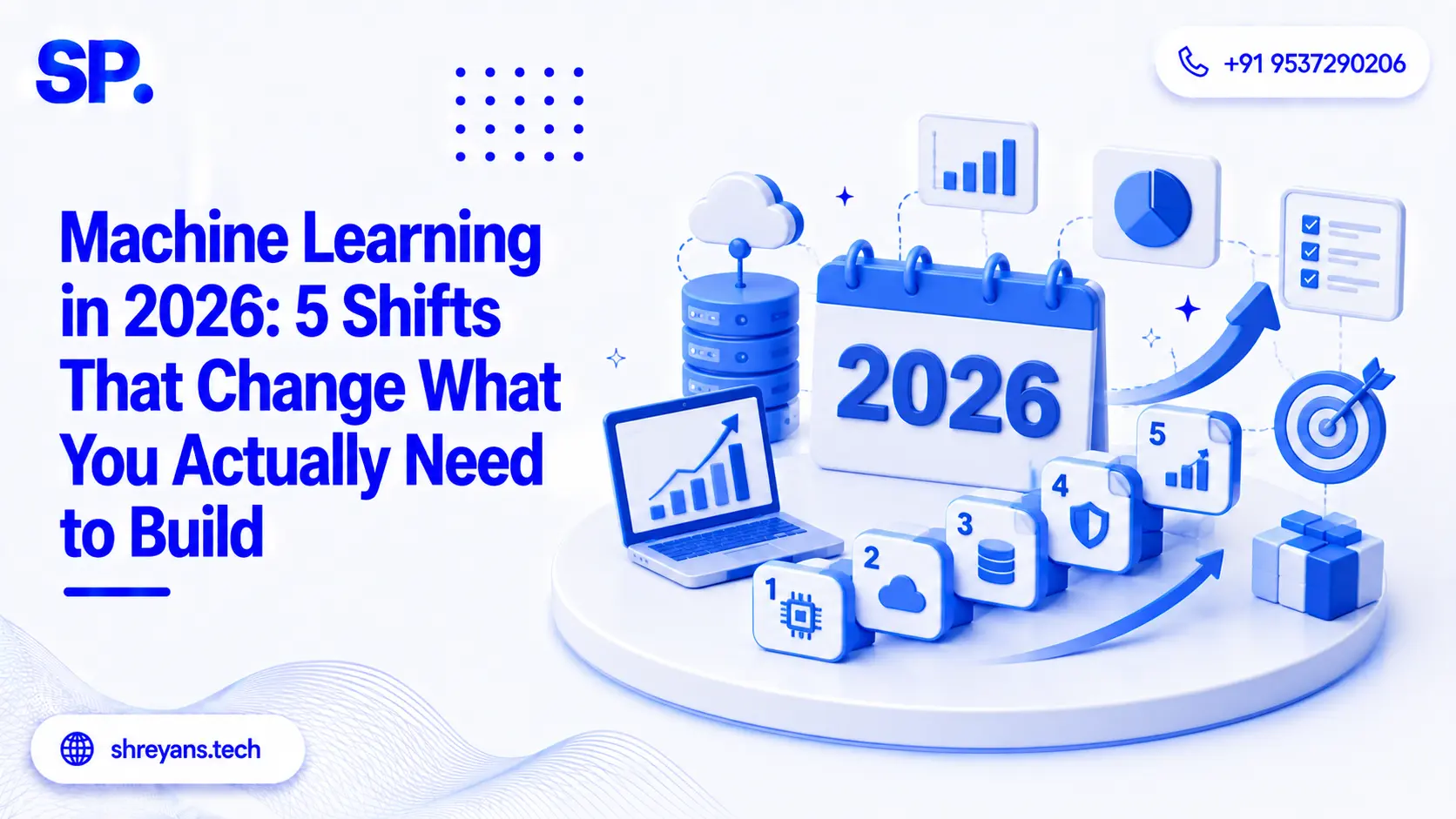
The five shifts below are not abstract industry commentary. They are the specific decisions that change what a founder or product team actually specifies when scoping a build: which parts of the pipeline get automated, where inference runs, how many models a single product needs, where training data comes from, and whether a model gets trained from scratch at all. Teams that scope machine learning development services against this list in 2026 avoid the rework that comes from architecting for assumptions that were already dated by mid-decade.
1. AutoML Matures From a Training Shortcut Into Decision Infrastructure
AutoML in 2026 does more than automate hyperparameter search. Industry coverage from MobiDev describes AutoML platforms now handling model selection, hyperparameter tuning, and deployment tuning together, deployed across sectors from agricultural quality testing to retail inventory management and cybersecurity threat monitoring. The distinction matters for scoping: a 2023-era AutoML integration assumed a data scientist reviewed every candidate model before deployment, while a 2026 AutoML pipeline is often trusted to select and promote a model automatically within a defined confidence threshold, with human review reserved for exceptions.
What this means for your project: the build cost shifts away from raw model training and toward monitoring, rollback, and confidence-threshold design. Budget more engineering time for the guardrails around an AutoML pipeline than for the pipeline itself. A team that skips this step ships a system that occasionally promotes a model nobody would have chosen manually, and finds out only after it is already in production.
2. Edge ML Becomes the Default for Latency-Sensitive and Privacy-Sensitive Products
Centralised, cloud-only inference is becoming harder to justify for products with real-time requirements. Outsource Accelerator's 2026 trends review points to manufacturing quality control as the clearest case: a plant running computer vision for defect detection cannot tolerate the round-trip delay of sending every frame to the cloud, so the model runs directly on the camera or an on-site industrial computer instead. The same logic applies to point-of-sale fraud detection, in-vehicle systems, and healthcare devices where a network outage cannot mean the model stops working.
What this means for your project: if your product touches a physical environment, a mobile device, or a regulated data type, edge deployment is worth pricing into the scope from day one rather than retrofitting later. Edge ML changes the model architecture decision itself, since a model built for a cloud GPU rarely compresses cleanly onto a low-cost edge chip without a rework of the network design.
3. Multimodal Models Replace Single-Modality Pipelines
The three-pipeline pattern, one model for text, a second for images, a third for structured data, is losing ground to models that process multiple modalities together. Appinventiv's 2026 enterprise ML research describes multimodal ML now working across text, images, audio, video, and structured data within a single system, which lets a support ticket, a screenshot, and a call transcript feed the same model instead of three disconnected ones. Outsource Accelerator gives the retail example directly: a platform that reads a shopper's search text, the product image they clicked, and audio from a prior service call together returns a more accurate result than any single input alone.
What this means for your project: for teams still running separate NLP and computer vision stacks, 2026 is the year to evaluate whether a unified generative AI development services engagement can collapse two or three pipelines into one, cutting both infrastructure cost and the integration bugs that live at the seams between systems.
4. Synthetic Data Fills the Gaps Real Data Cannot Cover
Labelled data remains the most common bottleneck in ML projects, and 2026 is the year synthetic data generation moved from a research curiosity to a production input. TechTarget's 2026 trends coverage notes that AI-generated content increasingly includes synthetic data built specifically for software testing, network security testing, and medical research, precisely the domains where real labelled examples are expensive, rare, or restricted by privacy rules. Manufacturing research published in 2025 on steel surface defect detection shows the same pattern at the industrial level, where synthetic augmentation fills gaps in rare-defect image libraries that real production lines cannot generate fast enough on their own.
What this means for your project: if your project depends on a class of data that is rare, sensitive, or expensive to label, fraud cases, rare medical conditions, or safety incidents, scope a synthetic data generation phase into the roadmap rather than assuming a vendor dataset will cover it. This also changes procurement, since budget now needs to cover validation of synthetic data quality, not just its generation.
5. Fine-Tuning a Foundation Model Beats Training From Scratch for Most Projects
Building a model from a blank architecture is now the exception rather than the default for most commercial ML projects. Appinventiv's 2026 research highlights small language models, lean, domain-tuned models that cost less to run and deploy more easily on-premise or at the edge, as the more practical starting point for regulated or latency-sensitive environments than a general-purpose foundation model called through an API. The practical question for most teams in 2026 is no longer build or buy, but which pretrained base to fine-tune and how much labelled data that fine-tuning actually requires.
What this means for your project: this is where most project timelines get miscalculated. Fine-tuning a foundation model is faster than training from scratch, but it still needs a defined evaluation set, a plan for catastrophic forgetting, and a decision about whether retrieval-augmented generation solves the problem more cheaply than fine-tuning at all. The model training approaches comparison breaks down which approach fits which budget.
What This Means for Your 2026 Roadmap
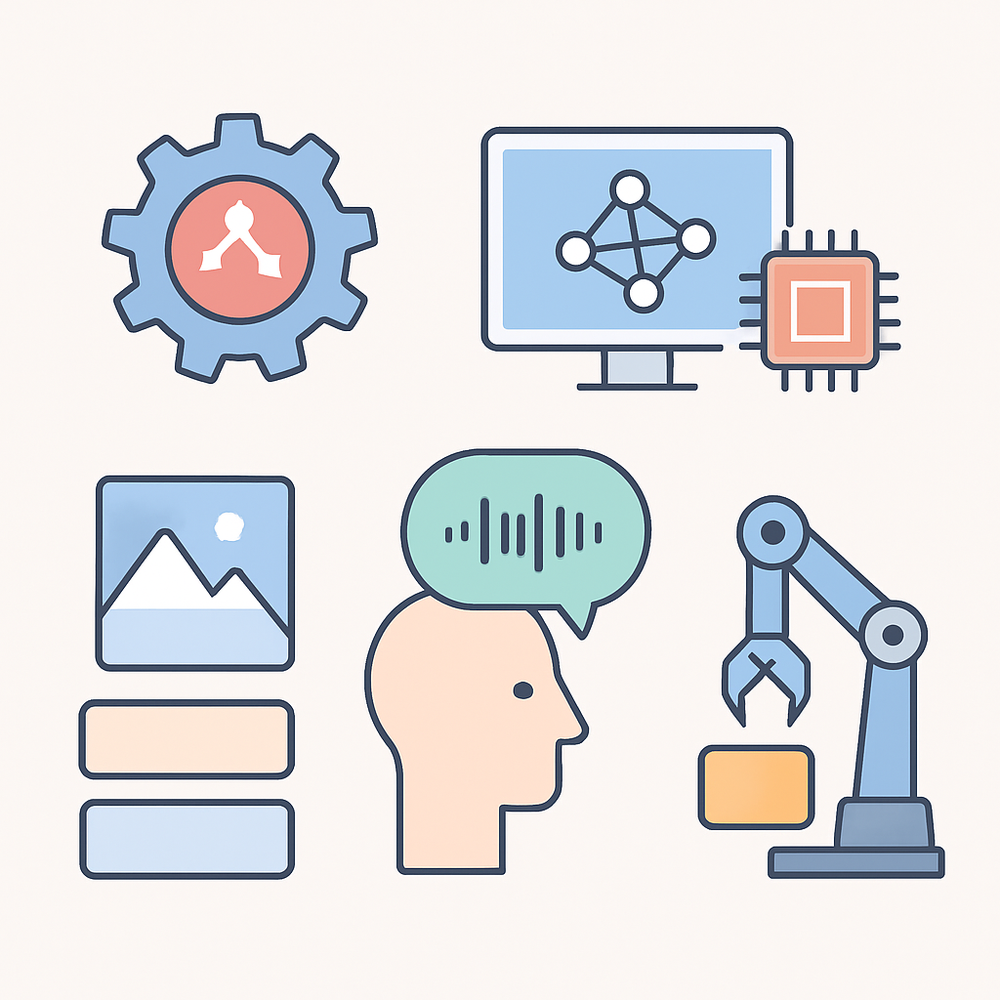
None of these five shifts operate in isolation. A product team building a defect-detection system for a manufacturing client, for example, is likely to touch all five: an AutoML pipeline for model selection, edge deployment for the camera hardware, synthetic data to fill rare-defect examples, and a fine-tuned vision-language foundation model to unify what used to be a separate detection and reporting pipeline. Scoping a 2026 build against a single shift instead of the full set is the most common reason ML timelines slip mid-project.
Gartner, McKinsey, and Global Market Insights each point to the same underlying pattern for 2026: machine learning investment is shifting from experimentation toward production infrastructure with defined governance, monitoring, and cost controls. A team that treats custom AI model training and deployment architecture as one connected decision, rather than two separate contracts, builds faster and spends less than a team that scopes them apart. For a broader view of where the underlying model landscape is heading through the rest of the year, the AI predictions 2026 breakdown covers vertical LLMs and autonomous agent adoption in more depth.
The 5 Shifts at a Glance
|
Shift |
What Changed in 2026 |
What to Scope For |
|---|---|---|
|
AutoML maturity |
Moved from a training shortcut to decision infrastructure |
Monitoring, rollback, confidence thresholds |
|
Edge ML |
Cloud-only inference is no longer the default |
On-device compression, latency budget |
|
Multimodal models |
Three separate pipelines become one system |
Unified data contracts across modalities |
|
Synthetic data |
Fills gaps real data cannot cover fast enough |
A dedicated validation phase for synthetic quality |
|
Foundation model fine-tuning |
Default approach, beats training from scratch |
Evaluation set, RAG-versus-fine-tune decision |
Where to Start Scoping
The teams getting the most from 2026's machine learning shifts scope a build against the full list before writing a line of code, not after a cloud-only prototype hits its first latency complaint. Good ML consulting separates the shifts that apply to a specific product from the ones that are still safe to defer.
Hire an AI developer with production experience across AutoML, edge deployment, and fine-tuning to map which of the five shifts change your 2026 roadmap and which do not.
Frequently asked questions
What is the biggest machine learning trend in 2026?
Do I still need a data scientist if I use AutoML in 2026?
When does edge ML make sense instead of cloud inference?
Is synthetic data as reliable as real data for training models?
Should I fine-tune a foundation model or train one from scratch?
How much does it cost to build a multimodal ML system in 2026?



Shreyans Padmani
Shreyans Padmani has 5+ years of experience leading innovative software solutions, specializing in AI, LLMs, RAG, and strategic application development. He transforms emerging technologies into scalable, high-performance systems, combining strong technical expertise with business-focused execution to deliver impactful digital solutions.