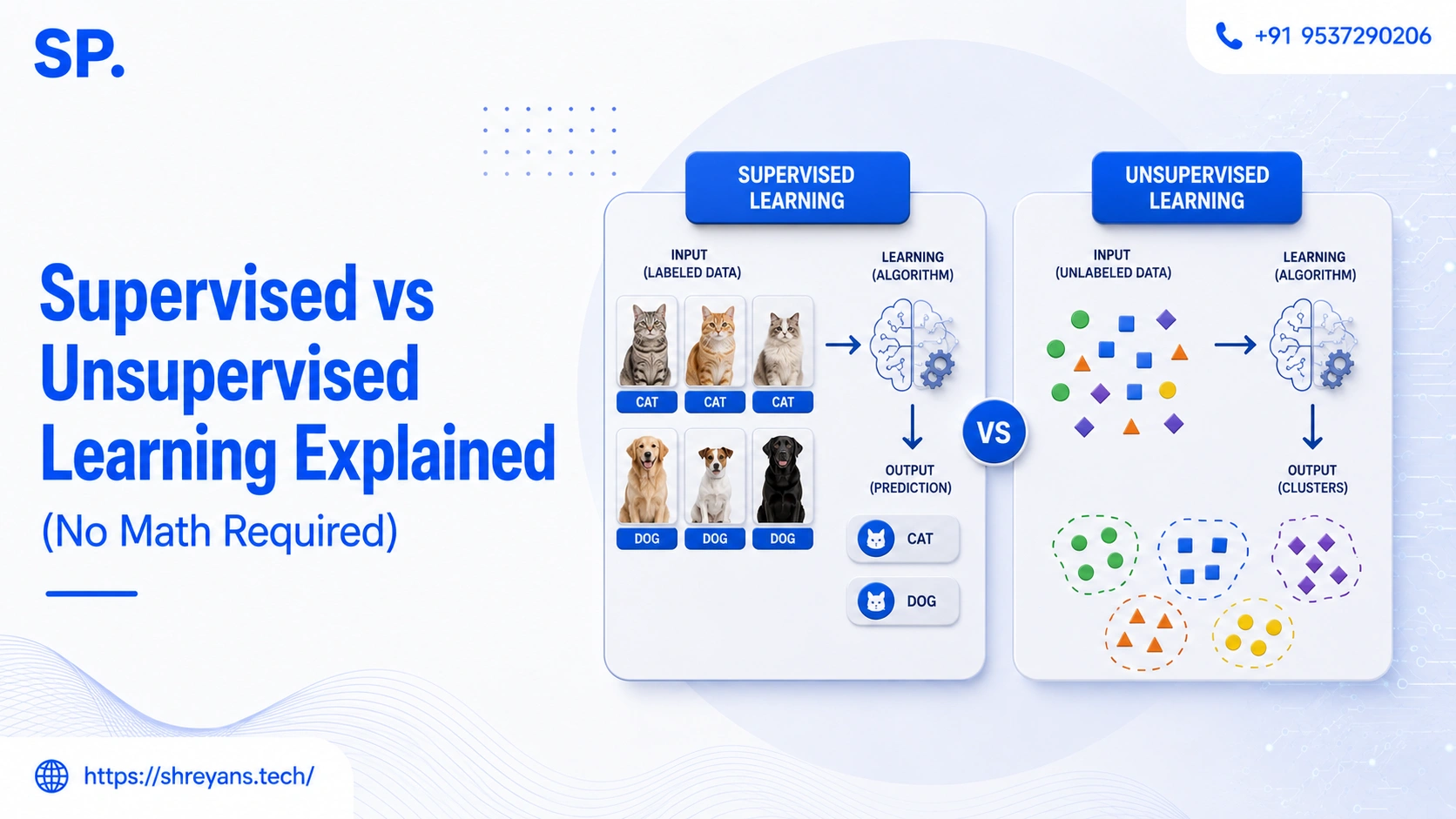
Labelling costs consume 80 percent of supervised project budgets according to Cognilytica research from 2023, while Gartner reported in 2024 that 85 percent of ML projects stall before deployment due to data quality gaps. The EU AI Act, enforceable from 2026, now classifies unvalidated model outputs in high-risk domains as a compliance breach.
A mid-sized fintech in London spent six months and £180,000 building a fraud-detection model on supervised learning, only to discover that 30 percent of their labelled transactions were misclassified by offshore annotators. The model passed offline metrics but flagged legitimate customers in production, forcing a full rollback and a three-month relabelling sprint that pushed the launch past the regulatory reporting deadline.
What the Labels Actually Buy You
Supervised learning trades labelling spend for a measurable contract: you supply ground truth, the model learns a mapping, and you can score every prediction against a known answer. Google Cloud's 2023 ML Adoption Survey found 68 percent of teams cite measurable metrics as the top reason for choosing supervised learning. In production terms, it means you can set an acceptance threshold before a single line of inference code ships, and you can monitor drift against the same benchmark six months later.
Syracuse University's analysis frames the decision around three variables: your data, your goal, and how much labelling effort you can invest. When the task is classification, regression, or any prediction with a verifiable target, the label spend buys you a service-level agreement you can write into a contract. That is the domain where machine learning development services deliver the clearest return, because every iteration can be measured against the same ground truth that funded the first training run.
What Unsupervised Learning Delivers Without Labels
Unsupervised methods operate on raw data without any ground truth, discovering structure through statistical regularities rather than labelled examples. Clustering algorithms such as K-means, DBSCAN, and hierarchical agglomerative grouping partition observations by similarity in feature space, while dimensionality reduction techniques like PCA, t-SNE, and UMAP expose low-dimensional manifolds that reveal natural groupings. In production pipelines these outputs serve as upstream signals: a clustering stage can segment customer behaviour for downstream propensity models, and an autoencoder trained on normal traffic can flag anomalies by reconstruction error without ever seeing a labelled attack.

Representation learning extends this capability by learning dense embeddings that capture semantic relationships directly from unlabelled corpora. The 2023 Hugging Face State of NLP report found 74 percent of teams use self-supervised pre-training to cut labelling needs. Models such as BERT trained with masked language modelling, SimCLR using contrastive objectives on image augmentations, and Word2Vec exploiting co-occurrence statistics all produce vectors where geometric proximity mirrors functional similarity. These embeddings become transferable assets: a single unsupervised pre-training run on millions of unlabelled documents can seed dozens of supervised fine-tuning tasks, dramatically reducing the labelled data each downstream model requires. The trade-off is that unsupervised objectives optimise for reconstruction or contrastive loss, not your business metric, so the discovered structure must be validated against operational goals before deployment.
Anomaly detection illustrates where unsupervised learning earns its place in a shipped system. Isolation Forest, One-Class SVM, and deep autoencoders model the support of normal data and flag outliers by deviation from that manifold. In network security, financial fraud, and industrial sensor monitoring, labelled anomalies are rare or non-existent, making supervised approaches infeasible. A competent engineer will pair an unsupervised detector with a human-in-the-loop triage queue: the model surfaces candidates at scale, analysts confirm or reject, and those judgements gradually bootstrap a labelled set for future supervised refinement. This loop turns an unsupervised capability into a sustainable data flywheel.
Hire AI Developers
Maximize project value with expert AI guidance, schedule a consultation
Hire AI ExpertsValidation: The Hidden Cost Centre
Validation is where the budget conversation shifts from data preparation to engineering rigour. In supervised projects you hold out a labelled test set, compute precision, recall, and F1, and hand those numbers to the product owner as a contract the model either meets or misses. Unsupervised work has no such contract; you rely on proxy metrics such as silhouette score for clustering, reconstruction error for autoencoders, or downstream task lift when the embeddings feed a classifier. Ambiguous validation criteria are a leading cause of stalls because stakeholders cannot sign off on a silhouette score the way they sign off on a 92 percent F1 on a held-out fraud test set.
The tooling gap reinforces the cost gap. Supervised pipelines plug into MLflow, Weights & Biases, or ClearML for experiment tracking, automated model cards, and drift alerts on labelled distributions. Unsupervised pipelines often need custom evaluation harnesses: you build a nearest-neighbour sanity check, a human-in-the-loop review queue for cluster coherence, or a synthetic anomaly injection suite to measure recall on events you have never seen. That bespoke validation layer typically adds two to four engineering weeks to a computer-vision engagement priced at $100,000 to $250,000 according to 2026 market data, and it is rarely scoped in the initial statement of work.
|
Validation Approach |
Primary Metric |
Stakeholder Sign-off Risk |
Typical Added Engineering Effort |
|
Supervised hold-out test set |
Precision, Recall, F1, AUC |
Low - binary pass/fail against threshold |
Included in standard modelling sprint |
|
Clustering (k-means, HDBSCAN) |
Silhouette, Davies-Bouldin, purity vs. labelled sample |
Medium - proxy metrics need business translation |
1-2 weeks for labelled purity audit |
|
Anomaly detection (Isolation Forest, AE) |
Reconstruction error, synthetic injection recall |
High - no ground truth for novel anomalies |
2-4 weeks for injection harness |
|
Embedding quality (contrastive, BERT) |
Downstream linear probe accuracy, k-NN recall |
Medium - depends on downstream task definition |
1-2 weeks for probe training |
Budgeting for that validation layer up front avoids the retrofit penalty that appears when a model reaches staging and the compliance team asks for evidence the clusters are stable across demographic slices. A competent ML consultant cost breakdown will itemise validation as a separate work package rather than burying it inside modelling hours, because the effort scales with regulatory surface area, not model complexity.
When to Blend Both: Semi-Supervised and Self-Supervised Patterns
Modern pipelines increasingly blend a small labelled set with large unlabelled corpora to reduce labelling spend while keeping measurable targets. A 2023 Cognilytica study found labelling consumes 80 percent of supervised project budgets, so shrinking the labelled fraction directly lowers the largest cost line. Semi-supervised learning uses a handful of ground-truth examples to steer a model that has already absorbed structure from unlabelled data, while self-supervised learning creates its own supervision signals from the raw corpus. Both patterns let you deploy a custom AI model training workflow that reaches production accuracy with a fraction of the annotation effort.
Self-supervised pre-training builds transferable representations before any task-specific labels appear. Masked language modelling, as used in BERT and its descendants, forces the model to predict randomly hidden tokens, learning syntax, semantics, and world knowledge from raw text alone. Contrastive learning applies the same principle to images and multimodal data: it pulls augmented views of the same sample together in embedding space while pushing different samples apart. A 2024 IBM analysis notes that these methods are truly unsupervised because they require no external ground truth, yet they produce features that fine-tune efficiently on downstream tasks such as Natural Language Processing classification or Computer Vision detection.

Once a self-supervised backbone exists, semi-supervised fine-tuning closes the gap to your specific metric. A practical loop starts with the pre-trained encoder, labels a few hundred representative examples, and fine-tunes a lightweight head under supervised loss. Active learning then selects the most informative unlabelled samples for human review, expanding the labelled set where the model is uncertain. This cycle repeats until validation metrics plateau, often after only two to three iterations. Teams following this pattern report reaching production thresholds with 10 to 20 percent of the labels a fully supervised baseline would demand, a figure consistent with the budget reductions documented in the model training approaches comparison.
The combined approach also simplifies governance because the final model still emits calibrated probabilities against known classes, satisfying audit requirements that pure unsupervised outputs cannot. You retain a measurable contract between input and prediction while the bulk of representation learning happens on unlabelled data that costs nothing to annotate. The next section maps these patterns to concrete decision criteria so you can choose the right entry point for your constraints.
Self-Supervised Pre-Training in Practice
Self-supervised pre-training in practice relies on proxy tasks that turn unlabelled data into supervised signal. Masked language modelling randomly masks 15 percent of tokens in each sequence and trains a transformer to reconstruct them, forcing the model to learn bidirectional context. In vision, masked autoencoders hide 75 percent of image patches and reconstruct pixels, yielding representations that transfer to detection and segmentation with minimal fine-tuning. Contrastive frameworks such as SimCLR and MoCo generate positive pairs through stochastic augmentation and optimise a temperature-scaled cross-entropy loss that maximises agreement between views of the same instance. These objectives require no human labels yet produce embeddings that linear-probe within a few points of fully supervised baselines on ImageNet and GLUE benchmarks.
Semi-Supervised Fine-Tuning Workflows
A semi-supervised fine-tuning workflow starts with the frozen self-supervised encoder, attaches a task-specific head, and trains on the small labelled set using standard cross-entropy or focal loss. Pseudo-labelling then generates predictions on the unlabelled pool; high-confidence predictions are added to the training set as soft labels, and the head is re-trained. Active learning selects the lowest-margin or highest-entropy samples for human annotation, maximising information gain per labelling dollar. Iterate this loop until validation AUC or F1 stabilises, typically within three cycles. The result is a model that meets production thresholds with a labelled fraction an order of magnitude smaller than a from-scratch supervised baseline.
Decision Framework: Match the Method to Your Constraints
A practical decision framework starts with three constraints: labelled data volume, regulatory exposure, and delivery deadline. If you hold at least five thousand verified examples per class and face audit requirements that demand traceable ground truth, supervised learning remains the default because every prediction maps to a documented label. The H2020 AI4EU consortium demonstrated that constrained decision trees trained on labelled data satisfy non-discrimination mandates in financial services where regulators require feature-level explanations for every credit decision. When labelled data falls below that threshold but unlabelled corpora exceed one hundred thousand records, self-supervised pre-training followed by semi-supervised fine-tuning typically closes the performance gap within two quarters.
|
Constraint |
Supervised |
Self-Supervised + Semi-Supervised |
Pure Unsupervised |
|
Minimum labelled examples per class |
5,000+ |
500 to 2,000 |
0 |
|
Regulatory traceability |
High (label audit trail) |
Medium (proxy-task audit) |
Low (post-hoc interpretation) |
|
Time to first measurable metric |
4 to 8 weeks |
8 to 14 weeks |
12 to 26 weeks |
|
Team skill-set required |
Standard ML engineering |
Transformer architecture, contrastive loss tuning |
Clustering evaluation, anomaly thresholding |
|
Typical compute budget (GPU-hours) |
200 to 500 |
800 to 2,000 |
400 to 1,200 |
Team capability often decides the paradigm faster than data volume. A squad fluent in PyTorch Lightning and Hugging Face Transformers can deploy a self-supervised BERT variant in six weeks, whereas the same team would need twelve weeks to design, label, and validate a custom supervised pipeline for the same task. Conversely, if your engineers specialise in scikit-learn pipelines and SQL feature stores, forcing a contrastive learning loop introduces silent failure modes that surface only in production drift monitoring. Match the method to the team's daily toolchain, not the latest benchmark leaderboard.
Frequently asked questions
How much does supervised vs unsupervised learning cost to deploy?
When should I choose supervised learning for a production system?
What unsupervised methods work best for anomaly detection in production?
How do I validate unsupervised models without ground truth labels?
Can unsupervised pre-training reduce labelled data needs for downstream tasks?
What tooling gaps exist between supervised and unsupervised pipelines?



Shreyans Padmani
Shreyans Padmani has 5+ years of experience leading innovative software solutions, specializing in AI, LLMs, RAG, and strategic application development. He transforms emerging technologies into scalable, high-performance systems, combining strong technical expertise with business-focused execution to deliver impactful digital solutions.