Computer vision cost estimates for the same category of project routinely span 10,000 to over 500,000 US dollars, and most production-grade deployments land between 50,000 and 250,000, according to pricing analysis compiled across current industry benchmarks. One documented manufacturing integration, retrofitting a Bosch automotive components facility with twenty-year-old equipment, took six months and 180,000 US dollars for integration alone, on top of the modelling work. The gap between the lowest and highest published estimates for a similar-sounding project is not vendor dishonesty; it reflects that computer vision cost is dominated by data and integration work most quotes describe vaguely or omit.
This guide breaks the cost down by the layers that actually consume budget, then by the four use cases businesses ask about most, so a number can be checked against your own project rather than borrowed wholesale from a vendor's headline figure.
What Actually Drives Computer Vision Cost
A computer vision budget spreads across six layers: discovery and requirements analysis, typically 5 to 10 percent of total spend; data collection and annotation, typically 15 to 25 percent for a simple project and considerably more for a complex one; model development and training; infrastructure; system integration; and ongoing deployment and monitoring. Development is usually the single largest phase, commonly exceeding half the total budget once engineering time, system integration and security work are included, which is why quotes that name only a model-training figure are quoting a fraction of the real project. This is the scoping conversation worth having explicitly with any computer vision development work engagement before a number is agreed.
Annotation deserves separate attention because it is consistently the most underestimated line item. Simple image classification runs roughly 0.05 to 0.10 US dollars per image, bounding box labelling 0.15 to 0.50, and segmentation masks 0.50 to 2.00, with video annotation running two to five times the equivalent image cost per frame. Medical or other technical domains requiring expert annotators run three to eight times higher again. For a dataset of one hundred thousand images or more, annotation alone can consume 30,000 to 100,000 US dollars, commonly 30 to 50 percent of total project spend, which makes it worth budgeting as a first-class cost line rather than an afterthought.
Proof of Concept vs Production: The Two Numbers That Matter
A focused discovery sprint or proof of concept for a single use case typically runs 10,000 to 35,000 US dollars over two to three months, testing whether the model achieves usable accuracy on your actual data before any production commitment. A controlled minimum viable deployment for one use case moves into the 35,000 to 120,000 range, and a full production workflow with integrations, dashboards, monitoring and edge or cloud deployment runs 120,000 to 350,000, with multi-site, safety-critical or heavily regulated deployments exceeding that and warranting a phased approach rather than a single contract.
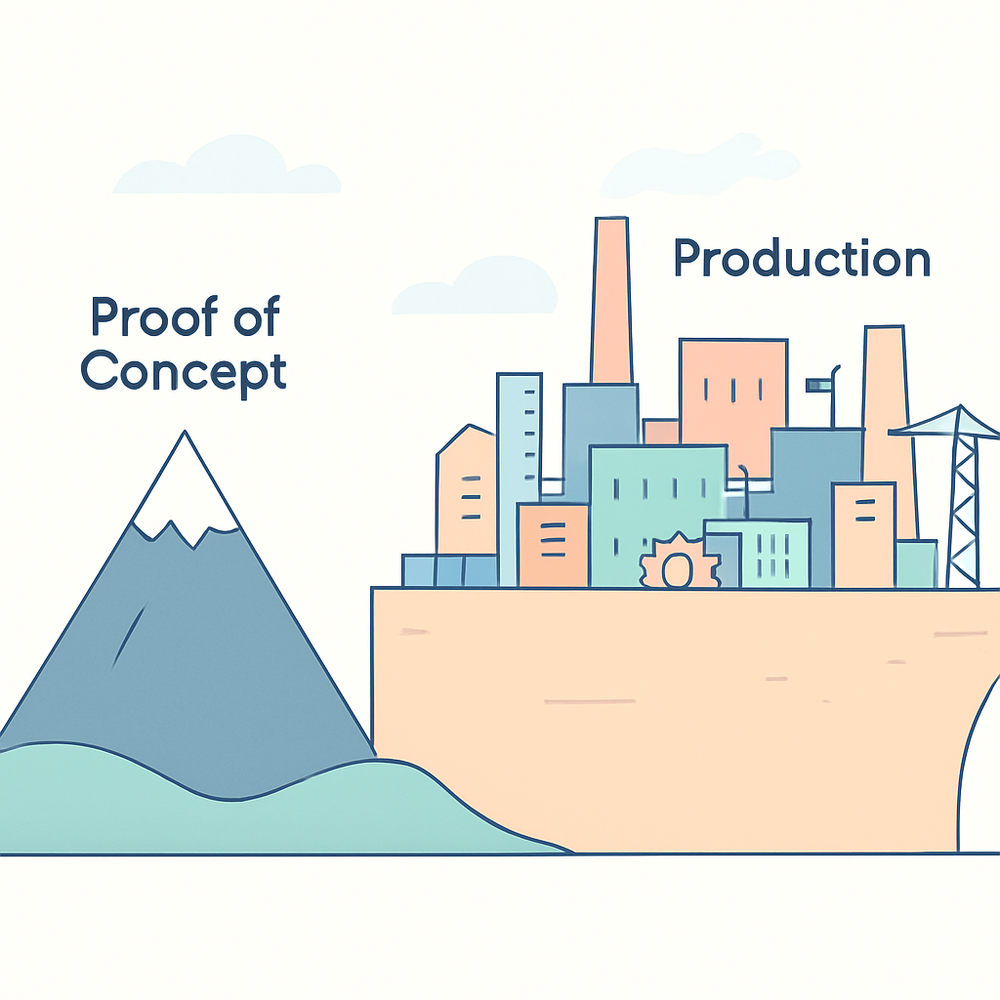
The jump from proof of concept to production is rarely proportional to the accuracy gain, and that is the point most budgets miss. A proof of concept proves the model works on curated data; production proves it keeps working on the messy, drifting, real-world version of that data across every store, line or camera angle it will actually encounter, and that reliability work is where the second and third layers of cost live.
Cost by Use Case: Retail Shelf Analytics
Shelf monitoring, detecting out-of-stocks, planogram compliance and pricing errors from camera imagery, typically runs 10,000 to 35,000 US dollars for a single-store proof of concept and 120,000 to 350,000 for a multi-store production rollout. The cost driver here is less the model than the physical deployment: camera hardware, installation across every store location, and an annotation pipeline covering the specific SKUs, lighting conditions and shelf layouts of each format. For a broader view of where computer vision returns the fastest payback across industries, the computer vision ROI by industry post covers the comparison beyond retail specifically.
Retailers commonly underbudget the annotation refresh cycle: a shelf model trained once on this season's packaging degrades as products, layouts and promotional displays change, and ongoing annotation to keep pace with that turnover belongs in the operating budget, not just the initial build.
Cost by Use Case: Manufacturing Defect Detection
A medium-complexity defect detection system for a single production line runs roughly 150,000 to 300,000 US dollars, with annotation alone commonly representing 15,000 to 40,000 of that, around 38 percent of the software budget on a typical medium-complexity build. Implementation, integrating the system with manufacturing execution and enterprise resource planning software, represents 20 to 30 percent of total cost but causes a disproportionate 45 percent of budget overruns because legacy equipment integration is routinely underestimated at quoting time.
Training or retraining models on a facility's own defect history and imagery is what makes a generic pretrained model actually work on your equipment, which is custom AI model training work in the most direct sense. Skipping it in favour of an off-the-shelf model is the most common reason a defect detection pilot performs well in a demo and poorly on the actual production line.
Hire Computer Vision Developers
Accelerate projects with expert help, get a free proof-of-concept scoping session
Get Free POC ScopingCost by Use Case: Document and OCR Processing
Extracting structured data from documents, invoices, forms, contracts, identification records, is typically the least expensive computer vision use case, running 10,000 to 30,000 US dollars for a proof of concept and 60,000 to 150,000 for a production system, because the underlying models are more mature and the annotation task is narrower than object detection on physical scenes. Cost still scales sharply with document variety, since a system trained on one invoice template generalises poorly to a hundred different vendor formats.
Downstream integration is the layer most often underbudgeted here. Extracted data is only valuable once it lands correctly in the accounting, procurement or compliance system that consumes it, and that integration work frequently costs as much as the extraction model itself, particularly against legacy enterprise software with limited API support.
Cost by Use Case: Video and Security Analytics
Real-time video analysis, tracking, anomaly detection, occupancy counting, typically costs 40,000 to 100,000 US dollars for a focused deployment and can exceed 100,000 for advanced three-dimensional or multi-camera systems, with full production rollouts commonly running 150,000 to 350,000. The cost driver is processing architecture: real-time inference at the edge, where footage cannot be sent to the cloud for latency or privacy reasons, requires dedicated hardware and inference optimisation that a cloud-based batch system does not.
Privacy and compliance requirements add a cost layer specific to this use case that other categories rarely face at the same intensity, since footage of people typically falls under data protection regulation that shapes retention, access and processing requirements from the start of the design rather than as a bolt-on afterward.
|
Use Case |
Proof of Concept |
Production System |
Main Cost Driver |
|---|---|---|---|
|
Retail Shelf Analytics |
10,000 to 35,000 US dollars |
120,000 to 350,000 US dollars |
Camera hardware and multi-store annotation volume |
|
Manufacturing Defect Detection |
30,000 to 60,000 US dollars |
150,000 to 300,000 US dollars per line |
Legacy system integration and defect-type coverage |
|
Document and OCR Processing |
10,000 to 30,000 US dollars |
60,000 to 150,000 US dollars |
Document variety and downstream system integration |
|
Video and Security Analytics |
40,000 to 100,000 US dollars |
150,000 to 350,000 US dollars |
Real-time processing and edge inference infrastructure |
What Inflates Budgets After the Quote
Vendor quotes commonly land 40 to 60 percent below eventual implementation cost, not because of dishonesty but because the quote describes the model-training layer and treats everything around it as assumed. The gap concentrates in predictable places: ongoing annotation as products, defect types or document formats evolve past the original training set; legacy system integration that turns out to need custom API development at 150 to 250 US dollars per hour; and the monthly operating cost of cloud compute, monitoring and retraining, typically 2,500 to 12,000 US dollars a month, that nobody budgeted as a recurring line. The hidden costs guide covers the same budget categories most quotes across AI project types leave out, not only computer vision specifically.
Regional Costs and Engagement Models
Where the development team is based materially affects cost without necessarily affecting quality. Outsourcing to experienced teams in India or Eastern Europe commonly reduces cost by 40 to 60 percent compared with a US-based team for comparable work, and the gap is driven by cost of living and regional wage benchmarks rather than a quality difference at the senior level. A freelance specialist working directly avoids the account-management layer an agency adds on top of either region's base rate, which is worth weighing against the coordination overhead of managing a project directly. For a fuller breakdown of how AI project pricing shifts by engagement model, the ML consultant cost post covers the comparison across project types more broadly.
Budgeting for the Whole Project, Not the Model
The number that actually predicts whether a computer vision project stays on budget is not the training cost; it is how carefully the annotation pipeline, integration work and ongoing retraining were scoped before the contract was signed. Projects that treat the model as the entire deliverable consistently land 40 to 60 percent over their original estimate, and the overrun is rarely the model's fault.
If you are scoping a computer vision project, hire an AI developer who will walk through all six cost layers before naming a number, not just the one that makes the initial quote look smallest.
Frequently asked questions
How much does a computer vision proof of concept cost?
Why do computer vision quotes vary so widely for similar-sounding projects?
What percentage of a computer vision budget goes to data annotation?
Is it cheaper to outsource computer vision development offshore?
What is the biggest hidden cost in a computer vision project?



Shreyans Padmani
Shreyans Padmani has 5+ years of experience leading innovative software solutions, specializing in AI, LLMs, RAG, and strategic application development. He transforms emerging technologies into scalable, high-performance systems, combining strong technical expertise with business-focused execution to deliver impactful digital solutions.