Global machine learning spend reached $209 billion in 2026 according to Itransition, while 61 percent of CEOs surveyed by the same source report that AI and ML are now core to their competitive strategy. Gartner projects that by 2026, 80 percent of enterprises will have deployed generative AI APIs or models in production environments, up from less than five percent in 2023.
A mid-market logistics firm commissioned a demand-forecasting model in early 2025 without an MLOps pipeline; when shipping patterns shifted after a port strike, the model drifted silently for six weeks, causing $2.3 million in excess inventory write-offs before the finance team flagged the variance. The remediation required a full retrain, feature-store rebuild, and automated monitoring -- work that would have cost roughly one-fifth of the loss if scoped into the original build.
How Machine Learning Differs from Traditional Software
Traditional software executes logic you write line by line; a machine learning system infers its own decision boundaries from data and updates them when the distribution shifts. That inversion means the artefact you ship is not a fixed binary but a statistical model whose behaviour changes between training and serving, so version control must track datasets, hyperparameters, and feature schemas alongside code. A competent developer will therefore treat a DVC pipeline or MLflow experiment log as first-class deliverables, not afterthoughts.
The probabilistic contract also rewrites testing: you cannot assert exact equality on floating-point outputs, so you validate with tolerance bands, population stability indices, and shadow deployments that compare model predictions against a champion baseline on live traffic. Drift detection becomes continuous -- feature drift, label drift, concept drift -- and each requires a retraining trigger wired into your orchestration layer, whether that is Airflow, Prefect, or a custom Kubeflow pipeline. Ignoring any of these differences turns a pilot that looks accurate offline into a liability the moment real users arrive.
The Three Core Learning Paradigms You Will Encounter
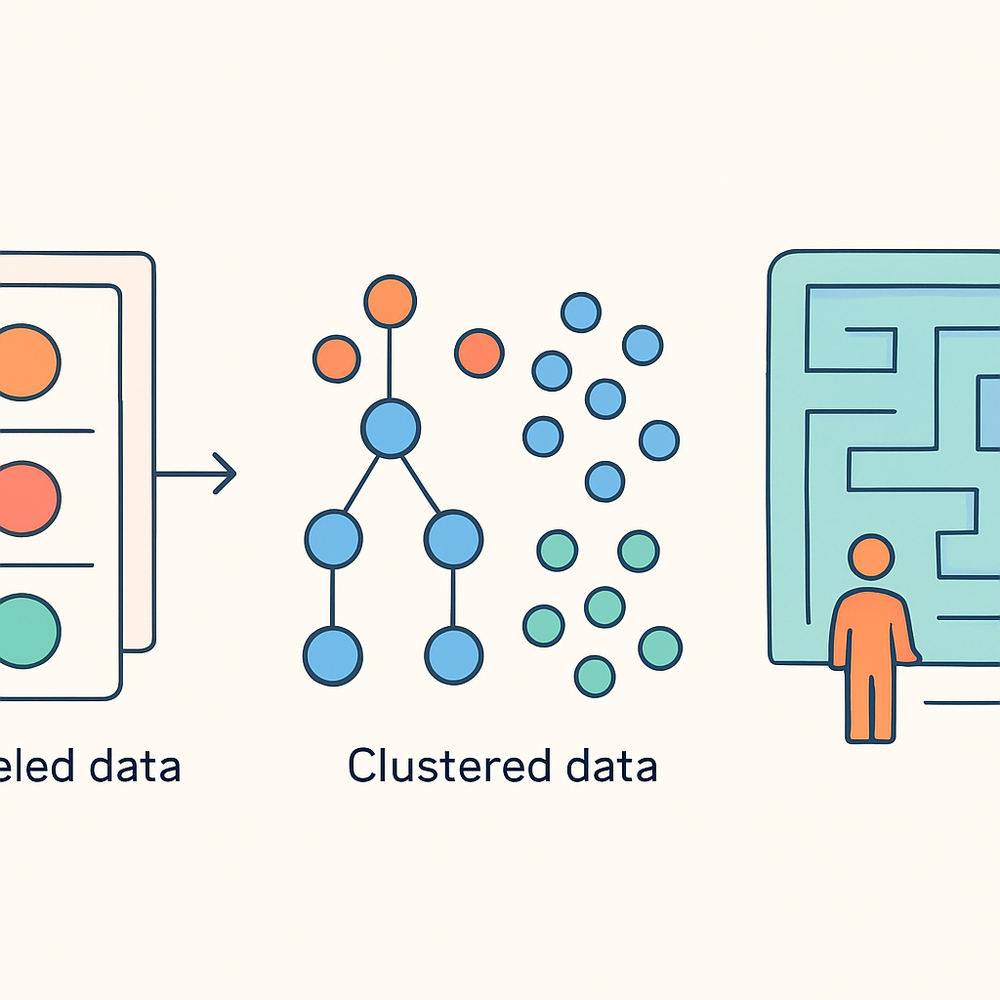
Supervised learning remains the workhorse for most commercial deployments because it maps labelled inputs to a target you already understand, whether that is next-quarter churn probability, defect classification on a conveyor line, or fraud scoring on a transaction stream. A 2026 industry analysis found that supervised approaches still account for the majority of production models precisely because the business metric, accuracy or F1 against a ground-truth label, is unambiguous and auditable. You will recognise a supervised problem when you can articulate the label, you have historical examples of that label, and the cost of a wrong prediction is bounded enough to tolerate a confusion matrix rather than a catastrophic failure.
Unsupervised learning shifts the objective from prediction to structure discovery, clustering customer behaviour into segments no marketing brief anticipated or surfacing anomalous sensor readings that precede equipment failure without a single failure label in the training set. Reinforcement learning, by contrast, optimises a policy through sequential interaction with an environment, which makes it the natural fit for dynamic pricing engines, autonomous warehouse routing, or real-time bidding agents where the reward signal is delayed and the action space is continuous. A competent developer will match the paradigm to the feedback loop you actually have, not the one you wish you had, because misaligned learning objectives are the single largest source of wasted GPU cycles in 2026 deployments.
Where ML Delivers Measurable ROI in 2026
Predictive analytics continues to generate the clearest near-term returns across regulated sectors. The University of Kansas Health System deployed machine learning to identify high-risk patients and trigger targeted interventions, achieving a 39 percent relative reduction in all-cause 30-day readmissions and a 52 percent reduction specifically for heart failure patients according to a 2026 industry analysis. In banking, supervised models now underwrite credit risk, flag transaction fraud in milliseconds, and optimise collections strategies, while manufacturers use the same paradigm to forecast demand, schedule predictive maintenance, and reduce unplanned downtime. A competent machine learning development services partner will frame every engagement around a measurable baseline metric -- readmission rate, fraud loss ratio, or mean time between failures -- so the business case survives the first model retrain.
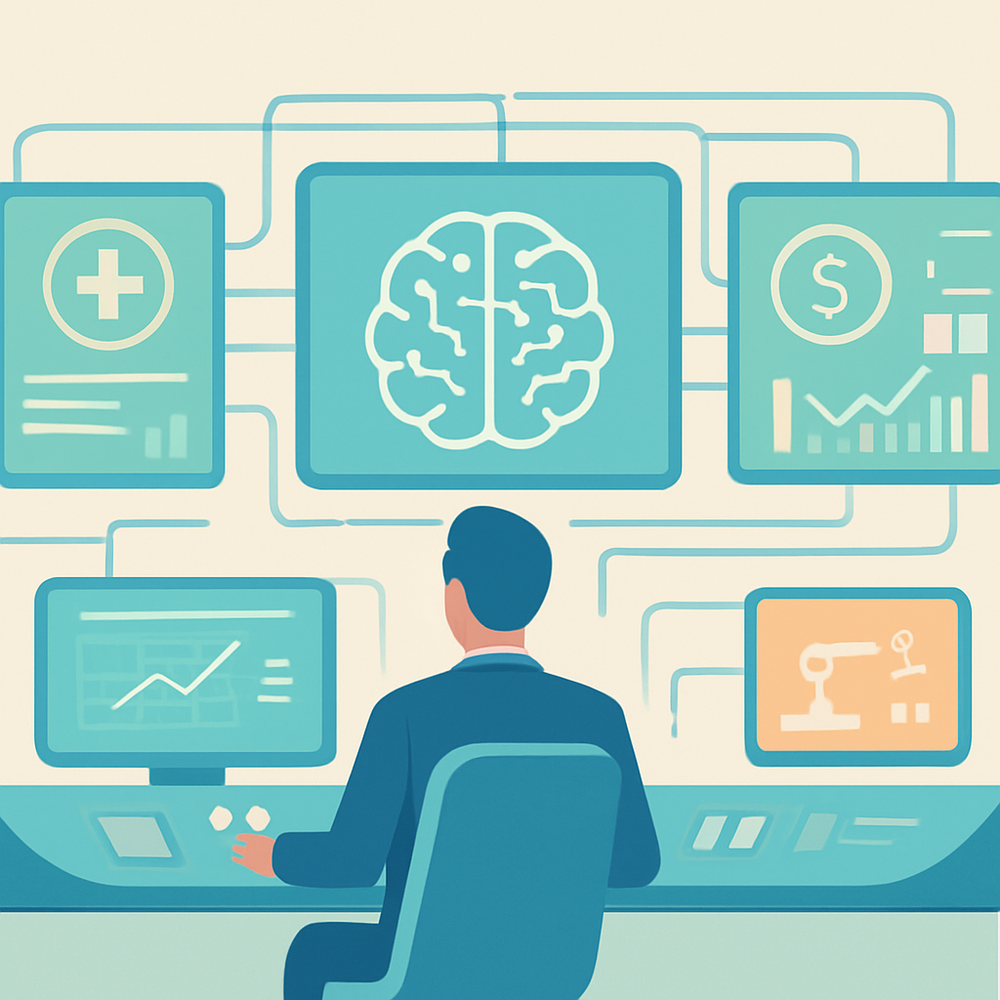
Computer vision and natural language processing are moving from pilot to production in parallel. Defect detection on high-speed assembly lines now runs on YOLO-based pipelines that process 60 frames per second with sub-millimetre localisation, while document intelligence workflows combine layout-aware OCR with transformer classifiers to extract clauses from unstructured contracts at scale. Generative assistants built on retrieval-augmented architectures are cutting first-response time in customer support by routing tickets to the right knowledge base before a human opens the queue. Teams that need specialised depth in these modalities should evaluate computer vision development, natural language processing expertise, or generative AI development services against the same production checklist: data lineage, drift monitoring, and a rollback plan that does not require a full retrain.
What Production-Grade Deployment Actually Requires
Moving a model from a notebook to a production environment demands an MLOps foundation that treats data, code, and artefacts as first-class citizens in a unified release process. A competent developer will version training data alongside model weights, containerise the inference service with Docker, and orchestrate the pipeline through Kubeflow or MLflow so that every deployment is reproducible and auditable. Without that discipline, a model that performs well on a static test set degrades silently once live traffic arrives.
Infrastructure choices compound the risk. Running inference on GPU instances without autoscaling leads to either wasted spend or latency spikes during demand surges, while serverless endpoints such as AWS SageMaker or Azure ML managed endpoints shift operational burden to the cloud provider at a higher per-request cost. A 2026 industry analysis found that organisations adopting a unified MLOps platform reduced model deployment time from months to weeks while maintaining regulatory traceability across the lifecycle.
Governance cannot be bolted on after launch. Feature stores such as Feast or Tecton enforce consistent feature definitions between training and serving, preventing the silent schema mismatches that cause prediction drift. Coupled with a model registry that gates promotion through automated validation suites, this architecture gives you a single source of truth for what is running in production at any moment.
Observability closes the loop. Structured logging of inputs, predictions, and business outcomes enables downstream analytics and audit trails, while distributed tracing across the inference graph surfaces latency bottlenecks before they breach SLAs. The hidden costs guide quantifies how under-investment in this layer inflates total cost of ownership by forcing reactive firefighting instead of planned iteration.
Hire Machine Learning Experts
Unlock business value with expert ML development, schedule a consultation
Hire ML DevelopersData Quality and Feature Engineering
Labelled data pipelines and feature engineering absorb the largest share of engineering hours in most ML projects, yet they receive the least executive visibility. A supervised fraud detection model, for example, may require millions of manually reviewed transactions before the positive class is represented adequately, and each labelling cycle introduces taxonomy drift that must be reconciled in the feature store.
Model Monitoring, Drift Detection, and Retraining Loops
Real-world distributions shift continuously, so a production system must detect covariate drift, concept drift, and label drift before they erode business metrics. Statistical monitors such as the Population Stability Index or Kolmogorov-Smirnov tests run on incoming feature vectors flag distribution changes, while a shadow model running in parallel validates whether retraining restores performance without human intervention. Automated retraining loops triggered by these signals, orchestrated through Airflow or Prefect, keep the model current without requiring a developer to re-run notebooks manually.
Governance, Compliance, and Risk Controls
The EU AI Act entered into force on 1 August 2024 with a phased timeline that buyers must map to their roadmap. Prohibited practices applied from 2 February 2025, general-purpose AI model rules from 2 August 2025, and most high-risk obligations take effect on 2 August 2026, with high-risk AI embedded in regulated products following on 2 August 2027. Any system that classifies biometric data, scores creditworthiness, or screens job candidates will fall under the high-risk tier and require a conformity assessment before deployment. A competent vendor will deliver a model card that records training data provenance, evaluation metrics, known limitations, and the intended use boundary, because Article 11 technical documentation and Article 12 record-keeping obligations make that artefact a legal requirement, not a courtesy.
Governance inventories, change-control procedures, and independent validation reports are now part of the procurement checklist. The Act expects organisations to maintain a living register of every AI system, its risk classification, and the controls applied throughout its lifecycle, while Article 55 mandates systemic-risk evaluations for general-purpose models that exceed the compute threshold. Bias audits must cover demographic parity, equalised odds, and disparate impact across protected attributes, with results documented for regulator review. Buyers should demand evidence of automated drift alerts, quarterly retraining schedules, and a rollback plan that restores the last compliant model version within a defined service-level objective, because ongoing reviews and post-market monitoring are explicit obligations under the regulation.
Build vs Buy vs Partner: Choosing the Right Engagement Model
Choosing between an internal team, a platform licence, or a specialist freelance developer remains the single most consequential decision before an AI initiative begins. A 2026 decision framework for UK mid-market businesses found that 65 percent of organisations that defaulted to internal hiring underestimated the time-to-value by at least six months because data engineering and MLOps tooling consumed sprint capacity meant for model iteration. Platform licences from vendors such as Databricks or Vertex AI accelerate infrastructure provisioning, yet they still require dedicated engineers to configure feature stores, monitoring dashboards, and retraining pipelines, which shifts the bottleneck from compute to talent. A competent freelance developer who ships production systems rather than demos can deliver a scoped MVP in eight to twelve weeks while transferring knowledge to your internal analysts, a model that team-augmentation analyses identify as the fastest route to a measurable business metric.
|
Engagement model |
Typical time to first production model |
Control over IP and roadmap |
Total cost of ownership (first 12 months) |
Best fit |
|
Internal hiring |
6 to 12 months |
Full |
£180,000 to £350,000 (salaries, tooling, ramp) |
Long-term product differentiation, regulated data that cannot leave premises |
|
Platform licence (e.g. Databricks, Vertex AI) |
3 to 6 months |
Shared (vendor lock-in risk) |
£120,000 to £250,000 (licences + 1-2 FTEs) |
Teams with existing ML engineers who need managed infrastructure |
|
Specialist freelance developer |
8 to 12 weeks |
Full (contractual) |
£40,000 to £90,000 (project fee + minimal cloud spend) |
Scoped MVP, knowledge transfer, regulated sectors needing audit-ready artefacts |
Budget conversations should reference a ML consultant cost breakdown that separates data preparation, model development, and MLOps handover so you can compare line items against an internal headcount plan. Before signing any engagement, run candidates through a practical ML interview questions set that tests feature-store design, drift-detection strategy, and EU AI Act artefact requirements rather than algorithm trivia. The next section examines the red flags that distinguish a production-grade practitioner from a notebook experimenter.
Frequently asked questions
How does machine learning differ from traditional software development?
What business problems suit supervised learning best?
When should I choose unsupervised or reinforcement learning instead?
What measurable results have healthcare and finance teams achieved with predictive models?
What MLOps foundations does a production deployment require?
How do infrastructure choices affect model serving cost and latency?



Shreyans Padmani
Shreyans Padmani has 5+ years of experience leading innovative software solutions, specializing in AI, LLMs, RAG, and strategic application development. He transforms emerging technologies into scalable, high-performance systems, combining strong technical expertise with business-focused execution to deliver impactful digital solutions.