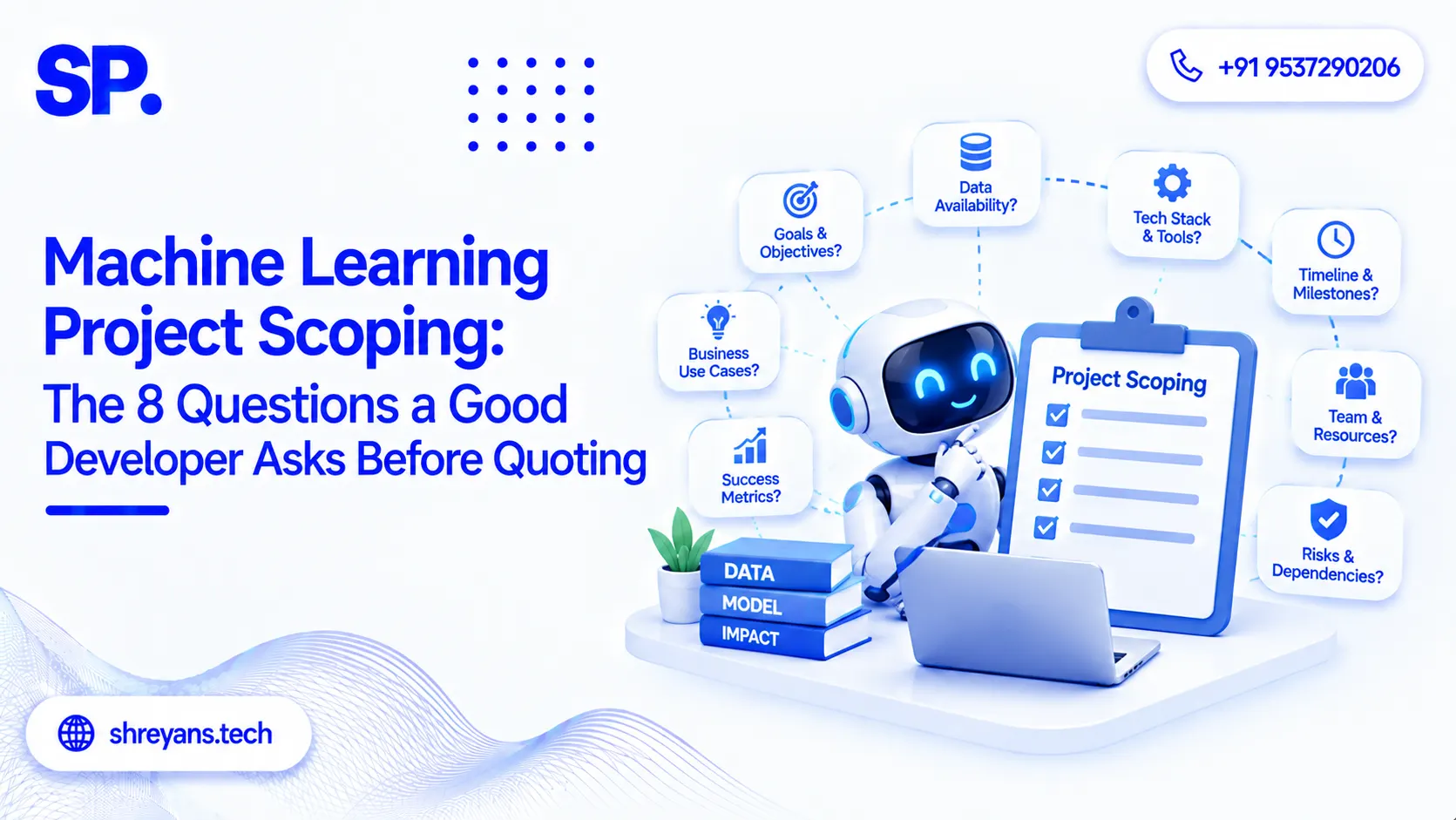
Machine Learning Project Scoping: The 8 Questions a Good Developer Asks Before Quoting
AI Business's scoping research draws a distinction worth internalising early: "whom should we contact to sell what" is a purely operational question judged only on prediction accuracy, while "what are the characteristics of customers who buy" needs an interpretable model a human can actually reason from, and the two questions require distinctly different models even though they sound similar. Databricks' 2026 implementation guide reports machine learning solutions fail most often from planning, scoping, and communication gaps rather than technical shortcomings, and Lydonia AI's 2026 CIO readiness research names the single most common gap directly: undefined or unmeasurable success metrics, where a business case exists but no one defined how success would actually be measured.
A developer who asks the right questions before quoting a project is not stalling, they are preventing the rework that comes from scoping the wrong problem. The eight questions below are what a developer with real production experience asks before a number goes on a proposal, and what you should expect to be asked before committing to machine learning development services.
1. What Decision Will This Model Actually Inform?
AI Business's research on ML project scoping uses a streaming platform's sales team as its example: "whom should we contact to sell what" is an operational question where the sales team does not care whether the answer comes from a statistical model or a 100-layer neural network nobody understands, only whether the prediction is accurate. "What are the characteristics of customers who buy a specific product" is a different question entirely, one that needs a model a human can actually interpret and reason from, since the output itself is the insight, not just a ranked list to act on.
A developer who does not ask which of these two categories your problem falls into is likely to build the wrong kind of model, technically competent but mismatched to what the business actually needs from the output.
Hire Edge Computer Vision
2. How Often Will Predictions Actually Need to Be Made?
AI Business's research calls prediction frequency one of the most underweighted scoping questions: a model answering a strategic question asked once, such as whether to open new locations in large or small cities, has a fundamentally different scope than a model making thousands of predictions per second, such as real-time fraud detection on credit card transactions. Prediction frequency barely affects how a model gets trained, but it has a massive effect on the overall project scope, since a high-frequency use case needs production infrastructure, latency budgets, and monitoring that a one-time strategic analysis never touches.
A quote that does not ask this question upfront is either underscoping a high-frequency production system or overscoping a one-time analysis, and the gap between the two shows up as a budget surprise partway through the project.
3. What Does Data Readiness Actually Look Like?
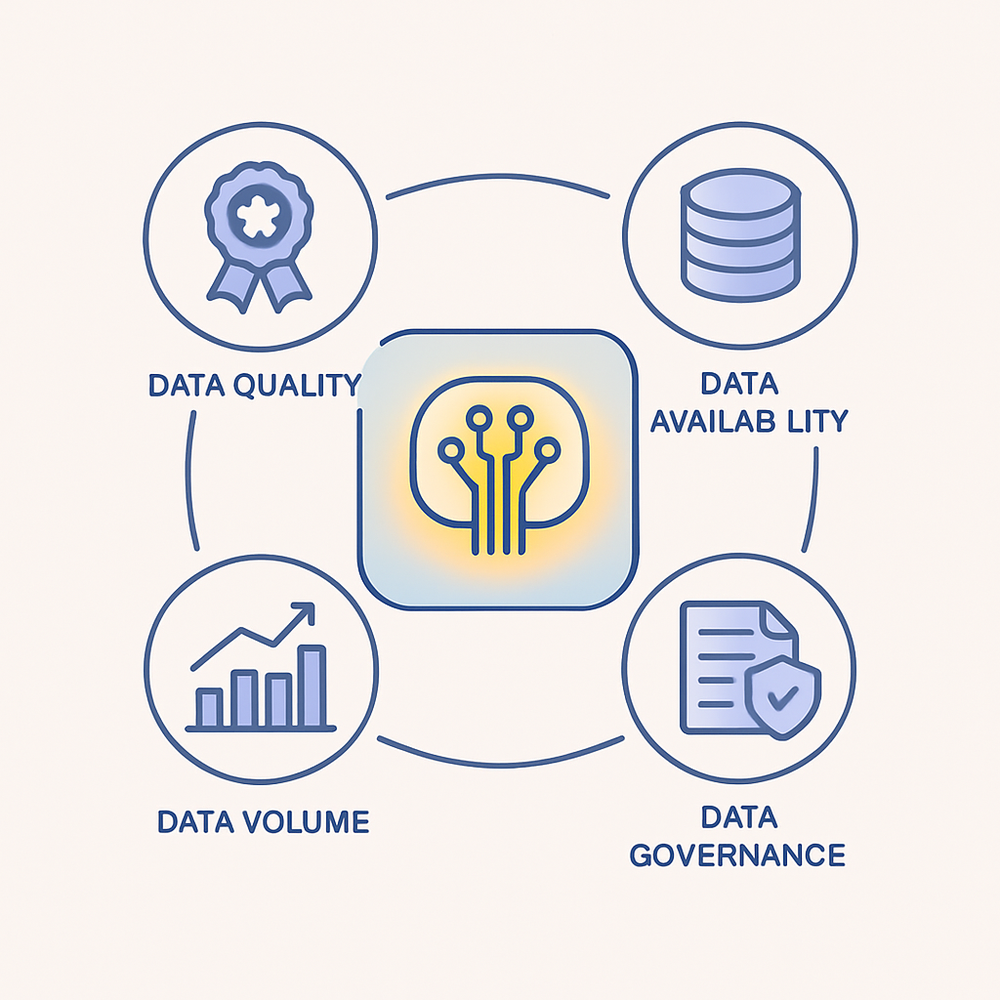
Databricks' 2026 implementation guide breaks data readiness into four dimensions worth asking about specifically: data quality, meaning accuracy, completeness, and consistency; data availability, whether the relevant data is actually accessible and current; data volume, whether enough examples exist to train a reliable model; and data governance, whether ownership and compliance coverage are clearly defined. Organisations that address gaps across these four dimensions before development begins consistently see higher deployment success rates than those that discover the gaps mid-project.
Fygurs' 2026 AI readiness research adds a blunt warning worth taking seriously: without proper data engineering, a data science team can spend up to 80 percent of its time on data plumbing instead of modelling. A developer scoping AI model training work who has not assessed all four data readiness dimensions before quoting a timeline is quoting a number that assumes data problems will not exist, which is rarely true.
4. What Is the Fallback When the Model Is Wrong or Unavailable?
Techloy's 2026 AI project scoping guide frames this as the question that separates careful scoping from wishful thinking: when someone says "AI will automate this," the follow-up questions are which specific steps, what accuracy level, and what the fallback looks like when the model gets it wrong or goes down. Validating this assumption early prevents the misalignment and scope creep that surface later when a stakeholder assumes full automation and the actual system needs a human review step the original scope never accounted for.
A model without a defined fallback is not a complete system, it is a component waiting for an incident to reveal the gap. This question matters most for any use case touching a customer-facing decision or a regulated process, where an unhandled model failure has consequences beyond an internal dashboard showing a wrong number.
Hire Edge Computer Vision
5. How Will Success Actually Be Measured, and By When?

Lydonia AI's 2026 CIO readiness checklist identifies undefined or unmeasurable success metrics as the most common gap across its enterprise AI readiness assessments: the business case for a project exists, but the measurement framework to prove it worked does not. Fygurs' research offers a useful reframe for a first ML project specifically: define success in terms of a learning outcome, "we will know whether ML can meaningfully predict churn for our business," rather than a performance guarantee like a specific accuracy percentage promised before the data has even been explored.
The ML consultant cost breakdown covers how success metrics should tie directly into project pricing, since a quote built around an undefined success measure is a quote nobody can hold accountable to anything specific once the project ships.
6. Who Owns Governance, and Which Decisions Can Be Automated?
Fygurs' 2026 research is direct that AI governance is not optional once a model makes decisions affecting customers, employees, or business outcomes: before building anything, an organisation needs to articulate which use cases are acceptable, which data can be used for training, and which decisions can be automated versus which require human oversight. The guide notes this does not need to be an extensive policy document, a one-page set of principles endorsed by leadership is a strong starting point.
The ML interview questions post covers how to probe a candidate developer's own thinking about governance during vetting, since a developer who has never had to work within a defined governance boundary may not think to ask for one before starting.
Hire Edge Computer Vision
7. What Is the Plan for Monitoring Drift After Launch?
Databricks' research is specific about what happens without this plan: models degrade silently as data distributions shift over time, and without MLOps practices, drift detection, automated retraining, CI/CD pipelines for model releases, and production monitoring, teams lack the tooling to detect or fix the problem efficiently once it happens. A model that performed well at launch and was never checked again is not a finished project, it is a project quietly accumulating risk.
A quote that ends at deployment, with no line item for ongoing monitoring, is scoping only part of what the model actually needs to stay useful. This question is worth asking specifically because it is the one most commonly missing from an initial proposal, not because it is hard to answer once asked.
8. Who Else Needs to Be Involved Beyond the Technical Team?

Techloy's research states plainly that scoping AI is not an engineering-only task, it requires cross-functional collaboration across the teams that will actually use, be measured by, or be affected by the model's output. Lydonia AI's research adds a specific reason this matters more than it might seem: Google Cloud's DORA 2025 report attributes 70 percent of AI transformation value to people, organisations, and processes, not to the underlying technology, yet change management is consistently the most underfunded part of enterprise AI programmes.
A developer who scopes a project only with the technical stakeholder in the room is scoping against an incomplete picture of what success actually requires. The people who will use the model's output daily, and the people whose workflow it changes, need a seat in the scoping conversation before a quote is finalised, not after the model ships and adoption stalls.
Hire Edge Computer Vision
8 Scoping Questions and What Skipping Each One Costs
|
Question |
What Skipping It Costs |
|---|---|
|
What decision will this inform? |
A technically correct model that answers the wrong question |
|
How often are predictions needed? |
Under- or over-scoped production infrastructure |
|
What does data readiness look like? |
A team spending most of its time on data plumbing, not modelling |
|
What is the fallback when it's wrong? |
An unhandled failure surfacing as a customer-facing incident |
|
How is success measured, and by when? |
No way to prove the project delivered value once it ships |
|
Who owns governance and automation limits? |
Automated decisions with no defined oversight boundary |
|
What is the drift monitoring plan? |
Silent accuracy decay nobody notices until it is costly |
|
Who else needs to be involved? |
Low adoption because the people affected were never consulted |
A Rushed Quote Skips These Questions First
None of these eight questions are exotic or hard to answer once asked. What separates a careful scope from a rushed one is whether they get asked before a number goes on a proposal or discovered halfway through a project when the original assumptions turn out to be wrong. A developer who walks through all eight before quoting is not being slow, they are pricing the project you actually need instead of the one that looked simplest at first glance.
The ML consulting post covers how this kind of scoping conversation compounds across multiple projects once the first one is done well. Hire an AI developer who asks all eight of these questions before quoting, and treat a quote that skips most of them as a signal to slow down, not speed up.
Hire Edge Computer Vision
Frequently asked questions
Why does a developer need to ask about prediction frequency before quoting a project?
What are the four dimensions of data readiness a developer should assess?
Why does a machine learning project need a defined fallback plan?
How should success be measured for a company's first machine learning project?
Why does a machine learning project need input from non-technical stakeholders during scoping?
What happens if a machine learning model has no drift monitoring plan after launch?



Shreyans Padmani
Shreyans Padmani has 5+ years of experience leading innovative software solutions, specializing in AI, LLMs, RAG, and strategic application development. He transforms emerging technologies into scalable, high-performance systems, combining strong technical expertise with business-focused execution to deliver impactful digital solutions.