HHS OCR published a Notice of Proposed Rulemaking on January 6, 2025 representing the first major update to the HIPAA Security Rule since the 2013 Omnibus Rule, and ITECS reports the rule remains on track for finalisation in May 2026 despite nearly 5,000 public comments, many opposing the added compliance burden on smaller entities. TechAhead's 2026 architecture guide is blunt about where most healthcare AI projects fail: proof-of-concept builds routinely stall before production because compliance was never architected into the data flows, access controls, and audit trails from day one. That stall is expensive, and it is also avoidable, which is part of why healthcare organisations increasingly look at healthcare cost reduction figures alongside the compliance requirements before scoping a project.
This guide breaks down what HIPAA-compliant machine learning actually requires in 2026: data governance, de-identification, audit trails, and explainability for clinical settings, plus a portfolio checklist to run before you hire. None of this is optional documentation to bolt on after a model works. OCR's 2026 enforcement guidance states plainly that written policies alone are not sufficient evidence that a required security measure was actually implemented.
Data Governance: What "Minimum Necessary" Means for an ML Pipeline
HIPAA's minimum necessary standard requires defining exactly what data a system collects, why it collects it, and the narrowest scope needed for the clinical or operational use case, according to Accountablehq's 2026 infrastructure guide. For a machine learning pipeline, this means segmenting protected health information from non-PHI data at the architecture level, isolating training environments from production systems, and securing model registries so that a data scientist cannot pull more patient data than the specific task requires.
Accountablehq's clinical decision support research adds a practical layer to this: access control policies need to enforce least privilege separately for data scientists, engineers, and clinicians, since these three roles legitimately need different slices of the same underlying data. A machine learning development services engagement scoped for healthcare should treat this segmentation as a build requirement from the first architecture diagram, not a compliance review item added before launch.

De-identification: Safe Harbor vs Expert Determination
HIPAA recognises two approved de-identification methods, per Accountablehq's 2026 compliance research: Safe Harbor, which removes a defined list of direct identifiers with no actual knowledge of re-identification risk, and Expert Determination, where a qualified expert applies statistical methods to conclude that re-identification risk is very small. Operationalising either method in a real pipeline means automated PHI detection in both text and images, generalisation or removal of identifiers, and suppression of rare data combinations that could indirectly re-identify a patient even after direct identifiers are stripped.
For projects that need longitudinal patient linkage, such as tracking outcomes over multiple visits, pseudonymisation replaces direct removal, and Accountablehq recommends keeping the token-to-identity key in a separate vault with strict identity and access management policies and a defined break-glass procedure for the rare cases where re-identification is clinically necessary. Clinical text is where this gets hardest in practice, since free-text notes carry PHI in unpredictable places, which is why NLP development services built specifically for clinical de-identification, rather than a generic redaction tool, matters more here than in most other healthcare AI use cases.
Audit Trails: What HIPAA Actually Requires You to Log
TechAhead's 2026 architecture guide lists what most organisations underestimate about AI-specific audit logging: every prompt that contains or references PHI, every AI-generated response containing PHI and what sources it drew from, every human review of AI-generated clinical content, every model version change, and access logs for vector databases showing exactly who queried patient data and what was retrieved. This creates the audit trail required under 45 CFR 164.312(b), and Aptible's developer-focused compliance guide is direct about the standard: an audit trail needs to answer who accessed what, when, and why, not just confirm that a policy document describing the requirement exists.
Accountablehq's infrastructure research adds that dataset and model registries should capture versions, lineage, training code, parameters, and environment hashes, which supports root-cause analysis and rollback during an incident without exposing more PHI than the investigation actually needs. Teams should also test explicitly for data leakage, membership inference risk, and unintended memorisation of PHI within the trained model itself, since a model that has memorised patient details can leak them even after the source data is deleted.
Model Explainability for Clinical Settings
Medcurity's 2026 compliance overview lists algorithmic transparency for patient safety as a core HIPAA-adjacent requirement for clinical AI, alongside de-identification, vendor agreements, and audit trails. In practice, this means a clinician using an AI-assisted diagnostic or triage tool needs a defensible answer to why the model produced a specific recommendation, not just a confidence score. ITECS's 2026 risk guide frames this as a vendor evaluation requirement directly: healthcare organisations should demand explainability documentation, data lineage tracking, and processing audit trails as non-negotiable conditions of any AI vendor relationship, not optional extras.
This is where the model training approach matters as much as the deployment architecture. A model fine-tuned through custom AI model training on a well-documented, de-identified clinical dataset is far easier to explain and audit than a general-purpose foundation model called through an API with no visibility into what data shaped its clinical reasoning.
Business Associate Agreements and Vendor Terms for AI
Every vendor that creates, receives, maintains, or transmits PHI on your behalf needs a signed Business Associate Agreement, and Accountablehq's 2026 vendor guidance is specific about the AI-related terms that generic BAAs often miss: a clause explicitly prohibiting the vendor from using your PHI to train their general models, required audit logging and incident cooperation, defined encryption standards, mandatory multi-factor authentication, and the right to review the vendor's security reports on request. Aptible's compliance guide reinforces the first point directly, noting that a no-training-on-PHI commitment needs to be explicit contract language, not an assumption based on a vendor's general privacy policy.
Downstream subcontractors matter here too. If your AI vendor uses a third-party model provider or cloud infrastructure partner, that subcontractor needs an equally strong BAA in place, since HIPAA liability follows the data through the full chain of custody, not just the vendor you contracted with directly.
Portfolio Checklist Before You Hire
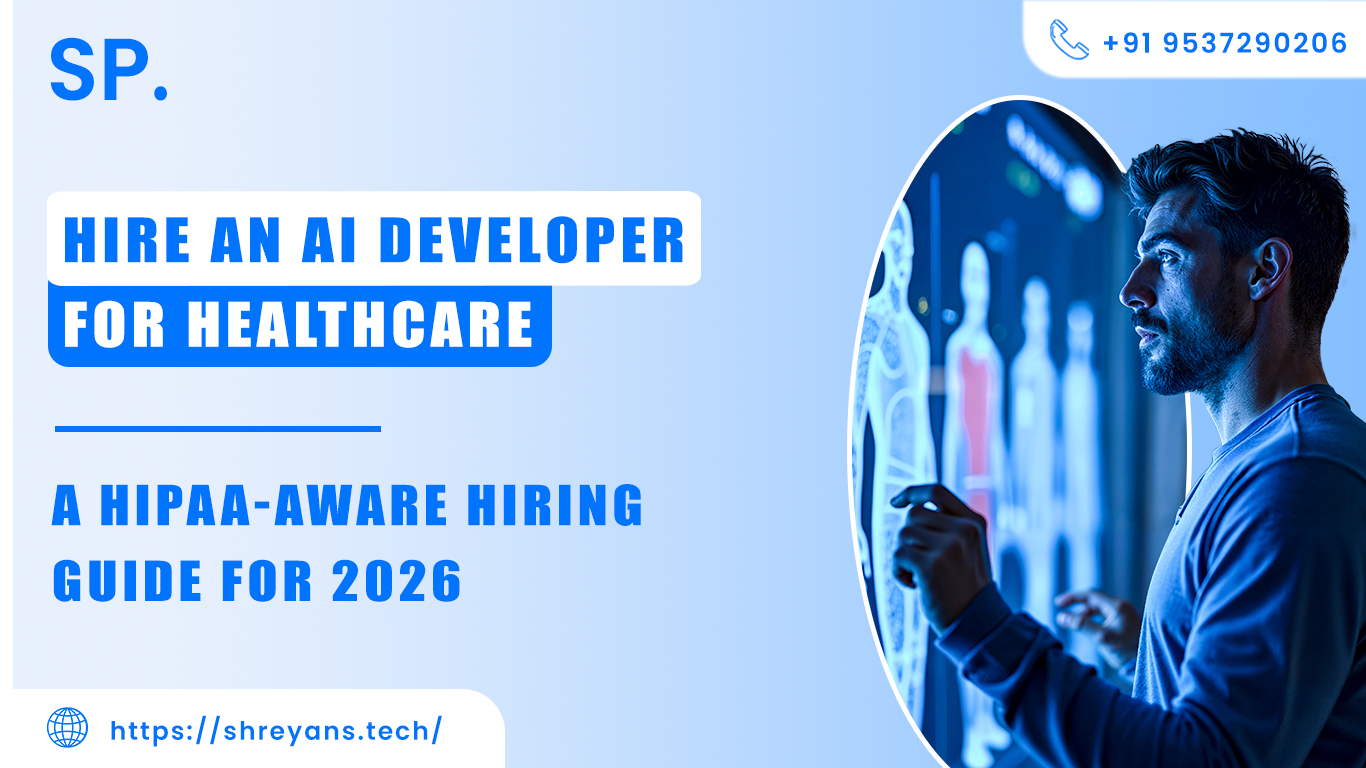
Before hiring an AI developer for a healthcare project, ask for evidence of HIPAA-specific work, not general ML experience alone: a described de-identification approach for a past project, an example of an audit trail architecture they have built, and a specific answer for how they have handled a Business Associate Agreement's technical requirements rather than treated it as a legal-team-only document. The HIPAA-aware hiring guide covers the full vetting conversation in more depth, including the questions that separate a developer who has actually shipped compliant healthcare AI from one who has only worked adjacent to it.
General ML vetting still matters alongside the healthcare-specific questions. The vetting ML developers post covers the technical interview questions worth asking any ML hire, healthcare-focused or not, before a contract is signed.
HIPAA-Compliant ML: Requirements at a Glance
|
Requirement |
What It Covers |
Common Gap |
|---|---|---|
|
Data governance |
Minimum necessary scope, PHI/non-PHI segmentation |
Training environments not isolated from production |
|
De-identification |
Safe Harbor or Expert Determination method |
Clinical free text carries PHI in unpredictable places |
|
Audit trails |
Every PHI access, prompt, response, and model version |
Written policy treated as proof of implementation |
|
Explainability |
Defensible reasoning behind clinical recommendations |
Foundation models with no visibility into training data |
|
BAAs and vendor terms |
No-training-on-PHI clause, encryption, MFA, subcontractor coverage |
Downstream subcontractors missing an equally strong BAA |
Architect Compliance Before You Write the First Model
The healthcare AI projects that reach production successfully are the ones that treat data governance, de-identification, audit trails, and explainability as architecture decisions made before the first line of model code, not compliance items reviewed after a prototype already works. Retrofitting these requirements onto a working model is consistently slower and more expensive than building them in from the start.
AI developer for healthcare work with a portfolio that includes de-identification architecture, audit trail design, and documented BAA technical terms, not just general machine learning experience, to move your project from proof-of-concept to production without a compliance rebuild in the middle.
Frequently asked questions
Does every healthcare AI project need to be HIPAA compliant?
What is the difference between Safe Harbor and Expert Determination de-identification?
What does HIPAA require for AI audit logging specifically?
Can an AI vendor use our patient data to train their general models?
Why does model explainability matter for HIPAA compliance?
What changed in the HIPAA Security Rule for 2026?



Shreyans Padmani
Shreyans Padmani has 5+ years of experience leading innovative software solutions, specializing in AI, LLMs, RAG, and strategic application development. He transforms emerging technologies into scalable, high-performance systems, combining strong technical expertise with business-focused execution to deliver impactful digital solutions.