Why Industry Taxonomies Mislead Technical Buyers
Most buyers start with an industry map and end up hiring the wrong profile. Eighty-eight percent of organisations used AI in at least one business function in 2025, according to Itransition research. That figure tells you what peers are buying, not what your engineering capacity can deliver. A founder at seed stage reads that customer service adoption sits at 61 percent overall, with the telecom sector at 83 percent overall, and assumes a chatbot is the obvious first project. The taxonomy hides the gap between a demo and a production system that survives load. Only 25 percent of organisations have moved 40 percent or more of AI experiments into production to date. That gap between adoption and deployment is where AI adoption trends become noise for a technical buyer.
The same customer-service use case demands a prompt engineer at seed, an MLOps specialist at series A, and a platform team at series B. Industry verticals do not capture that progression. Generative AI tooling changes every quarter, but the hiring ladder stays the same. Your team ships what it can operate, not what a sector report recommends. A CTO who selects use cases by vertical spends six months negotiating a contract for a document-extraction pipeline that requires three ML engineers they cannot hire. The same budget buys a retrieval-augmented generation service that one developer maintains. Production-readiness stage dictates the architecture, the hiring plan, and the vendor shortlist. Ignore the industry filter. Start with the engineering profile you can actually recruit and retain.
Comparison Table: 20+ Use Cases Mapped to Engineering Profiles
The next section maps twenty-plus use cases to the engineering profiles that actually ship them. Deloitte's AI Dossier catalogues 125 or more use cases across six industry categories while Google Cloud documents 1,302 generative AI deployments across eleven industry groups. Both taxonomies organise by vertical rather than by the hiring decision a founder faces. The table below reorders the same work by ML specialisation and production readiness so you can match a use case to the people you can actually hire.
Six agent types map to engineering profiles
Google Cloud's six agent types (Customer, Employee, Creative, Code, Data, Security) map cleanly to distinct engineering profiles. A Customer agent handling support tickets needs an ML engineer fluent in RAG and prompt orchestration plus a backend engineer for CRM integration. A Code agent generating production modules requires ML engineers with compiler and static analysis experience plus a platform engineer for CI gating. Creative agents for marketing copy need a prompt engineer and a designer, not an ML hire. Security agents demand an ML engineer with adversarial testing background and a DevSecOps lead. Reviewing AI agent use cases against this matrix prevents hiring mismatches before contracts are signed.
Agentic versus generative workloads
Agentic AI systems that chain tools and maintain memory across steps shift the profile toward ML engineers who have shipped LangGraph or AutoGen in production. Generative AI workloads that stay single-turn can often be delivered by a prompt engineer plus a full-stack developer. AI Models fine-tuned on proprietary data require an ML engineer with distributed training experience and a data engineer for pipeline governance. Cloud Computing choices (Vertex, Bedrock, Azure OpenAI) determine whether your team needs infra-as-code skills or can stay serverless. ChatGPT plugins are no longer a category; the OpenAI Assistants API replaced them in 2024.
Match use case to hiring capacity
Use the table to veto use cases your current headcount cannot support. A seed team should target single-turn Generative AI or Creative agents with a short production timeline. A Series A team can absorb Code agents or fine-tuned AI Models in a moderate timeline. A Series B team can staff Agentic AI workflows with evaluation loops and red-teaming in a longer timeline. Deloitte's taxonomy will still show you what competitors bought; this table shows you what your roster can deliver.
| Agent type | Primary use case | ML specialisation required | Non-ML roles needed | Production complexity |
|---|---|---|---|---|
| Customer | Support ticket resolution | RAG, prompt orchestration | Backend engineer, CRM integration | Medium |
| Employee | Internal knowledge retrieval | Embeddings, vector search | Backend engineer, auth integration | Medium |
| Creative | Marketing copy generation | Prompt engineering | Designer, brand reviewer | Low |
| Code | Production module generation | Compiler, static analysis | Platform engineer, CI gating | High |
| Data | Analytics report automation | SQL generation, schema mapping | Data engineer, governance | Medium |
| Security | Threat detection and response | Adversarial testing, anomaly detection | DevSecOps lead, compliance | High |
Hire ML Engineer
Boost AI delivery with expert ML engineers, Get Free Code Review
Get Free Code ReviewThe Evaluation Framework: Hiring Capacity and Production-Readiness Stages
The framework maps each use case to the engineering profile your current headcount can support, organised around three production-readiness stages. At seed stage a two-person team ships in six months on managed endpoints. Series A introduces a dedicated ML engineer who owns fine-tuning and evaluation. Series B runs internal platforms that let product teams deploy agent fleets without ML review. The stage you occupy dictates whether you hire for custom AI agent solutions or contract a specialist for a single workflow.
Function priorities reveal where hiring capacity matters most. Customer service leads AI agent adoption at 57 percent, followed by marketing and sales at 54 percent and IT and cybersecurity at 53 percent, according to Itransition. Agentic AI investment mirrors this pattern: customer service at 50 percent, customer journey at 38 percent and digital marketing at 28 percent. Meanwhile 46 percent of enterprise agent deployments sit in procurement, HR and finance operations. Each cluster demands a different ML specialisation and on-call commitment.
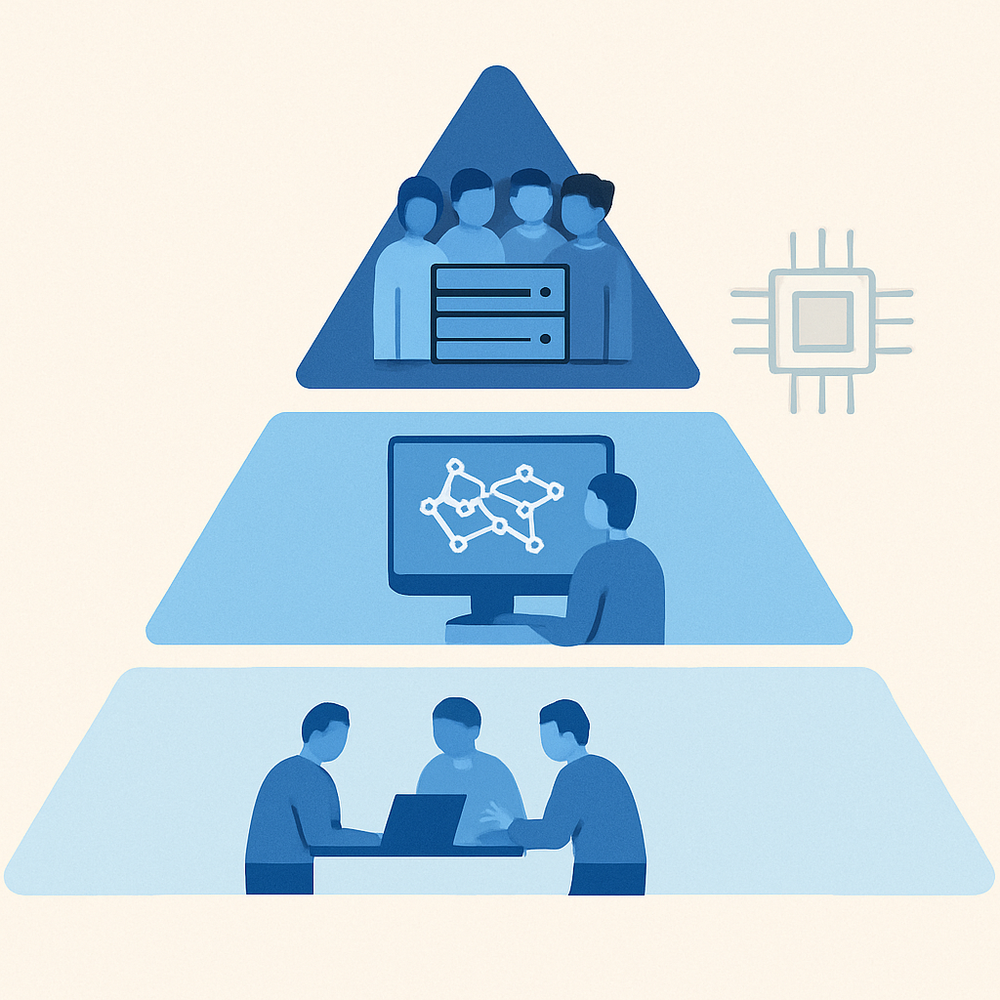
At seed stage you cannot afford a dedicated MLOps engineer, so you select use cases that run on hosted LLMs and vector search without touching Kubernetes. A two-person team can ship a customer service classifier or a marketing copy generator in weeks. Series A teams introduce fine-tuning loops and evaluation harnesses for finance reconciliation agents that require audit trails. Series B organisations build internal platforms that let product teams deploy agents across cybersecurity monitoring and CRM enrichment without ML review.
Cost scales non-linearly with stage because the engineering profile shifts from generalist to specialist. A seed prototype stays under ten thousand dollars when you accept managed API latency variance. Series A fine-tuning runs from twenty to fifty thousand dollars once you factor labelled data pipelines and regression testing. Series B platform work exceeds one hundred thousand dollars and requires AI agent development cost modelling that includes on-call rotation and model governance. Vet candidates by asking which stage they have shipped to production, not which demos they have built.
Seed-Stage Use Cases a Two-Person Team Can Ship in Six Months
A two-person team at seed stage can productionize five use cases using only prompt engineering and API skills. Customer Service/CRM automation with AI Agents leads the list because AI adoption in customer service reached 61 percent in 2025, with telecom sector at 83 percent overall. A single developer wires a ChatGPT endpoint to your ticketing system, adds retrieval over past resolutions, and ships a bot that resolves tier one queries without fine-tuning. The engineering profile stays at prompt engineer plus full-stack generalist.
Marketing & Sales content generation sits second. Generative AI models such as Veo 3 and Imagen 4 enable high-volume creative production. One person builds a prompt library for product descriptions, ad variants, and email sequences while the other integrates the API into your CMS. No training runs, no GPU budget, and the output quality matches agency copy for standard campaigns. The same pattern applies to internal knowledge bases.
HR screening automation ranks third. Thirty-nine percent of HR departments have implemented AI with seven percent planning implementation this year. A two-person team connects a large language model to your ATS, writes structured prompts for CV parsing and interview question generation, and deploys behind a simple review UI. The project stays in API territory so long as you avoid custom embeddings. Conversational agents for product support round out the four.
Auteco, a Colombian vehicle manufacturer, uses Gemini models for a conversational agent. Seed teams replicate this by grounding ChatGPT or Gemini in product manuals via RAG, adding guardrails for safety, and exposing a widget. The work requires NLP development services only when latency or hallucination rates exceed thresholds that prompt engineering cannot fix. The fifth use case is document classification for operations. Upload invoices, contracts, or support tickets to a prompt-driven classifier that routes to the right queue. Six months is realistic because every component is an API call. Hiring signal: if your founder can write the prompts and your developer can build the wrapper, you do not need an ML specialist yet.
Series A/B Use Cases Requiring Specialized ML Engineering
The same use cases now demand evaluation pipelines, fine-tuning infrastructure, and an ML engineer who owns model lifecycle. At this stage the engineering profile shifts from prompt engineering to full model lifecycle ownership across AI Models, AI Hardware, and Cloud Computing stacks. A two-person team that shipped a prototype in a short window cannot operate the monitoring, retraining, and compliance workflows that production scale demands. The gap is operational, not theoretical.
Manufacturing deployments such as semi-autonomous warehouse robotics and vision-enabled store operations demand computer vision development work alongside real-time sensor fusion on edge devices. Continental deploys Google's data and AI technologies for automotive solutions that combine fleet telemetry with route optimisation at scale. These systems require continuous retraining pipelines that a seed-stage team cannot maintain. The ML engineer designs evaluation frameworks that measure latency and accuracy drift across thousands of edge endpoints.
Cybersecurity is in the top three functions for AI agent use at 53 percent of organisations. An ML engineer must build evaluation harnesses for anomaly detection models that adapt to novel attack patterns without human labelling cycles. This requires dedicated GPU clusters and automated drift monitoring that feeds continuous training loops. The data engineer constructs feature stores that ingest security logs at terabyte scale daily. Seed tooling fails here.
Healthcare and Finance use cases introduce regulatory constraints that force reproducible training runs and audit trails for every model version. R&D functions receive 37 percent prioritisation for agentic AI, driving demand for specialised architectures in drug discovery and risk modelling. The data engineer owns feature stores that satisfy compliance while feeding continuous training. MLOps tooling must enforce lineage tracking from raw data to production inference for every regulatory audit.
ROI Measurement and Build-vs-Buy Decision Rules by Stage
Production ownership changes everything because the cost model shifts from experimentation to operational expenditure. At seed stage you measure ROI in weeks of engineering time saved against a single API bill, while series A teams must account for cloud computing spend, AI hardware depreciation, and the salary of an ML engineer who owns the pipeline. Only 25 percent of organisations have moved 40 percent or more of AI experiments into production according to itransition, which means most ROI projections are built on demo metrics not production reality.
The build versus buy decision collapses to a simple rule: if your team cannot staff the ML interview questions required to evaluate a vendor model you do not have the hiring capacity to maintain a custom build. Seed teams should default to managed endpoints and pay per token because the break even point for fine tuning sits above six months of sustained traffic. Series A teams with a dedicated ML engineer can justify fine tuning when the use case demands latency or data privacy that APIs cannot guarantee.
A stage gated ROI calculator starts with three inputs: monthly inference volume, engineering hours per month, and the fully loaded cost of cloud computing versus self hosted AI hardware. Seed stage plugs in zero engineering hours for model maintenance because the vendor owns that line item. Series A plugs in one ML engineer at market rate plus data engineering support. The output is a payback period in months that you can take to the board instead of a vendor slide deck.
Honest Exclusions: What Not to Attempt at Your Current Stage
That cut starts now. Stop there. At seed stage, exclude custom model training for recruitment screening or workforce planning analytics entirely. Thirty-four percent of European HR teams piloted GenAI for workforce planning and analytics, and thirty-three percent for recruitment. A two-person team shipping with prompt engineering and API skills alone cannot close the data labelling and bias audit gap in six months. The engineering profile simply does not exist at this headcount.
At Series A or B, exclude real-time inference systems requiring sub-hundred-millisecond latency across multi-region deployments unless you have hired an MLOps engineer and a data engineer full time. The same applies to any use case needing continuous fine-tuning loops on proprietary data. Nitin Mittal, Global AI Leader at Deloitte Consulting LLP, and Beena Ammanath, Global Deloitte AI Institute Leader, have both emphasised that infrastructure maturity measures in quarters not sprints. Your specialised ML engineering budget buys model quality, not operational readiness.
Regulatory Compliance demands audit trails and model cards that seed teams cannot produce without dedicated governance headcount. Workforce Transformation initiatives requiring continuous learning loops fall on the wrong side of the stage boundary until you have the engineering profile to sustain them. Draw the line in writing before you sign any statement of work or commit budget. The cost of ignoring this boundary compounds every sprint you delay the hire.
If the use case sits on the wrong side of your stage boundary, park it and revisit only after you have hired the engineering profile the framework demands. machine learning development services fill that gap only when the team structure matches the problem. No shortcuts exist for teams that ignore these boundaries. The prototype you ship today becomes the technical debt you service tomorrow, and the interest rate compounds with every missed milestone.
Key takeaways
- Industry taxonomies often mislead technical buyers by ignoring company-specific hiring and readiness constraints
- Seed-stage teams with two engineers can ship AI use cases like chatbots or simple recommendation systems in six months
- Series A or B companies require specialized ML engineers for complex use cases like predictive maintenance or fraud detection
- ROI and build versus buy decisions must align with your company’s production readiness and current hiring capacity
Frequently asked questions
What are the most practical AI applications for businesses in 2026?
What are the most popular AI platforms in 2026?
When AI initiatives don't align with target business outcomes, do organizations struggle to prove or achieve strong ROI?
What are 12 common AI/ML use cases?
What industries are using AI?
How many companies use AI?



Shreyans Padmani
Shreyans Padmani has 5+ years of experience leading innovative software solutions, specializing in AI, LLMs, RAG, and strategic application development. He transforms emerging technologies into scalable, high-performance systems, combining strong technical expertise with business-focused execution to deliver impactful digital solutions.