Freelance AI developer rates in 2026 span roughly 10 to over 300 US dollars per hour, which is a range wide enough to be almost useless as a single number. The gap between a mid-level machine learning engineer in San Francisco and a mid-level machine learning engineer in Manila runs four to five times, according to platform rate data, and that gap reflects cost of living and regional wage benchmarks rather than a difference in output quality. Specialisation compounds the spread further: senior large language model specialists' rates climbed from roughly 145 US dollars per hour in 2023 to around 210 in 2026, a 45 percent increase in three years, while general machine learning rates moved far less over the same period.
The useful version of this data is not a single average; it is the three variables that actually move the number, specialty, region, and experience level, and how they compound with each other. This guide breaks each one down so a quoted rate can be checked against what it should actually be, rather than accepted or rejected on gut feeling.
Rates by Specialty: Why LLM and Agent Work Costs More
Three years ago, machine learning engineer was effectively a single pricing bucket. It no longer is. Engineers who have shipped retrieval pipelines, agent orchestration or fine-tuned foundation models now command a clear premium over general machine learning work, because the skill is truly scarcer and the demand curve has moved faster than the supply of developers who have shipped production systems rather than prototypes. generative AI development services and AI agent development services both sit at the top of the specialty premium for exactly this reason: the number of developers who have taken a retrieval-augmented system or a multi-agent pipeline to production remains small relative to demand.
The specialised knowledge required for AI work generally commands 40 to 60 percent more than equivalent general software development rates, and that premium itself is not uniform across AI specialties. MLOps and distributed training sit at the very top of the range, commonly 275 to 450 US dollars per hour for specialists handling safety, evaluation or large-scale training infrastructure, because that combination of skills has the smallest available talent pool of any AI specialisation.
Rates by Region: The Same Skill, Very Different Prices
North America carries the highest rates globally, with freelance AI engineers commonly running 80 to 200 US dollars per hour and top talent in specialised research work reaching 300 US dollars per hour in major hubs. State-level data shows real variation even within the US: Massachusetts averages 77 US dollars per hour for freelance AI engineers, Washington 58, New York 56 and Colorado 54, according to salary benchmarking data. Western Europe tracks North America at roughly 70 to 80 percent, with London, Berlin and Amsterdam rates in the 70 to 150 range, driven partly by demand from US companies wanting business-hours overlap without relocating anyone.
Eastern Europe occupies a middle tier, roughly 40 to 90 US dollars per hour across Poland, Ukraine, Romania and the Czech Republic, and that gap has been narrowing toward Western European rates as nearshoring demand increases. India spans the widest range of any region: average Upwork rates for Indian AI freelancers sit around 15 to 25 US dollars per hour, while top-tier India-based specialists bill US-adjacent rates of 80 to 100. The distance between the top decile and the median is larger in India than in any other region, which makes region alone a poor proxy for what a specific candidate should cost.
Rates by Experience: Junior vs Senior vs Deep Specialist
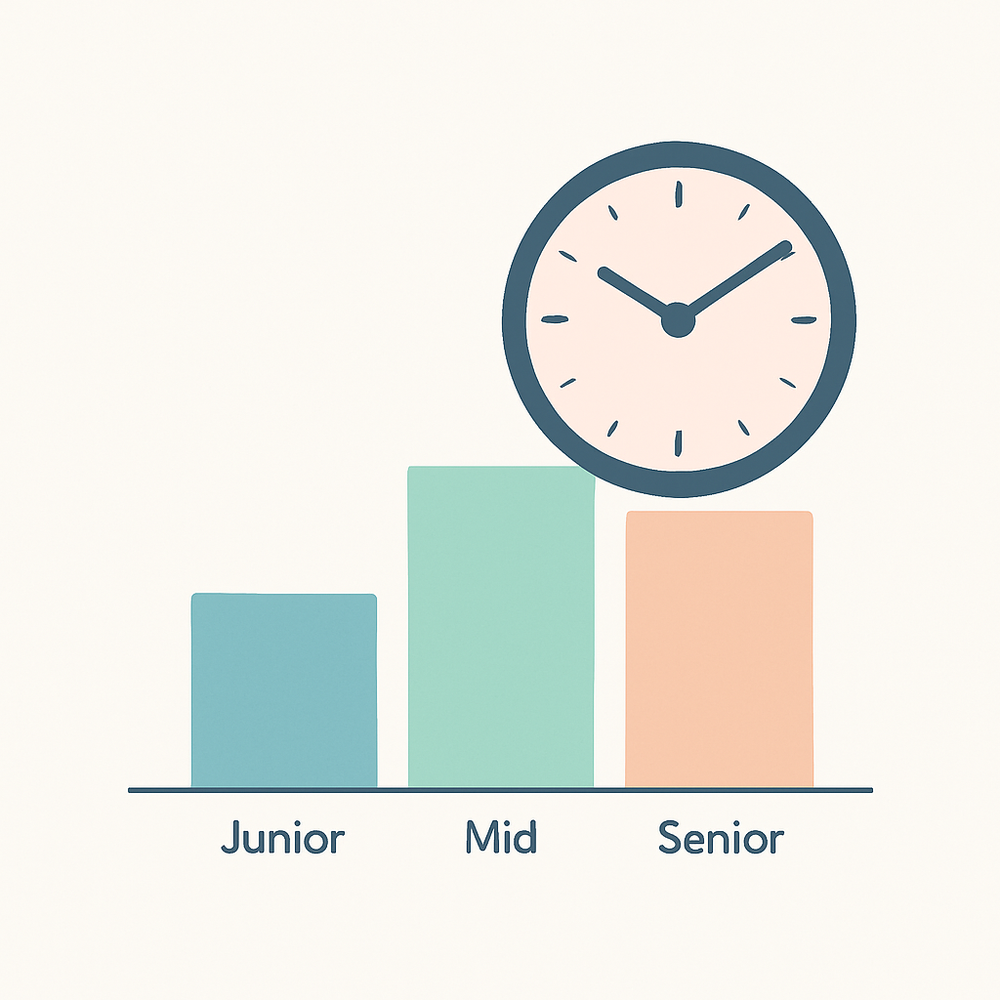
Experience compounds specialty and region rather than sitting independently alongside them. A junior AI engineer with one to two years of experience commonly runs 70 to 115 US dollars per hour in North America, while a senior specialist in the same region and specialty can price at 185 US dollars per hour or more, roughly two to three times the junior rate, a multiplier that holds fairly consistently across regions even as the absolute numbers shift. Building machine learning development services expectations around this multiplier, rather than a single blended average, gives a more accurate budget than a headline range ever will.
A structural shift is worth noting for how this plays out over the next year: developers using AI coding assistants are completing tasks 25 to 40 percent faster according to early productivity studies, but hourly rates have not fallen in response. Instead, total project budgets are shrinking because fewer hours are needed to deliver the same outcome, which means the smarter lens for a 2026 budget is cost per outcome delivered rather than hourly rate in isolation.
Platform Markup: What You Pay vs What the Developer Takes Home
The rate you see quoted is rarely the full picture of what a project costs, because the hiring route adds its own markup on top of the developer's rate. Elite vetted networks such as Toptal embed a markup commonly estimated at 30 to 60 percent above what the developer actually takes home, built into a single blended rate you cannot see the split of. Open marketplaces publish their fee structure transparently, typically a 5 to 10 percent client fee stacked on the freelancer's rate, but offer little to no vetting in exchange for that lower markup. Working directly with an independent specialist removes the platform margin entirely, which is why a direct engagement often costs meaningfully less than a marketplace-quoted rate for comparable seniority. The places to find developers post breaks down how vetting quality and markup trade off across each hiring route.
|
Specialty |
Junior to Mid Rate |
Senior Rate |
Notes |
|---|---|---|---|
|
General ML Engineering |
70 to 115 US dollars per hour |
Median around 185 US dollars per hour |
The baseline most other specialties are priced against |
|
LLM and Generative AI |
100 to 150 US dollars per hour |
210 US dollars per hour and rising |
Senior rates climbed roughly 45 percent from 2023 to 2026 |
|
AI Agent Development |
100 to 180 US dollars per hour |
200 US dollars per hour or more |
Premium reflects orchestration and evaluation skill scarcity |
|
Computer Vision |
80 to 130 US dollars per hour |
150 to 220 US dollars per hour |
Rates track annotation and edge-deployment complexity |
|
MLOps and Distributed Training |
120 to 180 US dollars per hour |
275 to 450 US dollars per hour |
The narrowest talent pool of any AI specialty |
Hire LLM Specialists
Get expert AI development with a free proof-of-concept scoping session
Get Free POC Scoping
Hourly vs Project vs Retainer: Which Model Fits Which Project
Hourly billing suits exploratory or loosely scoped work where the path to a solution is not fully known upfront, since it does not require either side to commit to a fixed outcome before understanding the problem. Project-based pricing suits well-defined builds with a clear deliverable, and it shifts estimation risk onto the developer, which is reflected in a modest premium over the equivalent hourly total. Monthly retainers, commonly 25,000 to 40,000 US dollars for senior specialists including on-call incident response, suit ongoing work where consistency and immediate availability matter more than per-hour cost efficiency. For a fuller breakdown of how project pricing shifts by type and scope, the ML consultant cost and AI agent development cost posts cover the ranges for their respective project types in more depth.
Pricing the Right Variable
A quoted rate means little without knowing which of the three variables, specialty, region or experience, is doing the work of explaining it. A senior LLM specialist in San Francisco and a senior LLM specialist in Warsaw can both be correctly priced at very different numbers for the same underlying skill, and a junior generalist and a senior specialist in the same city can be correctly priced three times apart. The question worth asking before comparing two quotes is not which is cheaper, but whether they are actually pricing the same thing.
If you are ready to scope a project and want a rate that reflects the specific specialty and seniority it actually needs, hire an AI developer whose rate you can evaluate against the work itself rather than a platform's blended markup. The right price is the one that matches the problem, not the lowest number on the page.
Frequently asked questions
What is the average hourly rate for an AI developer in 2026?
Why do LLM and AI agent developers cost more than general ML engineers?
Is it worth hiring an AI developer from a lower-cost region?
How much of a freelance platform's quoted rate goes to the developer?
Should I hire hourly, by project, or on retainer?
Do AI coding assistants mean hourly rates will fall?



Shreyans Padmani
Shreyans Padmani has 5+ years of experience leading innovative software solutions, specializing in AI, LLMs, RAG, and strategic application development. He transforms emerging technologies into scalable, high-performance systems, combining strong technical expertise with business-focused execution to deliver impactful digital solutions.