AI and ML hourly rates span roughly 50 to over 200 US dollars in 2026, with a median near 100 US dollars for machine learning engineers, according to rate analysis compiled across the major hiring platforms. Toptal's markup is not publicly disclosed, though independent buyer analyses published across 2025 and 2026 commonly estimate the effective figure at 30 to 60 percent above what the freelancer takes home. Upwork lists over 18 million registered freelancers and applies no platform-level technical vetting at all.
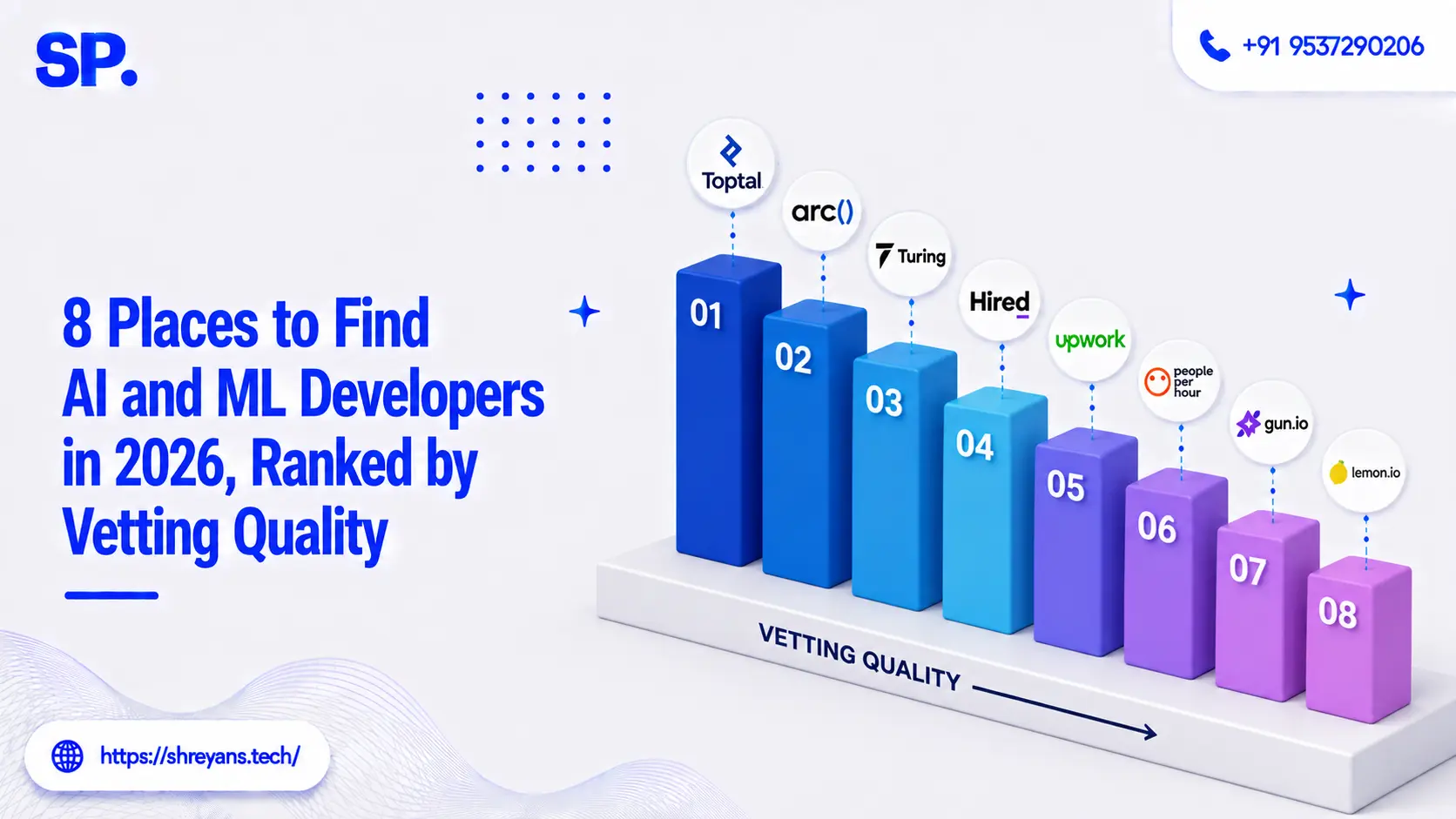
Those three facts frame the actual decision, which is not where the best developers are but how much screening you want done before a candidate reaches you, and what you are willing to pay for it. This ranking orders eight sources by how much technical vetting each performs, from most to least, with the caveat that more vetting is not automatically better: it is better when you lack the internal capability to screen candidates yourself, and expensive redundancy when you do not.
1. Elite Vetted Networks: Toptal and Gun.io
Toptal built its position on a stated top three percent acceptance rate, and the screening is demanding, with developers reporting five or six interview stages. For a business without a technical evaluator internally, that pre-screening removes the burden of distinguishing a strong AI engineer from a well-written CV. Rates run roughly 60 to over 200 US dollars per hour, with AI and ML specialists typically in the 100 to 200 range, plus a refundable deposit and a monthly membership fee. Gun.io occupies similar territory at comparable rates.
Two caveats are worth stating plainly. Client reviews are not uniformly positive, and some report matched developers whose skills did not align closely with requirements, which means the vetting reduces variance rather than eliminating it. The markup is also embedded in a single blended rate, so clients cannot see the split between what they pay and what the developer receives. Interviewing candidates yourself remains advisable even here.
2. Specialist AI Talent Networks
A category of networks focused specifically on AI and machine learning talent has grown since 2024, screening for competencies that generalist developer networks do not assess: model evaluation, retrieval architecture, MLOps and production deployment rather than general software engineering ability. For AI-specific roles this focus is a real advantage, since a general senior engineering screen tells you little about whether someone can diagnose catastrophic forgetting or design an evaluation harness.
The category is newer and less consistent than the established networks, so vetting depth varies considerably between providers, and some describe themselves as AI-specialist while running a generic technical screen. The question worth asking directly is what specifically the screening tests for in an AI context, and a network that cannot answer concretely is a generalist network with different marketing.
3. Mid-Tier Vetted Marketplaces: Turing, Arc and Lemon
Turing, Arc and Lemon.io sit between the elite networks and open marketplaces, screening candidates but less selectively, at rates commonly reported around 55 to 110 US dollars per hour for Arc and Lemon and higher for Turing's senior placements. For mid-market projects this band frequently represents the best value, since the screening removes the worst of the variance without the elite-network premium, and the rate gap against Toptal is substantial across a multi-month engagement.

The trade-off is that a moderate screen catches obvious weakness but is less reliable at confirming senior-level depth in a specialism. These platforms suit a buyer who can run one meaningful technical conversation themselves and wants the platform to handle the first filter, rather than one delegating the assessment entirely.
4. Direct Hire from Independent Specialists
Working directly with an established independent specialist involves no platform vetting at all, which sounds like a downgrade until you consider what replaces it: a verifiable public track record, a portfolio you can interrogate, references you can contact, and a specialist accountable to you rather than to a platform's matching algorithm. There is no account-management layer and no platform margin, so more of the budget reaches the person doing the work. Businesses that hire AI and ML developers this way are trading platform screening for direct visibility into who is actually building the system.
The honest limitation is that the burden of verification sits entirely with the buyer, and there is no platform dispute process or replacement guarantee if the engagement goes wrong. This route rewards buyers who can assess a portfolio and run a technical conversation, and penalises those who cannot, which is the same trade-off as an open marketplace but with a much smaller candidate pool to filter.
5. Specialist AI Recruitment Agencies
Recruitment agencies focused on AI and data roles screen candidates through a recruiter rather than a technical assessment in most cases, which is a meaningful distinction: a recruiter's filter is strongest on background, seniority and communication, and weakest on whether someone can actually build the system. Agencies suit permanent hiring and longer engagements where the role is well-understood, and their fee structure, typically a percentage of first-year salary, makes them expensive for short project work.
Where agencies add real value is in access to candidates who are not actively looking, which matters for senior specialists in a tight market. For a defined project build rather than a permanent role, the fee structure rarely justifies itself against a freelance route.
6. Open Marketplaces: Upwork, Fiverr and Contra
Upwork offers the largest talent pool of any option and a transparent published fee schedule, with AI and ML rates spanning roughly 50 to over 200 US dollars per hour. The catch is stated plainly in most honest reviews: the platform performs almost no technical vetting itself. A company without someone technical enough to review code samples and run a real test task will struggle to distinguish a strong AI engineer from a well-written profile, and the volume of irrelevant proposals following a job post is itself a filtering cost.
Lower rates come with higher variance rather than uniformly lower quality, and excellent AI engineers do work on these platforms. Open marketplaces are the right choice for well-defined, bounded tasks where a buyer can specify acceptance criteria precisely, and the wrong choice for an open-ended build where the buyer cannot evaluate the work in progress.
Hire AI Developers
Expert AI solutions with a free proof-of-concept scoping session
Get Free POC Scoping7. Developer Communities, GitHub and Conference Networks
Sourcing from open-source contribution history, research communities or conference networks provides no vetting whatsoever, but it offers something no platform does: direct evidence of work. A candidate's public repositories, issue discussions and contribution history show how they actually write code, respond to review and handle disagreement, which is more informative than most interview signals. For niche specialisms, retrieval architecture, a specific vision model family, a particular MLOps stack, this is often where the deepest expertise is visible.
The obvious costs are time and conversion rate. Sourcing this way is slow, most strong candidates are not looking for contract work, and there is no structure for rates, contracts or dispute resolution. It suits organisations with the internal technical depth to recognise good work and the patience to build a relationship before a project exists.
8. Offshore Staffing and Development Firms
Embedded offshore staffing places a developer inside a client team full time at rates well below marketplace levels, and development firms provide teams rather than individuals. Vetting quality varies more widely across this category than any other, from firms running rigorous internal assessment to those whose selection amounts to availability. The economics are compelling for sustained work, since the platform margin disappears and the engineer is dedicated rather than splitting attention across clients.
For AI specifically, the risk is that a firm's general software engineering competence does not extend to machine learning depth, and a team assembled to fill a headcount request may include no one who has taken a model to production. The question to press on is not team size but whether the named individuals have shipped comparable AI systems, and whether you get to interview them before committing.
|
Source |
Vetting Done For You |
Typical AI/ML Rate |
Best For |
|---|---|---|---|
|
Elite networks (Toptal, Gun.io) |
High, multi-stage screening before you see a profile |
Roughly 100 to 200+ US dollars per hour |
Business-critical projects where a wrong hire is costly |
|
Mid-tier vetted (Turing, Arc, Lemon) |
Moderate, screened but less selective |
Roughly 55 to 200 US dollars per hour |
Mid-market projects wanting a balance of cost and screening |
|
Open marketplaces (Upwork, Fiverr) |
Minimal, platform does little technical screening |
Roughly 15 to 200+ US dollars per hour |
Well-defined tasks where you can filter yourself |
|
Direct independent specialists |
None by a platform, verifiable via track record |
Varies, no platform markup |
Scoped projects where you want the specialist accountable directly |
Matching the Source to the Specialisation
Vetting quality is only half the question; the other half is whether the source can supply the specific skill set the project needs. A network that screens well for general senior engineering may have few candidates who have built a production retrieval pipeline, and a project needing generative AI development services is poorly served by a pool assessed mainly on classical software ability. The same applies in reverse: a project needing machine learning development services for structured prediction does not need a language model specialist, and hiring one is an expensive mismatch.
Doing Your Own Vetting Regardless of Source
No platform screening removes the need for a technical conversation, and the buyers who report the worst outcomes are consistently the ones who delegated assessment entirely. A structured technical round using the ML interview questions as a starting checklist costs an hour and catches most mismatches that survive a platform filter. For generative AI roles specifically, portfolio review deserves particular scrutiny because the work demos impressively and verifies poorly, and the Gen AI portfolio red flags post covers what separates a production system from a polished demonstration.
The engagement model deserves as much thought as the source. A freelance specialist, a permanent hire and an embedded team carry different cost structures, different IP considerations and different failure modes, and the freelancer vs full-time team comparison covers how that decision usually resolves for startups and mid-market teams.
The Variable That Decides the Outcome
Ranking these sources by vetting quality is useful, but the ranking inverts in practical value depending on one thing: whether you can assess a candidate yourself. A buyer with internal technical depth gets better results and pays less further down this list, while a buyer without it should pay for screening near the top and still expect to interview. The expensive mistake is being in the second group while shopping in the first group's price range.
If you would rather work directly with a specialist than filter a marketplace, hire an AI developer whose track record you can verify before a contract exists. Whichever route you take, the hour spent on a real technical conversation is the highest-return hour in the entire hiring process.
Frequently asked questions
Is Toptal worth the premium for hiring AI developers?
What do AI and ML developers cost per hour in 2026?
Which platform is best if I cannot technically vet candidates myself?
Is Upwork viable for hiring AI developers?
Should I hire a freelance AI developer or use an agency?
How do I verify an AI developer's experience is real?



Shreyans Padmani
Shreyans Padmani has 5+ years of experience leading innovative software solutions, specializing in AI, LLMs, RAG, and strategic application development. He transforms emerging technologies into scalable, high-performance systems, combining strong technical expertise with business-focused execution to deliver impactful digital solutions.