
AI Developer for SaaS Products: How to Scope an ML Feature Without Slowing Down Your Roadmap

Apptension's 2026 SaaS product management research names the actual difficulty directly: adding a model to a product is not the hard part, shipping something that stays correct, safe, and useful after the first demo is. The failure mode is consistent enough to be recognisable: a team ships a chatbot, adoption spikes for a week, and support tickets climb as users hit wrong answers and inconsistent behaviour, while the product team watches usage rise without churn actually falling. Gartner's research, cited in IT IDOL Technologies' 2026 SaaS roadmap guide, puts a number on the risk of skipping proper scoping: more than 40 percent of agentic AI projects will be scrapped by 2027 unless carefully scoped and validated first.
The good news is that scoping an ML feature correctly does not require slowing the rest of the roadmap down. It requires treating the AI feature as a different kind of work with its own planning rules. The seven practices below cover how to do that without either freezing product velocity or shipping something that erodes trust faster than it builds it, the kind of scoping conversation machine learning development services should walk through with you before a line of code gets written.
1. Separate the AI Track From the Rest of the Roadmap
Ideaplan's 2026 product roadmap research makes a structural point worth internalising: AI product work is probabilistic where traditional software work is deterministic, and a model improvement might take two weeks or six months with no reliable way to know in advance. The fix is a parallel-track roadmap, one track for model research, training, and evaluation planned with confidence ranges rather than fixed dates, and a separate track for the rest of the product moving on its normal, predictable timeline.
Userpilot's 2026 roadmap template research reaches the same conclusion from a different angle, noting a Now-Next-Later framework works better for AI capability work than a fixed-date Gantt chart, since it avoids the false precision a 2026 team cannot actually deliver on for probabilistic work. Keeping the AI track visibly separate from the rest of the roadmap is what stops an uncertain model timeline from blocking or distorting the certain-timeline features shipping around it.
2. Build the Evaluation Dataset Before You Build the Feature

Conception Labs' 2026 SaaS AI playbook names the step almost every team skips: building an evaluation dataset before writing the feature itself. Without it, a team is tinkering in the dark, with no reliable way to know whether a given change to a prompt, a model, or a retrieval pipeline actually made the feature better or simply looks different. This step does not need a data science team to start; it needs a defined set of representative inputs and expected outputs that the team can score changes against consistently.
Ideaplan's 2026 research lists the specific metrics worth tracking once that evaluation set exists: task completion rate, accuracy or quality scores from the evaluation runs, the rate at which users override or reject the AI's output, and latency. The ML consulting post covers how to structure this kind of measurement work so it compounds across multiple AI features rather than starting from zero each time.
3. Check Whether If/Then Logic Already Gets You There
Conception Labs' guide includes advice worth repeating loudly on any SaaS roadmap with "AI" written across it in 2026: do not add machine learning to a feature that already works with simple conditional logic, since if simple rules already get you 95 percent of the way there, adding a model on top mostly wastes time and money without a proportional improvement in outcome.
This check takes an afternoon of honest assessment and can save a full development cycle. Not every feature that could technically use a model needs one, and a roadmap under pressure to show "AI features" is exactly the environment where this distinction gets skipped most often.
4. Sequence Quick Wins Before Proprietary Features
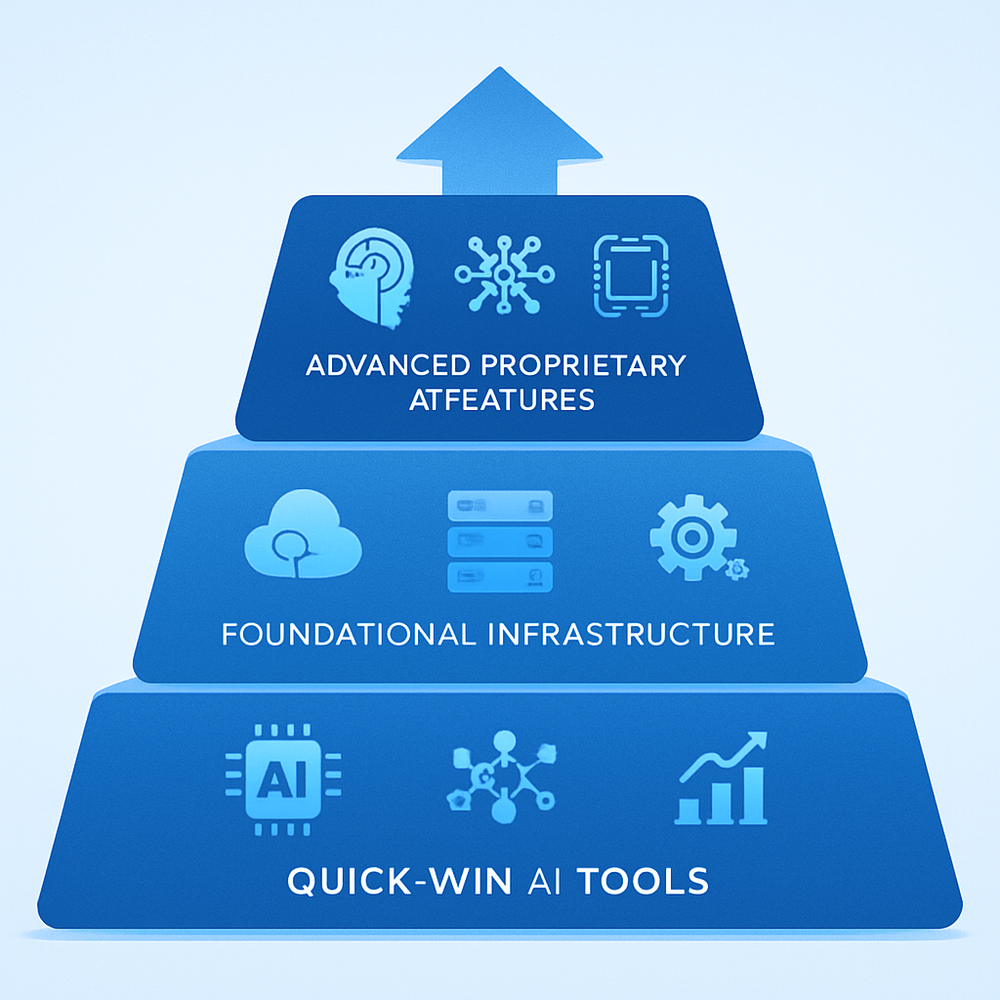
ProductGrowth's 2026 AI roadmap framework recommends a specific sequence: start with quick wins like chatbots and semantic search that use largely off-the-shelf capability, build the foundational infrastructure a more ambitious feature will need, retrieval pipelines and vector databases specifically, and only then invest in truly proprietary AI features built on your unique data.
This sequencing matters for roadmap velocity specifically because the infrastructure built for the quick win, the retrieval pipeline, the evaluation harness, the vector database, is exactly what the more ambitious feature needs later. Teams that skip straight to a proprietary feature end up building that same infrastructure anyway, just later and under more time pressure. A generative AI development services engagement scoped around this sequence ships a working quick win fast while quietly laying the groundwork for what comes next.
5. Run a Lightweight Cross-Functional Review, Not a Committee
IT IDOL Technologies' 2026 SaaS roadmap research recommends a cross-functional review spanning product, engineering, legal, finance, and support before a significant AI feature ships, alongside a commitment to modular delivery and rigorous pilots rather than betting on enterprise-scale rollout before repeatable metrics exist. The guide's specific recommendation, a 90-day AI roadmap audit that inventories candidate features and applies a consistent triage process, is a bounded exercise, not an ongoing bureaucratic layer.
This matters especially for agentic features, where custom AI agent solutions that take autonomous action carry a different risk profile than a chatbot that only answers questions. The review does not need to slow every feature down; it needs to exist as a defined, fast checkpoint specifically for the features where getting it wrong is expensive.
6. Measure Outcomes, Not Just Usage
Apptension's 2026 research is precise about the metric trap that catches most SaaS teams: measuring output, features shipped, instead of outcomes, tasks completed, time saved, fewer support tickets, higher retention. Usage climbing while churn stays flat or worsens is not a success signal, it is a sign users are trying the feature and not getting enough value to keep using it.
Ideaplan's research adds the business-facing half of this measurement: AI feature adoption rate, retention lift specifically attributable to the AI feature, and cost per AI inference, tracked together rather than any single metric in isolation. A feature with high usage and negative retention lift is a feature actively working against the product, not one succeeding by the usage number alone.
7. Know When to Bring in Outside AI Development Help
Origami Studios' 2026 research on AI product timelines is specific about scope: simple AI features can ship in a few months, while enterprise-grade AI products can reasonably need six to twelve months or more once evaluation, testing, and deployment are counted properly. Many organisations bring in outside AI development help specifically because an experienced partner accelerates development, reduces the risk of the scoping mistakes covered above, and gets a working feature to market faster than an in-house team building this kind of infrastructure for the first time.
The ML consultant cost breakdown covers what this kind of engagement typically costs by scope, which is worth reviewing before deciding whether to build the evaluation and infrastructure work in-house or bring in specialist help for the first feature specifically.
7 Scoping Practices and What Each One Prevents
|
Practice |
What It Prevents |
|---|---|
|
Separate AI track with confidence ranges |
An uncertain model timeline blocking certain-timeline features |
|
Build the evaluation dataset first |
Tinkering in the dark with no way to measure improvement |
|
Check if simple logic already works |
Spending an ML budget on a problem rules already solve |
|
Sequence quick wins before proprietary features |
Rebuilding the same infrastructure later under more pressure |
|
Lightweight cross-functional review |
An agentic feature shipping without legal or support sign-off |
|
Measure outcomes, not usage |
Declaring a feature a success while churn quietly rises |
|
Know when to bring in outside help |
An in-house team learning AI infrastructure for the first time on your critical roadmap |
Scope the Feature Like It Is Different Work, Because It Is
None of these seven practices requires slowing your roadmap down across the board. They require treating AI feature work as a distinct category with its own planning rules, its own evaluation step, and its own review checkpoint, while the rest of your roadmap continues to ship on its normal, predictable schedule.
The why startups hire freelance post covers why a freelance specialist often scopes this kind of feature more realistically than a generalist team building AI infrastructure for the first time. Hire an AI developer who can walk through these seven practices with you before the feature is scoped, not after the demo has already set the wrong expectations.
Frequently asked questions
How do I keep an AI feature from delaying the rest of my SaaS roadmap?
What is the first thing to build before starting an AI feature?
How do I know if a feature actually needs machine learning or just better logic?
What order should I build AI features in on a SaaS roadmap?
What metrics actually show whether an AI feature is working?
When should a SaaS team bring in outside AI development help instead of building in-house?



Shreyans Padmani
Shreyans Padmani has 5+ years of experience leading innovative software solutions, specializing in AI, LLMs, RAG, and strategic application development. He transforms emerging technologies into scalable, high-performance systems, combining strong technical expertise with business-focused execution to deliver impactful digital solutions.