By mid-2026, tracking databases had logged more than 1,490 court cases worldwide involving AI-hallucinated legal citations. In one June 2026 case, both sides filed fake citations, the judge cancelled the trial and suspended the two lead attorneys from the district for two years.
In the same period, Harvey AI reached roughly $300 million in annual recurring revenue at an $11 billion valuation. Both facts are true, and they aren't contradictory. The two halves of ai in legal tech named in this article's title have almost opposite risk profiles, and understanding why is the difference between a deployment that saves thousands of hours and one that ends careers.
Closed Corpus vs Open Corpus: The Distinction That Explains Everything
Contract review and legal research look like the same category of work. Technically they are opposites.
|
Contract review |
Legal research |
|
|---|---|---|
|
What the AI does |
Reads and flags content inside a document you supplied |
Generates references to authority from the entire body of law |
|
Source of truth |
The document itself, in front of you |
External case law the model may or may not have seen |
|
Can output be checked? |
Yes, directly against the source text |
Only by manually pulling every cited case |
|
Dominant failure mode |
Missing a clause (recoverable) |
Fabricating a citation (sanctionable) |
|
Adoption status |
Fastest and least controversial |
Widely used, widely sanctioned |
Contract review is a closed-corpus task. The answer exists in a document the user already has, so the model is summarising and flagging rather than recalling, and any output can be verified in seconds by looking at the clause. That single property removes most of the hallucination risk that dominates legal AI discourse, which is why contract review, due diligence, and e-discovery have become the highest-confidence applications in the field.
Contract Review: Where It Genuinely Works
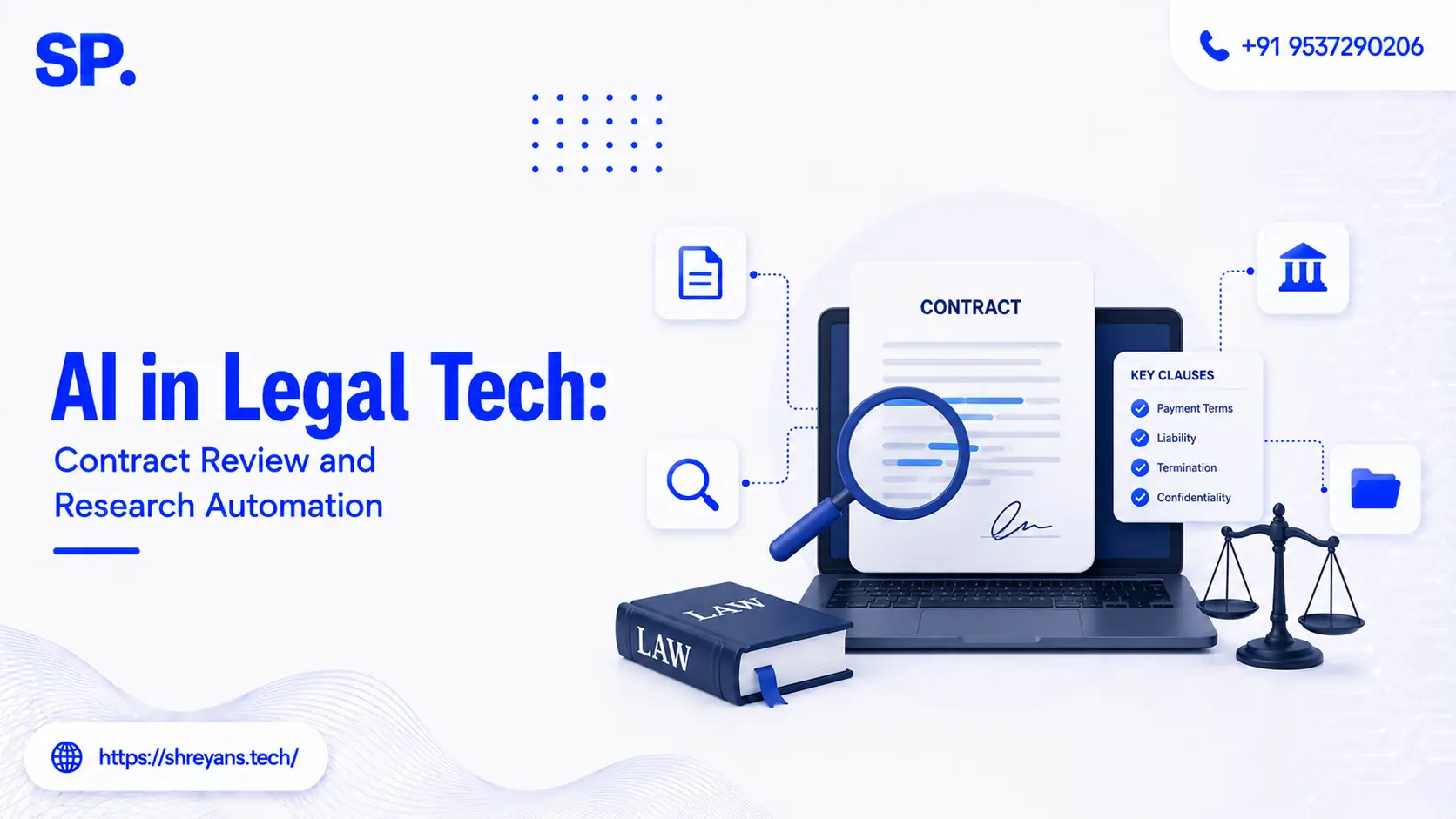
In practice, AI contract review handles clause extraction and classification, comparison against a playbook or standard position, deviation flagging, obligation and date extraction, and consistency checking across long agreements. In a 2026 survey of legal teams, contract redlining and NDA review were reported as the highest-confidence AI use cases among in-house functions.
The reason these work is structural rather than a matter of model quality. A model asked "does this contract contain an unlimited liability clause, and where?" is performing retrieval against a supplied document, and the reviewing lawyer confirms or rejects the answer immediately. The underlying grounding approach is the same one covered in RAG in generative AI, where responses are tied to retrieved source material rather than model memory.
The realistic failure mode is a missed clause rather than an invented one, which is a materially different risk: it's the same error a junior associate can make, it's caught by normal review, and it doesn't constitute a false statement to a court.
Legal Research: What the Data Actually Shows
A peer-reviewed Stanford RegLab study published in the Journal of Empirical Legal Studies tested the two leading commercial legal research tools, both marketed as effectively hallucination-free. Lexis+ AI hallucinated on 17% of queries. Westlaw AI-Assisted Research hallucinated on 33%. Both vendors disputed the methodology; the study remains peer-reviewed.
General-purpose chatbots perform far worse on legal questions, with reported error rates ranging from 58% to 88% depending on query specificity, and a bare GPT-4 baseline around 43%. The direction of the finding matters more than any single figure: retrieval-grounded legal tools are substantially better than general chatbots, and they are nowhere near zero.
Legal hallucination takes three distinct forms, and all three have drawn sanctions: citations to cases that do not exist, fabricated quotations attached to real cases, and real cases cited for propositions they never held. The second and third are more dangerous than the first, because a citation-checking tool confirms the case exists and a reviewer stops looking.
What Courts Actually Sanction
A point that gets lost in the coverage: courts almost never punish the use of AI itself. They punish the failure to verify, and the lack of candour when an attorney is caught and defends rather than corrects.
|
Case |
What happened |
Outcome |
|---|---|---|
|
Mata v. Avianca (2023) |
Six fabricated citations from ChatGPT |
$5,000 sanction and public reprimand |
|
Wadsworth v. Walmart |
Eight of nine citations from the firm's own in-house AI tool did not exist |
Sanctions; notable because the tool was purpose-built |
|
Lacey v. State Farm |
Fabricated and mischaracterised authorities |
~$31,000 order against two AmLaw firms |
|
Withers v. City of Aberdeen (2026) |
Both sides filed fake citations |
Trial cancelled; two lead attorneys suspended two years |
The professional obligations are already explicit. ABA Formal Opinion 512 and Model Rule 3.3 establish that unverified hallucinated citations filed with a court are false statements of law regardless of whether the lawyer knew they were false. A state supreme court disciplinary opinion put it directly: using artificial intelligence does not relieve an attorney of the obligation to verify the accuracy of every representation made to the court.
Deploying It Without the Downside
Three practices separate firms capturing the efficiency from firms appearing in the tracker.
Match the tool to the corpus
Point AI at documents you supplied, contracts, discovery sets, deal rooms, and treat any output referencing external authority as a research lead requiring independent confirmation. This single rule eliminates most of the exposure while preserving most of the value.
Verify in layers, not once
Confirm the case exists. Then pull the opinion and confirm the quoted passage appears exactly as quoted. Then confirm the proposition attributed to the case is actually supported by its reasoning. Checking only the first layer catches fabricated cases but misses fabricated quotes and mischaracterised holdings, which is precisely how experienced attorneys have been sanctioned.
Resolve confidentiality before deployment, not after
Client documents carry privilege obligations that most general-purpose AI terms do not accommodate. Confirm whether inputs are retained or used for training, and whether the architecture keeps privileged material inside a controlled boundary. The access-scoping discipline in AI agent security applies directly: decide what the system can reach before it reaches anything.
Build Considerations for Legal Teams
Firms building internal tooling rather than buying should note the Wadsworth case carefully, since those fabricated citations came from a firm's own in-house platform. Building it yourself does not confer immunity; grounding, citation verification, and confidence handling have to be engineered deliberately.
The competencies that matter here are retrieval quality, evaluation against a held-out set of real legal questions, and explicit handling of low-confidence outputs rather than always returning an answer. LLM integration hiring covers what to screen for in that kind of production work, and the highest-value first build for most legal teams remains a closed-corpus one: contract analysis, obligation extraction, or document comparison against a house playbook.



Shreyans Padmani
Shreyans Padmani has 5+ years of experience leading innovative software solutions, specializing in AI, LLMs, RAG, and strategic application development. He transforms emerging technologies into scalable, high-performance systems, combining strong technical expertise with business-focused execution to deliver impactful digital solutions.