The natural gap between speakers in human conversation averages 239 milliseconds. Production voice AI systems currently deliver a median response latency of 1,400 to 1,700 milliseconds, making the typical deployment five to eight times slower than the humans it's replacing.
That sounds like a verdict, but it isn't. Sub-250ms at the median is demonstrably achievable in 2026 with the right architecture. The honest answer to whether ai voice agents are production-ready is that the technology is; the median deployment isn't. Here's how to tell which one you're being sold, as part of the wider generative ai for business picture.
The Latency Gap That Decides Everything
Voice is unforgiving in a way text isn't. A chatbot that takes two seconds to reply is fine. A voice agent that takes two seconds has already lost the caller, who interprets the silence as a dropped call and starts talking over the agent or hangs up.
|
Latency |
What it corresponds to |
Caller experience |
|---|---|---|
|
~239 ms |
Natural human turn-taking |
Indistinguishable from a person |
|
Under 400 ms |
2026 competitive floor |
Feels natural, no perceptible lag |
|
800 ms |
Reliability ceiling (P95 target) |
Noticeable; delays past this drive ~40% higher abandonment |
|
1,400–1,700 ms |
Current industry median (P50) |
Agent "feels slow," frequent talk-over |
|
3,300–3,800 ms |
Common P90 tail |
One in ten callers; frequent breakdown |
The P90 number is the one buyers miss. A vendor quoting an average of 800ms may still be delivering a broken experience to one caller in ten, and averages conceal that entirely. Always ask for P95 and P99, not the mean.
The Accuracy Tradeoff Vendors Don't Volunteer
Speed isn't free. An independent Coval benchmark ran 2,400 tests across five speech-to-text models and found a structural tension: the two fastest models on time-to-first-token recorded word error rates above 25%, while the most accurate models sat well down the latency ranking.
|
Speech-to-text model |
Median latency delta |
Word error rate |
|---|---|---|
|
Deepgram Nova-3 |
0 ms |
25.3% |
|
Deepgram Nova-2 |
22 ms |
25.2% |
|
AssemblyAI Universal Streaming |
57 ms |
4.2% |
|
Gradium STT |
596 ms |
2.4% |
|
ElevenLabs Scribe v2 |
1,053 ms |
3.1% |
No single model led on both. That matters because transcription errors compound downstream: a misheard account number or medication name doesn't just produce a wrong answer, it produces a confidently wrong action. A production-ready target is under 5% WER on any path where the transcription drives a decision, which rules out the fastest tier outright for most real use cases.
Five Benchmarks to Hold a Vendor To
These are 2026 baselines drawn from published evaluation frameworks, not aspirational targets. A vendor who can't produce numbers against all five hasn't run a serious production deployment.
|
Metric |
Production-ready threshold |
|---|---|
|
Turn-level latency |
Under 400 ms at P50, under 800 ms at P95 |
|
Word error rate |
Below 5% on decision-critical paths |
|
Containment rate |
Above 70%, measured on genuinely resolved calls |
|
Task success rate |
Above 85% |
|
Uptime and scaling |
99.9% uptime; elastic from 100 to 10,000 concurrent calls |
Containment is the most frequently inflated of these. A number that folds abandoned calls into "contained" counts a caller who gave up as a success. Ask specifically whether the figure counts resolved intents or merely calls that never reached a human.
Three Failure Modes That Only Appear at Scale
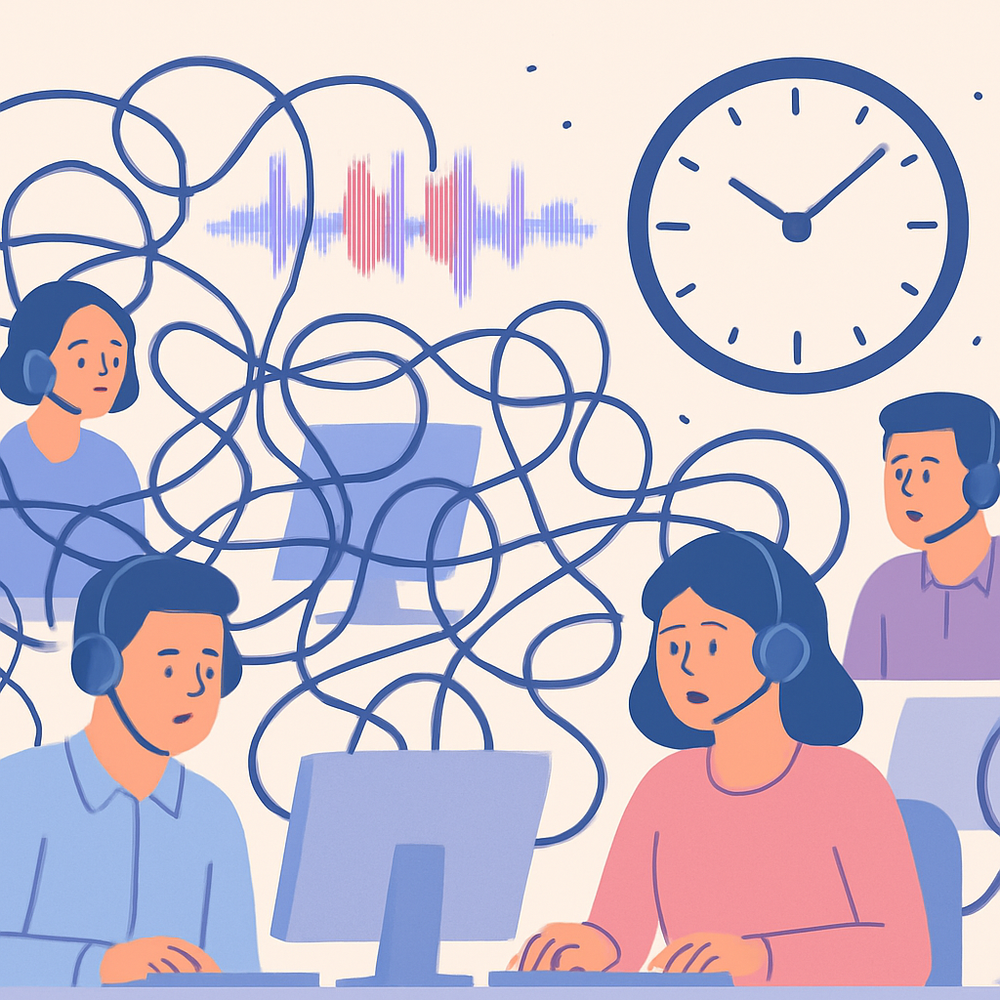
A pilot handling twenty calls a day reveals almost none of what breaks at two thousand. Three classes of failure dominate real deployments.
Latency spikes rather than latency averages
Rate-limit responses from the LLM provider add 500 to 2,000ms while the agent retries. Without a fallback model or provider queue, these spikes land unpredictably on real callers.
Audio session instability
Unmanaged WebRTC sessions produce connection failures and audio glitches that never surface in a controlled demo but appear consistently under concurrent load.
Compliance gaps in the transcript path
Customer PII routinely surfaces in LLM provider logs unless the pipeline is explicitly designed to prevent it. This is a day-one architecture decision, not a later fix, and it's the same access-scoping discipline covered in AI agent security, applied to a voice transcript rather than a database.
So: Ready or Not?
The verdict splits cleanly by use case rather than by technology.
Ready now: appointment scheduling, order status, routine account queries, call routing and qualification. These have bounded intent sets, tolerate a clean handoff when confidence drops, and are where 70%+ containment is realistically achievable today.
Ready with tight guardrails: outbound follow-up, payment reminders, basic troubleshooting, anything regulated where a human reviews outcomes and the escalation path is genuinely instant rather than nominal.
Not ready: open-ended advisory conversations, emotionally sensitive calls, and any interaction where a confidently wrong answer carries real cost. The distinction mirrors the one between agents vs chatbots: the further a system moves from answering toward independently acting, the more the failure cost rises and the more the guardrails have to carry.
Frequently asked questions
Are AI voice agents ready for production use in 2026?
What latency do AI voice agents need to feel natural?
What is a good containment rate for a voice agent?
Why do fast speech-to-text models have worse accuracy?
What breaks when a voice agent pilot scales to production?



Shreyans Padmani
Shreyans Padmani has 5+ years of experience leading innovative software solutions, specializing in AI, LLMs, RAG, and strategic application development. He transforms emerging technologies into scalable, high-performance systems, combining strong technical expertise with business-focused execution to deliver impactful digital solutions.