Introduction
In today’s digital-first world, businesses are generating massive amounts of visual data through cameras, sensors, mobile devices, and IoT systems. However, extracting meaningful insights from this data is not easy without intelligent systems.
Computer Vision a branch of Artificial Intelligence—enables machines to “see” and understand images and videos just like humans. It helps enterprises automate processes, improve accuracy, and make faster decisions.
Custom computer vision solutions take this a step further by tailoring AI models specifically for your business needs, ensuring maximum efficiency and ROI.
What Are Custom Computer Vision Solutions?
Custom computer vision solutions are AI-powered systems designed to analyze, process, and interpret visual data for specific enterprise use cases.
These solutions include capabilities such as:
Object Detection and Tracking
-
Object detection identifies specific objects such as people, vehicles, or products in an image or video. Tracking follows these detected objects over time across multiple frames. This is useful in applications like surveillance, traffic monitoring, and inventory management.
Image Segmentation
-
Image segmentation divides an image into multiple parts or regions to simplify analysis. It helps in identifying objects more accurately by separating them from the background. This is commonly used in medical imaging, quality inspection, and autonomous systems.
Video Analytics
-
Video analytics uses artificial intelligence to analyze live or recorded video data. It can detect events, monitor activities, and generate real-time alerts. This technology is widely used in security systems, smart cities, and customer behavior analysis.
OCR (Optical Character Recognition)
-
OCR technology extracts text from images, scanned documents, or videos and converts it into digital format. This allows easy editing, searching, and storage of information. It is commonly used in document processing, banking, and automation systems.
Facial Recognition and Pose Estimation
-
Facial recognition identifies or verifies a person based on their facial features. Pose estimation tracks body movements and positions. These technologies are used in security systems, attendance tracking, fitness applications, and gesture-based controls.
They are built using advanced technologies like deep learning, neural networks, and frameworks such as TensorFlow and OpenCV.
Why Enterprises Need Computer Vision
1. Automation of Manual Tasks
Businesses can automate repetitive processes like inspection, monitoring, and data entry, reducing human effort.
2. Improved Accuracy
Computer vision systems reduce errors and deliver high precision in operations like quality control and analytics.
3. Cost Reduction
Automation and efficiency lead to lower operational costs and higher profitability.
4. Faster Decision Making
Real-time image and video analysis enable quicker and smarter business decisions.
Key Enterprise Applications of Computer Vision
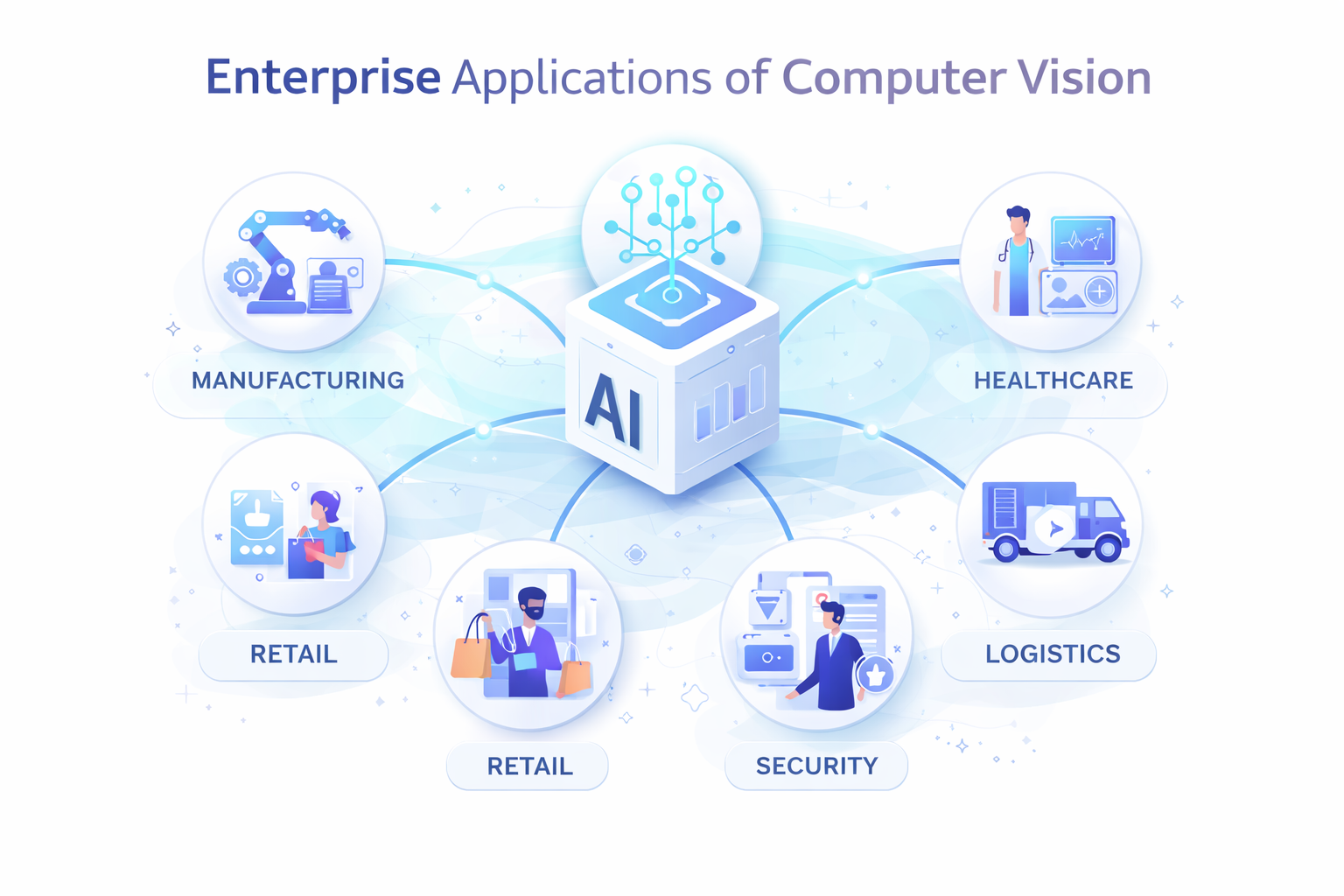
1. Manufacturing & Quality Inspection
-
Detect Product Defects Automatically
-
Computer vision systems can identify defects such as cracks, scratches, or shape irregularities in products during the production process. This ensures faulty items are detected early without manual inspection.
-
Reduce Production Waste
-
By detecting defects in real time, businesses can stop or adjust production immediately. This helps in minimizing material waste, saving costs, and improving overall efficiency.
-
Maintain Consistent Quality Standards
-
Automated inspection ensures that every product meets the same quality criteria. Unlike human inspection, computer vision provides consistent and accurate results, helping maintain high-quality standards across all products.
Computer vision systems can identify abnormalities in products faster than human inspection.
2. Retail & E-commerce
-
Visual Search and Product Recommendations
-
Visual search allows users to find products by uploading images instead of typing keywords. The system analyzes the image and suggests similar or matching products, improving the shopping experience and increasing sales.
-
Customer Behavior Analysis
-
Computer vision can track and analyze customer movements, interactions, and preferences in stores or online platforms. This helps businesses understand buying patterns, improve store layouts, and create personalized marketing strategies.
-
Inventory Tracking
-
Computer vision systems can automatically monitor stock levels by scanning shelves or warehouses. This ensures accurate inventory management, reduces out-of-stock situations, and improves supply chain efficiency.
Image-based product matching helps customers find similar products quickly, improving user experience.
3. Healthcare
-
Medical Image Analysis (X-rays, MRIs)
-
Computer vision is used to analyze medical images such as X-rays, MRIs, and CT scans. It helps in identifying abnormalities like tumors, fractures, or internal injuries with high accuracy and speed.
-
Disease Detection and Diagnosis
-
AI-powered systems assist doctors in detecting diseases at an early stage by analyzing medical data and images. This improves diagnosis accuracy and supports better treatment planning.
-
Patient Monitoring Systems
-
Computer vision enables continuous monitoring of patients through cameras and sensors. It can track movements, detect unusual behavior, and alert medical staff in case of emergencies, ensuring better patient care.
Computer vision helps doctors detect diseases earlier with better accuracy.
4. Logistics & Supply Chain
-
Automated Warehouse Monitoring
-
Computer vision systems monitor warehouse operations in real time by tracking goods, equipment, and worker activities. This improves efficiency, reduces errors, and ensures smooth handling of inventory.
-
Cargo Damage Detection
-
AI-powered vision systems can inspect goods during loading, unloading, and transportation to identify any damage. This helps businesses take immediate action, reduce losses, and maintain product quality.
-
Route and Traffic Analysis
-
Computer vision analyzes road and traffic data to optimize delivery routes and monitor traffic conditions. It helps in reducing delivery time, improving fuel efficiency, and ensuring safer transportation.
Real-time tracking ensures operational efficiency and safety.
5. Security & Surveillance
-
Facial Recognition Systems
-
Facial recognition technology identifies or verifies individuals based on their facial features. It is commonly used in security systems, access control, attendance management, and surveillance.
-
Intrusion Detection
-
Computer vision systems can detect unauthorized access or suspicious entry into restricted areas. They monitor live video feeds and generate alerts in real time, improving security and preventing potential threats.
-
Behavior Analysis
-
Behavior analysis uses AI to study human actions and patterns from video data. It helps in identifying unusual or suspicious activities, enhancing security, and supporting decision-making in areas like surveillance and customer analytics.
AI-powered video analytics can detect suspicious activities in real time.
6. Fitness & Sports
-
Pose Estimation for Workout Tracking
-
Pose estimation tracks body movements and positions during exercises using computer vision. It helps users maintain correct posture, count repetitions, and follow workouts more accurately without a personal trainer.
-
Performance Analysis
-
Computer vision analyzes movements and techniques to evaluate performance in sports and fitness activities. It provides detailed insights that help improve skills, efficiency, and overall results.
-
Injury Prevention
-
By monitoring body posture and movement patterns, computer vision can detect incorrect form or risky motions. This helps in preventing injuries and ensures safer workouts and training sessions.
These systems track human movement and provide feedback for improvement.
Core Features of Custom Computer Vision Solutions
Object Detection & Tracking
Identify and track objects in real time across images and videos.
Image Segmentation
Break images into meaningful parts for better analysis.
OCR & Data Extraction
Extract text from documents and automate workflows.
Video Analytics
Analyze live video feeds for insights and alerts.
Visual Search
Find similar products using images instead of keywords.
How Custom Computer Vision Works
-
Data Collection – Gather images/videos from cameras or databases
-
Data Processing – Clean and label data for training
-
Model Training – Use AI/ML algorithms to train models
-
Deployment – Integrate into enterprise systems
-
Monitoring & Optimization – Improve performance over time
Benefits of Custom Computer Vision Solutions
Increased Productivity
-
Computer vision automates repetitive and time-consuming tasks, allowing employees to focus on more important activities. This leads to faster operations and higher overall efficiency.
Reduced Human Error
-
Automated systems perform tasks with high accuracy and consistency, minimizing mistakes that can occur with manual processes. This improves reliability and quality of outcomes.
Better Customer Experience
-
By understanding customer behavior and preferences, computer vision helps businesses offer personalized services, faster responses, and smoother interactions, enhancing overall customer satisfaction.
Real-Time Insights
-
Computer vision processes visual data instantly, providing immediate insights and alerts. This enables businesses to make quick and informed decisions.
Scalable Business Operations
-
These solutions can easily scale as the business grows. They can handle increasing amounts of data and operations without significantly increasing costs or complexity.
Custom solutions are flexible and tailored to specific business challenges, making them more effective than generic tools.
Future of Computer Vision in Enterprises
The future of computer vision is highly promising with advancements like:
Edge AI (Real-Time Processing on Devices)
-
Edge AI allows computer vision models to run directly on devices such as cameras, smartphones, or embedded systems. This enables real-time data processing without relying on cloud servers, resulting in faster response times, lower latency, and improved data privacy.
3D Vision and Spatial Analysis
-
3D vision enables systems to understand depth, distance, and spatial relationships between objects. It is used in applications like robotics, autonomous vehicles, and augmented reality to provide more accurate and detailed analysis of the physical environment.
Integration with IoT and Smart Systems
-
Computer vision can be combined with IoT devices and smart systems to create intelligent environments. For example, smart cameras, sensors, and connected devices can work together to automate processes, monitor conditions, and improve efficiency in homes, industries, and cities.
AI-Powered Automation Across Industries
-
Computer vision is driving automation in various industries such as manufacturing, healthcare, retail, and logistics. It helps in reducing manual work, increasing speed, and improving accuracy, leading to smarter and more efficient business operations.
Businesses adopting these technologies early will gain a strong competitive advantage.
FAQ (Frequently Asked Questions)
Q1. What is computer vision in simple terms?
Ans: Computer vision is a technology that allows machines to understand images and videos like humans.
Q2. How much does a computer vision solution cost?
Ans: The cost depends on complexity, but typically ranges from $15,000 to $100,000+ for enterprise-level solutions.
Q3. Which industries use computer vision?
Ans: Industries include healthcare, manufacturing, retail, logistics, security, fitness, and more.
Q4. What technologies are used in computer vision?
Ans: Popular technologies include TensorFlow, OpenCV, PyTorch, and deep learning models.
Q5. Why should businesses choose custom solutions?
Ans: Custom solutions are tailored to business needs, ensuring better performance, scalability, and ROI.
Conclusion
Custom computer vision solutions are transforming how enterprises operate by turning visual data into actionable insights. From automating workflows to enhancing customer experiences, this technology is becoming essential for modern businesses.
By adopting tailored computer vision systems, enterprises can improve efficiency, reduce costs, and stay ahead in a competitive market. The future belongs to businesses that can “see” data clearly—and act on it intelligently.



Shreyans Padmani
Shreyans Padmani has 5+ years of experience leading innovative software solutions, specializing in AI, LLMs, RAG, and strategic application development. He transforms emerging technologies into scalable, high-performance systems, combining strong technical expertise with business-focused execution to deliver impactful digital solutions.