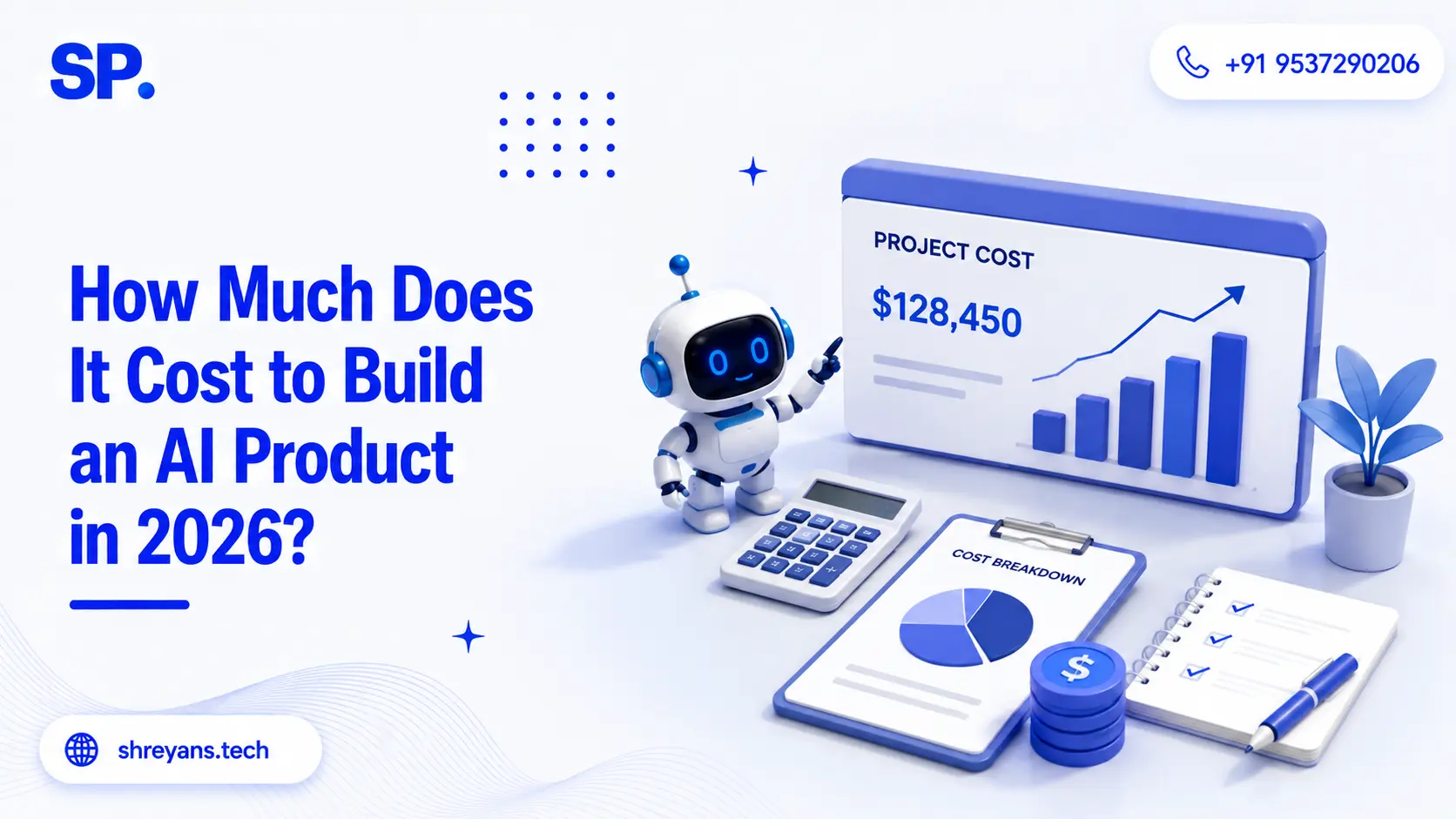
How Much Does It Cost to Build an AI Product in 2026?
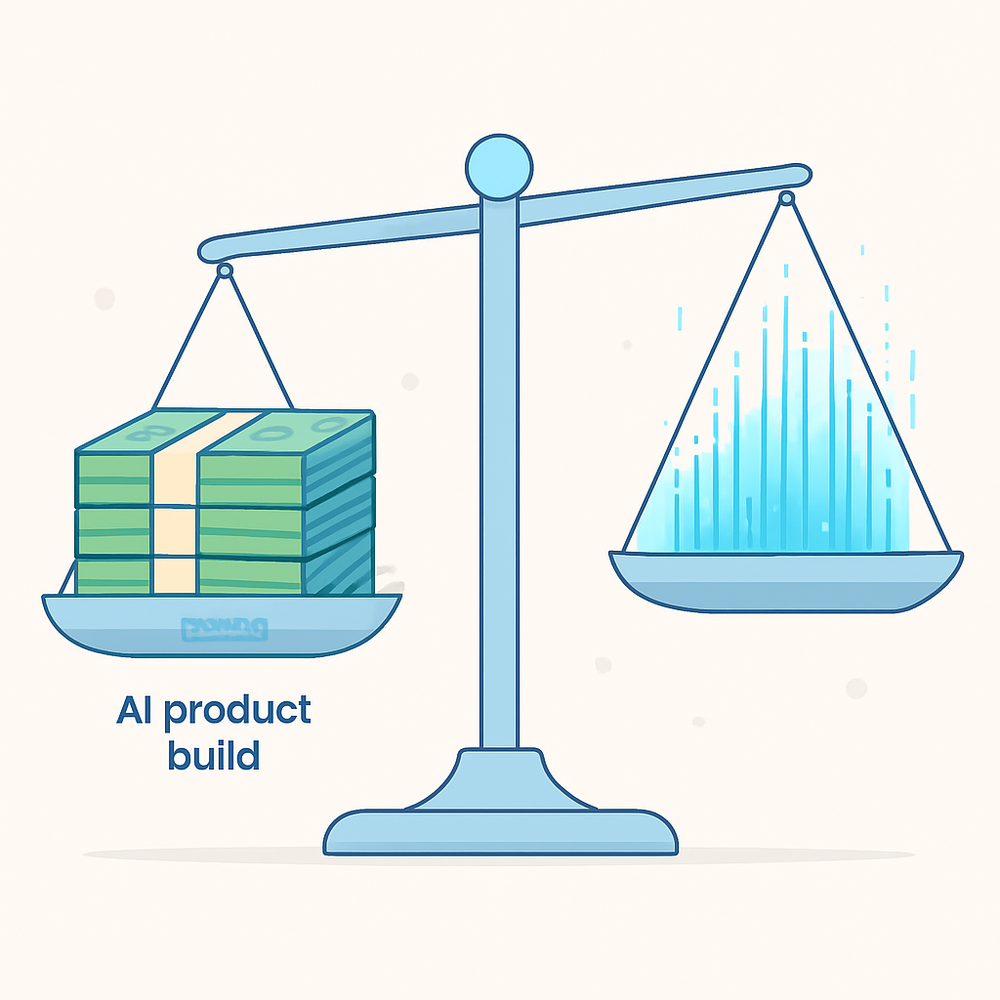
For every $1 million in AI product revenue booked in 2026, roughly $230,000 leaves as inference cost before a single engineer, salesperson, or marketer is paid. That figure comes from ICONIQ's 2026 State of AI data, and it points at the part of ai product development cost that quotes rarely mention.
The build is a one-time number. A product has a cost curve, and AI products have an unusual one: unlike conventional software, the marginal cost of serving another user does not approach zero. In fact ICONIQ found inference rising from 20% to 23% of total spend as products mature. The cost share grows with scale rather than shrinking, which inverts the assumption most software business cases are built on.
Build Cost: The Smaller Number
Worth establishing quickly, since it's the figure most people arrive looking for.
|
Product type |
Typical build cost |
|---|---|
|
Focused assistant or automation tool |
$5,000–$20,000 |
|
LLM product with RAG over your own data |
$20,000–$75,000 |
|
Custom model trained on proprietary data |
$50,000–$150,000 |
|
Multi-agent or computer vision platform |
$80,000–$300,000 |
|
Enterprise platform, multiple models, regulated |
$300,000+ |
Two levers move these materially. Scope discipline is the larger one, and team location is the more mechanical: AI developer cost by region breaks down how much that shifts the figure, while AI development pricing guide covers what sits inside each band in more detail.
For a one-off internal tool, that's most of the story. For a product, it's the deposit.
Hire Edge Computer Vision
Why AI Breaks the Software Cost Model
Traditional SaaS is built once and served to each additional customer for almost nothing, which is why mature SaaS businesses run 70% to 90% gross margins and why "scale fixes the economics" became conventional wisdom.
An AI product cannot do that. Every query spends real compute, so the ten-thousandth request costs roughly what the thousandth did. Bessemer documents AI gross margins at 50% to 60% against 70% to 90% for mature SaaS, and the 2026 average across AI-native companies sits near 52%. Variable cost of goods runs 20% to 40% of revenue where traditional SaaS sits below 5%.
The practical translation: inference is a raw material cost, closer to manufacturing than to software. It belongs in cost of goods sold, it needs to be tracked separately from generic cloud spend, and a business plan assuming 80% margins on an AI product is planning against economics that don't exist.
Which Cost Profile Are You Actually In?
Not every AI product carries the same exposure. Three profiles behave very differently.
|
Profile |
What it means |
Target gross margin |
|---|---|---|
|
AI-augmented |
AI tools used internally by staff; the product itself doesn't call models |
~80%, largely unaffected |
|
AI-enabled |
AI features inside an existing product; customers trigger inference through normal use |
60–79% |
|
AI-native |
Inference is the product; every unit of value delivered costs compute |
50–60%, 2026 average ~52% |
Knowing which row you're in before you build matters more than the build quote does, because it determines whether you're pricing a software product or something closer to a service with a variable input cost. A useful reference point: bolting an AI assistant onto an $80-per-month seat can add roughly $15 in direct variable cost, which is a fifth of the price before anything else is paid for.
The Heavy User Inversion

This is the consequence founders most often discover late, and it reverses an instinct built over two decades of SaaS.
In SaaS, heavy users are your best customers: they churn least and expand most, and they cost essentially nothing extra to serve. In an AI product, heavy users can be your least profitable. A power user making 50,000 model calls a month at $0.003 per call costs $150 in API fees; on a $199 plan that leaves $49 of contribution. A light user making 2,000 calls costs $6 and contributes $193. The engaged customer is worth a quarter of the casual one.
Free tiers carry the same inversion. A SaaS free tier costs near-zero per user; an AI free tier with model access runs roughly $0.50 to $5.00 per monthly active user. Ten thousand free users is $5,000 to $50,000 a month in compute against no revenue, which is a marketing expense most teams have never had to model before.
The Levers That Protect Margin
None of this is fixed. The spread between an expensive implementation and an efficient one is large, and most of it is engineering decisions rather than vendor negotiation.
Model routing is the biggest single lever. Within one vendor's range the price spread between the cheapest and most capable model is roughly 5x, and most real workloads contain a majority of simple steps, classification, extraction, routing, that don't need the flagship model. Sending everything to the top tier is the most common and most expensive default.
Prompt caching converges around a 90% discount on cached reads across the major providers, which matters enormously for products that resend the same system prompt or document context on every call.
Infrastructure choice carries a wide spread too, with GPU rental ranging roughly from $0.30 to $14.90 per hour depending on provider and commitment, a gap of more than twenty times for comparable compute.
The prerequisite for all three is measurement. Teams that report inference inside general cloud spend are blind on the most important cost line in the business, and a surprising number of founders first calculate per-user inference cost when an investor asks.
Hire Edge Computer Vision
What This Means for Pricing
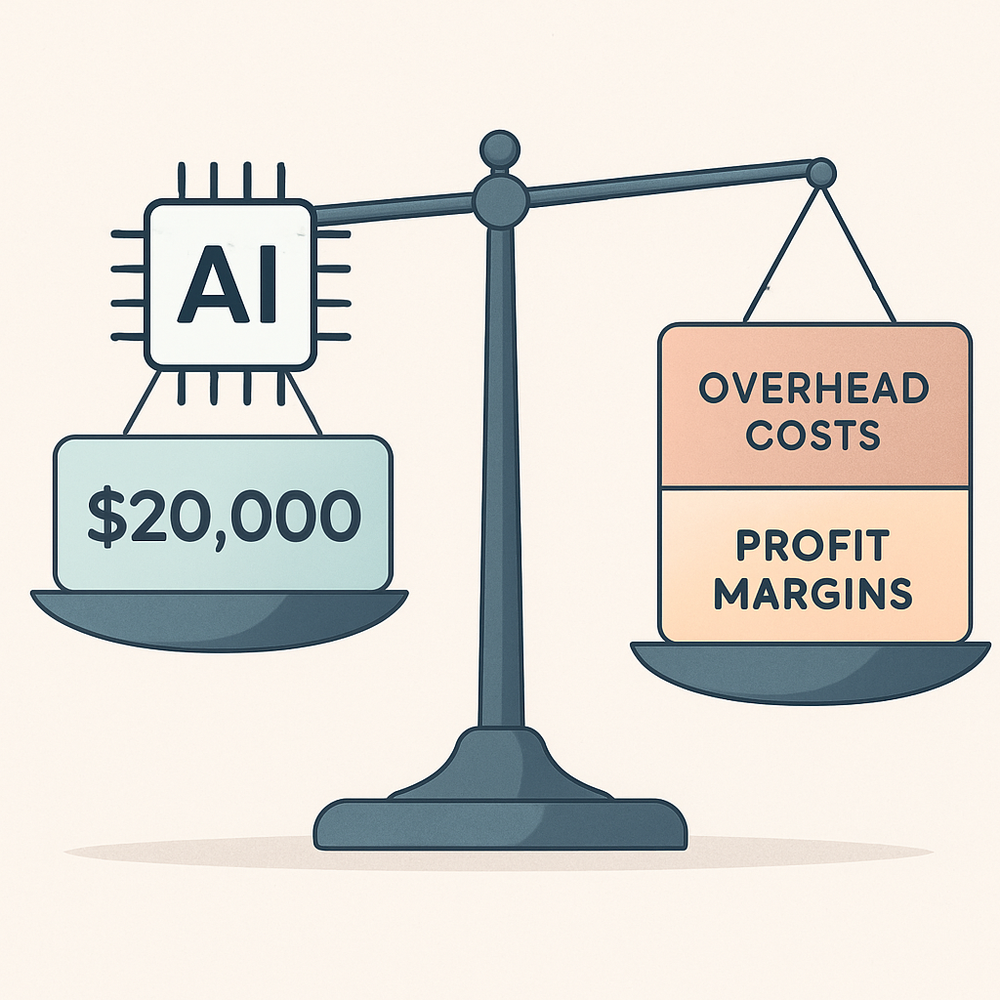
If gross margin lands near 52% rather than 80%, the same headline price produces substantially less to cover overheads. An AI product at $20,000 a year and 52% margin yields $10,400 of gross profit, where matching the gross profit of an equivalent SaaS account would require pricing closer to $30,000 to $35,000.
Three practical rules follow. Model per-user inference at both median and heavy usage rather than average, since the average conceals the users who determine your margin. Set the base price to deliver your target margin on the median user and cap usage at roughly three times that level. And avoid passing token costs through to customers one-for-one, which transfers your cost volatility onto the buyer and makes the product impossible to budget for.
When evaluating a vendor or partner, ask directly how they'll measure and control inference cost, and whether the architecture they're proposing routes work by complexity. choosing an AI development partner covers the wider set of questions worth pairing with that one.
Frequently asked questions
How much does it cost to build an AI product in 2026?
Why are AI product gross margins lower than SaaS?
Do AI costs go down as you scale?
Why can heavy users be unprofitable in an AI product?
What is the biggest lever for reducing AI running costs?
How should an AI product be priced given these economics?



Shreyans Padmani
Shreyans Padmani has 5+ years of experience leading innovative software solutions, specializing in AI, LLMs, RAG, and strategic application development. He transforms emerging technologies into scalable, high-performance systems, combining strong technical expertise with business-focused execution to deliver impactful digital solutions.