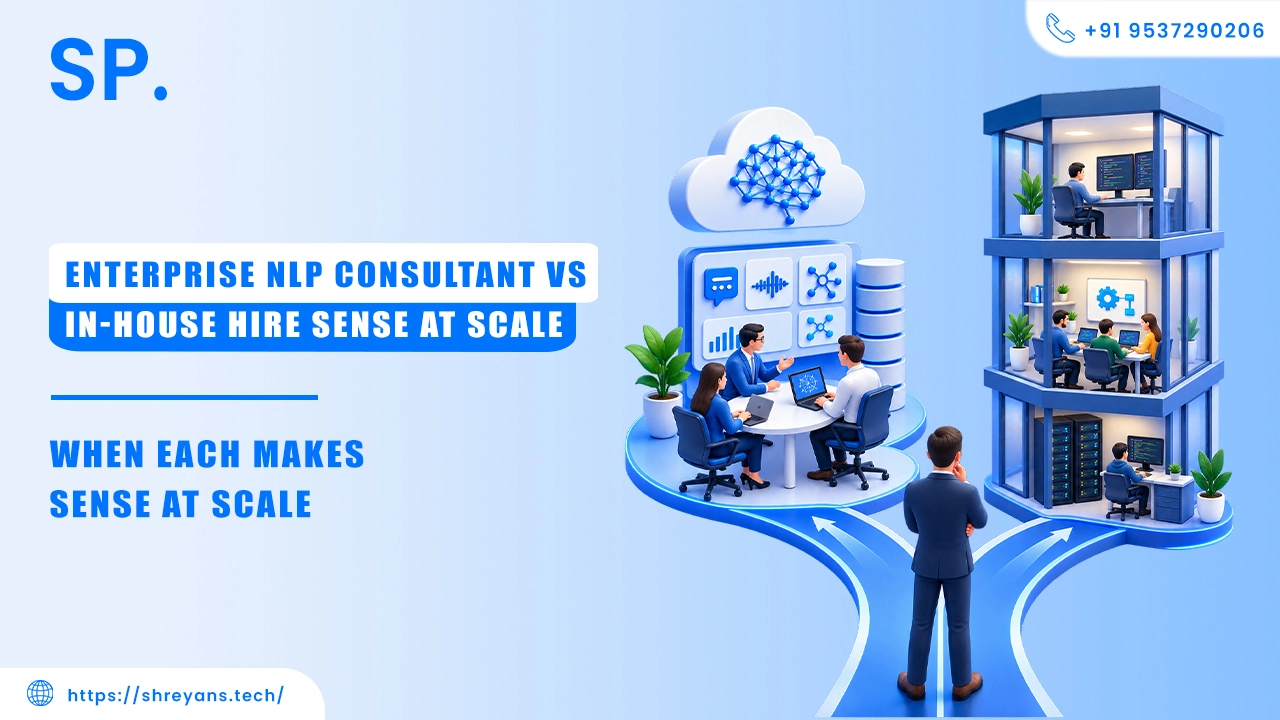
NLP engineers in 2026 command a 130,000 to 175,000 US dollars base for mid-level roles and 200,000 to 295,000 for senior positions, with most US searches closing in six to ten weeks, per KORE1's 2026 hiring data. AI consultants covering the same specialisation charge 150 to 300 US dollars an hour on average, with the full market spanning 80 to 600, according to Groovyweb's 2026 consulting rate guide.
Those two figures sit far enough apart that the decision looks obvious until the actual scope is defined. This guide breaks down what each path costs at enterprise scale and, more importantly, when a consultant delivering NLP development services outperforms an in-house hire, and when the reverse is true.
NLP vs LLM: The Scoping Mistake That Sets the Wrong Budget
KORE1's recruiters report that three of their last seven NLP placements started out mislabelled as something else. A logistics platform that asked for a generative AI engineer actually needed someone to rebuild a shipment-classification taxonomy after its BM25 weights had drifted for eighteen months. A legal technology company had an LLM engineer write a retrieval-augmented generation pipeline that returned the wrong contract clause one in four times because nobody owned the retrieval evaluation.
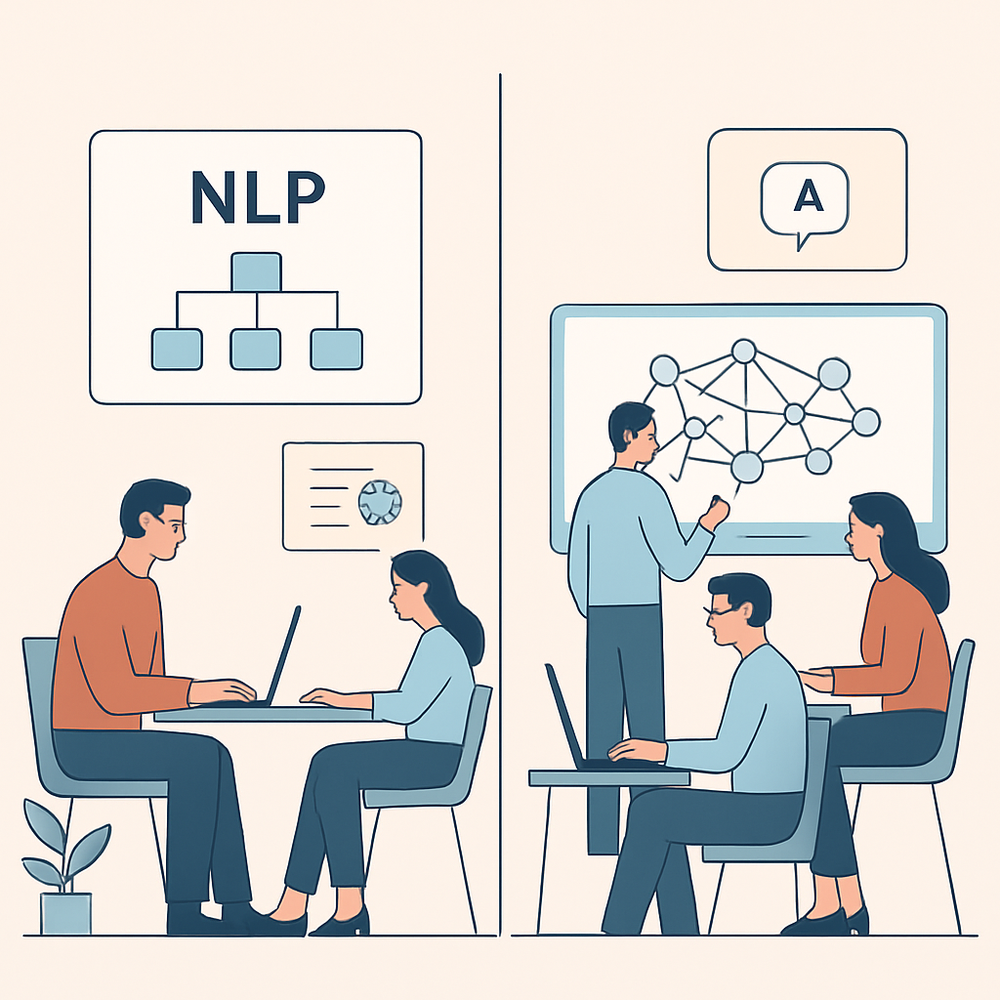
Most enterprises in 2026 need both NLP and LLM capability in different proportions, run by different people, which is exactly why the hiring decision cannot be made on a single generic AI job description. Getting this scoping right before comparing consultant against employee cost is what keeps the eventual budget honest.
What an Enterprise NLP Consultant Costs
Solo NLP and AI experts charge 80 to 200 US dollars an hour, boutique consultancies 150 to 300, and Big Four firms 300 to 600, per Groovyweb's 2026 tiered breakdown, while AI-first agencies deliver comparable production scope from 22 to 50 US dollars an hour by working at fixed fees rather than billing hourly. A senior NLP specialist on a 160-hour monthly dedicated contract at 90 US dollars an hour costs roughly 14,400 US dollars a month; the US-equivalent rate of 200 US dollars an hour runs 32,000 a month, figures the NLP developer rates breakdown covers by specialisation and platform.
|
Engagement type |
Typical rate |
Monthly equivalent |
|
Solo NLP consultant |
$80 to $200/hr |
$12,800 to $32,000 (160 hrs) |
|
Boutique NLP consultancy |
$150 to $300/hr |
$24,000 to $48,000 (160 hrs) |
|
Big Four consulting firm |
$300 to $600/hr |
$48,000 to $96,000 (160 hrs) |
|
AI-first agency, fixed fee |
$22 to $50/hr equivalent |
$3,520 to $8,000 (160 hrs) |
Defined implementation and pilot work costs far less than the hourly numbers suggest once it is priced as a fixed engagement rather than open hours. AI Essentials' 2026 guide puts a defined small-business AI implementation at 5,000 to 25,000 US dollars, and AI assessment or feasibility studies at 7,000 to 35,000, both well below the first-year cost of a single technical hire.
What an In-House NLP Hire Costs
A single technical hire costs 190,000 to 260,000 US dollars in the first year once recruiting, benefits, tools and ramp time are added on top of base salary, per AI Essentials' 2026 analysis, a figure consistent with KORE1's 200,000 to 295,000 US dollar senior NLP salary band before overhead. March 2026 BLS data shows benefits alone represent 30.1 percent of private-industry compensation, which is the single largest hidden line item founders underestimate when comparing a salary figure to a consulting quote.
The recruiting timeline itself is a cost most budgets never line-item. KORE1 reports NLP searches running longer than the broader IT average of seventeen days, frequently ten weeks or more, because the scoping mistake described above sends the wrong candidates through the pipeline before the role is corrected.
When a Consultant Makes Sense at Scale
A consultant wins when speed to validated results matters more than cost per hour. Dan Cumberland Labs' 2026 pricing guide found that external consultants deliver AI pilots in six to twelve weeks, 60 to 70 percent faster than building the same capability in-house from a standing start, which is decisive when a large enterprise needs to prove NLP value before committing headcount to a new function.
A consultant also wins for a defined, bounded problem: a taxonomy rebuild, a retrieval evaluation overhaul, a fraud-narrative classification pipeline with class imbalance nobody has solved internally. These are exactly the specific AI capabilities, NLP, computer vision, recommendation systems, where Groovyweb's 2026 guide notes consultants excel, because the practitioner has built the same system in production multiple times across different clients.
Hire NLP Engineers
Expert NLP solutions with a free proof-of-concept scoping session
Get Free POC ScopingWhen In-House Makes Sense at Scale
Dan Cumberland Labs places the break-even point for building in-house AI capability at roughly 50 million US dollars in annual revenue, or whenever AI becomes core to a company's competitive differentiation rather than a supporting function. Below that threshold, a fractional AI lead at 5,000 to 15,000 US dollars a month during the validation phase, paired with machine learning development services for the initial build, consistently outperforms a full-time hire on both cost and speed to first result.
In-house makes sense once the validated backlog is large enough to keep a specialist genuinely busy, and once the business needs the institutional knowledge, security posture and deep system integration that only comes from someone embedded full-time. That threshold is measurably higher than most enterprises assume when they open the requisition.
Vetting Enterprise NLP Talent
Whichever path an enterprise chooses, the screening bar is the same: can the candidate explain why an F1 score is misleading on a 95-to-5 class-imbalanced dataset, and have they owned retrieval evaluation on a production system rather than just building the pipeline. The ML interview questions guide is a strong baseline screen to run before adding NLP-specific questions on taxonomy design and evaluation methodology.
A strong signal in either a consultant or an employee is the ability to describe post-deployment monitoring for distribution shift, not just training-time accuracy. Practitioners who only discuss the training phase have usually never carried an NLP system through a full production lifecycle.
A Scaling Framework for the Next 12 Months
Scope the problem correctly first, NLP or LLM, and get specific about the failure mode being solved. Engage a consultant for the first six to twelve weeks to validate the use case and ship a working pilot, then measure that pilot's results against a defined metric before opening a full-time requisition. The freelancer vs full-time team framework applies the same sequencing logic across broader AI and ML hiring, not NLP alone, and is worth reading before the first requisition goes out.
Sequencing the Hire Correctly
The consultant-versus-employee question resolves itself once the actual problem is scoped correctly. Most enterprises are better served validating NLP value with a focused engagement first, then hiring in-house once the backlog and the budget both justify a permanent seat.
Shreyans Padmani delivers production NLP and generative AI systems for enterprise teams that need results validated before headcount is committed. Hire an AI developer to scope your NLP pilot and get a realistic first-project number.
Frequently asked questions
Is an NLP consultant cheaper than an in-house NLP hire?
How much does an enterprise NLP consultant charge per hour?
What is the difference between hiring for NLP and hiring for LLM work?
At what company size does an in-house NLP team make more sense than a consultant?
How long does it take to hire a senior in-house NLP engineer?
What should an enterprise ask when vetting NLP talent?



Shreyans Padmani
Shreyans Padmani has 5+ years of experience leading innovative software solutions, specializing in AI, LLMs, RAG, and strategic application development. He transforms emerging technologies into scalable, high-performance systems, combining strong technical expertise with business-focused execution to deliver impactful digital solutions.