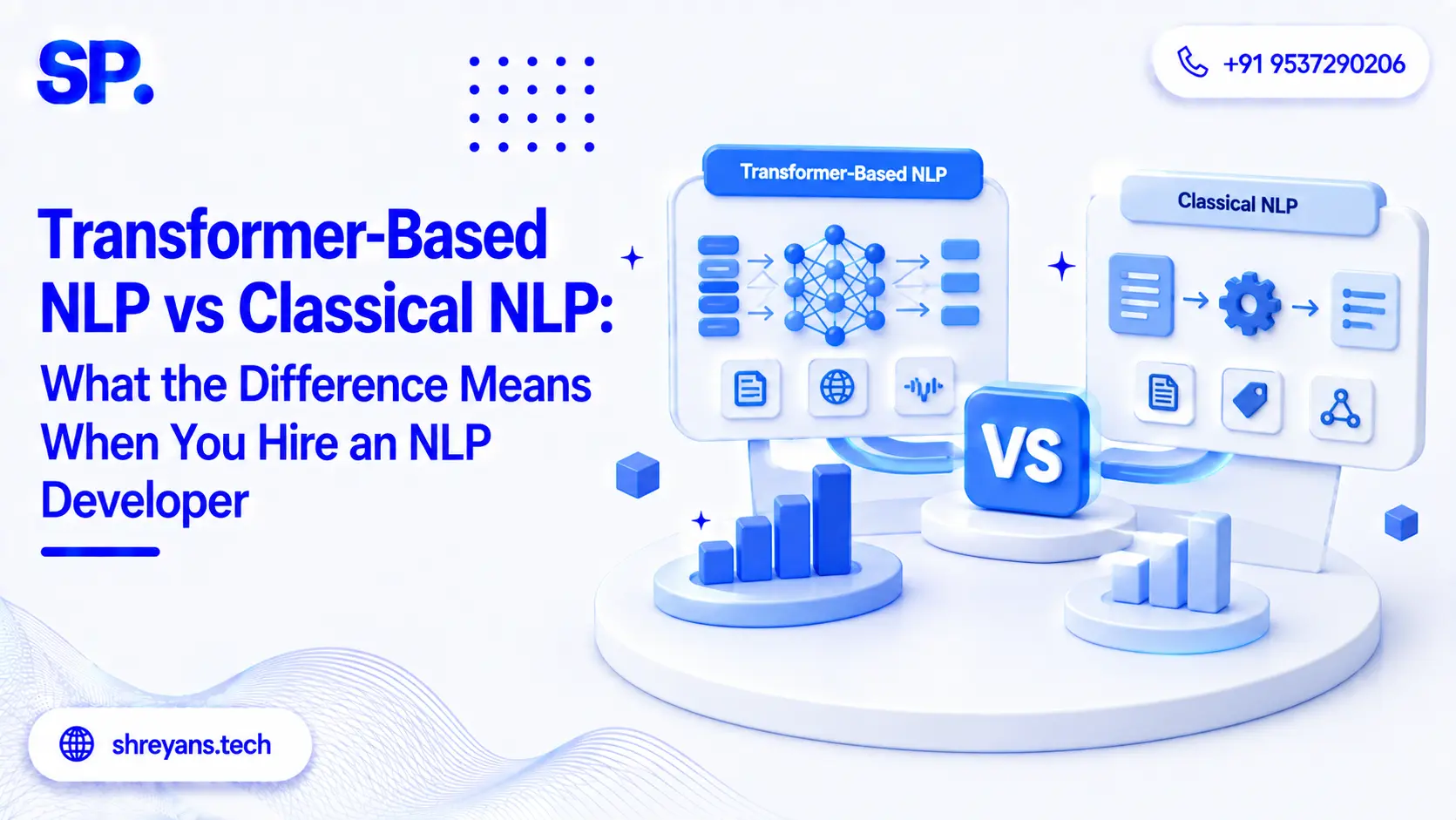
Transformer-Based NLP vs Classical NLP: What the Difference Means When You Hire an NLP Developer
Liora's 2026 practitioner survey finds transformer-based approaches now dominate virtually every NLP benchmark and production application, a shift from the bag-of-words, TF-IDF, and support vector machine methods that defined classical NLP through the 2010s. That same research shows engineers with hands-on retrieval-augmented generation, fine-tuning, and agent skills commanding a 20 to 30 percent salary premium over those with classical NLP skills alone, based on 2026 compensation data from ZipRecruiter and Signify Technology's ML salary benchmarks. Educative's technical comparison adds a cost dimension buyers often miss: classical NLP models can often be trained on local machines with small datasets and minimal cloud spend, while transformer-based systems typically need larger infrastructure and data budgets.
None of this means classical NLP is obsolete. It means the two approaches solve different problems, and hiring the wrong specialist for your problem is the single most common reason NLP projects run over budget. NLP development services scoped against the actual technical requirement, rather than against whichever approach is trending, is what keeps a project on schedule.
1. Classical NLP: What It Still Does Best
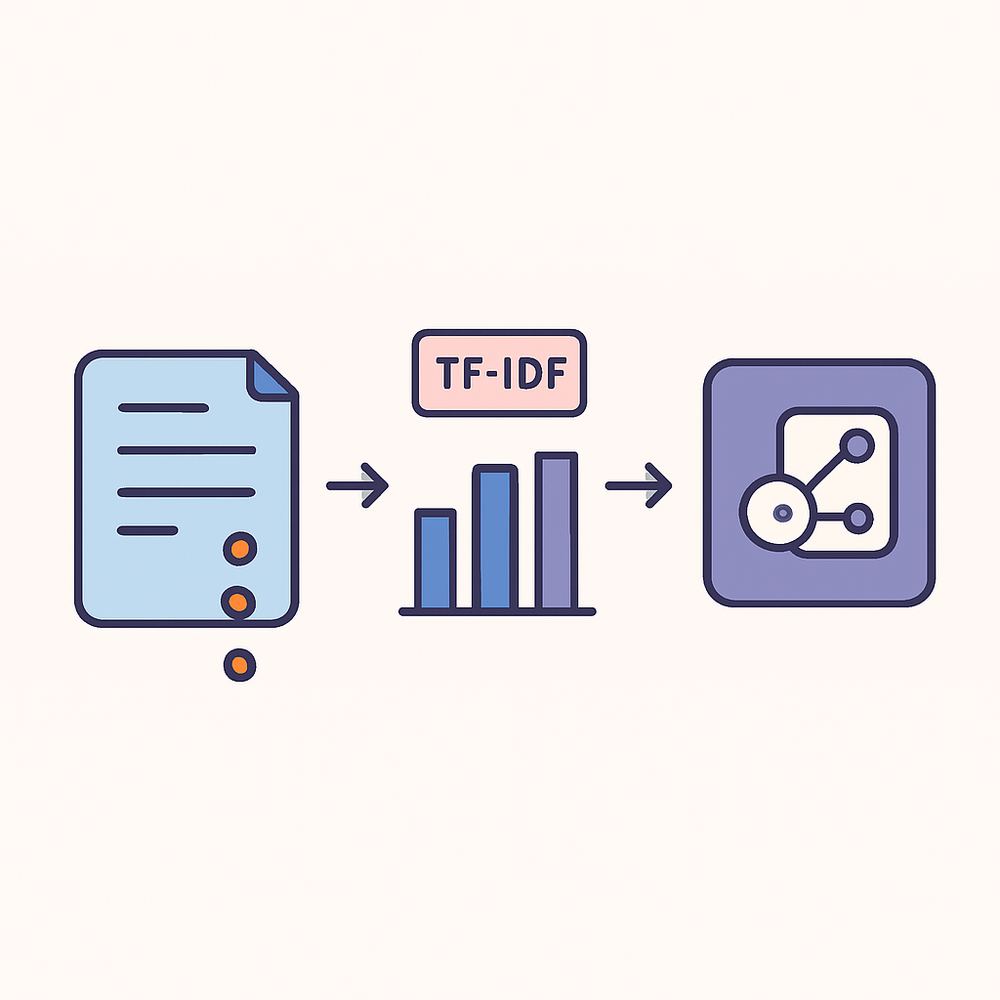
Classical NLP treats text as structured, countable data. Liora's 2026 course review describes the approach directly: it counts tokens, computes TF-IDF scores, and feeds sparse vectors into traditional machine learning models such as SVM or Naive Bayes. The result is interpretable and lightweight, since a developer can trace exactly why a document was classified a certain way, but the approach is limited on context and nuance. Classical models cannot distinguish that "bank" means something different in "river bank" versus "bank account" the way a transformer-based model can.
This trade-off is why classical NLP remains the right choice for narrow, well-defined tasks with tight interpretability or compliance requirements: spam filtering, simple sentiment scoring on structured feedback forms, or keyword-based document routing where an auditor needs to see exactly why a document was flagged. Educative's comparison confirms the cost side of this decision too: classical NLP training is relatively cheap and can run on local infrastructure, which matters for budget-constrained projects that do not need general-purpose language understanding.
2. Transformer-Based NLP: What Changed
Transformer architectures use attention mechanisms to model the full context of every word in a passage simultaneously, producing dense contextual embeddings instead of sparse token counts. Liora's 2026 course review calls this the gap that matters: a transformer model like BERT captures word sense from surrounding context, where TF-IDF cannot. Educative frames the broader shift as moving from narrow, task-specific pipelines toward general-purpose systems trained on massive unlabeled corpora, which generalise across tasks through prompting rather than needing a new pipeline built for each use case.
The practical upside for buyers is flexibility. A single generative AI development services engagement built on a transformer or large language model foundation can often handle summarisation, translation, classification, and extraction inside one system, where classical NLP would need a separately trained pipeline for each task. The trade-off is infrastructure cost, data volume requirements, and reduced interpretability compared with a classical model's transparent scoring logic.
Hire Edge Computer Vision
3. Skill Sets: What a Classical NLP Engineer Knows vs a Transformer or LLM Engineer
A classical NLP specialist is fluent in statistical methods, rule-based systems, feature engineering, and libraries such as NLTK, spaCy, and CoreNLP, tools Educative describes as modular, interpretable, and easy to integrate into an existing pipeline. This skill set stays valuable for tasks needing explainability or running with minimal compute, and it remains cheaper to hire for narrowly scoped work.
A transformer or LLM-focused engineer works in a different ecosystem entirely: Hugging Face Transformers, LangChain, and provider APIs, with day-to-day work centred on prompt design, fine-tuning, and retrieval pipeline construction rather than feature engineering. Liora's data on the 20 to 30 percent salary premium for RAG, fine-tuning, and agent skills reflects genuine scarcity, not just market hype, since these skills require comfort with infrastructure scaling and model behaviour that classical NLP training does not cover. Before hiring, it is worth checking a candidate's answers against a structured ML interview questions set that probes both sides of this divide rather than assuming transformer experience implies classical NLP fluency, or the reverse.
4. Tooling Differences That Affect Your Project Timeline
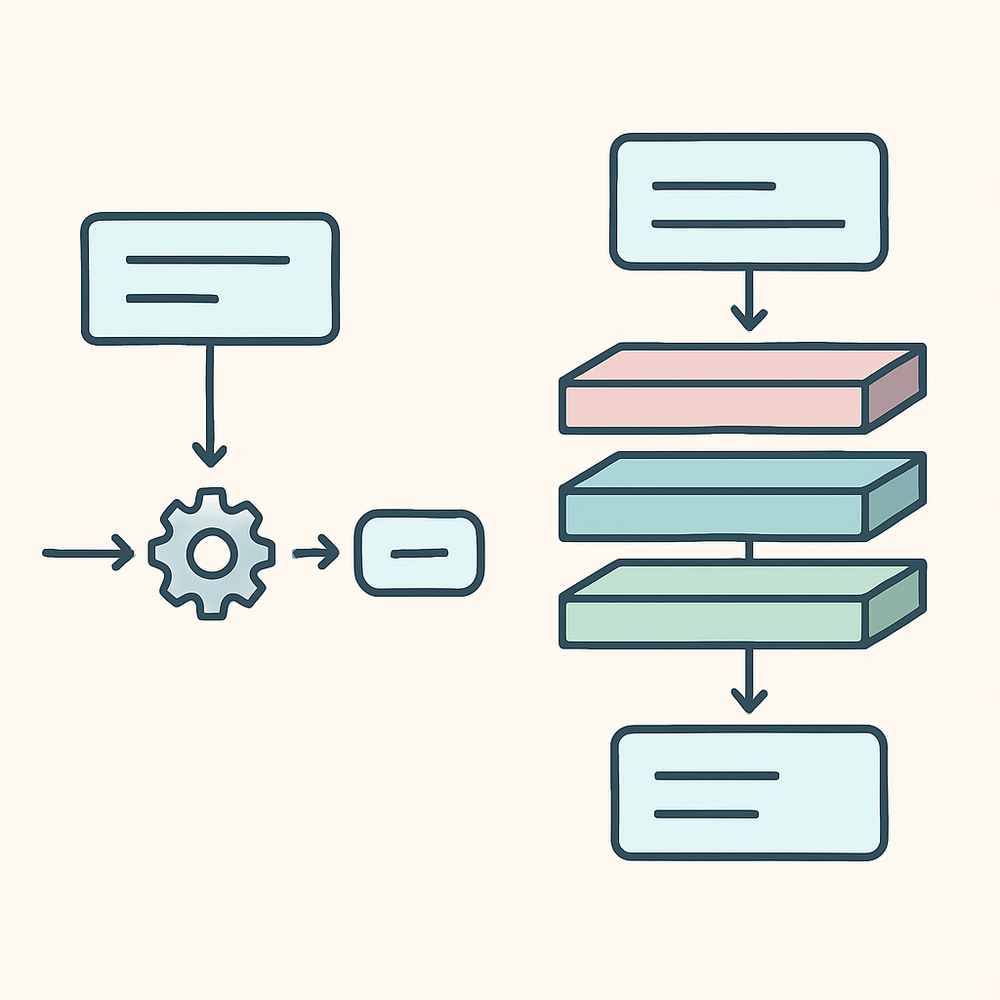
The ecosystems diverge sharply in day-to-day workflow. Classical NLP development cycles are typically shorter for narrow tasks: a spaCy pipeline for entity extraction on a defined document type can often reach production in weeks, since the model is small, trains fast, and needs less labelled data per class. Transformer and LLM-based development introduces a different rhythm, one built around prompt iteration, evaluation set construction, and fine-tuning cycles that Kairntech's 2026 NLP tools review frames as a shift toward task orchestration and infrastructure scaling rather than pure model training.
This distinction should shape your timeline expectations before a contract is signed. A classical NLP project with a well-defined scope and existing labelled data can move faster than a transformer-based build that needs a retrieval pipeline, an evaluation harness, and a fine-tuning loop built from scratch, even though the transformer-based system is often more capable once it ships.
5. Which One Fits Your Project? A Decision Guide
The right choice depends on four questions: how much labelled data you have, how much interpretability your use case legally or practically requires, how varied the language input is, and how much infrastructure budget the project can absorb. A project with a small, well-labelled dataset, a narrow task, and a need to explain every decision to an auditor points toward classical NLP. A project with varied, unpredictable language input, multiple tasks to handle in one system, and a budget for cloud infrastructure points toward a transformer-based or LLM approach.
Many production systems in 2026 use both: a lightweight classical model for fast, interpretable first-pass filtering, with a transformer-based model handling the harder, more ambiguous cases that the classical layer routes to it. Deciding this architecture before development starts is the difference between a project that ships on the original estimate and one that needs a second contract to add the capability the first one was scoped without. The why startups hire freelance post covers why this kind of scoping conversation is often better handled by a freelance specialist than a generalist agency team.
Hire Edge Computer Vision
Classical NLP vs Transformer-Based NLP: Side by Side
|
Dimension |
Classical NLP |
Transformer / LLM-Based NLP |
|---|---|---|
|
Core method |
TF-IDF, bag-of-words, SVM, Naive Bayes |
Attention mechanisms, dense contextual embeddings |
|
Interpretability |
High, decisions are traceable |
Lower, harder to explain a single output |
|
Data needs |
Works with small, labelled datasets |
Needs larger datasets or strong pretraining |
|
Infrastructure cost |
Low, can run on local machines |
Higher, cloud GPU or API spend |
|
Flexibility across tasks |
One pipeline per task |
One system often handles multiple tasks via prompting |
|
Typical tools |
NLTK, spaCy, CoreNLP |
Hugging Face Transformers, LangChain, provider APIs |
Scope the Problem Before You Scope the Developer

The classical-versus-transformer question is really a proxy for a more specific set of decisions: how much data you have, how much interpretability you need, and how much infrastructure budget the project can carry. Answering those questions first makes the hiring decision far easier, since it points directly at the skill set the project actually requires instead of the one that happens to be trending.
Hire an NLP developer who can work across both classical and transformer-based approaches and recommend the architecture that fits your data and budget, not the one that pads the scope.
Frequently asked questions
Is classical NLP obsolete in 2026?
What is the main technical difference between transformer NLP and classical NLP?
Do NLP developers who know transformers cost more to hire?
Can one NLP developer handle both classical and transformer-based work?
Which approach is cheaper to build and run?
Should my project use classical NLP, transformer-based NLP, or both?



Shreyans Padmani
Shreyans Padmani has 5+ years of experience leading innovative software solutions, specializing in AI, LLMs, RAG, and strategic application development. He transforms emerging technologies into scalable, high-performance systems, combining strong technical expertise with business-focused execution to deliver impactful digital solutions.