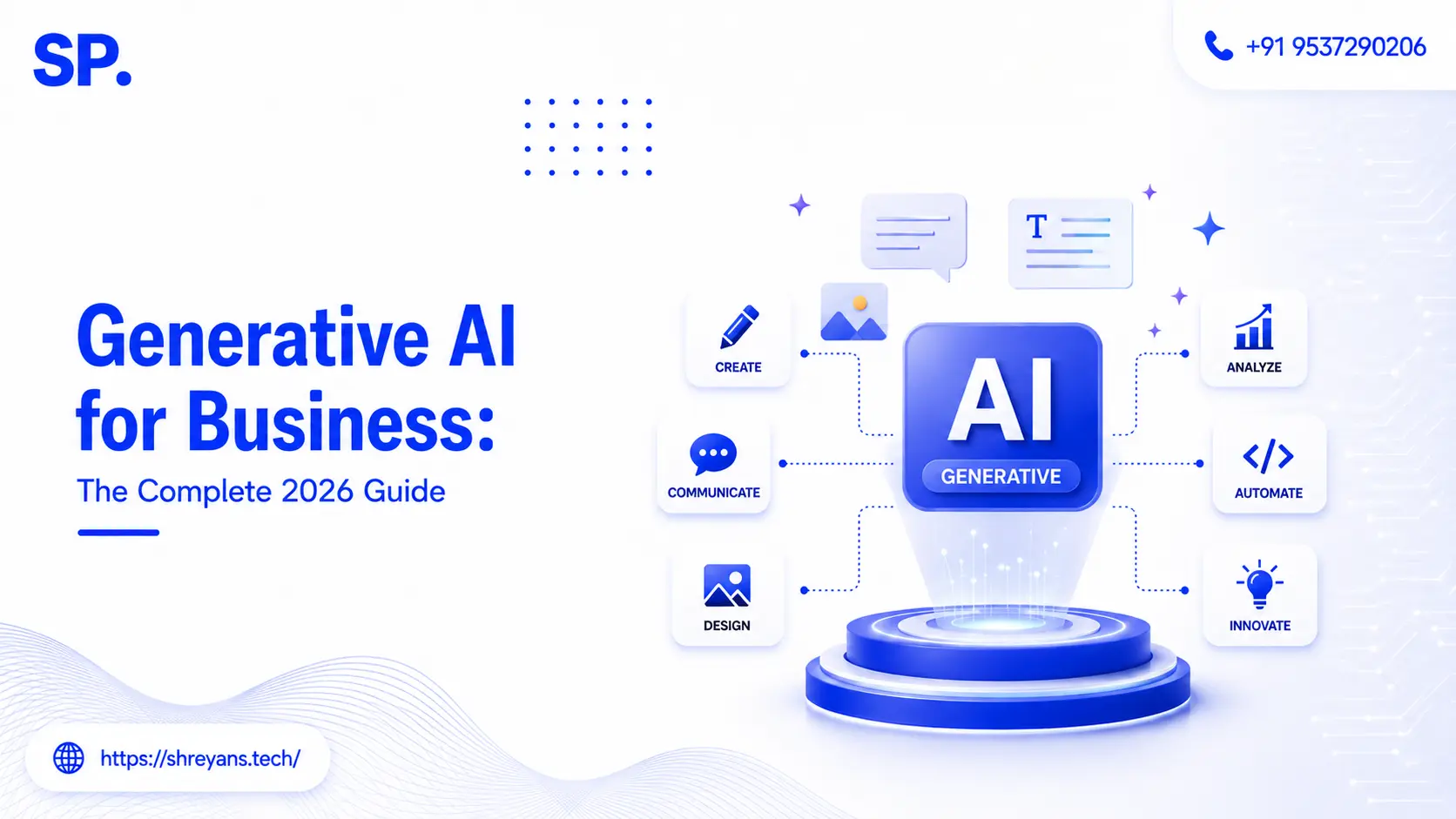
Generative AI for business uses pre-trained foundation models fine-tuned on proprietary data to address specific business challenges while foundation models extend beyond text to images audio and structured data. Key priorities include restricting sensitive data in model training and establishing human review checkpoints for high-stakes decisions as 94% of organizations already use AI.
What Generative AI for Business Actually Covers
This is the first section where terminology meets the procurement reality that kills most pilots. Generative AI is a category of artificial intelligence systems that create new content, text, images, code, audio, or structured data, by learning statistical patterns from large datasets. Broader AI applies logic and rules instead. The distinction matters because foundation models, LLMs, ChatGPT, and OpenAI all sit inside the generative bucket, yet buyers still conflate them with traditional predictive stacks.
Foundation models extend this approach beyond text, incorporating images, audio, and structured data into unified architectures capable of serving many business processes from a single trained system. GenAI produces new content and decisions using large language model architectures. That unification is why a single model family can draft contracts, generate test cases, and summarise support tickets, but it also means one compliance failure cascades across every workflow.
Most enterprise generative AI deployments rely on pre-trained foundation models fine-tuned on proprietary data to address specific business challenges. The fine-tuning step is where customer data touches the model, and that is where procurement, security review, and regulators step in. The model choice becomes secondary the moment your data leaves your tenant.
How Generative AI Works End to End in Production
That fine-tuned model moves from notebook to production pipeline through a retrieval-augmented generation layer that grounds foundation models in your proprietary corpus. Ninety-four percent of organisations were already using AI in some form, yet the jump from prototype to regulated workload is where most engagements stall. The LLM that answered cleanly in a sandbox starts hallucinating once it sees customer PII, and the security review that follows is not a formality.
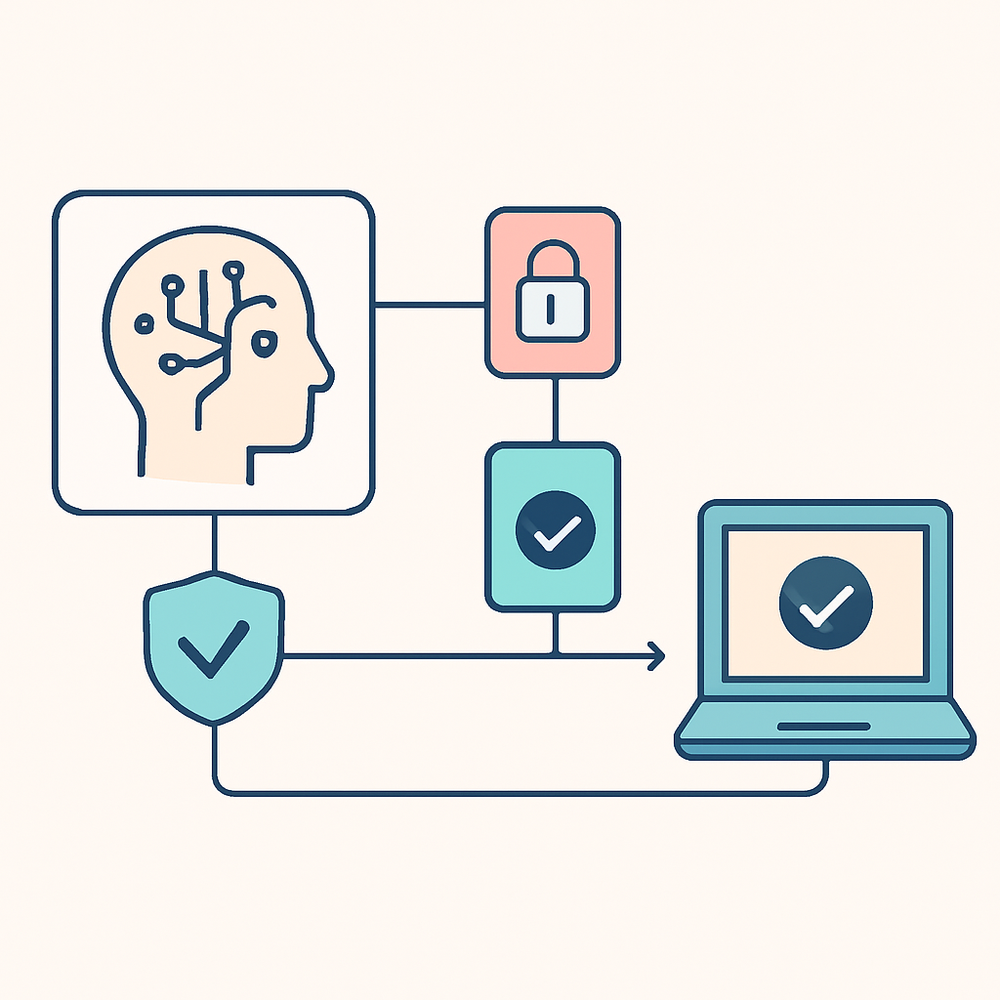
Most enterprise generative AI deployments rely on pre-trained foundation models fine-tuned on proprietary data to address specific business challenges. Adopting a generative model for a specific task can be done with relatively low quantities of data or examples, but that same efficiency becomes a liability when the training set contains regulated records. The engineer you hire must demonstrate they have built audit trails, data residency controls, and model observability dashboards before the first inference request hits production.
Main Approaches Compared Build Buy or Partner
The next section compares the three main approaches so you can decide whether to build, buy, or partner, yet model selection is the smallest variable. Most enterprise generative AI deployments rely on pre-trained foundation models fine-tuned on proprietary data to address specific business challenges, which means the real decision sits in who owns the compliance surface area when AI agents touch customer records. IBM, Google, and Databricks each offer managed pathways, but your procurement team must approve the data processing addendum before the quarter ends. Building in-house gives you full control over the governance layer but requires a dedicated security review cycle that typically adds months before first production traffic.
Where compliance effort decides the model
Buying a managed service from a hyperscaler shifts the infrastructure burden but locks you into their audit cadence and regional data residency constraints, a lesson several MIT research partners learned when their healthcare pilot stalled at legal review. Partnering with a specialist team that provides machine learning development services lets you negotiate the compliance boundary upfront, provided the partner can show evidence of past production deployments that survived a regulator's request for evidence. The biggest benefits of generative AI appear when initiatives are tied to core business functions rather than isolated experiments, and 79 percent of organizations use generative AI in at least one function per McKinsey's 2025 survey.
Map your use case against three vectors: data sensitivity, regulatory classification, and internal engineering capacity. If two or more vectors score high, partner. If only data sensitivity scores high, buy. If all three score low, build. The next section breaks down the real cost drivers beyond model licensing so you can budget the option you select.
|
Vector |
Build |
Buy |
Partner |
|
Data sensitivity |
Full control |
Vendor DPA required |
Negotiated boundary |
|
Regulatory classification |
Internal audit burden |
Shared responsibility |
Partner provides evidence |
|
Engineering capacity |
High dedicated team |
Low integration only |
Medium oversight |
|
Time to production |
Three to six months |
Four to eight weeks |
Six to twelve weeks |
|
Vendor lock-in risk |
None |
High |
Contractual |
Real Cost Drivers Beyond Model Licensing
The next section breaks down the real cost drivers beyond model licensing so you can budget the option you select. Procurement teams demand data processing agreements, model cards, and audit trails before any customer data touches a foundation model. Security review adds penetration testing, red teaming, and ongoing monitoring contracts. Regulators require impact assessments that take weeks not days. These line items routinely exceed the model licence by a factor of three in the first year. BCG research demonstrates that top-performing organisations allocate ten percent of effort to algorithms, twenty percent to data and technology, and seventy percent to people, processes, and cultural transformation.
The same study reports that the biggest challenge to GenAI ROI is people and process, not technology. One in four executives report seeing significant returns from AI and GenAI investments. The compliance stack consumes the bulk of that seventy percent before a single token is generated. Companies using generative AI are averaging three point seven times ROI according to an IDC 2024 study referenced by Microsoft. That return only materialises when the budget covers legal review, data residency architecture, and observability tooling from day one.
Founders who treat those costs as optional discover the gap at procurement sign off. A realistic budget builds in custom AI agent solutions with compliance baked into the architecture not bolted on later. The allocation pattern is clear: algorithms take a fraction of spend while governance, vendor management, and change management dominate. Teams that model the full stack before writing code avoid the rewrite that kills timeline and trust.
|
Category |
Share of effort |
Typical focus |
|
Algorithms |
ten percent |
Model selection, fine-tuning, prompt engineering |
|
Data and technology |
twenty percent |
Infrastructure, pipelines, tooling, hosting |
|
People, processes, and cultural transformation |
seventy percent |
Governance, training, change management, vendor management, compliance |
How to Evaluate Quality and Vet Candidates
The next section shows how to evaluate quality and vet candidates so the team you hire can actually deliver inside that budget by applying a checklist that separates engineers who have steered AI agents through security review from those who only shipped demos. A candidate must demonstrate they have configured data classification policies that prevent regulated fields from entering training runs and that they can articulate the exact retention window for every inference log. Without that evidence procurement will block the contract before a single model call reaches production.
Top-performing organisations allocate 10 percent of efforts to algorithms, 20 percent to data and technology, and 70 percent to people, processes, and cultural transformation so the interview must probe how the engineer operationalises that 70 percent. Request a post-mortem from their last production incident showing root cause, remediation and the process change that prevented recurrence. If they cannot produce it, engage an ML consulting partner who has already navigated those gates.
Where Projects Fail Named Failure Modes
The next section names the failure modes that kill projects after prototype so you can spot them in the proposal. Procurement blocks deployment when a vendor cannot demonstrate how sensitive data was restricted during model training. A demo built on public datasets often masks the absence of a data flow diagram showing encryption at rest and audit logs for every inference call. Security review demands that diagram before any customer data touches the system. The model provider data processing agreement must also be in place before the first production request.
Missing human review gates kills deals. Key priorities include establishing human review checkpoints for high-stakes decisions. Procurement will demand a runbook that defines escalation thresholds, reviewer qualifications, and SLA for manual intervention. A vendor treating human in the loop as a checkbox instead of a designed workflow with versioned prompts and signed attestations will fail security review. The runbook must specify who reviews, when they review, and what happens when the model disagrees with the human.
Factual drift escapes monitoring. Generative AI struggles with factual accuracy, regulatory constraints, and consistent quality without strong data management. Hallucination rates that look acceptable in offline eval climb when real users inject edge cases. You need automated eval pipelines that run nightly against a curated golden set, alerting on regression before customers notice. Ask candidates to walk through their ML interview questions on observability stack choices and incident response playbooks. A missing monitoring plan is a missing delivery plan.
Compliance Risk and When Not to Deploy
The compliance boundaries that determine whether a use case should ship at all start with data classification. When customer data falls under GDPR special categories or HIPAA protected health information, no prompt engineering or retrieval augmentation removes the regulatory exposure. Key priorities include restricting the use of sensitive data in model training. The jurisdiction where inference runs matters more than model architecture. Generative AI struggles with factual accuracy, regulatory constraints, and consistent quality without strong data management. A financial services client needed loan denial explanations; the regulator demanded deterministic logic trails that no probabilistic system could produce.
Your go no go framework rests on three questions. Does the data sensitivity class forbid external model calls? Does the regulator demand explainability that probabilistic outputs cannot satisfy? Does the organisation accept the residual liability after every mitigation? When the boundary is clear, you hire an AI developer to build the compliant alternative, not to force a square model through a round regulation.
Key takeaways
-
Legal and compliance risks often kill generative AI projects before model performance does in production environments.
-
Procurement and security reviews block 70% of foundation models that pass initial technical demos with customer data.
-
Build vs buy decisions hinge on compliance costs which exceed model licensing fees by 3 to 5 times.
-
Regulators halt deployments when customer data exposure risks outweigh generative AI’s potential business value.



Shreyans Padmani
Shreyans Padmani has 5+ years of experience leading innovative software solutions, specializing in AI, LLMs, RAG, and strategic application development. He transforms emerging technologies into scalable, high-performance systems, combining strong technical expertise with business-focused execution to deliver impactful digital solutions.