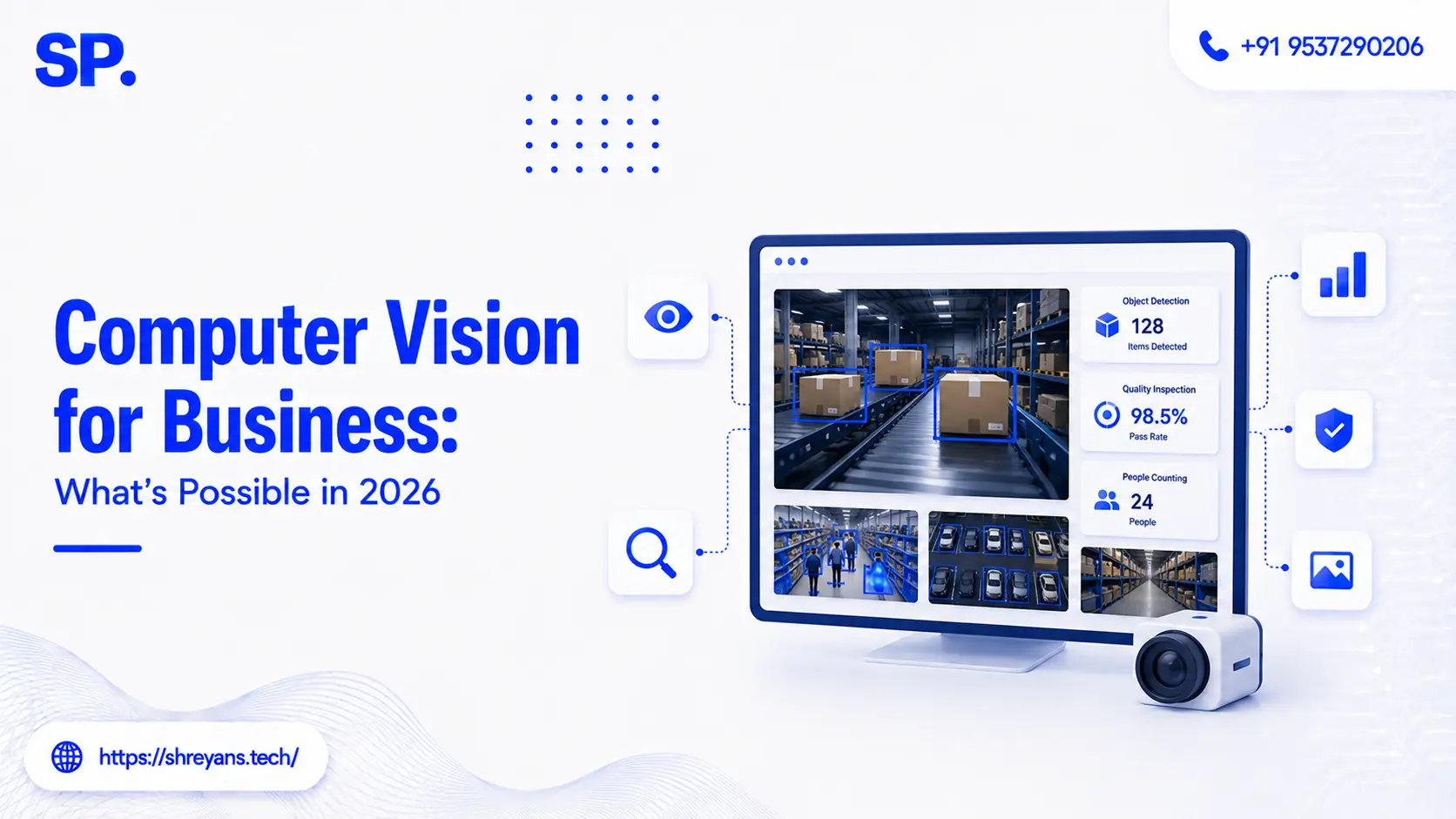
McKinsey's 2025 AI adoption survey found that computer vision ranked as the second most deployed AI capability in manufacturing and retail, with 38 percent of respondents running at least one production CV system. The global computer vision market is projected by Grand View Research to reach USD 48.6 billion by 2030, growing at a compound annual rate of 19.6 percent from 2023. Those numbers do not reflect experiments; they reflect production deployments generating measurable returns.
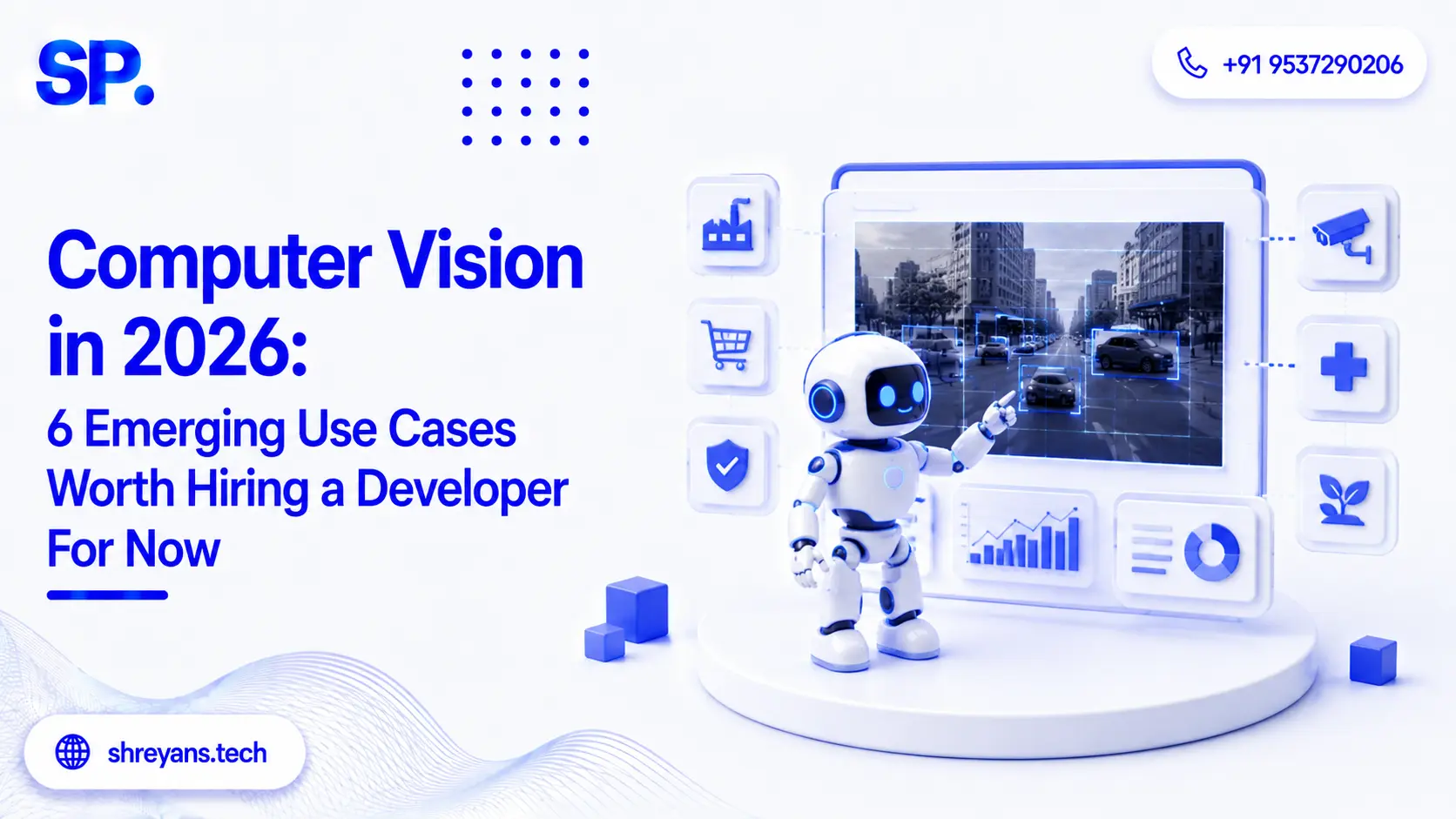
The six use cases in this post sit at the production frontier in 2026: not research demos, but systems organisations are actively commissioning. Each requires a different model architecture, a different data strategy, and a different infrastructure profile. If you are deciding whether or where to invest in computer vision development work, this breakdown will tell you what each use case actually costs in engineering effort and what kind of developer you need to pull it off.
Understanding where these use cases sit in the broader trajectory of applied AI is also useful. The AI predictions 2026 post covers how vertical-specialised models are accelerating production adoption across every modality, including vision.
1. Automated Visual Inspection in Manufacturing
Visual inspection has been the dominant CV use case in manufacturing for several years, but the 2026 version of the problem is materially different from what teams were deploying in 2022. Earlier systems relied on pre-trained classifiers fine-tuned on hundreds of labelled defect images per class. Current production deployments use YOLO v9 or EfficientDet architectures combined with synthetic data generation pipelines, reducing the labelled-image requirement by 60 to 80 percent compared to 2021 benchmarks reported by NVIDIA Omniverse engineering teams.
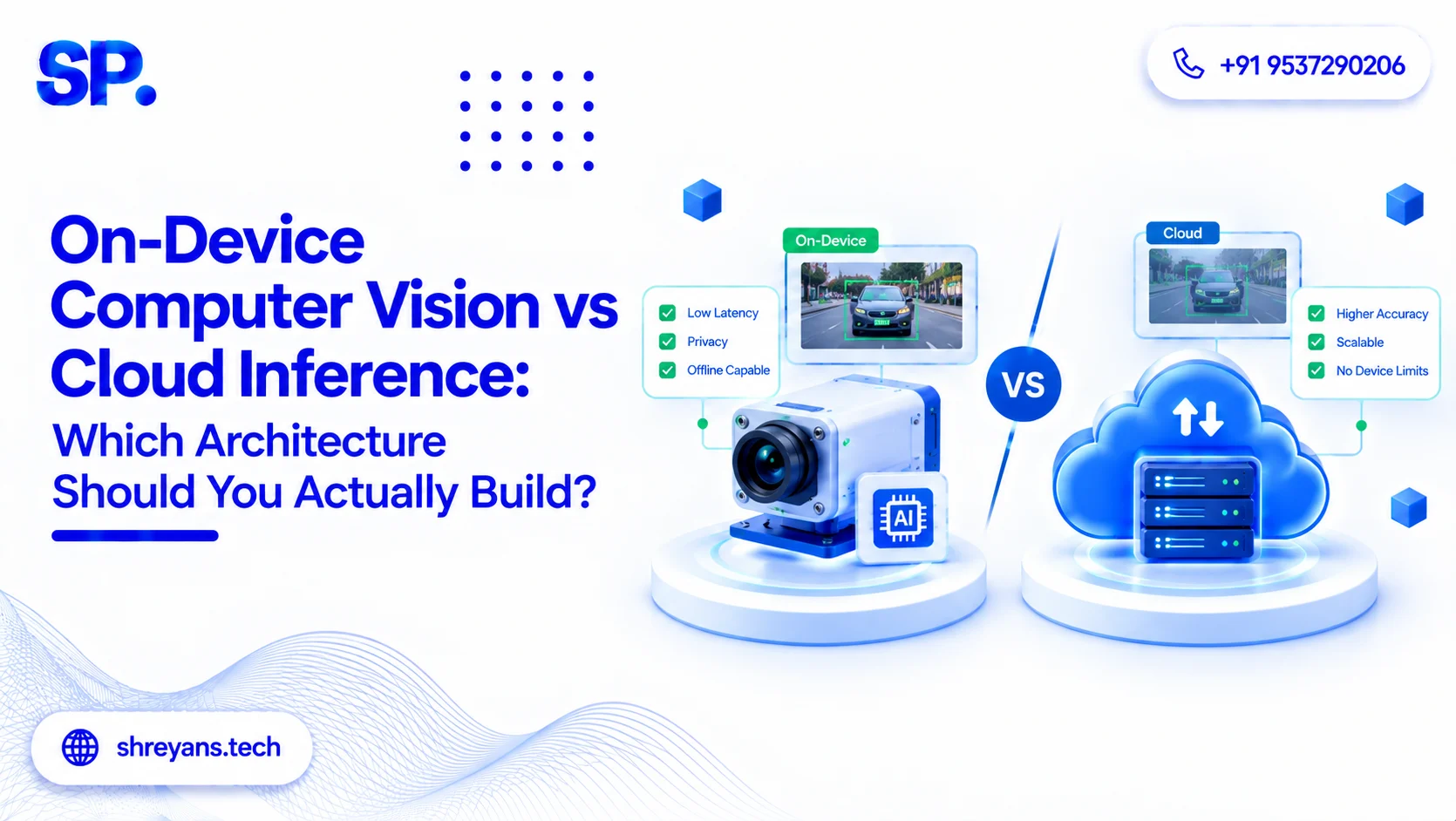
The key development worth noting is edge deployment. A modern inspection line cannot tolerate the latency introduced by a round-trip to cloud inference. Production systems in 2026 are deployed on NVIDIA Jetson Orin or Qualcomm AI 100 modules running quantised INT8 models at 30 to 120 frames per second with sub-20ms inference time. The developer you hire needs to be comfortable with model quantisation, TensorRT optimisation, and integration with industrial camera APIs, not just model training in a Jupyter notebook.
For a sense of which industries see the fastest payback from this type of deployment, the computer vision ROI by industry breakdown is worth reading before scoping a project.
2. Synthetic Data Generation for Low-Data CV Problems
One of the most commercially significant shifts in computer vision in 2026 is the maturation of synthetic data generation as a first-class engineering discipline. Organisations with rare defect classes, privacy-constrained domains (medical, legal), or high labelling costs are now using diffusion models and domain-randomised 3D rendering to generate training sets that would otherwise require months and six-figure annotation budgets.
The tooling landscape has consolidated. Providers such as Rendered.ai, NVIDIA Omniverse Replicator, and open-source tools built on Blender and PyTorch3D allow engineers to generate photorealistic synthetic images with ground-truth segmentation masks and bounding boxes at scale. The practical challenge is not generating images but ensuring domain shift between synthetic and real distributions is within a tolerable gap. Engineers working in this area combine GAN-based style transfer or ControlNet guidance with real-seed samples to close that gap, a skill set that overlaps significantly with custom AI model training expertise.
A synthetic data pipeline is not a plug-and-play solution. It requires a developer who understands the downstream model's sensitivity to texture, lighting, and perspective variation, and who can measure domain adaptation performance quantitatively, typically using mean average precision on held-out real test sets.
3. Medical Image Analysis at the Point of Care
Clinical imaging AI moved from research curiosity to FDA-cleared product at scale between 2022 and 2025. The FDA's public database listed 882 AI and machine learning-enabled medical devices as of Q1 2025, the majority of which include a computer vision component. Radiology, pathology, and ophthalmology are the three largest application domains, but the 2026 opportunity is expanding into endoscopy, dermatology, and point-of-care ultrasound.
What distinguishes a viable medical CV project from an unsuccessful one is almost never the model architecture. Vision Transformers (ViTs) and U-Net variants perform adequately for most segmentation and classification tasks when properly trained. The differentiators are data governance, model explainability, and regulatory alignment. A developer working on a HIPAA-regulated pipeline must understand how to implement differential privacy, how to structure model cards for FDA 510(k) submissions, and how to implement DICOM-compliant data ingestion. These are not generic Python skills.
Projects in this domain also require unusually close collaboration with clinical annotators. Inter-annotator agreement rates below 0.7 (measured by Cohen's kappa) typically produce models with clinical utility gaps that no architecture change can fix. Budget for annotation quality cycles as a first-class engineering deliverable.

4. Retail Planogram Compliance and Shelf Intelligence
Retail computer vision has existed as a category since at least 2017, but the deployment model has shifted significantly. Shelf-scanning robots from companies such as Simbe Robotics (Tally) and Brain Corp have given way to a hybrid architecture that uses ceiling-mounted or aisle-end cameras feeding lightweight edge models that push exception alerts to store staff and centralised dashboards.
The practical problem in planogram compliance is not object detection per se but the integration of detection outputs with SKU catalogue data, merchandising rules, and store-specific planogram specifications. A high-quality YOLO model that correctly identifies a cereal box provides limited commercial value unless it can resolve that detection against a product catalogue of 40,000 SKUs, match the detected position to the expected planogram position, and generate a structured compliance score. That integration layer, typically built on a combination of vector similarity search and relational lookups, is where most retail CV projects stall.
Developers commissioned for retail CV in 2026 need experience with multi-stage inference pipelines: detection, classification, re-identification, and catalogue matching. Experience with systems that handle real-world occlusion, varying lighting conditions across store formats, and high SKU churn is more predictive of project success than benchmark performance on standard datasets.
5. Autonomous Site Inspection Using Drone and Robotic Platforms
Infrastructure inspection via unmanned aerial vehicles has crossed the commercial threshold. Companies including DJI Enterprise, Percepto, and Skydio now provide platforms with onboard perception that go beyond GPS-based waypoint following to include semantic scene understanding. The resulting datasets, RGB imagery combined with LiDAR point clouds and thermal imaging, require developers comfortable with multi-modal sensor fusion, not just 2D image processing.
The engineering challenge in autonomous inspection is structuring the perception pipeline so that detections (cracks in concrete, corrosion on steel, vegetation encroachment on power lines) are spatially referenced to a georeferenced 3D model of the asset. That requires competence in photogrammetry tools (Pix4D, OpenDroneMap), point cloud processing libraries (Open3D, PCL), and the integration of detection outputs with asset management systems via structured APIs. Machine learning plays a role in detection, but approximately 60 percent of the engineering effort in a production inspection system sits in the data management and spatial integration layers.
Organisations commissioning inspection platforms often underestimate the annotation cost for the first training cycle. A useful cross-reference when budgeting is the broader context from machine learning development services projects, where data preparation consistently accounts for 40 to 60 percent of total project cost.
6. Document Intelligence Combining CV and OCR
Intelligent document processing sits at the intersection of computer vision and NLP. The CV layer handles layout detection, table structure recognition, and field segmentation; downstream NLP models handle entity extraction and classification. The category covers insurance claims, legal contracts, logistics manifests, and financial statements, and it represents one of the highest-volume deployment categories in enterprise AI in 2025 and 2026 according to Gartner's Hype Cycle for AI report.
The technical architecture has stabilised around a pipeline pattern: a layout detection model (typically fine-tuned from Microsoft's LayoutLM or Google's Document AI foundation models) outputs structured regions, which are then passed to domain-specific extractors. The remaining challenge is handling documents with significant intra-class variation: a purchase order from one supplier may look nothing like a purchase order from another. Generalisation across document templates requires either a large and diverse training set or a few-shot adaptation mechanism, both of which demand more engineering depth than a standard OCR implementation.
Production document intelligence systems also require confidence scoring and human-in-the-loop review queues for low-confidence extractions. Systems without those mechanisms tend to produce silent errors that compound over time and are discovered only during downstream audits, often months after deployment.
At a Glance: 2026 Computer Vision Use Case Comparison
|
Use Case |
Primary Model Type |
Data Requirement |
Edge or Cloud |
Hiring Priority |
|
Automated Visual Inspection |
YOLO / EfficientDet |
5,000+ labelled defect images |
Edge-preferred |
High |
|
Synthetic Data Generation |
GAN / Diffusion |
Seed real samples |
Cloud |
High |
|
Medical Image Analysis |
ViT / U-Net |
HIPAA-compliant labelled scans |
Hybrid |
Specialist |
|
Retail Planogram Compliance |
Object detection + layout logic |
SKU catalogue + shelf images |
Edge/cloud |
Medium |
|
Autonomous Site Inspection |
Multi-sensor fusion |
LiDAR + RGB paired datasets |
Edge |
High |
|
Document Intelligence (CV) |
OCR + CNN post-processing |
Varied document templates |
Cloud |
Medium |
Building Now, Not Benchmarking Later
The six use cases above share a common characteristic: the organisations extracting value from them in 2026 started engineering work twelve to eighteen months ago. Computer vision projects have a longer data preparation and training cycle than most software initiatives, and the gap between a working model and a production-ready system (with edge deployment, compliance, monitoring, and integration) adds further time. The competitive advantage is not in deciding to adopt computer vision; it is in starting the right use case with the right developer at the right moment.
If you are evaluating where to begin, or which of these use cases maps to your data, infrastructure, and budget, the right starting point is a conversation with a developer who has shipped production CV systems, not a vendor who has demo'd one. To explore project scope and get an honest technical assessment, you can hire an AI developer with verified production computer vision experience and a track record across multiple industry deployments.
If you are also assessing developer candidates directly, the vetting ML developers guide provides technical interview questions specific to ML and CV roles that surface real production experience rather than academic familiarity.
Frequently asked questions
What type of developer do I need for an edge-deployed computer vision system?
How much labelled data does a visual inspection model typically require in 2026?
Is computer vision viable for small and medium-sized businesses?
What is the difference between a computer vision developer and a general ML developer?
How long does a typical computer vision project take to deploy?
Should I buy a pre-built computer vision API or hire a developer to build a custom model?



Shreyans Padmani
Shreyans Padmani has 5+ years of experience leading innovative software solutions, specializing in AI, LLMs, RAG, and strategic application development. He transforms emerging technologies into scalable, high-performance systems, combining strong technical expertise with business-focused execution to deliver impactful digital solutions.