How to Hire Dedicated ML Developers Without Overpaying in 2026
The global machine learning market reached 79 billion US dollars in 2024, according to MarketsandMarkets, and is projected to exceed 500 billion US dollars by 2030. Yet the hiring decisions companies make for ML talent remain surprisingly inefficient: Upwork data shows that 60 percent of technical contracts are renegotiated or cancelled within the first 30 days due to misaligned scope, inflated rates, or mismatched domain expertise. The cost of a wrong ML hire, whether full-time or contracted, extends well beyond the invoice.
Hiring a dedicated ML developer in 2026 is not simply a matter of posting a job description and choosing the highest-rated applicant. The market is fragmented across independent freelancers, specialist agencies, and offshore studios, each with a different cost structure and risk profile. Shreyans Padmani, a freelance AI and ML developer with a 100 percent Upwork job success score and 12 published case studies, builds production ML systems for clients globally. The difference between paying appropriately and overpaying almost always comes down to three variables: role definition precision, vetting methodology, and engagement model selection.
What Does a Dedicated ML Developer Actually Do?
The term "machine learning developer" covers a wide spectrum. A data scientist focuses on exploratory analysis and model prototyping. An ML engineer builds and deploys production pipelines. An MLOps engineer specialises in infrastructure, monitoring, and model lifecycle management. Hiring without defining which of these you need is the single most common source of budget misalignment in technical AI contracts.
A dedicated ML developer, as opposed to a project-based freelancer, typically owns the full development lifecycle for a specific business problem: data preparation, model selection, training, validation, API integration, deployment, and ongoing monitoring. Shreyans Padmani's approach, as documented across 12 case studies on shreyans.tech, follows this lifecycle exactly. His NLP-based resume screening system reduced client hiring review time by 70 percent, not because a model was trained, but because the end-to-end pipeline from parsing to scoring was production-ready from day one.
Defining the scope before hiring also determines the appropriate engagement model. A one-off model built for a defined dataset requires different expertise and a contract structure than a continuously retrained fraud detection system embedded in a payment platform.
Dedicated vs Freelance vs Agency: A Cost and Control Comparison
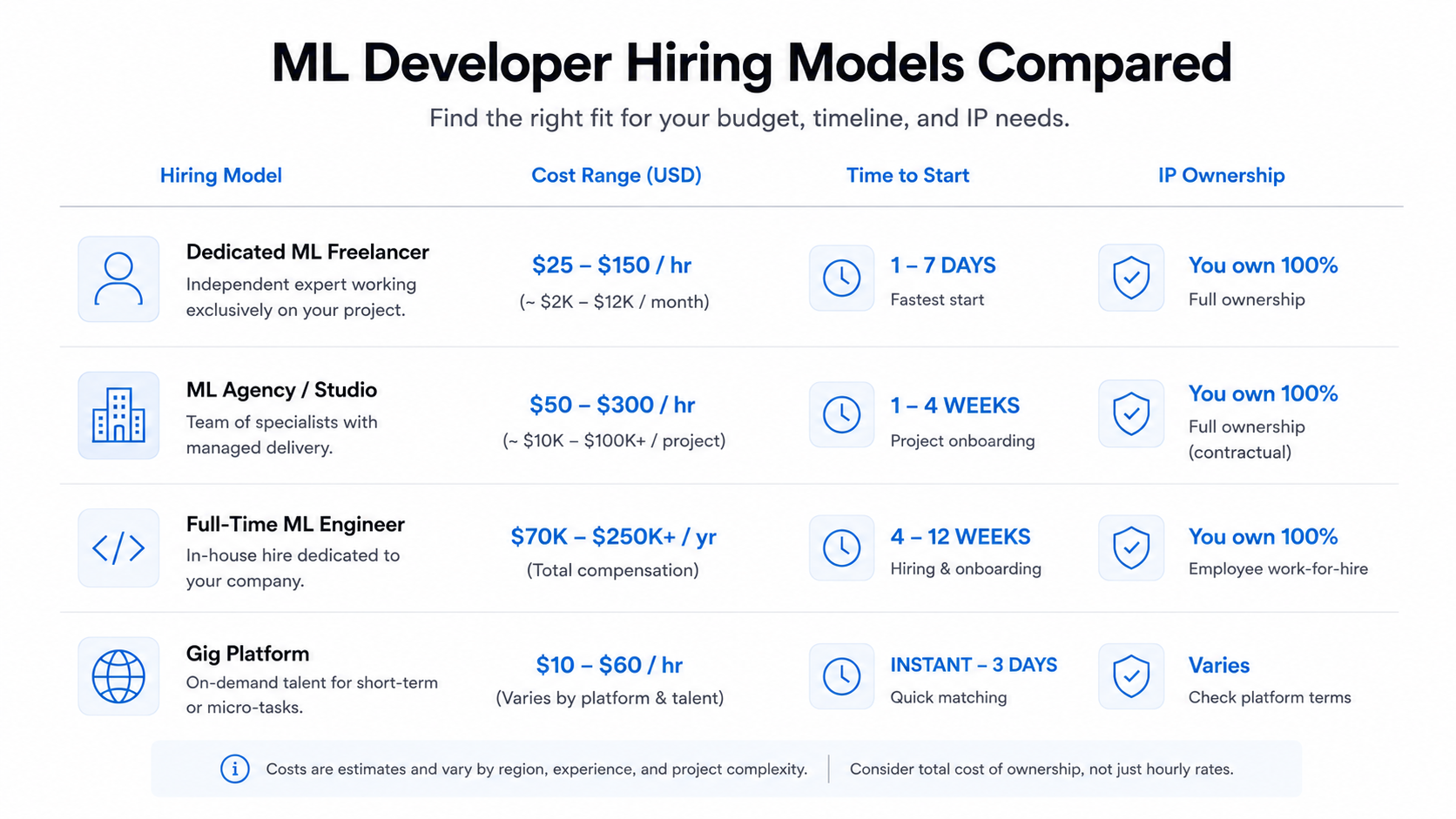
The three primary hiring paths each carry different cost structures and control implications. Understanding these before reaching out to candidates prevents the most common form of ML budget overrun: hiring the wrong model for the engagement.
|
Hiring Model |
Cost Range (USD/hr) |
Time to Start |
IP Ownership |
Best For |
|
Dedicated ML Freelancer |
$40 - $80 (India) / $80 - $140 (US) |
3 - 7 days |
Full client ownership |
Ongoing model dev, long-term projects |
|
ML Agency / Studio |
$120 - $250 |
2 - 4 weeks |
Negotiated, often split |
Large-scale builds with PM overhead |
|
Full-Time ML Engineer |
$130k - $200k/yr (US) |
4 - 12 weeks |
Employer-owned |
Core product AI, 12+ month roadmap |
|
Gig Platform (Upwork/Toptal) |
$35 - $100 |
1 - 5 days |
Full client ownership |
PoC builds, short-term engagements |
Dedicated ML freelancers, particularly those based in India with verified track records on Upwork or similar platforms, represent the highest value engagement for projects with a duration of three to twelve months. Shreyans Padmani's machine learning development services page lists three engagement options: hourly consulting for short-term audits, monthly contracts for ongoing model development, and fixed-price milestones for end-to-end delivery. Each maps to a different client scenario and risk appetite.
ML agencies carry overhead that independent professionals do not. Account managers, internal QA processes, and coordination costs are baked into rates that often start at 120 US dollars per hour and rise sharply for senior model work. The value is real when the project requires parallel workstreams or dedicated product management, but for a single focused ML model, that overhead rarely translates into better output.
What ML Developer Rates Look Like by Region in 2026
Hourly rate ranges have shifted materially since 2023 due to increased global competition for Python and deep learning talent, the rise of MLOps as a distinct discipline, and the mainstreaming of generative AI skills as a hiring requirement. The table below reflects 2026 market rates across the key sourcing regions.
|
Region |
Avg. Hourly Rate |
Timezone Overlap (US EST) |
Portfolio Signal Quality |
|
India |
$35 - $80 |
9.5 hrs behind (overlap: 6 - 10am IST) |
Strong in TensorFlow, PyTorch, scikit-learn |
|
Eastern Europe |
$60 - $110 |
6 - 7 hrs ahead (overlap: 9am - 1pm EST) |
Strong in research-grade ML, Kaggle pedigree |
|
Latin America |
$50 - $90 |
0 - 3 hrs difference |
Growing fast; Python/MLOps strong |
|
USA / Canada |
$120 - $200 |
Full overlap |
Deep ML research + enterprise deployment |
India remains the strongest value region for dedicated ML development, particularly for projects requiring Python, TensorFlow, PyTorch, and scikit-learn. Shreyans Padmani holds a Microsoft AI certification and a 100 percent Upwork job success score, placing him in the upper tier of India-based ML developers. Eastern European talent commands a premium justified by strong mathematical and research backgrounds, which matters more for experimental or academic-grade model work than for production deployment.
Timezone overlap is often underestimated as a cost factor. A 9.5-hour difference with India means synchronous communication requires early mornings or late evenings from a US-based client. Monthly contracts with defined async workflows and weekly video reviews resolve this effectively, as evidenced by Shreyans Padmani's structure of fixed delivery milestones and weekly progress updates documented in his case studies.
5 Vetting Questions That Separate Real ML Developers from Resume Inflaters
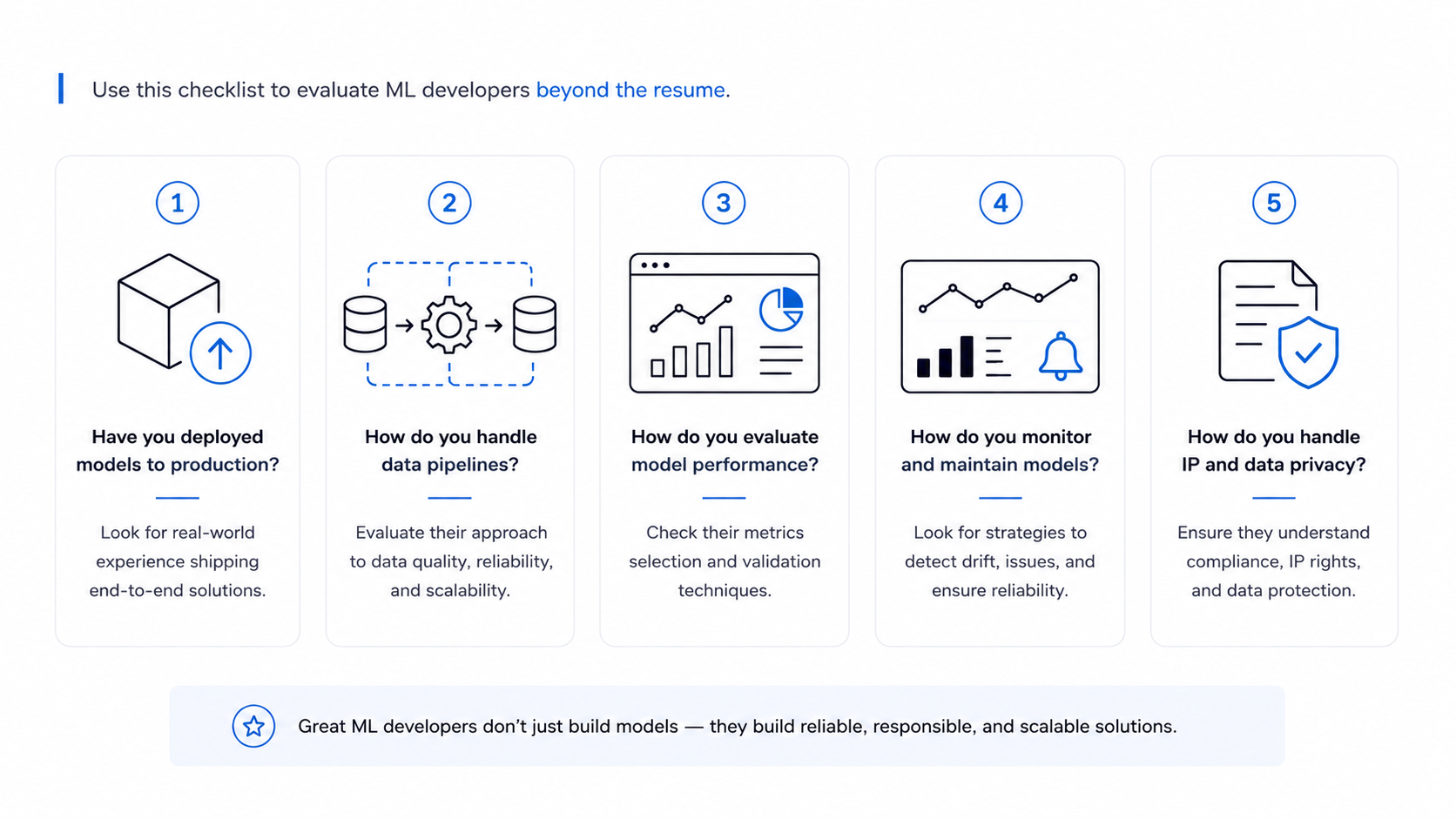
1. Can you show me a deployed model, not a notebook?
Notebooks demonstrate exploration. Production deployments demonstrate engineering. Any ML developer worth hiring can point to a GitHub repository, a live API endpoint, or a documented case study where the model moved from training to real-world inference. Shreyans Padmani's 12 case studies at shreyans.tech/ai-case-studies each include the business outcome, not just the technical stack. An AI video summarisation system reduced meeting review time from 45 minutes per video to under 5. That is the signal you are looking for.
2. How do you handle data quality problems before training?
Real ML projects spend 60 to 80 percent of their time on data preparation, not model training. A candidate who cannot explain their data cleaning strategy, feature engineering approach, or how they handle class imbalance in classification tasks has not shipped a real system. Expect a specific answer referencing tools: pandas, Great Expectations, dbt, or similar. Vague answers about "preprocessing" signal shallow experience.
3. What model evaluation metrics do you use and why?
Accuracy is the wrong metric for most business ML problems. A fraud detection model reporting 99 percent accuracy on an imbalanced dataset where 99 percent of transactions are legitimate is useless. The right candidate will discuss precision-recall tradeoffs, F1 scores, AUC-ROC curves, and crucially, how the chosen metric connects to the business objective. If they cannot explain why they chose a metric, they likely did not choose it.
4. How do you deploy and monitor a model after launch?
Model performance degrades over time as real-world data distribution shifts. This is called model drift, and it is the primary reason ML projects fail six months after an apparently successful launch. A capable dedicated ML developer will describe their monitoring approach: whether they use tools like MLflow, Weights and Biases, or custom dashboards, and how they detect when a model needs retraining. Shreyans Padmani's process explicitly includes continuous monitoring and optimisation as a post-deployment phase.
5. What is your approach to IP and data confidentiality?
Training data and trained model weights are business assets. Any engagement with a dedicated ML developer should include a signed NDA covering training data, model architecture, and inference outputs. Confirm who owns the final model weights, whether the developer will retain copies, and whether any third-party APIs or services will have access to your proprietary data during development. These questions are non-negotiable before work begins.
How to Structure the Engagement to Avoid Budget Overruns
The most reliable way to avoid overpaying is not to negotiate the rate down but to define the scope precisely before the contract starts. Fixed-price engagements with milestone-based payment are the strongest protection against scope creep. Shreyans Padmani's fixed-price service structure on shreyans.tech defines deliverables, milestone structure, and clear ROI expectations before a line of code is written.
For longer engagements, monthly contracts with a defined bandwidth commitment and weekly progress reviews provide the control of a dedicated hire without the overhead of a full-time salary. The break-even analysis is straightforward: a dedicated ML freelancer at 60 US dollars per hour working 160 hours per month costs approximately 9,600 US dollars monthly. A mid-level ML engineer in the United States costs between 12,000 and 17,000 US dollars monthly in total compensation before benefits. The freelancer model wins on cost for all projects under 18 months in duration.
Trial projects lasting one to two weeks are a legitimate and effective vetting tool. A 500 to 1,500 US dollar scoped problem using a subset of your actual data reveals working style, communication quality, and code standard faster than any interview process. Most experienced ML freelancers will accept a paid trial on reasonable terms.
The Only Hire That Overpays Is the Imprecise One
The machine learning talent market in 2026 is liquid, global, and well-supplied with competent practitioners. The businesses that overpay are not victims of scarcity but of vague scope documents, insufficient vetting, and engagement models chosen by default rather than by design. A precisely scoped project with a verified developer, a milestone payment structure, and a signed IP agreement will not only protect the budget but also produce a better ML system.
Shreyans Padmani's approach demonstrates what this looks like in practice: 12 case studies with documented business outcomes, a 100 percent Upwork job success score, and three engagement models designed to fit projects at different scales and risk tolerances. The developer you need exists. The question is whether your hiring process is designed to find them or simply to fill a seat quickly and worry about the rest later.
FAQs: Hire Dedicated ML Developers Questions
What does it mean to hire a dedicated ML developer?
Hiring a dedicated ML developer means engaging a machine learning professional who works exclusively on your project for a defined period, as opposed to a part-time or project-gig arrangement. The developer owns the full ML lifecycle: data preparation, model training, deployment, and monitoring. This model suits businesses building production ML systems with a project duration of three months or more, where continuity of context and iterative model improvement deliver the most value.
How much does it cost to hire a dedicated ML developer in 2026?
Dedicated ML developer rates in 2026 range from approximately 35 to 80 US dollars per hour for India-based developers to 120 to 200 US dollars per hour for US-based engineers. Monthly dedicated contracts for India-based developers typically run 7,000 to 14,000 US dollars, depending on seniority and specialisation. Fine-tuning LLMs or building MLOps infrastructure commands the higher end of these ranges. Fixed-price projects for a defined model build start at around 3,000 US dollars for straightforward classification tasks.
What is the difference between a freelance ML developer and a dedicated ML developer?
A freelance ML developer typically works across multiple clients on project-based engagements, often for shorter durations. A dedicated ML developer commits their bandwidth exclusively to one client for a sustained period, building deeper context with the business data and requirements over time. Dedicated arrangements are more appropriate when the ML system requires continuous retraining, integration with internal systems, or iterative improvement based on production feedback rather than a one-time delivery.
How do I vet an ML developer before hiring them?
Vetting an ML developer requires examining four things: production deployments rather than notebooks, specific model evaluation decisions tied to business metrics, a clear data pipeline methodology, and post-deployment monitoring practices. Ask to see a case study with quantified business outcomes. Shreyans Padmani's 12 case studies show the specific outcome, such as 70 percent reduction in hiring review time, not just the model architecture. A paid trial project on a subset of your data is the most reliable final vetting step.
What are the main risks of hiring the wrong ML developer?
The primary risks of a wrong ML hire are: a model that performs well in testing but fails in production due to data distribution differences; a system with no monitoring that degrades silently over months; IP ambiguity where the developer retains rights to model weights or proprietary training data; and scope creep from an underdefined brief that inflates costs by 50 percent or more. Each of these risks is mitigated by thorough pre-hire scoping, a signed IP agreement, and a milestone-based payment structure.
Should I hire a dedicated ML developer from India or locally?
For most production ML projects with a defined scope, a verified India-based dedicated ML developer delivers equivalent output at 40 to 60 percent lower cost than a US or UK equivalent. The trade-off is timezone overlap, which is manageable with async-first workflows and weekly synchronous reviews. The key filter is not geography but verified production track record: a 100 percent Upwork job success score, published case studies with quantified outcomes, and a technical interview focused on actual deployment experience rather than theoretical knowledge.



Shreyans Padmani
Shreyans Padmani has 5+ years of experience leading innovative software solutions, specializing in AI, LLMs, RAG, and strategic application development. He transforms emerging technologies into scalable, high-performance systems, combining strong technical expertise with business-focused execution to deliver impactful digital solutions.