A no-code chatbot builder and an NLP chatbot developer both produce something that answers customer messages in a chat window. That surface-level similarity is why businesses frequently choose between them based on price and speed to launch rather than on the technical distinction that determines whether the chatbot still works well once real users, real phrasing variation, and real edge cases start arriving. The distinction is not cosmetic. A no-code chatbot builder assembles conversation flows from a visual interface using pattern matching and predefined triggers. An NLP chatbot developer builds a system that understands language, meaning it can generalise beyond the exact phrases a designer anticipated, maintain context across a multi-turn conversation, and integrate with the specific business systems that make a chatbot genuinely useful rather than a scripted decision tree with a chat interface.
This guide covers what actually differs between the two approaches at the technical level, the specific signals that indicate a business has outgrown what a no-code builder can deliver, and how to evaluate an NLP chatbot developer once that decision has been made. The goal is not to argue that no-code builders are always wrong. For a genuinely simple, low-volume FAQ bot, a no-code platform is often the correct choice. The goal is to make the decision deliberately, based on the technical requirements of the specific use case, rather than by default.
What a No-Code Chatbot Builder Actually Does
No-code chatbot platforms (Tidio, ManyChat, Landbot, and similar tools) work by matching user input against a library of predefined trigger phrases or keywords, then following a scripted conversation flow designed in a visual drag-and-drop interface. The underlying natural language understanding, where it exists at all, is typically a thin layer of keyword and pattern matching, not a trained model that generalises to phrasing the designer never anticipated. When a user's message does not match any configured trigger closely enough, the bot falls back to a generic response or a menu of pre-defined options.
This architecture is genuinely well-suited to a specific category of use case: a small, well-defined set of common questions (store hours, shipping policy, return process) where the range of ways a user might phrase the question is limited and predictable, and where the cost of an occasional fallback to a human agent is low. For this use case, a no-code builder can be configured in hours, requires no engineering resource, and delivers acceptable coverage of the common questions it was designed to answer.
What an NLP Chatbot Developer Actually Builds
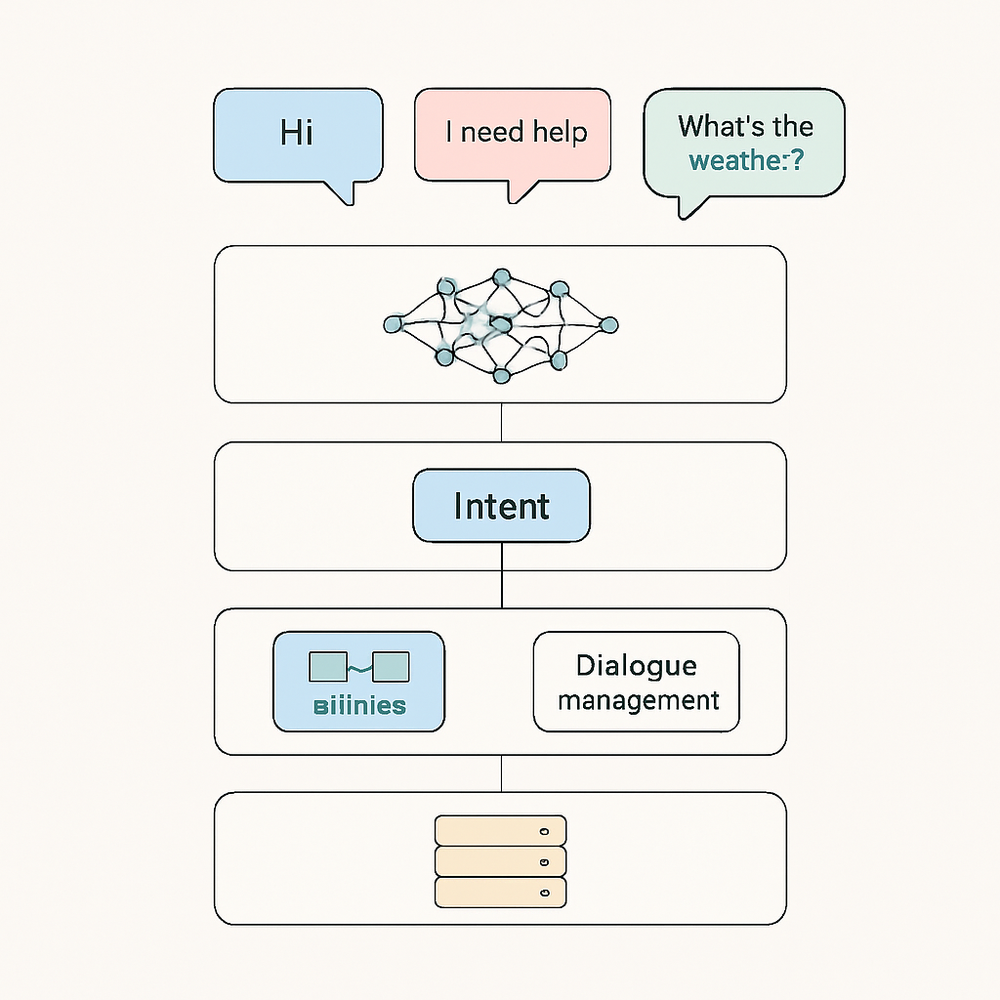
An NLP chatbot developer builds a system with a fundamentally different architecture: a trained or fine-tuned intent classification model that maps user input to a business intent regardless of the specific phrasing used, a named entity recognition layer that extracts structured information from free text (order numbers, dates, product names, account details), a dialogue management system that tracks conversation state across multiple turns, and integration logic that connects the extracted intent and entities to the business's actual systems, whether that is a CRM lookup, an order management API, or a knowledge base retrieval layer. A hire an NLP developer to search for this kind of work is looking for someone who builds this full stack, not someone who configures a visual flow builder.
The critical architectural difference is generalisation. A trained intent classifier learns the underlying semantic pattern of a request from training examples, which means it correctly classifies a phrasing it has never seen before as long as the underlying intent matches patterns in its training data. A no-code builder's keyword matching only catches phrasings the designer explicitly anticipated and configured as triggers. This is the single technical fact that explains why NLP-based chatbots handle real-world conversation volume with materially higher resolution rates than no-code builders once the phrasing variation of genuine users exceeds what a human designer could have manually enumerated.
Side-by-Side: The Ten Dimensions That Actually Differ
|
Dimension |
No-Code Chatbot Builder |
Custom NLP Chatbot Developer |
|
Intent understanding |
Keyword and pattern matching against predefined trigger phrases |
Trained intent classification model that generalises to phrasing the designer never anticipated |
|
Handling ambiguous input |
Falls back to a generic 'I didn't understand' response or a menu of options |
Confidence scoring routes ambiguous input to clarification questions or human handoff intelligently |
|
Multi-turn context |
Limited or scripted; loses context once the conversation deviates from the designed flow |
Maintains dialogue state across turns; can reference earlier parts of the conversation |
|
Integration depth |
Pre-built connectors to common platforms (Zendesk, Shopify) with limited customisation |
Custom API integration to any internal system, CRM, database, or proprietary business logic |
|
Domain vocabulary |
Generic language model with no domain adaptation |
Fine-tuned or prompt-engineered specifically for the business's terminology and edge cases |
|
Scalability of complexity |
Becomes unmanageable as flow branches multiply; visual flow builders hit a complexity ceiling |
Scales to complex, non-linear conversations because logic is code, not a visual flowchart |
|
Data ownership and privacy |
Conversation data typically stored on the vendor's platform under their data policies |
Full ownership of conversation data and model, deployed on infrastructure the business controls |
|
Ongoing cost structure |
Recurring per-seat or per-conversation SaaS fee that scales with usage |
One-time development cost plus optional maintenance; no per-conversation fee |
|
Best fit |
Simple FAQ bots, low-volume support, rapid prototyping with no engineering resource |
Production customer support, complex workflows, high-volume systems where accuracy compounds value |
The multi-turn context dimension is frequently underestimated when businesses first evaluate this decision because a demo of either approach, tested with the designer's own prepared questions, looks similar. The difference appears when a real user asks a follow-up question that references something said two turns earlier: 'what about for the annual plan instead' after discussing monthly pricing, or 'can you cancel that one too' after discussing multiple orders. A no-code builder's flow-based architecture handles this only if the designer explicitly anticipated and scripted that specific follow-up path. An NLP chatbot built with proper dialogue state management resolves the reference because the conversation context is maintained as structured state, not as a position in a predetermined flowchart. Real production examples of AI chatbot development freelancer work demonstrate this distinction directly: chatbot deployments built with intent classification and dialogue management have increased customer engagement measurably because the system resolves a substantially higher share of genuine queries without falling back to a human agent or a generic non-answer.
Six Signals That You Have Outgrown a No-Code Builder
The decision between a no-code builder and a custom NLP chatbot developer should be driven by specific signals in the actual use case, not by a general preference for either approach. The six signals below indicate that a business has reached, or will shortly reach, the limits of what a no-code platform can deliver.
|
Outgrowing Signal |
What It Means |
|
The flowchart has more than 40 branches |
Visual no-code builders become unmaintainable past a certain branching complexity; each new edge case requires manually wiring another path |
|
Users constantly hit the fallback response |
The builder's keyword matching cannot generalise to real phrasing variation, meaning a large share of genuine queries are not being resolved |
|
You need the bot to reference earlier conversation context |
Most no-code builders handle single-turn or narrowly scripted multi-turn flows; genuine dialogue state management requires custom logic |
|
You need a custom integration the platform doesn't support |
No-code platforms offer a fixed connector library; anything outside it (a proprietary internal system, a custom database) requires code |
|
Conversation volume has made the per-seat SaaS cost expensive |
At high volume, a one-time custom build frequently costs less over 12 months than a recurring per-conversation or per-agent SaaS fee |
|
You need the bot to handle industry-specific or technical vocabulary accurately |
Generic no-code NLU engines are not fine-tuned for specialised terminology; a custom NLP model can be trained on your specific domain data |
The fallback response frequency signal is the most measurable and the one businesses should track from the earliest deployment of a no-code chatbot. Most no-code platforms report a fallback or 'unresolved query' rate in their analytics dashboard. A fallback rate consistently above 20 to 30 percent indicates that the pattern matching is not generalising to the actual range of ways real users phrase their questions, and no amount of adding more trigger phrases will close that gap completely, because the space of possible phrasings for any non-trivial question is effectively unbounded. This is precisely the problem a trained intent classification model is designed to solve, because it generalises from training examples rather than requiring every possible phrasing to be manually enumerated.
What to Ask a No-Code Vendor Before Committing
Businesses evaluating a no-code chatbot builder should ask three questions that reveal whether the platform will scale to the actual use case: what is the fallback rate reported across similar deployments in this industry, what happens when a user's question spans multiple pre-configured flows (does the bot fail or intelligently merge context), and what is the migration path if the business outgrows the platform's flow complexity limits. Vendors who cannot answer the third question, or whose answer involves manually rebuilding the entire conversation logic on a different platform, are signalling that the migration cost will eventually be paid, just deferred to a less convenient time.
What to Ask an NLP Chatbot Developer Before Hiring
What intent classification approach will you use, and why?
A developer should describe a specific approach: fine-tuning a transformer model such as BERT or DistilBERT on the business's historical support conversation data if sufficient volume exists, or using a smaller, faster classical ML classifier if the intent taxonomy is simple and the training data is limited. They should explain the trade-off between the two for the specific project rather than defaulting to one approach regardless of context.
How will the system handle a question outside its trained intent taxonomy?
The correct answer describes confidence thresholding: when the model's confidence in its top predicted intent falls below a defined threshold, the system should either ask a clarifying question or hand off to a human agent, rather than confidently misclassifying an out-of-scope question and providing an unhelpful or incorrect response. A developer who has not designed this fallback has not built a chatbot that degrades gracefully under real-world query diversity.
How will the chatbot integrate with our existing systems?
Ask specifically how the developer will connect the chatbot's intent and entity outputs to the business's CRM, order management system, or knowledge base. A strong answer names the specific API integration approach and describes how authentication, error handling, and data synchronisation will work. A vague answer suggests the developer has not scoped the integration complexity, which is frequently the largest source of underestimated cost in custom chatbot projects.
How will the model improve after launch based on real conversations?
Production NLP chatbots improve over time as new conversation data reveals intents and phrasings the initial training set did not cover. A developer should describe a process for reviewing low-confidence or misclassified conversations, adding them to the training set, and periodically retraining the model. A developer with no plan for post-launch improvement has built a static system that will not adapt as the business's customer base and language patterns evolve.
The Interface Looks the Same. The Engineering Underneath Does Not.
A no-code chatbot and a custom NLP chatbot both present a chat window to the user, and both can be demonstrated successfully with a handful of prepared questions. The difference that determines whether either system actually works for a business is invisible in that demo and becomes visible only once real users, with real phrasing diversity and real edge cases, start using the system at scale. A no-code builder's keyword matching handles what its designer anticipated. An NLP chatbot's trained intent classification generalises to what its designer did not.
The decision between the two is not about which is universally better. It is about matching the technical approach to the actual complexity of the use case: simple, low-volume, well-defined interactions are well-served by a no-code platform, while complex, high-volume, or deeply integrated conversational systems require the custom engineering that only an NLP developer search, rather than a no-code platform trial, will surface. The six signals and the four vetting questions in this guide give a business the framework to make that decision deliberately rather than by default, and to hire the right kind of developer once the decision points toward a custom build.
Frequently asked questions
What is the difference between a no-code chatbot and an NLP chatbot?
When should I use a no-code chatbot builder instead of hiring an NLP developer?
How much does a custom NLP chatbot cost compared to a no-code builder?
Can a no-code chatbot be upgraded to use NLP later, or do I need to start over?
What conversation volume justifies hiring a custom NLP chatbot developer?
How do I know if my current no-code chatbot is underperforming?



Shreyans Padmani
Shreyans Padmani has 5+ years of experience leading innovative software solutions, specializing in AI, LLMs, RAG, and strategic application development. He transforms emerging technologies into scalable, high-performance systems, combining strong technical expertise with business-focused execution to deliver impactful digital solutions.